

Larsen & Toubro: what their latest filing actually means
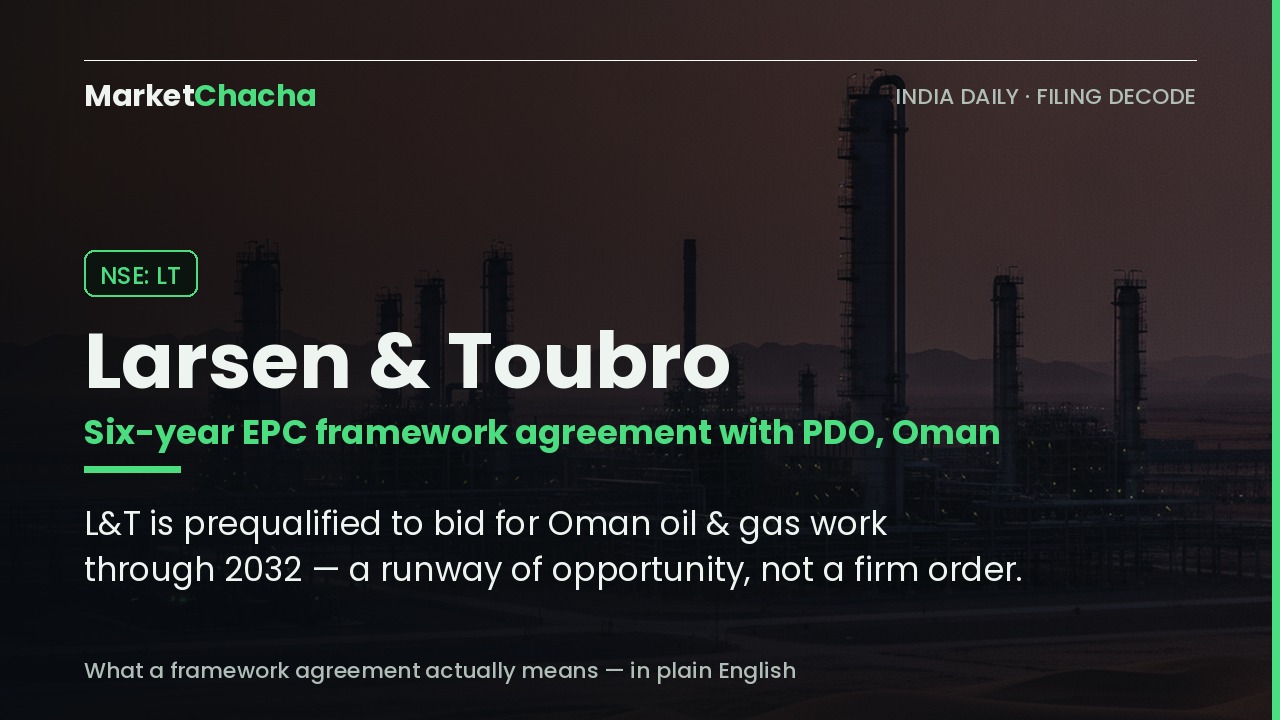
Larsen & Toubro (L&T) told the exchanges on 31 July 2026 that its Energy Hydrocarbon Onshore business has signed a six-year EPC framework agreement with Petroleum Development Oman (PDO), the country's largest oil and gas producer. In plain terms, L&T has been prequalified as one of a small group of contractors allowed to compete for onshore oil-and-gas construction work in Oman for the next six years — a runway, not a single confirmed order.
What was announced
L&T filed a press release under Regulation 30 (the rule that forces listed companies to disclose material news) confirming that L&T Energy Hydrocarbon Onshore has entered a six-year framework agreement with PDO for engineering, procurement and construction (EPC) services.
- What it covers: detailed engineering, procurement of equipment and materials, construction, installation, commissioning and project management for future oil-and-gas facilities in Oman.
- Who PDO is: Petroleum Development Oman is the majority state-owned company that produces most of Oman's crude oil and natural gas — a large, repeat buyer of energy-infrastructure work.
- Track record: L&T is a long-standing PDO contractor; it has executed earlier Oman projects such as depletion-compression facilities and a coke calciner plant, so this framework extends an existing relationship rather than opening a brand-new market.
What this type of filing means
A framework agreement (sometimes called a "master" or "enabling" agreement) is not the same as a firm order. It is a pre-approval: the client screens a handful of contractors and signs multi-year agreements with the ones it trusts, so that when actual projects come up they can be awarded quickly through competitive tenders — without re-running the whole qualification process each time.
The important consequences for a reader:
- A framework does not carry a fixed rupee value the way a normal order win does. It sets up the opportunity to bid, and revenue only lands as individual project tenders are actually won.
- PDO's overall six-year framework programme has been reported in the region as worth over US$6 billion in total — but that pool is shared across all the prequalified contractors (other names, such as an Egyptian Petrojet–ENPPI consortium, have signed similar PDO framework deals). No single contractor is guaranteed that figure.
- So the honest reading is: positioning and visibility, not a booked contract. It improves L&T's odds of steady Middle-East hydrocarbon work, which is exactly why companies disclose these agreements.
Why it matters / potential impact
L&T's Middle-East energy business is one of its highest-margin and most cyclical franchises, and Gulf oil producers are in a heavy capex phase. Being one of the few prequalified EPC players for a producer as large as PDO gives L&T a multi-year pipeline of tender opportunities in a region where it already has execution history and local presence. It reinforces order-book visibility (L&T reported a group order book of about ₹7.79 lakh crore at its Q1 FY27 results) without, by itself, adding a confirmed number to it. The real financial impact shows up only if and when L&T actually wins projects under the framework.
Is it expensive?
L&T is a large-cap: market capitalisation of roughly ₹5.4 lakh crore with the stock near ₹3,900. On a consolidated basis it trades at roughly the mid-30s times trailing earnings (~₹15,000–16,000 crore annual profit) — a premium to the broad market, which reflects its scale, order-book visibility and diversified quality.
One thing that confuses beginners: L&T's standalone P/E can look very high (optically ~70x) because a big chunk of group profit sits in its separately listed subsidiaries (LTIMindtree, L&T Technology Services, L&T Finance). The consolidated figure in the mid-30s is the more meaningful one. Compared with pure capital-goods peers, L&T is actually cheaper — Siemens India trades around 45x and ABB India around 60x — because those are focused product companies, whereas L&T is a diversified engineering-plus-services-plus-finance conglomerate. "Rich versus the market, but reasonable versus its closest engineering peers" is a fair summary. This is context, not a target or a buy/sell call.
The business
L&T is a diversified engineering and construction conglomerate. Its main segments are:
- Infrastructure & construction — its largest business (roads, metros, buildings, water, power transmission).
- Energy — hydrocarbon (onshore and offshore oil-and-gas EPC, the segment in this filing) and power.
- Hi-tech manufacturing — heavy engineering, defence and shipbuilding.
- IT & technology services — via listed arms LTIMindtree and L&T Technology Services.
- Financial services — via listed arm L&T Finance.
Because this PDO agreement sits inside the Energy Hydrocarbon vertical, it affects only one slice of a very diversified group — not the whole company.
Beginner takeaway
L&T has been prequalified to chase six years of onshore oil-and-gas work in Oman — think of it as earning a seat at the table, not winning the meal. It strengthens L&T's Middle-East pipeline and shows the franchise is healthy, but the framework carries no guaranteed rupee value on its own. Watch for the actual project wins that may follow; those are what convert into revenue.
FAQ
Is this a confirmed order that adds to L&T's order book? No. A framework agreement prequalifies L&T to bid; only the individual projects it later wins under the framework become firm orders and enter the order book.
Why doesn't the filing give a rupee value? Because framework agreements don't have one — they define scope and eligibility, not a booked contract sum. The often-quoted "$6 billion" is the whole PDO programme shared across several prequalified contractors, not L&T's share.
Does it affect all of L&T's businesses? No. It sits inside the Energy Hydrocarbon Onshore vertical, which is one part of a diversified group that also spans infrastructure, defence, IT and finance.
Why does L&T's P/E look so different depending on where I check? The standalone P/E (~70x) strips out its listed subsidiaries and looks inflated; the consolidated P/E (mid-30s) includes them and is the more representative number.
As of 31 July 2026. Source: official BSE filing dated 31 July 2026 — read it directly here. We summarise filings for education and may make errors, so always verify against the official document. Educational content only — not investment advice, not a buy/sell recommendation.
This article is for educational and informational purposes only. It is not financial advice, investment recommendation, or a solicitation to buy or sell securities. Investing involves significant risks. I am not a SEBI-registered investment advisor. Readers should consult their own financial advisor and conduct their own research before making any investment decisions.
Comments
Join the conversation
Sign in to join the conversation.
Follow replies, add your view, and take part in the discussion.
Sign in to commentLoading comments...