

Why did Atkore (ATKR) jump ~28% today? A $3.8B all-cash buyout, decoded
What happened
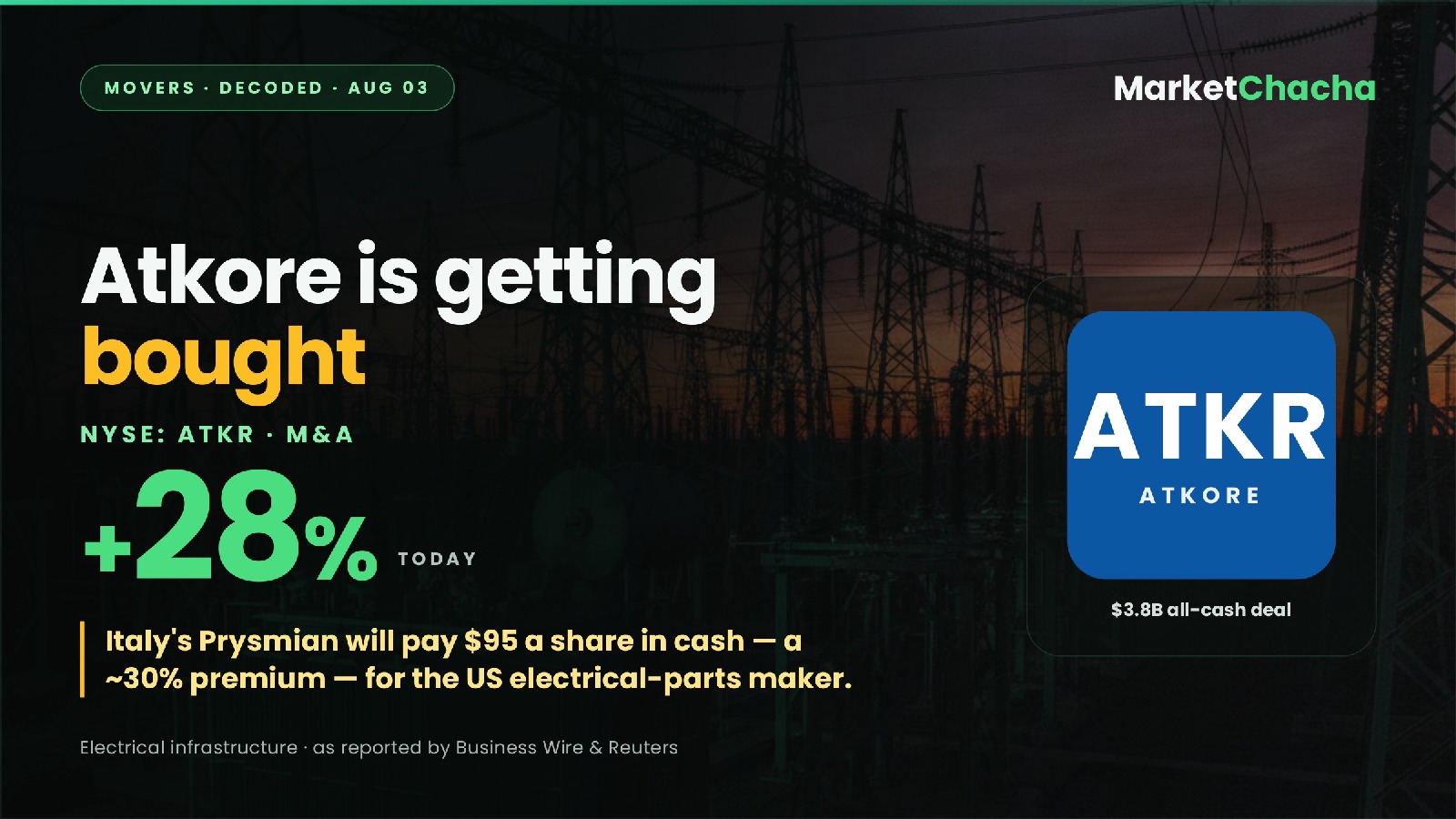
Atkore (NYSE: ATKR) jumped about 28% on Monday — to roughly $93 — after Italy's Prysmian, the world's largest cable maker, agreed to buy the whole company for $95.00 a share in cash, a deal worth about $3.8 billion in enterprise value. Both boards approved it unanimously and there's no financing condition, so this is a firm bid, not a rumour.
That price is a ~30% premium to Friday's close of $72.96, and about 57% above the $60.69 the stock sat at last September — the day before Atkore put itself under "strategic review." In plain terms: management quietly shopped the business, and $95 is the number a buyer was finally willing to write a cheque for.
Why it moved
This is the cleanest kind of move to read. When an acquirer offers a fixed cash price, the shares snap up toward that price almost at once — nobody wants to sell for less than the $95 someone has promised to pay. Notice the stock stopped a couple of dollars short, near $93. That small gap isn't random: it's the market pricing in deal risk — the months of regulatory review and a shareholder vote before the targeted close by end-2026. Close it and you pocket the last few dollars; break it and the stock falls back toward $73.
Is it expensive?
Before the bid, Atkore looked cheap. It traded around a $2.3 billion market cap on roughly $390–410 million of adjusted EBITDA — about 6.7x EV/EBITDA and a forward P/E in the low-teens. Prysmian is paying up to roughly 9–10x EV/EBITDA (~$3.8bn against that EBITDA) and about 15x forward earnings. That's full for a cyclical parts-maker — but it's the going rate to buy scale in US electrification.
For contrast, look at the Indian cable leaders riding the very same theme: Polycab trades near a ~55x P/E and KEI Industries around ~53x (per BlinkX / Trendlyne), versus a cables-industry average nearer 40x. India's names carry a far richer multiple because investors are paying for years of double-digit growth; a mature US supplier changes hands for a fraction of that, even with a takeover premium stacked on top.
The business
Atkore isn't a "theme" stock — it's a boring, essential supplier. It makes the physical guts of electrical systems: steel and PVC conduit (the tubing that protects wiring), armored cable, and metal framing and supports (Unistrut, Power-Strut), sold under brands like Allied Tube & Conduit, AFC Cable Systems and Heritage Plastics. That's about $2.85 billion of FY25 sales. Every time a data centre, factory or piece of grid gets built, someone buys a lot of this stuff — which is exactly why Prysmian wants it.
Who it touches
- Prysmian (the buyer): gets an instant US electrical-products arm and deeper exposure to data-centre and grid spending; it's targeting $150 million of annual cost savings by 2029.
- Other US electrical names (Hubbell, nVent, Eaton): a marquee cash bid tells the market acquirers will pay up for electrification assets — a read-through for the whole group.
- Indian wire & cable makers (Polycab, KEI, Havells, Finolex, RR Kabel): same electrification-plus-data-centre tailwind; a big global deal validates the theme, even if it changes nothing in their day-to-day.
What to watch
The one thing that flips this: the deal breaking. A foreign buyer taking out a US electrical-infrastructure supplier can attract antitrust and national-security (CFIUS) scrutiny, and Atkore holders still have to vote. Watch the proxy filing and the review timeline. Until it closes, that ~$2 gap below $95 is just the market's live odds on whether it actually gets done.
As of ~12:40 pm ET, Aug 3, 2026. Sources: Reuters/KFGO, Prysmian, Investrade/Hammerstone, stockanalysis.com, BlinkX. For discussion and education only — not investment advice. Verify before acting.
This article is for educational and informational purposes only. It is not financial advice, investment recommendation, or a solicitation to buy or sell securities. Investing involves significant risks. I am not a SEBI-registered investment advisor. Readers should consult their own financial advisor and conduct their own research before making any investment decisions.
Comments
Join the conversation
Sign in to join the conversation.
Follow replies, add your view, and take part in the discussion.
Sign in to commentLoading comments...