

State Bank of India: what their Q1 FY27 results filing actually means
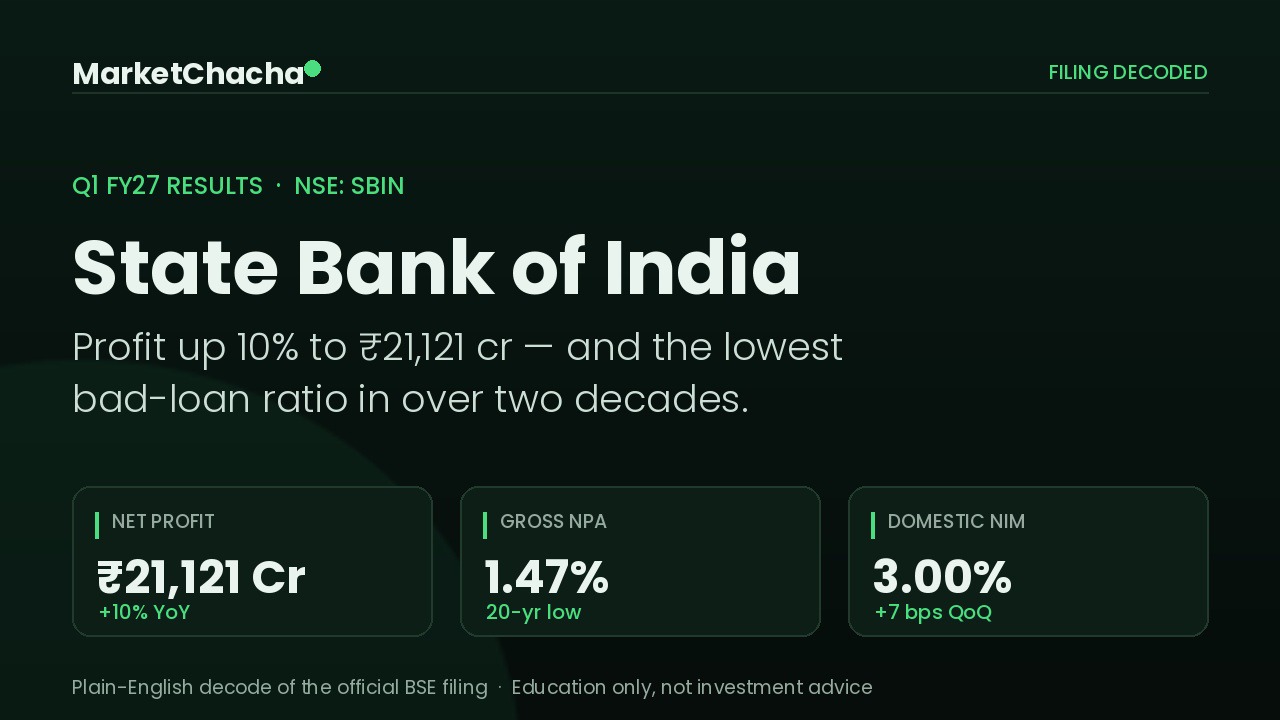
State Bank of India (SBI) filed its results for the first quarter of FY27 (the three months ended 30 June 2026) with the exchanges. In plain terms: India's largest bank told the market how much money it made last quarter — and the headline is a record-low bad-loan ratio alongside a 10% jump in profit.
What was announced
SBI reported its Q1 FY27 numbers. The key figures, straight from the filing:
- Standalone net profit: ₹21,121 crore — up ~10.2% from ₹19,160 crore a year ago, and up ~7.3% from the previous quarter.
- Consolidated net profit: ₹24,113 crore — up ~13.7% year-on-year (this includes subsidiaries like SBI Life, SBI Cards and SBI Mutual Fund).
- Net Interest Income (NII): ₹46,992 crore — up ~14.9% year-on-year. This is the bank's core "spread" earnings.
- Domestic Net Interest Margin (NIM): 3.00%, up 7 basis points over the prior quarter (whole-bank NIM 2.86%).
- Gross NPA: 1.47% and Net NPA: 0.38% — the bank said this is its lowest bad-loan ratio in over two decades.
- Provisions for bad loans: ₹3,359 crore — down from ₹4,934 crore a year ago.
- Gross advances (loans) grew ~18.6% and deposits grew ~9.7% year-on-year; capital adequacy stood at 15.67%.
The stock rose about 3.5% on the day, touching ₹1,123 before settling near ₹1,111.
What this type of filing means
This is a quarterly results filing — every listed company must report its financials four times a year. For a bank, the numbers to understand are a little different from a normal company, so here's the beginner's glossary:
- Net Interest Income (NII): a bank borrows from you (deposits) at a low rate and lends it out (loans) at a higher rate. NII is roughly the difference it keeps. It's the engine of a bank's profit.
- Net Interest Margin (NIM): NII expressed as a percentage of the money the bank has lent out. Think of it as the bank's profit margin on lending. Even a 0.1% move matters when you lend lakhs of crores.
- Gross NPA / Net NPA: "Non-Performing Assets" are loans that have stopped being repaid — bad loans. A lower NPA ratio means fewer borrowers are defaulting, which is a sign of a healthier loan book.
- Provisions: money the bank sets aside from profit to cover loans that might go bad. Lower provisions (when asset quality is good) means more of the earnings drop through to net profit.
Why it matters / potential impact
Three things make this a genuinely good-quality quarter rather than just a big number:
- Profit grew on core banking, not one-offs. NII up ~15% and operating profit up ~10% show the money is coming from actual lending, not from selling investments.
- Asset quality is at a multi-decade best. A 1.47% gross NPA for a bank this size is remarkable — it means the loans SBI made in recent years are performing well, and it needed to set aside less money for defaults.
- Margins ticked up. After a stretch where falling interest rates squeezed bank margins across the sector, SBI's NIM edging up is a positive signal for the quarters ahead.
The flip side to keep in mind: deposit growth (~9.7%) is running slower than loan growth (~18.6%). If deposits don't keep pace, banks eventually have to pay up to attract them, which can pressure margins later. Worth watching, not alarming.
Is it expensive?
SBI's market capitalisation is roughly ₹9.7 lakh crore, making it India's most valuable public-sector company by a wide margin. It trades at a P/E of around 11 (price-to-book, the metric usually preferred for banks, is roughly 1.4–1.5x).
How does that compare? Among public-sector peers, Bank of Baroda trades cheaper at a P/E of about 7.7 and PNB around 6.4. So SBI carries a premium to other PSU banks — reasonable, given its scale, its lowest-in-two-decades asset quality, and the hidden value of its listed subsidiaries (SBI Life, SBI Cards, SBI MF). Against private-sector peers like HDFC Bank, which typically trades at a much richer multiple, SBI still looks inexpensive. In short: fair-to-reasonable, not cheap and not stretched — the market is paying up modestly for quality and size, but not euphorically. (This is a description of valuation, not a target or a buy/sell call.)
The business
State Bank of India is the country's largest bank — around a fifth of the entire banking system by assets, with over 22,000 branches and a customer base in the hundreds of millions. Its main businesses are: lending (home loans, corporate loans, agriculture, SME and personal loans), deposits (savings and current accounts, fixed deposits), and treasury (managing its investment book). It also owns valuable listed arms in life insurance (SBI Life), credit cards (SBI Cards) and asset management (SBI Mutual Fund). So this quarterly filing reflects the health of the whole banking machine, not just one slice — which is why bank results are treated as a barometer for the wider economy.
Beginner takeaway
SBI made more money (profit +10%) while its loans went bad less often than at almost any point in 20+ years — that's the combination investors like to see in a bank. Strong core earnings plus clean asset quality is a healthy report card. Just remember one quarter is a snapshot, not a trend, and results tell you about the past, not the future price.
FAQ
Is a lower NPA always good? Generally yes — it means fewer loans are going unpaid. But it should be read alongside how fast the bank is growing its loan book; very fast growth with very low NPAs can sometimes just mean problems haven't surfaced yet. SBI's slippage ratio also improved, which is reassuring here.
Why are there two profit numbers — ₹21,121 crore and ₹24,113 crore? The smaller one is "standalone" (just the bank). The larger "consolidated" figure adds in SBI's subsidiaries like SBI Life and SBI Cards. Both are useful; standalone shows the core bank, consolidated shows the whole group.
The profit is up but why do I keep hearing about "margins under pressure" for banks? When the Reserve Bank cuts interest rates, loan rates often reset down faster than deposit rates, squeezing NIM. SBI's margin actually rose slightly this quarter, which is why the market reacted well.
Does a good result mean the share will go up? Not necessarily. Markets often "price in" expected results in advance, so even strong numbers can be met with a flat or falling price if they were already anticipated. On the day, SBI did rise ~3.5%, but that's not a rule.
As of 7 August 2026. Filing dated 7 August 2026. Source: official BSE filing — read it directly here. We summarise filings for education and may make errors, so always verify against the official document. Educational content only — not investment advice, not a buy/sell recommendation.
This article is for educational and informational purposes only. It is not financial advice, investment recommendation, or a solicitation to buy or sell securities. Investing involves significant risks. I am not a SEBI-registered investment advisor. Readers should consult their own financial advisor and conduct their own research before making any investment decisions.
Comments
Join the conversation
Sign in to join the conversation.
Follow replies, add your view, and take part in the discussion.
Sign in to commentLoading comments...