

China's factories beat, its shoppers didn't: retail +0.4%, investment −7.2% — and why the cumulative number hides the real drop
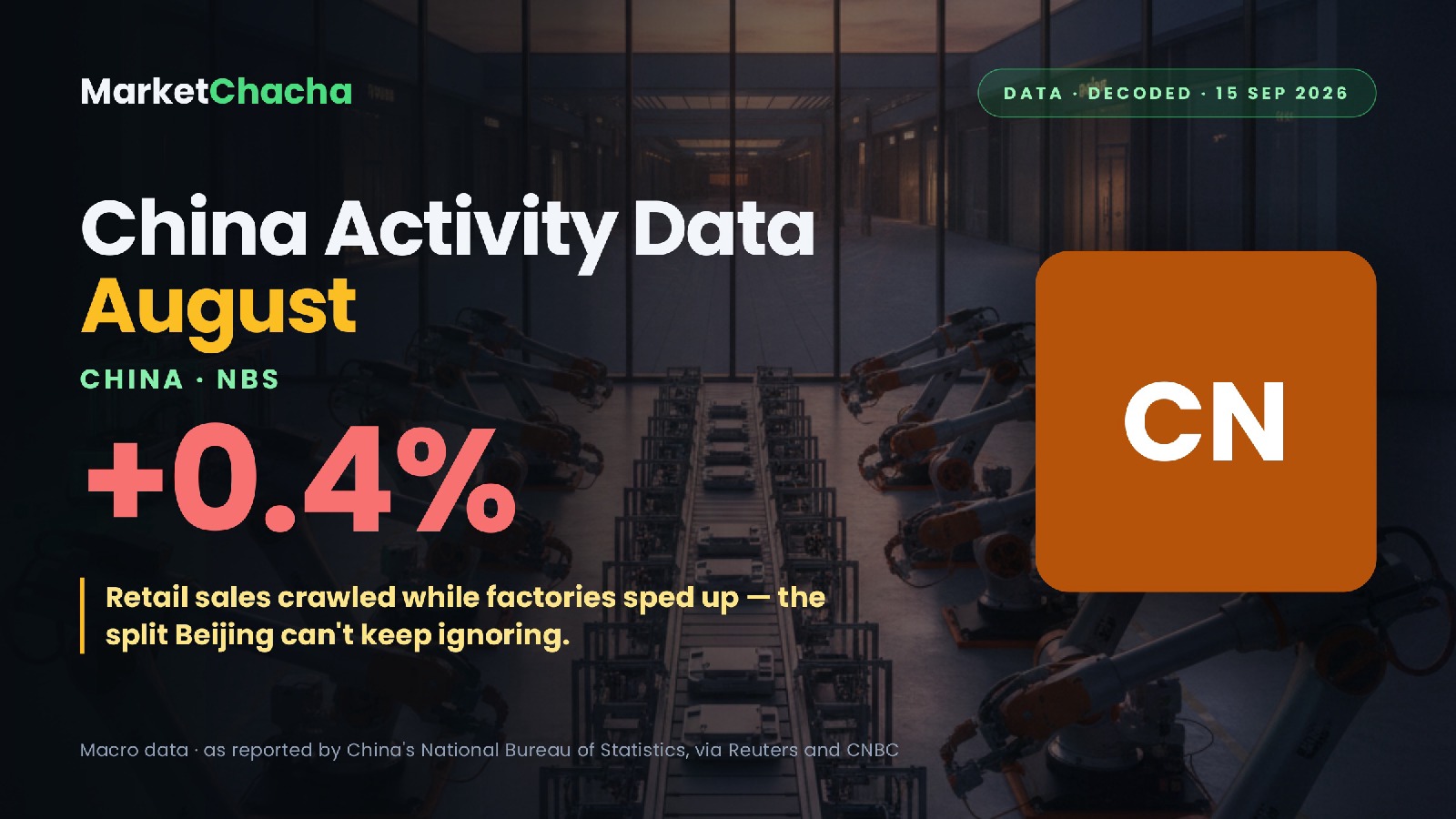
China put out its monthly activity dump this morning, and it told two completely different stories depending on which line you read. The factories are humming. The shoppers and the builders are not. That gap is now the single most important number in the world's second-largest economy — and it reaches a lot further than Shanghai.
The numbers
- Industrial output: +5.2% YoY in August, up from +4.5% in July and ahead of the +4.8% a Reuters poll of 42 analysts had penciled in.
- Retail sales: +0.4% YoY, slowing from +0.6% in July and missing the +0.8% consensus.
- Fixed-asset investment: −7.2% YoY for January–August, deepening from −6.7% through July. That one matched forecasts.
- Inside that investment number: property development −19.9%, infrastructure −4.0%, manufacturing −2.3%.
- Urban survey unemployment: 5.3%, up from 5.2% in July. NBS spokesperson Fu Linghui pinned the tick-up on graduation season.
What it means
Here's the thing most headlines skipped. China's fixed-asset investment is reported as a year-to-date cumulative figure, not a monthly one. So when the eight-month number slides from −6.7% to −7.2%, that isn't a gentle drift. It means August on its own was far worse than the average of the seven months before it — bad enough to drag the whole running total down half a point. The slump isn't stabilising. It's accelerating.
Retail sales at +0.4% deserves the same care. That's a nominal number — it includes prices. With China running close to flat-to-negative consumer prices, near-zero nominal growth means households are still buying roughly similar volumes, but nobody has any pricing power. Shops are moving goods by discounting, not by demand.
Put the three together and you get the imbalance Beijing has been trying to talk its way out of for two years: supply is being produced faster than domestic demand can absorb it. Goods that Chinese households don't buy don't vanish. They get exported — at whatever price clears. That's how China's domestic deflation becomes everyone else's problem.
Who it touches
- Steel and metals everywhere. Property investment down 19.9% is the demand hole under global steel and iron ore. Indian producers — Tata Steel, JSW Steel, SAIL, JSPL — feel it twice: softer global prices, plus cheaper Chinese tonnage looking for a home, which is exactly the argument behind India's safeguard-duty debate.
- Aluminium and copper. Manufacturing investment at −2.3% caps the base-metals demand story. Hindalco and Vedanta are levered to that price, not to Indian volumes.
- Crude. Weak Chinese consumption sits awkwardly against Brent near $107 — that spread is being held up by supply-side and geopolitical factors, not by demand. For India, an oil importer, the demand side of that equation is the friendlier half.
- Anything priced off Chinese stimulus. Hang Seng, mainland industrials, commodity currencies. Data this soft raises the odds of a policy response, which is why bad China numbers sometimes make Chinese equities go up.
- Global luxury and consumer names with China revenue exposure — a fifth straight month of near-zero retail growth is a trend, not a blip.
What to watch
Two things. First, whether Beijing answers — a rate move or a consumption-support package would confirm the numbers were bad enough to force a hand. Second, the FOMC decision on 16 September at 2:00 PM ET, which lands tomorrow with an updated dot plot. A dovish Fed plus a stimulating China is a very different world for commodities and emerging-market flows than a hawkish Fed plus a passive one. China's next monthly activity print comes mid-October and will tell us whether that investment slide was August-specific or the new run rate.
As of 1:45 PM IST, 15 September 2026. Sources: CNBC, Reuters via Investing.com, China National Bureau of Statistics. For discussion and education only — not investment advice. Verify before acting.
This article is for educational and informational purposes only. It is not financial advice, investment recommendation, or a solicitation to buy or sell securities. Investing involves significant risks. I am not a SEBI-registered investment advisor. Readers should consult their own financial advisor and conduct their own research before making any investment decisions.
Comments
Join the conversation
Sign in to join the conversation.
Follow replies, add your view, and take part in the discussion.
Sign in to commentLoading comments...