

US private hiring slumps to +44K in July — the year's softest jobs read just revived rate-cut bets
The numbers
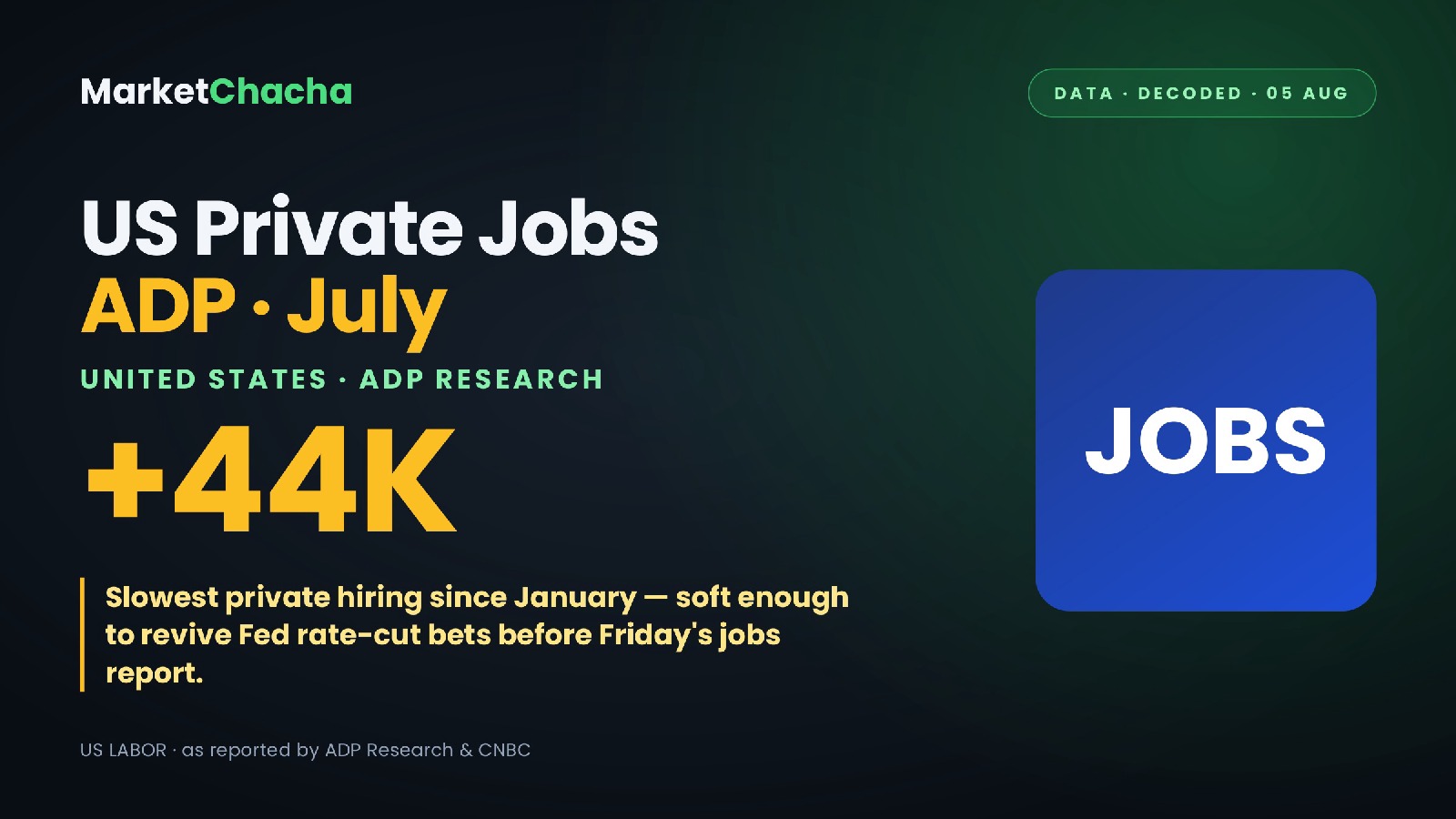
US companies added just 44,000 private-sector jobs in July, according to the ADP National Employment Report — the monthly payroll read from ADP Research, the analytics arm of the country's biggest payroll processor. That badly undershot the roughly 70,000–75,000 economists had penciled in, and it's down sharply from June's 95,000 (itself revised lower from 98,000). It's the weakest hiring since January.
Under the hood, the softness was lopsided. Services firms added 47,000 jobs — nearly all of it from education and health, which alone put up 36,000. Goods-producing employers actually cut 3,000, with mining and natural resources shedding 6,000. Pay growth was steady: workers who stayed in their jobs saw 4.4% annual gains, while job-changers pulled 7%, the biggest year-over-year jump since August 2025.
What it means
ADP counts paychecks at private employers, so it's a rough preview of the government's official jobs report — not the same thing, and the two often disagree month to month. But the direction here is hard to miss: hiring is cooling, and it's narrowing to just a couple of defensive corners of the economy. When new jobs come almost entirely from hospitals, clinics and schools, it means the cyclical, growth-sensitive parts of the labor market — factories, mining, construction-linked goods — have stopped adding people.
Here's the part the headline number hides: a slow jobs print is exactly what rate-cut hopes feed on. A cooling labor market gives the Federal Reserve more room to lower interest rates without worrying it'll reignite inflation. That's why Wall Street read a bad hiring number as good news — stocks opened higher on the day (S&P 500 up about 0.7%) as traders leaned back into bets on a cut this autumn.
Who it touches
- Rate-sensitive stocks: Softer jobs revive rate-cut odds, which tends to help beaten-down rate-sensitive names — housing, small caps, and long-duration growth tech that lives and dies on the discount rate.
- Bonds & the dollar: Weaker labor data usually pushes Treasury yields down and pressures the dollar, as markets price in an easier Fed.
- Cyclicals vs. defensives: The goods-side job cuts flag caution for industrials and materials; the health-and-education strength keeps defensive hiring intact.
- The job-changer premium: That 7% pay bump for people who switch jobs — versus 4.4% for those who stay — signals employers are still paying up to poach talent even as overall hiring slows.
What to watch
The real test lands Friday, August 7, when the Bureau of Labor Statistics releases July's official Employment Situation report — nonfarm payrolls plus the unemployment rate — at 8:30am ET. ADP only loosely tracks that number, so a soft government print would confirm the cooling story and firm up expectations for a September rate move; a hot one would muddy it. That's the data point that actually sets the Fed's next move.
As of ~4:00pm ET, Aug 5, 2026. Sources: CNBC, ADP / PR Newswire, Fox Business. For discussion and education only — not investment advice. Verify before acting.
This article is for educational and informational purposes only. It is not financial advice, investment recommendation, or a solicitation to buy or sell securities. Investing involves significant risks. I am not a SEBI-registered investment advisor. Readers should consult their own financial advisor and conduct their own research before making any investment decisions.
Comments
Join the conversation
Sign in to join the conversation.
Follow replies, add your view, and take part in the discussion.
Sign in to commentLoading comments...