

Bajaj Auto: what their latest filing actually means
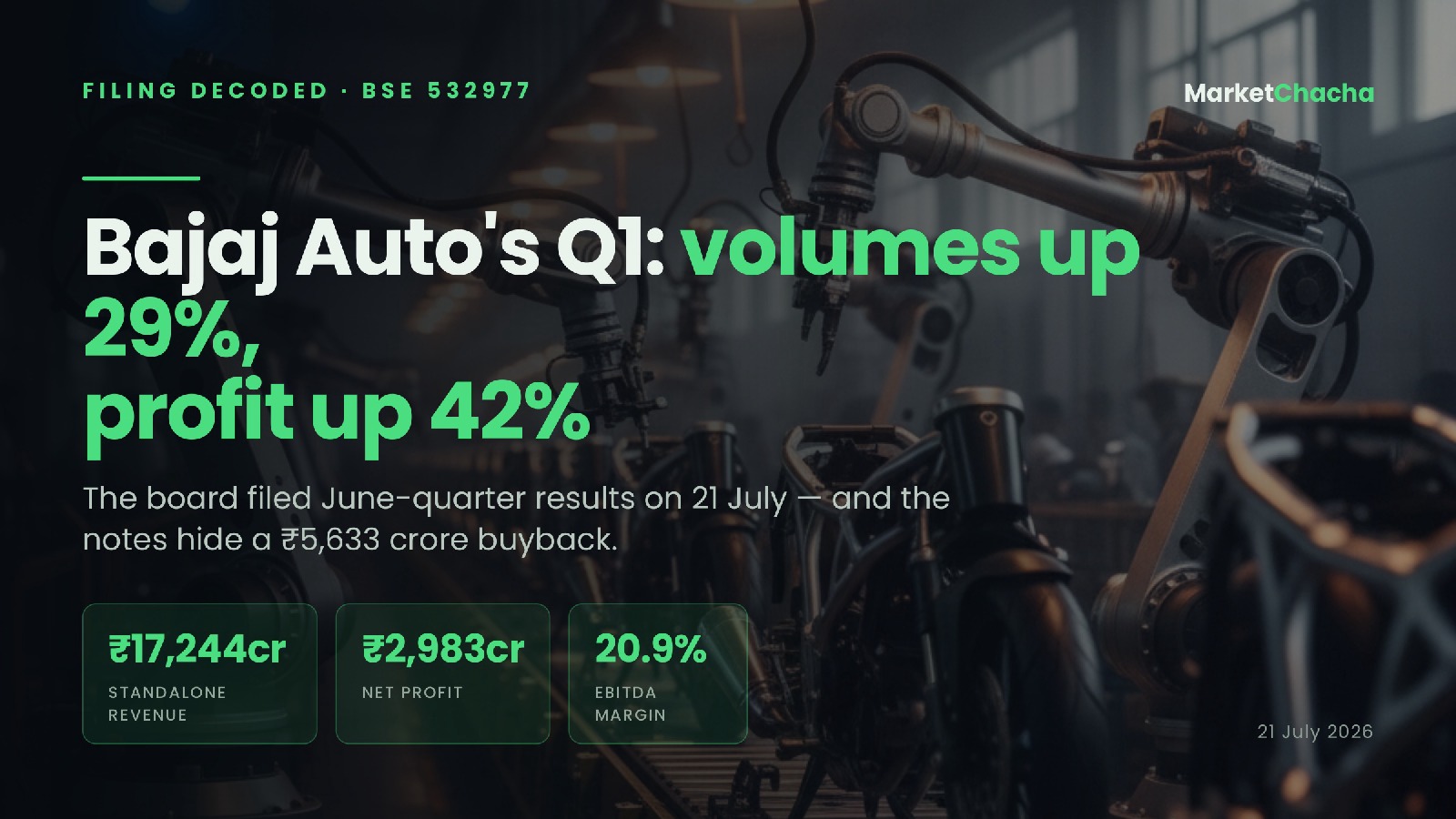
Bajaj Auto filed its June-quarter (Q1 FY27) results with BSE and NSE on 21 July 2026, straight after a board meeting that ran 10:30 a.m. to 12:30 p.m. The headline is a strong one: it sold 14.38 lakh vehicles in three months, up 29% from a year ago, and standalone net profit rose 42% to ₹2,983 crore. But the most interesting things in this filing are in the footnotes, not the headline.
What was announced
Bajaj Auto files two sets of numbers — standalone (the Indian vehicle business on its own) and consolidated (that business plus subsidiaries such as KTM and its lending arm). Both matter, and they tell different stories this quarter.
Standalone, quarter ended 30 June 2026 vs the same quarter last year:
- Vehicles sold: 14,38,251 units, up from 11,11,237 (+29%)
- Revenue from operations: ₹17,244 crore, up from ₹12,584 crore (+37%)
- Profit before tax: ₹3,985 crore, up from ₹2,788 crore (+43%)
- Net profit: ₹2,983 crore, up from ₹2,096 crore (+42%)
- Earnings per share: ₹106.8 for the quarter, up from ₹75.1
- Operating (EBITDA) margin: roughly 20.9%, up from about 19.7%
Note that revenue grew faster than volumes (37% vs 29%). Average revenue per vehicle rose from about ₹1.13 lakh to ₹1.20 lakh — the company sold more, and sold pricier machines.
Consolidated: revenue ₹21,689 crore (up 65%) and profit attributable to shareholders ₹3,226 crore (up 46%), with EPS of ₹115.5. Read that 65% carefully. Note 3a of the filing explains that Bajaj took controlling interest in the holding company above KTM AG on 18 November 2025. So this quarter's consolidated figures include KTM; last year's June quarter did not. A large part of that 65% is an accounting change in what gets added up, not 65% more business. The standalone +37% is the cleaner like-for-like read.
Two footnotes deserve attention:
- The ₹5,633 crore buyback (Note 2). Bajaj bought back 46,94,000 shares at ₹12,000 each via the tender-offer route. Bidding ran 1–7 July and shareholders were paid on 14 July 2026. That is after this quarter closed, so it does not show up in these numbers — it will land in the September quarter.
- An unquantified future liability (Note 3). Under the Environment Protection (End-of-Life Vehicles) Rules, vehicle makers carry an obligation to fund the scrapping of old vehicles. Bajaj states it cannot yet reliably estimate this cost because the pricing mechanism for the certificates has not been notified. In plain terms: a real obligation exists, and the size is currently unknown.
What this type of filing means
Every listed Indian company must report results each quarter under Regulation 33 of SEBI's LODR rules, and must tell the exchanges about anything price-sensitive under Regulation 30. A "Board Meeting Outcome — Unaudited Financial Results" filing is that quarterly report.
The word unaudited is not a red flag. Only the annual accounts get a full audit. Quarterly numbers get a limited review — a lighter check by the same statutory auditor (SRBC & CO LLP here). It is a real check, just a narrower one, which is why quarterly figures occasionally get restated at year end.
The other thing worth learning: the notes are the filing. A media summary gives you the profit number. The buyback, the KTM consolidation and the end-of-life-vehicle liability above all came from the notes, and each changes how you read the headline. When a company reports consolidated growth that looks startlingly better than standalone growth, checking for a newly consolidated subsidiary is a reflex worth building.
Why it matters / potential impact
Demand. A 29% volume jump is a genuinely strong quarter for a two-wheeler and three-wheeler maker, and rising revenue per vehicle suggests the growth is not being bought with discounts. Bajaj sells heavily into export markets as well as India, so this number blends both.
Margins. Operating margin improved by roughly a percentage point. For a manufacturer, that is the interesting line — it means the extra volume dropped through to profit rather than being eaten by input costs.
Balance sheet. Standalone finance costs were just ₹4.3 crore on ₹17,244 crore of revenue. The core vehicle business carries essentially no debt. Consolidated finance costs are far higher (₹387 crore), but most of that belongs to the financing arm, where borrowing is the raw material rather than a burden.
The KTM question. Consolidated profit attributable to Bajaj's own shareholders (₹3,226 crore) is higher than total consolidated profit (₹3,189 crore). That happens when minority shareholders absorb a loss — here ₹36.9 crore. It is a small number, but it is the filing quietly telling you the newly consolidated European business is not yet contributing profit.
Share count. The buyback retires about 47 lakh shares. Fewer shares means the same profit is divided among fewer owners, which mechanically lifts earnings per share from next quarter. It also means roughly ₹5,633 crore of cash has left the company.
Is it expensive?
Bajaj Auto trades around ₹10,300 a share with a market capitalisation of roughly ₹2.89 lakh crore and a trailing P/E of about 29 times, per Screener.in and Business Standard data around 15–20 July 2026. If this quarter's run-rate holds, the forward multiple would sit meaningfully below that — but a single strong quarter is not a run-rate.
Against listed peers: TVS Motor trades near 56 times earnings at about ₹1.72 lakh crore market cap, and Eicher Motors (Royal Enfield) around 41 times at roughly ₹2.08 lakh crore. Hero MotoCorp, the volume leader in Indian motorcycles, is the cheap one at roughly 17–18 times and about ₹98,000 crore.
So Bajaj sits in the middle of its own sector: clearly not the bargain of the group, clearly not the most expensive either. The honest framing is that the market already pays up for Bajaj's export mix and its margins, while paying far less for Hero's larger but slower-growing domestic volumes. Whether 29 times is fair depends entirely on whether this quarter's growth repeats — and that is not something a filing can tell you.
The business
Bajaj Auto is India's second-largest motorcycle maker and its dominant three-wheeler manufacturer. Its consolidated filing splits into three segments:
- Automotive — ₹20,800 crore of the quarter's revenue. Motorcycles (Pulsar, Platina, Freedom CNG), three-wheelers and autorickshaws, Chetak electric scooters, plus premium brands through its KTM, Husqvarna and Triumph relationships. Exports to Africa, Latin America and South-East Asia are a large slice of volumes.
- Financing — ₹1,112 crore. Bajaj Auto Credit, the in-house lender that finances customers buying its vehicles.
- Investments — ₹465 crore. Returns on the company's large treasury of surplus cash.
Because the automotive segment is roughly 93% of revenue, a filing like this one is a read on the whole company, not one corner of it.
Beginner takeaway
Strong quarter on the numbers that matter for a manufacturer: more units sold, higher price per unit, better margin, almost no debt in the core business. The two things a careful reader should hold onto are that the eye-catching 65% consolidated revenue growth is inflated by KTM being newly added to the accounts, and that a ₹5,633 crore buyback and an unsized environmental liability both sit in the footnotes rather than the headline. None of that says whether the shares are worth buying — it says you now know what the company actually reported.
FAQ
What is the difference between standalone and consolidated results? Standalone covers only the parent company's own operations. Consolidated adds in subsidiaries the parent controls. When a company acquires or newly consolidates a subsidiary, consolidated growth can look dramatic even if the underlying business grew far less.
Does a share buyback mean the stock is cheap? Not necessarily. A buyback returns cash to shareholders and reduces share count, which lifts earnings per share. Managements do it for many reasons — surplus cash, tax efficiency, signalling confidence. It is information, not a verdict on price.
Why are the quarterly results "unaudited"? Indian rules require a full audit only once a year. Quarterly numbers get a limited review by the statutory auditor, which is a real but less exhaustive check. It is completely normal.
Profit attributable to shareholders was higher than total profit. Is that a typo? No. It happens when minority (non-controlling) shareholders in a subsidiary absorb a loss. Here they took ₹36.9 crore of loss, so what remained for Bajaj's own shareholders was slightly more than the group total.
Where can I read the actual filing myself? Every announcement is free on the BSE and NSE websites. Reading the primary document instead of a summary is the single biggest upgrade a retail investor can make, and it costs nothing.
As of 21 July 2026. Source: official BSE/NSE filing dated 21 July 2026 — read it directly here. Valuation figures per Screener.in and Business Standard, 15–20 July 2026. We summarise filings for education and may make errors, so always verify against the official document. Educational content only — not investment advice, not a buy/sell recommendation.
This article is for educational and informational purposes only. It is not financial advice, investment recommendation, or a solicitation to buy or sell securities. Investing involves significant risks. I am not a SEBI-registered investment advisor. Readers should consult their own financial advisor and conduct their own research before making any investment decisions.
Comments
Join the conversation
Sign in to join the conversation.
Follow replies, add your view, and take part in the discussion.
Sign in to commentLoading comments...