

Marvell Q2 results: what the numbers say
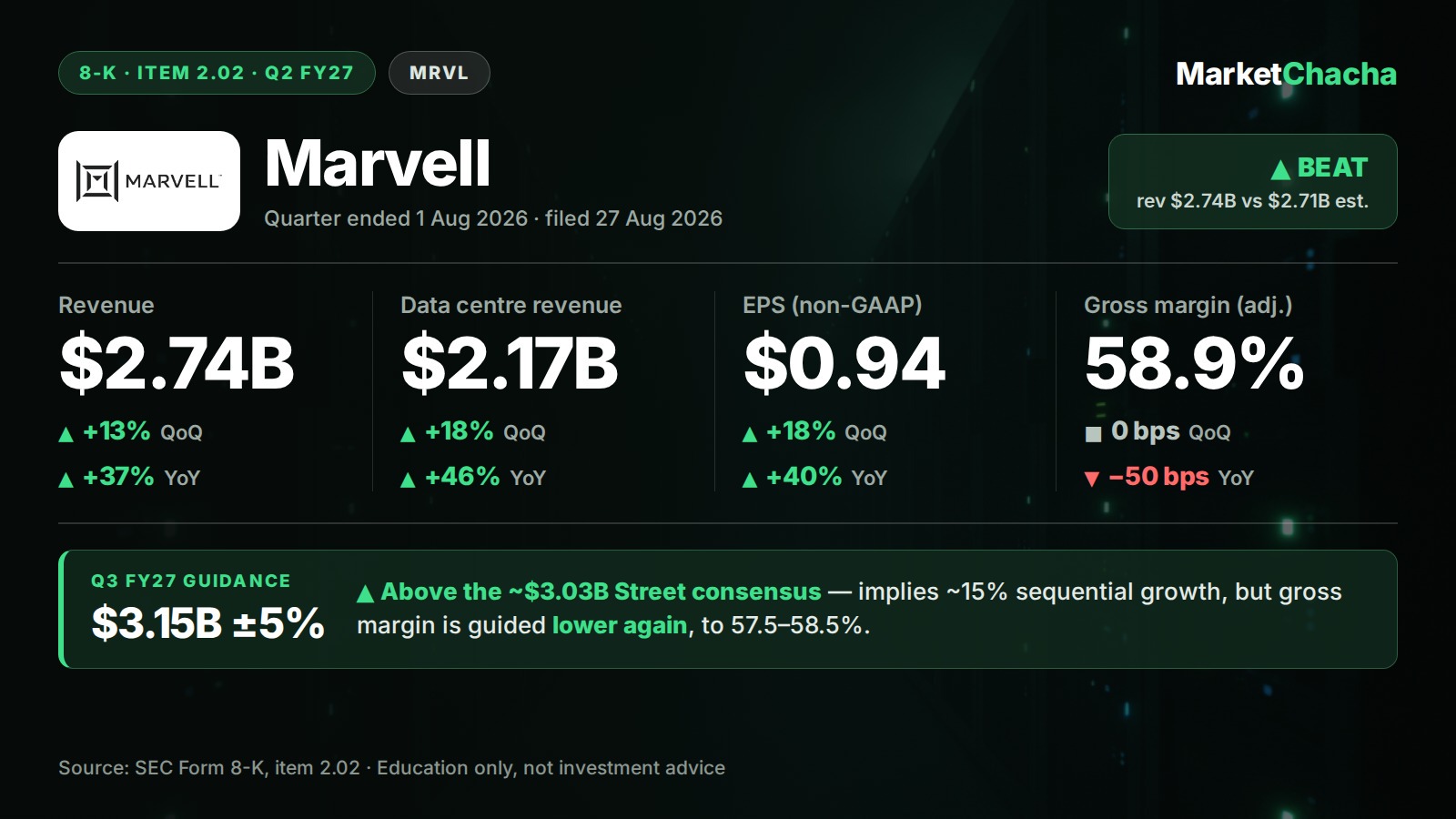
Marvell Technology (NASDAQ: MRVL) filed an 8-K on 27 August 2026 under Item 2.02 to report results for its fiscal second quarter, which ended 1 August 2026. Revenue hit a record $2.739 billion, up 37% from a year earlier, and the company guided the current quarter well above where Wall Street had it — with the data-centre business now supplying roughly four of every five dollars Marvell earns.
The numbers
- Revenue: $2,739.3 million — a record, up 37% year on year (from $2,006.1m) and up 13% from last quarter ($2,417.8m). The filing notes this came in $39.0 million above the mid-point of the guidance Marvell gave on 27 May 2026. Consensus was about $2.71 billion, so a modest beat.
- Non-GAAP EPS: $0.94 vs the $0.93 consensus — a one-cent beat. That is up from $0.80 last quarter and $0.67 a year ago, so roughly 40% growth year on year.
- GAAP EPS: $0.33 (net income $308.0m). Note the gap to the non-GAAP figure: it is mostly $326.2m of stock-based compensation and $214.9m of amortisation of acquired intangibles, both excluded from the adjusted number.
- Data centre revenue: $2,171.5 million, up 46% year on year (from $1,490.5m) and 18% sequentially (from $1,832.7m). It is now 79% of total revenue, up from 76% last quarter and 74% a year ago. This is the story of the quarter.
- Margins: non-GAAP gross margin 58.9% — flat versus last quarter but down from 59.4% a year ago. Non-GAAP operating margin improved to 36.6%, from 35.0% last quarter and 34.8% a year ago.
- Cash generation: operating cash flow of $605.5 million, up from $461.6 million in the same quarter last year.
- Guidance (fiscal Q3): revenue of $3.150 billion, plus or minus 5% — about 15% sequential growth from the quarter just reported, and roughly 4% ahead of the ~$3.03 billion analysts were carrying. Non-GAAP EPS is guided to $1.10 (±$0.05), non-GAAP gross margin to 57.5%–58.5%, and non-GAAP operating expenses to about $655 million.
What was filed, and what an 8-K Item 2.02 actually is
An 8-K is the SEC's "something happened" form. Unlike the 10-Q and 10-K, which arrive on a fixed calendar, an 8-K is event-driven: a company files one within four business days of a disclosable event, and each event type has a numbered item.
Item 2.02 — "Results of Operations and Financial Condition" — is the one companies use to publish quarterly earnings. In practice the 8-K itself is a short cover page; the actual content sits in an exhibit, usually EX-99.1, which is the earnings press release with the income statement, balance sheet, cash-flow statement and the GAAP-to-non-GAAP reconciliation tables. Item 9.01 is simply the housekeeping item that lists those exhibits.
Two things worth knowing as a reader. First, the 8-K is the legal release of the numbers — it typically lands minutes after the closing bell and before the management conference call, so the filing exists before most of the commentary about it does. Second, the audited detail and the risk-factor discussion come later, in the 10-Q. An earnings 8-K is unaudited.
Why it matters
The mix shift is the substance. Marvell sells data-infrastructure chips, and the company now reports in two buckets: data centre, and communications and other. Data centre at 79% of revenue means Marvell has effectively become a bet on AI infrastructure spending. That is why the segment growth rate accelerating to 46% matters more than the headline 37%: the fast-growing part is also the biggest part, which is what pulls the total up.
Guidance is doing more work than the quarter. A one-cent EPS beat on a modest revenue beat is, on its own, an unremarkable quarter. The larger signal is the outlook: guiding to $3.150 billion implies about 15% growth in a single quarter, and management said in the release that it is raising its revenue outlook for both fiscal 2027 and fiscal 2028, citing an acceleration in its custom-silicon business in the back half of the year. For a components supplier, forward guidance is a read on customer order books.
The honest wrinkle is gross margin. Non-GAAP gross margin of 58.9% is half a point below where it was a year ago, and guidance points to 57.5%–58.5% next quarter — lower again. Custom chips designed for a specific large customer generally carry thinner margins than standard products sold to many buyers. So the same custom-business momentum that is driving revenue is also, mechanically, diluting the margin percentage. Growing revenue and slipping margin can coexist; it is a trade, not a contradiction.
Concentration is the risk the filing names itself. Marvell's own risk language flags dependence on a few customers for a significant portion of revenue, "particularly as our major customers comprise an increasing percentage of our revenue." A business that is 79% data centre and increasingly custom is a business whose revenue is tied to the capital-spending decisions of a small number of very large buyers.
Watch the GAAP line, not just the adjusted one. GAAP EPS of $0.33 against non-GAAP of $0.94 is a wide gap. Last quarter it was wider still — GAAP EPS was just $0.04, depressed by a $250.7 million charge from the change in fair value of a contingent consideration liability. Comparing this quarter's GAAP EPS to last quarter's therefore flatters the improvement. Stock-based compensation, the largest single add-back at $326.2 million, has also more than doubled from $153.6 million a year ago — it is a real cost to existing shareholders in the form of dilution, even though it is not a cash outflow.
Beginner takeaway
Marvell beat modestly on the quarter and guided the next one meaningfully above expectations, driven by AI data-centre demand that is now four-fifths of the business. The thing to hold in your head is the trade-off: revenue accelerating, gross margin drifting down, and the customer base concentrating. None of that tells you what the share price will do — earnings reactions depend on what was already priced in, which no filing can tell you. Read the guidance and the margin line together rather than either alone.
FAQ
Why does Marvell call this "fiscal Q2" when it is August? Marvell's financial year does not match the calendar. Its fiscal 2027 second quarter ended on 1 August 2026, so the fiscal year runs roughly a year ahead of the calendar year. Many chip and retail companies use non-calendar fiscal years, which is why you should always check the period-end date rather than assuming.
What is the difference between GAAP and non-GAAP EPS, and which one is "real"? GAAP follows the standard accounting rules; non-GAAP is the company's own adjusted version, here excluding stock-based compensation, amortisation of acquired intangibles and certain one-off items. Both are real — they answer different questions. Non-GAAP is closer to underlying operating performance; GAAP captures costs that genuinely affect shareholders, such as share issuance. Companies choose what to exclude, so the reconciliation table in the filing is the part worth reading.
Why did the stock's reaction not appear in this post? Because it is not in the filing. An 8-K reports what the company disclosed; the market reaction happens afterwards and depends on expectations that were already built into the price before the release. A beat can be followed by a fall and a miss by a rise.
Is a "beat" of one cent significant? Not by itself. Analyst consensus is an estimate that companies guide toward, and small beats are common. The more informative parts of an earnings release are usually the segment trends, the margin direction and the forward guidance — all of which say more here than the one-cent number does.
As of 27 August 2026. Source: official SEC filing — read it directly here. Consensus estimates as reported by Zacks Investment Research (fiscal Q2) and market consensus cited by TradingKey (fiscal Q3). We summarise filings for education and may make errors, so always verify against the official document. Educational content only — not investment advice, not a buy/sell recommendation.
This article is for educational and informational purposes only. It is not financial advice, investment recommendation, or a solicitation to buy or sell securities. Investing involves significant risks. I am not a SEBI-registered investment advisor. Readers should consult their own financial advisor and conduct their own research before making any investment decisions.
Comments
Join the conversation
Sign in to join the conversation.
Follow replies, add your view, and take part in the discussion.
Sign in to commentLoading comments...