

Shakti Pumps: what their latest filing actually means
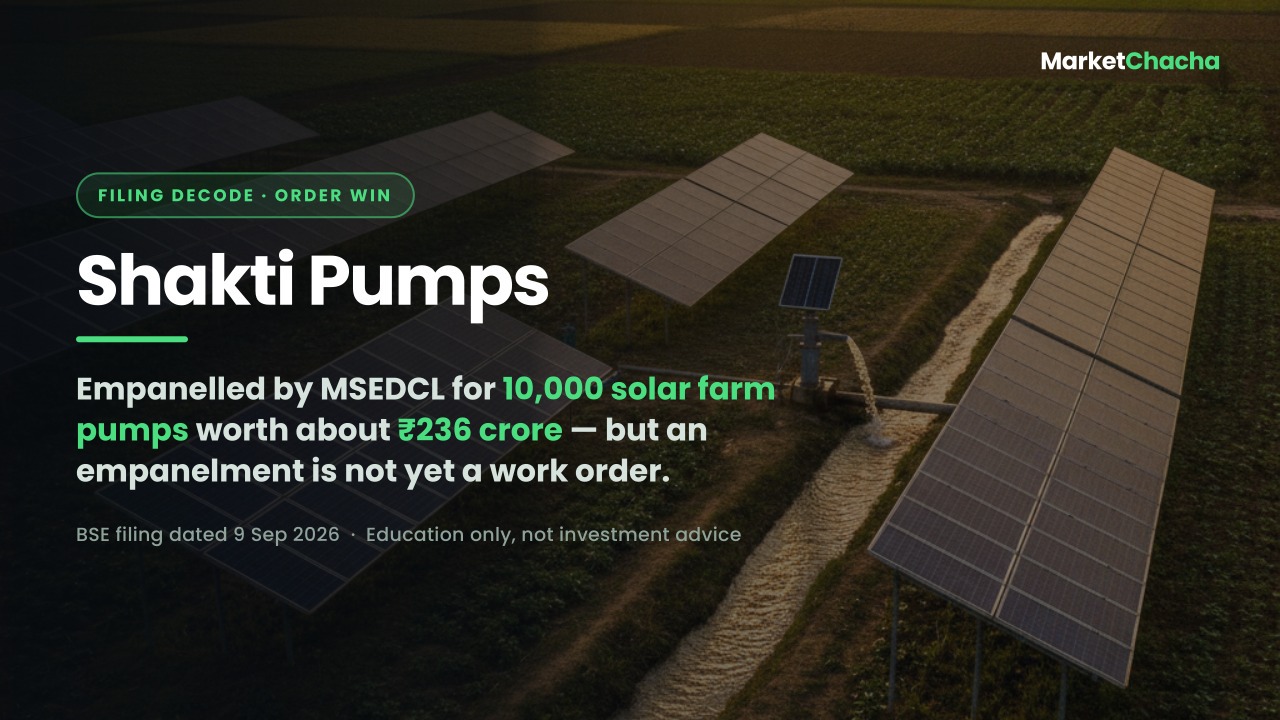
Shakti Pumps (India) told the exchanges after market hours on 9 September 2026 that it has received a Letter of Empanelment from Maharashtra State Electricity Distribution Company Limited (MSEDCL) to supply 10,000 off-grid solar water pumps for farmers across Maharashtra. The headline value is about ₹236 crore including GST (₹216.64 crore before GST). The stock opened roughly 8% higher the next morning and touched ₹524.45 intraday, up about 12%.
What was announced
The filing was made under Regulation 30 of SEBI's LODR rules, in the sub-category "Award of Order / Receipt of Order". The specifics, straight from the document:
- Who is awarding it: MSEDCL — Maharashtra's state electricity distribution utility. A domestic entity, not a related party, and no promoter or group-company interest.
- What: 10,000 Off-Grid Solar Photovoltaic Water Pumping Systems in 3 HP, 5 HP and 7.5 HP sizes, for the entire state of Maharashtra.
- Under which scheme: Magel Tyala Saur Krushi Pump Yojana — Maharashtra's "solar agriculture pump on demand" programme for farmers.
- Scope: not just supply. Design, manufacture, supply, transport, installation, testing and commissioning — the full turnkey job.
- Value: ₹216.64 crore as the work-order amount, ₹235.92 crore with GST added.
- Timeline: to be executed within 60 days from the issuance of the Work Order / Notice to Proceed.
What this type of filing means
Regulation 30 requires a listed company to tell the exchange, promptly, about any event a reasonable investor would consider material. An order win is one of the listed categories, and SEBI prescribes a fixed annexure — who awarded it, domestic or international, the terms, the timeline, the size, and whether any promoter has an interest. That standard format is why order-win filings all look alike, and it is what lets you compare one against another.
Two details in this particular filing are worth learning to spot, because they change how much the number is actually worth:
- "Letter of Empanelment" is not the same as a work order. Empanelment means the company has been approved onto the utility's panel of qualified suppliers for this programme at an agreed price and quantity. Revenue is recognised only when actual work orders are issued and pumps are delivered and commissioned. The filing itself says the 60-day clock starts from the issuance of the Work Order / NTP — a date that has not happened yet. Government solar-pump schemes have historically seen gaps between empanelment and full drawdown, so treating an empanelment as booked revenue is the classic beginner mistake here.
- The headline includes GST. ₹235.92 crore is the number in the press coverage, but ₹19.28 crore of that is tax that passes through to the government. The revenue-relevant figure is ₹216.64 crore. Always look for the ex-GST line in the annexure.
Why it matters / potential impact
On trailing twelve-month sales of roughly ₹2,934 crore (Screener.in), ₹216.64 crore is about 7% of a year's revenue — meaningful for a company this size, though not transformational on its own. Three angles worth thinking about:
- Order visibility. Shakti's business is lumpy and heavily tied to government solar-pump tenders (PM-KUSUM at the centre, state schemes like Magel Tyala Saur Krushi Pump Yojana). Each empanelment adds visibility to a book that otherwise depends on tender cycles the company does not control.
- Working capital. This is the number to watch with utility-funded orders. Screener shows debtor days of roughly 173 — nearly six months to collect. A large state-utility order adds revenue, but it can also add receivables before it adds cash. A turnkey scope with installation and commissioning usually means cash goes out before it comes in.
- Concentration. Depending on a handful of state utilities and one central scheme means policy timing, subsidy disbursal and tender pace drive the P&L more than end-customer demand does.
None of this is a view on the share price. It is what the filing does and does not commit the company to.
Is it expensive?
As reported on Screener.in, Shakti Pumps trades at a P/E of about 28.8 on a market capitalisation of roughly ₹6,100 crore, with a book value of ₹138 per share (so a P/B near 3.6x), ROCE of 23.6% and ROE of 18.0%. TTM net profit is around ₹212 crore.
Against listed pump peers, that is the cheapest of the three on earnings:
- Shakti Pumps — P/E ~28.8, market cap ~₹6,100 crore, ROCE 23.6%
- Kirloskar Brothers — P/E ~35.9, market cap ~₹14,540 crore, ROCE 20.4%
- KSB Ltd — P/E ~53.2, market cap ~₹13,941 crore, ROCE 24.7%
Fair framing: mid-to-high 20s earnings multiple is neither bargain-bin nor stretched for an industrial with 20%+ returns on capital, and the discount to Kirloskar Brothers and KSB is not free — those two have broader end-markets (industrial, building services, energy) while Shakti's earnings lean much harder on government solar-pump programmes, which makes them more cyclical and more policy-dependent. The market appears to be paying for that difference in predictability. Worth noting for honesty: the stock's 52-week range is roughly ₹456 to ₹915, so even after this jump it sits nearer the bottom of its own one-year range than the top. That is context, not a signal.
The business
Shakti Pumps manufactures pumps and motors at Pithampur, Madhya Pradesh, and sells water-pumping solutions into irrigation, horticulture, domestic water supply and industrial use. Broadly four product lines:
- Pumps — submersible, solar, centrifugal and specialised variants
- Motors — submersible, surface and EV motors
- Controllers — solar pump controllers and soft starters
- Others — mechanical seals, solar mounting structures and related components
This matters for reading the filing: the solar agricultural pump line is Shakti's largest and most visible driver, not a small side division. An MSEDCL empanelment lands in the core of the business, not on a fringe of it.
Beginner takeaway
When you see a big order headline, open the actual filing and check three things: is it a firm work order or only an empanelment or letter of intent; is the value quoted with or without GST; and when does the execution clock actually start. Here the answers are empanelment, with GST, and "not yet". That does not make it unimportant — ₹217 crore of ex-GST scope is a real addition for a company doing about ₹2,900 crore a year — but it is a step toward revenue rather than revenue itself.
FAQ
What is a Letter of Empanelment? It means the utility has approved the company as a qualified supplier for a scheme, at agreed specifications and pricing. Actual purchases follow later through separate work orders, so it is a licence to be given business rather than the business itself.
Why does the company file this with the exchange at all? SEBI's Regulation 30 requires prompt disclosure of material events, and order or contract awards are explicitly on that list. Filing it makes sure every investor learns the same thing at the same time, instead of the news leaking to a few people first.
Is ₹236 crore the amount Shakti Pumps will actually earn? No. ₹19.28 crore of it is GST that passes through to the government, so the revenue-relevant figure is ₹216.64 crore — and even that is earned only as pumps are supplied, installed and commissioned against work orders yet to be issued.
Why did the stock move so much on a ₹217 crore order? Because it is around 7% of a year's revenue for a company of this size, and because Shakti's earnings depend heavily on winning exactly this kind of government solar-pump mandate. How much of that move persists is a separate question this post does not attempt to answer.
As of 10 September 2026. Source: official BSE/NSE filing — read it directly here. We summarise filings for education and may make errors, so always verify against the official document. Educational content only — not investment advice, not a buy/sell recommendation.
This article is for educational and informational purposes only. It is not financial advice, investment recommendation, or a solicitation to buy or sell securities. Investing involves significant risks. I am not a SEBI-registered investment advisor. Readers should consult their own financial advisor and conduct their own research before making any investment decisions.
Comments
Join the conversation
Sign in to join the conversation.
Follow replies, add your view, and take part in the discussion.
Sign in to commentLoading comments...