

Why is crude oil suddenly back above $76? The Strait of Hormuz just got dangerous again
What happened
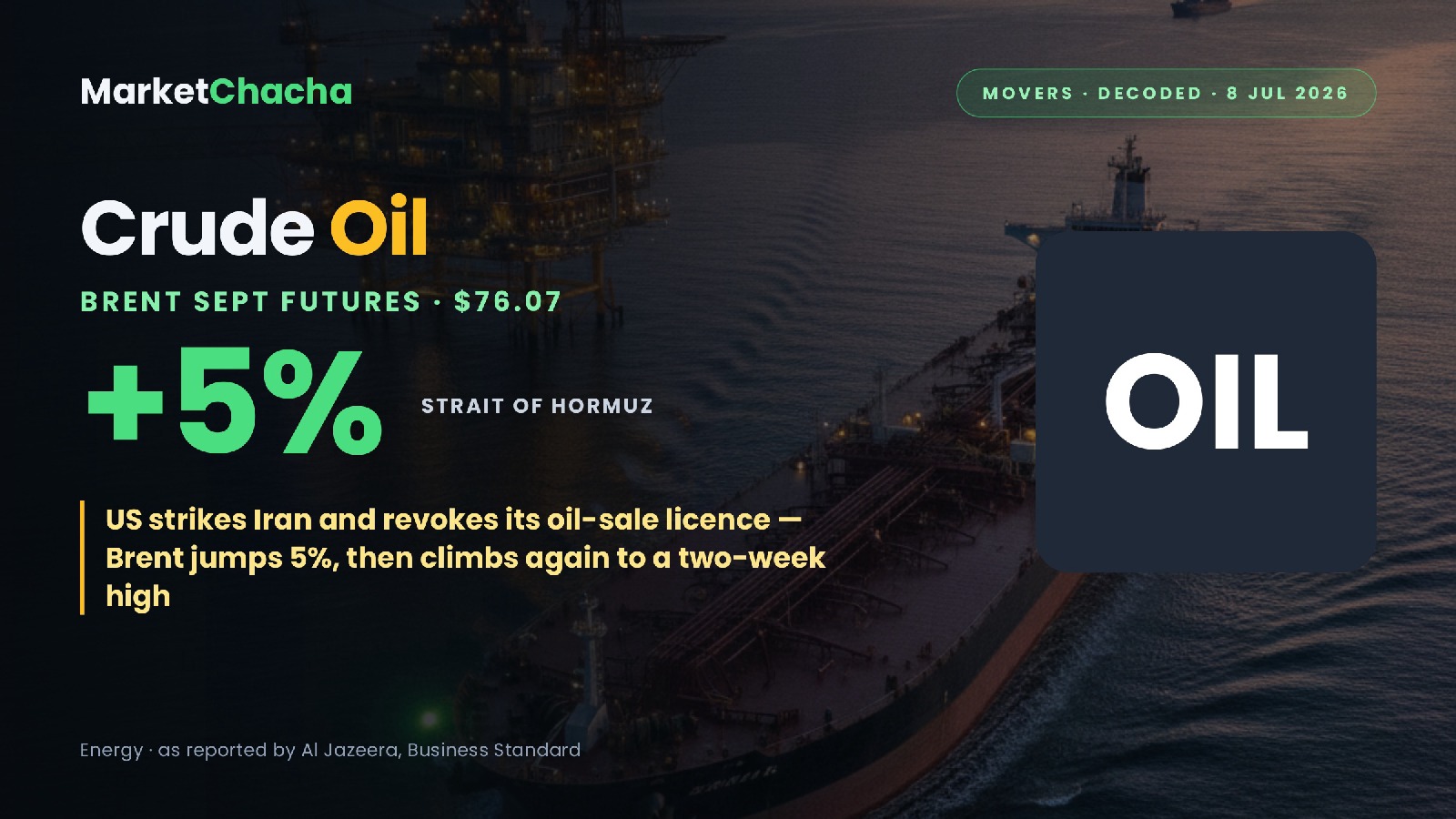
Crude just made its sharpest move in weeks. Brent futures jumped roughly 5% on Tuesday to trade above $75.50 a barrel, with US benchmark WTI up a similar 5% to around $72, as reported by NBC News and CNBC. Then it kept going: on Wednesday morning Brent rose as much as 3% more, with the September contract at $76.07 as of 04:00 GMT — the highest since June 23, per Al Jazeera. Two weeks ago oil had drifted all the way back to pre-war levels. That slide just reversed in about 36 hours.
Why it moved
Three things hit the market almost at once, and each one tightens expected supply.
- Attacks in the Strait of Hormuz. Three commercial vessels — including a Qatari LNG carrier and a Saudi oil tanker, per Yahoo Finance — were struck by projectiles in the strait. US, Qatari and Saudi officials blamed Iran. The strait is the world's most important oil chokepoint; roughly a fifth of global oil supply passes through it, so any doubt about safe passage gets priced instantly.
- The US revoked Iran's oil-sale licence. Last month, as part of a negotiated truce, the US Treasury had allowed Iran to sell its sanctioned crude until August 21. That waiver is now cancelled: no new purchases or loadings after Tuesday, and all transactions end by 12:01am EDT on July 17, per the Treasury statement cited by Al Jazeera. Iranian barrels the market was counting on are coming off the table.
- US strikes on Iran. US Central Command said it launched "powerful strikes" to impose costs for the shipping attacks, and Iran's military command vowed a "crushing response", per Business Standard. That raises the odds of a longer disruption, not a one-day scare.
The mechanism is simple: oil prices track expected barrels, not just current ones. Fewer Iranian exports plus a riskier Hormuz means traders pay more today for delivery tomorrow. MST Marquee's head of energy research told Al Jazeera that passage through the strait could stay below 50% of pre-war levels for months.
Who it touches
India imports most of its crude, so this lands hard at home — Indian markets opened lower on Wednesday, with the Nifty down about 0.56% at 24,261 by mid-morning and oil & gas the worst sector, per Business Standard.
- Hurt: Indian oil marketing companies (HPCL, BPCL, Indian Oil) — they buy crude and can't always pass on higher costs; HPCL and BPCL were among Wednesday's top losers. Also airlines (IndiGo), paints (Asian Paints, Berger) and tyre makers, where crude is a core input.
- Helped: upstream producers like ONGC and Oil India, which sell crude at prices linked to Brent; US shale producers; and LNG shippers able to avoid the strait.
- Watch the rupee: costlier oil widens India's import bill and tends to pressure the currency, which feeds inflation beyond fuel.
What to watch
The one thing that would flip this move: a credible de-escalation that reopens the strait to normal traffic — that's what dragged Brent back to pre-war levels earlier, and it could do so again just as fast. On the other side, the July 17 licence deadline is now a hard date; if Iranian barrels actually stop flowing then, today's price may look cheap. Gold and silver, notably, fell on Wednesday (down 0.99% and 1.87% per Business Standard) — this is an oil-supply story, not yet a broad flight to safety.
As of 11:00 IST, July 8. Sources: Al Jazeera, Business Standard, NBC News, Yahoo Finance. For discussion and education only — not investment advice. Verify before acting.
This article is for educational and informational purposes only. It is not financial advice, investment recommendation, or a solicitation to buy or sell securities. Investing involves significant risks. I am not a SEBI-registered investment advisor. Readers should consult their own financial advisor and conduct their own research before making any investment decisions.
Comments
Join the conversation
Sign in to join the conversation.
Follow replies, add your view, and take part in the discussion.
Sign in to commentLoading comments...