

Five big banks reported on the same Saturday: what their Q1 numbers actually say
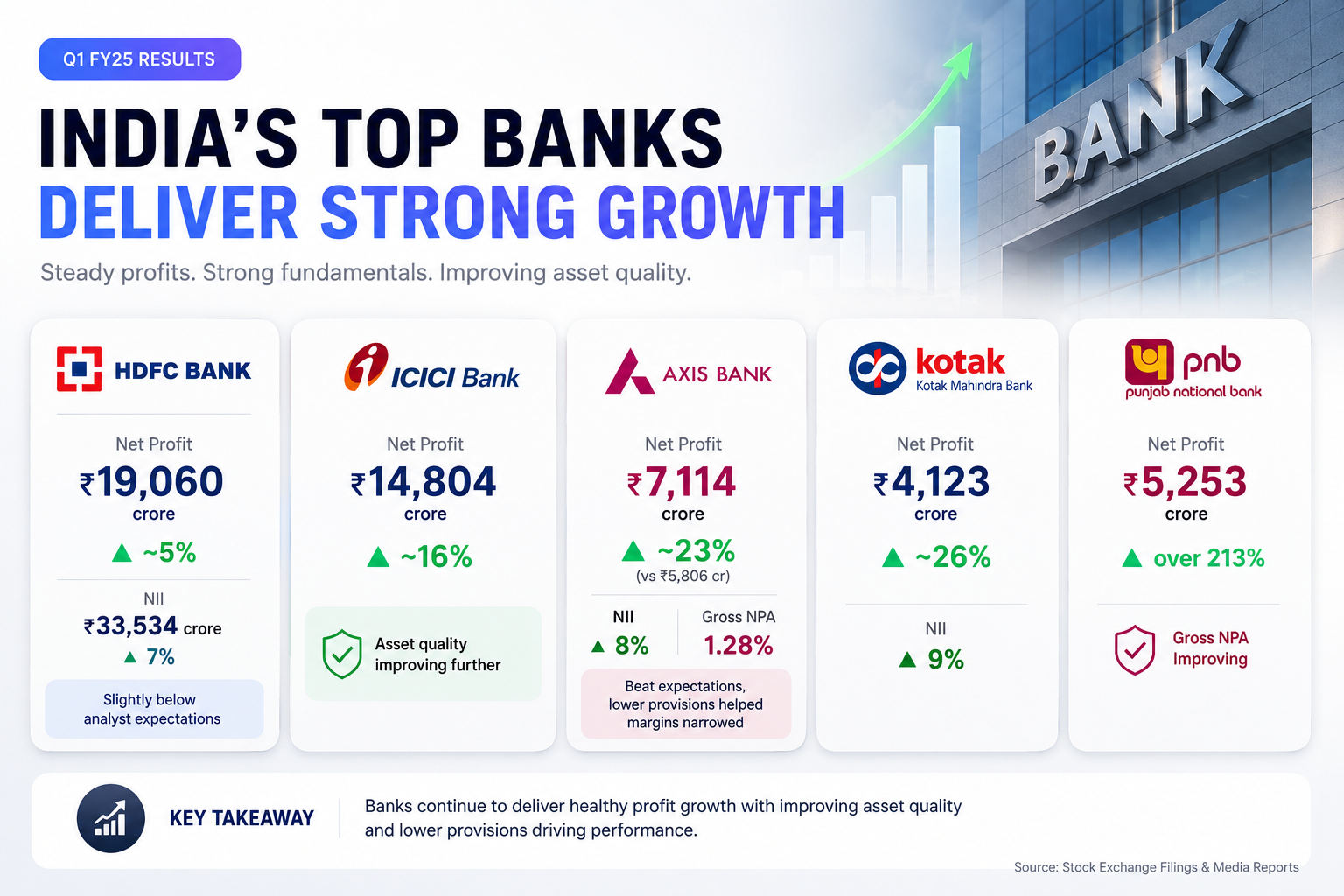
Saturday was the single biggest day of India’s Q1 FY27 earnings season so far: HDFC Bank, ICICI Bank, Axis Bank, Kotak Mahindra Bank and Punjab National Bank all declared results for the quarter ended 30 June 2026, part of roughly 21 companies reporting on the same day. Put side by side, they tell one clear story — the biggest bank grew the slowest, and almost everyone’s profit was helped by setting aside less money for bad loans.
What was announced
HDFC Bank — net profit ₹19,060 crore, up ~5%. NII ₹33,534 crore (+7%). Slightly below analyst expectations.
ICICI Bank — net profit ₹14,804 crore, up ~16%, with asset quality improving further.
Axis Bank — standalone net profit ₹7,114 crore, up ~23% (from ₹5,806 crore). NII +8%, gross NPA improved to 1.28%. Beat expectations, helped by lower provisions, though margins narrowed.
Kotak Mahindra Bank — standalone net profit ₹4,123 crore, up ~26%. NII +9%.
Punjab National Bank — net profit ₹5,253 crore, up over 213%, with gross NPA improving.
Yes Bank, IDBI Bank and Punjab & Sind Bank also reported on the same day.
What this type of filing means
When several banks report together you can learn more from the pattern than from any single number. Three metrics decode almost any bank result:
NII (net interest income) — interest earned on loans minus interest paid on deposits. Note that every bank above grew NII in the single digits (7–9%) while profits grew far faster. That tells you the profit growth is not mainly coming from core lending.
Provisions — money set aside for loans that may go bad. This is the swing factor this quarter: Axis explicitly grew profit on lower provisions, and PNB’s enormous jump is largely the same effect.
NIM (net interest margin) — the spread a bank earns. Margins narrowed across the board, which is why loan books growing ~15% only produced ~7–9% NII growth.
Why it matters / potential impact
Beware the biggest percentage. PNB’s +213% is the flashiest number on the list, but a jump that large almost always means the year-ago quarter was unusually depressed, not that the bank tripled its earning power. Growth off a low base is arithmetic, not necessarily performance.
Size caps growth. HDFC Bank earns more in one quarter than Kotak and Axis combined, so a 5% increase there is a larger rupee gain than Kotak’s 26%. Percentages flatter the small.
Falling provisions cannot repeat forever. Profit growth driven by setting aside less for bad loans has a floor — provisions cannot fall below zero. Once credit costs normalise, banks need margins or loan growth to take over. That is the key thing to watch next quarter.
Margin pressure is sector-wide. After RBI rate cuts, loans reprice faster than deposits. This squeezes every lender, and it is why NII growth was uniformly modest.
Is it expensive?
On valuation the two giants frame the sector. HDFC Bank is the largest at roughly ₹12.6 lakh crore market cap (~₹820 a share) on about 16–17× earnings and ~2.1× book value, with ROE ~13.6%. ICICI Bank is smaller at roughly ₹10.4 lakh crore (~₹1,418–1,450 a share) but pricier at about 17.6–19× earnings and ~2.85× book. Axis Bank trades around ₹1,470 a share. For banks, price-to-book is the sharper tool because the balance sheet is the business — and on that basis the market is paying roughly a third more per rupee of book value for ICICI than for HDFC Bank, a premium earned by faster growth and cleaner asset quality. Broadly the sector looks fairly valued rather than cheap, with the quality names carrying visible premiums. This is framing, not a recommendation.
The business
All five make money the same fundamental way — take deposits, lend at a higher rate, keep the spread — but they are not the same animal. HDFC Bank and ICICI Bank are the two large private-sector giants with big retail loan books and sizeable insurance, asset-management and broking subsidiaries. Axis Bank is the third large private lender, retail and corporate weighted. Kotak Mahindra Bank is smaller and historically the most conservative, with a strong capital-markets and wealth arm. PNB is a state-owned public-sector bank — typically lower margin, more corporate and government-linked lending, and the group most affected by the bad-loan cycle, which is exactly why its recovery percentages look so dramatic.
Beginner takeaway
Five banks, one Saturday, and the ranking by profit growth almost exactly inverts the ranking by size. That is normal. The more useful observation is that core lending income grew only 7–9% everywhere while profits grew much faster — meaning this quarter’s earnings were powered largely by lower provisions for bad loans. Enjoy it, but do not annualise it.
FAQ
Why did PNB’s profit jump 213% when others grew 5–26%? Almost certainly a low-base effect — the year-ago quarter was weighed down by provisions for bad loans. When those charges fall away, the percentage change looks enormous even if the underlying business changed modestly.
Why do all these banks report on the same Saturday? Indian banks commonly schedule board meetings on weekends so the market has time to digest the numbers before Monday’s open.
If margins are falling everywhere, why are profits rising? Because provisions for bad loans fell faster than margins compressed. Profit is revenue minus costs minus provisions, and this quarter the provisions line did the heavy lifting.
Which single number should a beginner look at first? Net interest income growth. It shows whether the core lending business is genuinely expanding, before one-off items and provisioning decisions flatter or depress the headline profit.
As of 18 July 2026. Figures as reported by the banks to the stock exchanges on 18 July 2026; verify against each bank’s official filing — for example HDFC Bank and ICICI Bank. We summarise filings for education and may make errors, so always check the official document. Educational content only — not investment advice, not a buy/sell recommendation.
This article is for educational and informational purposes only. It is not financial advice, investment recommendation, or a solicitation to buy or sell securities. Investing involves significant risks. I am not a SEBI-registered investment advisor. Readers should consult their own financial advisor and conduct their own research before making any investment decisions.
Comments
Join the conversation
Sign in to join the conversation.
Follow replies, add your view, and take part in the discussion.
Sign in to commentLoading comments...