

The market is trading a US-Iran deal that isn't signed yet - here's the gap
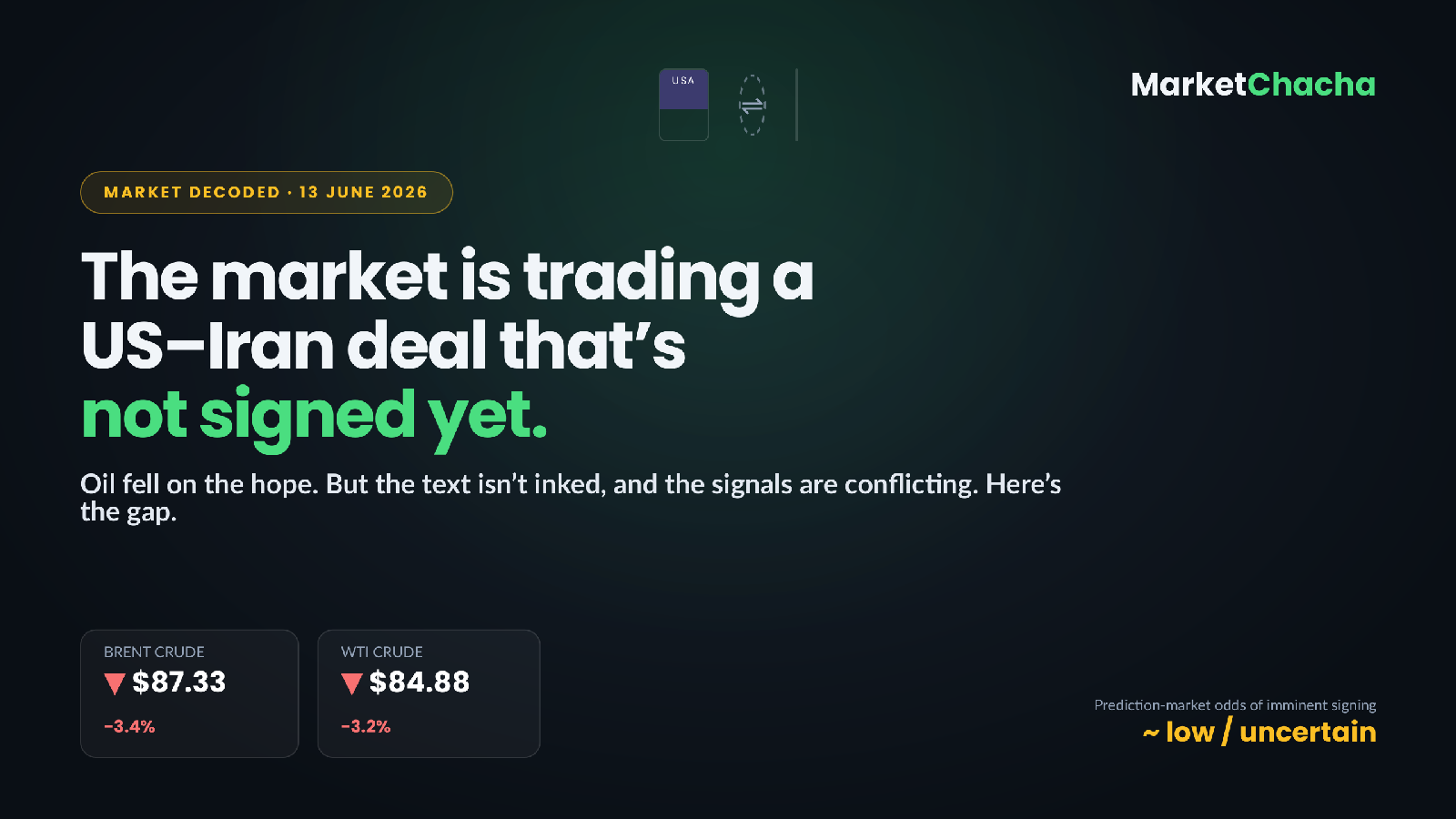
A US–Iran peace deal is close — a draft text was agreed on 12 June and President Trump said it could be signed Sunday — but it is not signed, the signals are contradictory, and oil markets have already moved on the hope. This is a live lesson in how markets trade expected outcomes, not confirmed facts.
What is actually agreed (and what isn’t)
On 12 June 2026, US and Iranian negotiators — with Pakistani mediation — reportedly agreed the final text of a draft peace deal (an MOU). The reported terms: reopening the Strait of Hormuz, lifting the US naval blockade, steps to dismantle Iran’s nuclear program and remove enriched uranium, sanctions relief, and an inspection regime.
Optimistic side: Trump said the deal could be signed Sunday; Pakistan’s PM said the two sides are “closer than ever.”
The caveats: a senior US official put the chance of signing at only 80–85% — explicitly “not 100%.” Iranian officials called the reports preliminary and said nuclear issues would need separate follow-on talks.
The contradiction the headlines bury
Here is what makes this a textbook “don’t trust one headline” moment. At almost the same time as the peace talk, the situation on the ground escalated:
On 11 June, the US launched strikes across southern Iran — described as the most serious breakdown of the ceasefire to date.
Iran’s IRGC closed the Strait of Hormuz and fired on passing ships.
Prediction markets — where people bet real money on outcomes — priced the odds of an imminent (mid-June) signing very low, a stark contrast to the “signing Sunday” headlines.
So “a deal is close” and “the ceasefire is breaking down” are both true right now. That tension is the whole story.
Why the market moved anyway
Despite the contradictions, oil fell hard on the hope of a deal: Brent −3.4% to $87.33 and WTI −3.2% to $84.88 on 12 June. Why? Because markets trade probability, not certainty. A credible chance that Hormuz reopens — the chokepoint for a fifth of the world’s seaborne oil — is enough to pull the “war premium” out of crude before anything is signed.
Why it matters for India: cheaper crude is almost pure good news for India — a smaller import bill, lower imported inflation, a steadier rupee. This is the same force that drove India’s sharp rally last week. But it cuts both ways: if signing slips or strikes resume, that war premium snaps right back, and oil — and risk assets — reverse just as fast.
What this teaches you
Markets are forward-looking discounting machines. They move on the expected path, then re-rate as reality confirms or denies it. A “peace-deal rally” built on an unsigned draft is fragile by definition. The disciplined read isn’t “the deal is done” — it’s “the market is pricing an 80%-ish chance of a deal, and here’s what flips if that number moves.”
What to watch next
Does it actually sign? Watch for a confirmed, signed agreement — not just statements about one.
Strait of Hormuz status — reopening (bearish oil) vs. renewed closure/strikes (bullish oil).
Oil’s direction as the single cleanest real-time gauge of whether the deal narrative is strengthening or breaking.
FAQ
Is the US–Iran deal signed? No. As of 13 June 2026 a draft text is reportedly agreed and signing was floated for Sunday, but it has not been signed and officials put it below certain.
Why did oil fall if there’s no deal yet? Markets price probability. A credible chance the Strait of Hormuz reopens removes some of the “war premium” from oil before anything is finalised.
How does this affect Indian markets? Lower oil eases India’s import bill, inflation and rupee pressure — a tailwind. But it reverses quickly if the deal falls through.
As of 13 June 2026. This is a fast-developing story — verify the latest before relying on it. Sources: CNBC, CBS News, CBC, Al Jazeera. Educational content only — not investment advice, and not a buy/sell recommendation.
This article is for educational and informational purposes only. It is not financial advice, investment recommendation, or a solicitation to buy or sell securities. Investing involves significant risks. I am not a SEBI-registered investment advisor. Readers should consult their own financial advisor and conduct their own research before making any investment decisions.
Comments
Join the conversation
Sign in to join the conversation.
Follow replies, add your view, and take part in the discussion.
Sign in to commentLoading comments...