

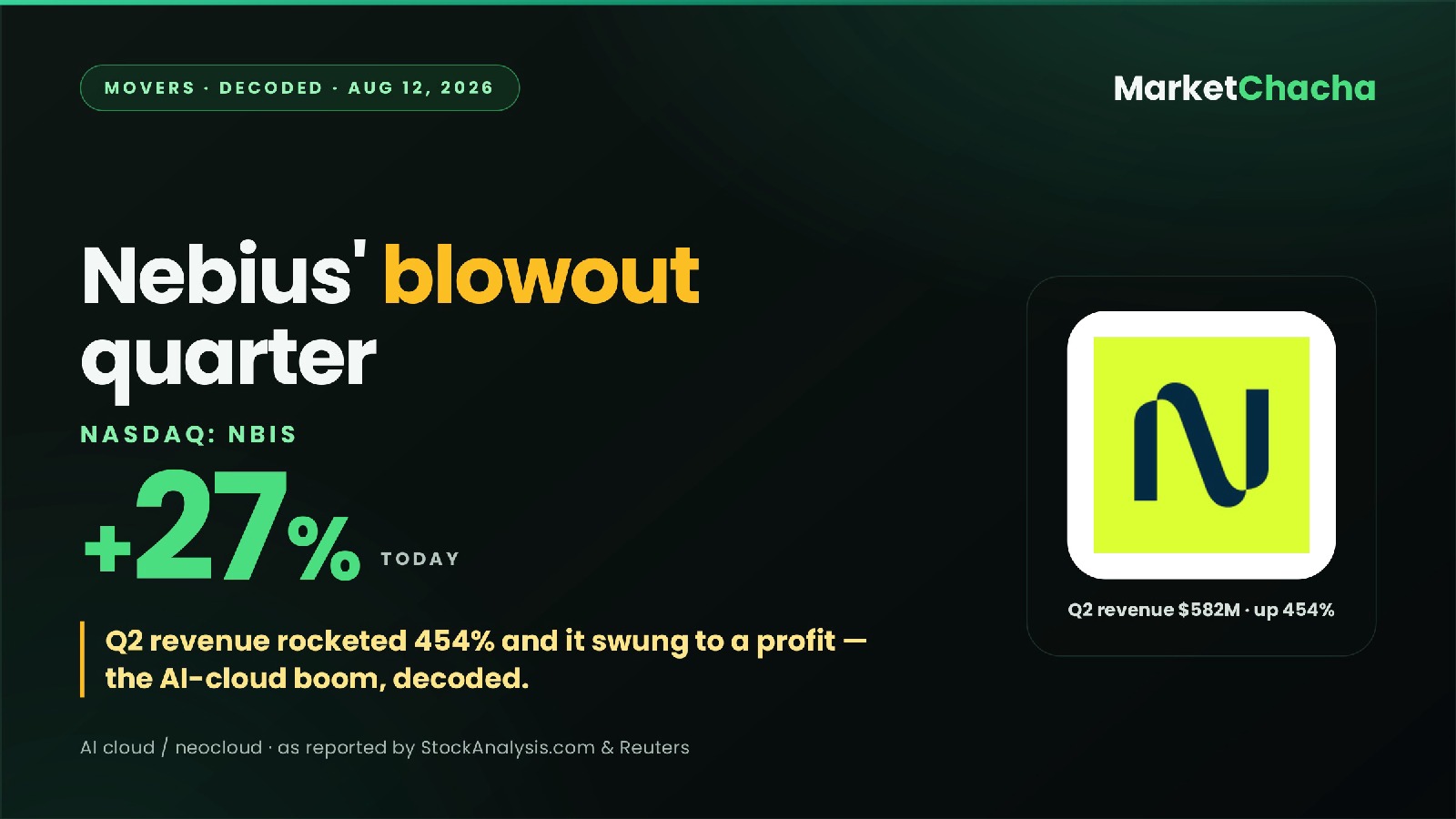
Why did Nebius (NBIS) rocket ~27% today? Its Q2 revenue jumped 454%
What happened
Nebius (NASDAQ: NBIS) is up about 27% in Wednesday afternoon trade — around $246 versus Tuesday's $193.23 close, as reported by StockAnalysis.com, after opening roughly 17% higher. The trigger was its Q2 2026 results, out after Tuesday's bell, and they were a genuine blowout. Separately, Nebius said it signed a fresh $1 billion-plus compute deal with Reflection AI running through 2029 — a second piece of good news the same morning.
Why it moved
Two things drove it, and they're different, so let's keep them apart.
First, the numbers. Revenue hit $582.3 million, up 454% year-on-year — more than five times bigger than a year ago — and it beat what Wall Street expected. The bigger surprise was profitability: adjusted EBITDA (a rough cash-profit measure) swung to a positive $236.2 million from a ~$21 million loss a year earlier, about a 41% margin. Its annualized run-rate revenue crossed $3 billion, and the quarterly loss narrowed to -$0.12 a share, versus the roughly -$0.70 the street penciled in. A hyper-growth story that suddenly throws off cash is exactly what this market pays up for.
Second, that Reflection AI order. It's worth over $1 billion through 2029 and lands on top of a backlog already stuffed with anchor contracts — a Microsoft deal worth up to ~$19.4 billion and a Meta deal worth up to ~$27 billion. Total remaining performance obligations sit near $33.6 billion. That's the "why the growth is durable" part.
The business
Nebius is a "neocloud" — a vertically integrated AI-cloud operator. In plain terms, it buys huge fleets of NVIDIA GPUs, wires them into data centres, and rents that compute (plus the software to run it) to AI companies. It was spun out of Russia's Yandex — Nebius kept the international business and divested the Russian assets. It also owns two smaller side bets, TripleTen (an edtech re-skilling platform) and Avride (self-driving tech), but the AI cloud is the engine doing essentially all of today's talking.
Is it expensive?
Yes — richly. After the pop, Nebius is worth about $63 billion. It's only just profitable on paper, so a normal P/E (over 1,000x) is meaningless; the honest lens is sales. Against management's 2026 revenue guide of $3–3.4 billion, you're paying roughly 20 times this year's sales. Compare fellow neocloud CoreWeave (CRWV), which carries a similar-ish market cap near $50 billion but books multiples more revenue — its Q2 sales alone were $2.58 billion — so per dollar of sales, CoreWeave is far cheaper. Neither is a bargain; Nebius is priced for years of near-flawless execution.
Who it touches
- Other neoclouds re-rated in sympathy: CoreWeave (CRWV) jumped after its own strong quarter, and Australia-listed IREN rose about 10% — the whole "rent-a-GPU" group moved together.
- NVIDIA (NVDA): almost every dollar Nebius spends on capex buys NVIDIA chips, so blowout neocloud demand is a read-through for NVIDIA's order book.
- Microsoft and Meta: already Nebius's anchor customers, they're effectively renting capacity they can't build fast enough themselves.
What to watch
The one thing that could flip this: the cash going out the door. Nebius plans $20–25 billion of capex in 2026 — far more than it earns — funded by debt and fresh equity. It's also a crowded short: investor Michael Burry recently disclosed a bet against Nebius (and Oracle), arguing AI valuations have gotten "fat," and part of today's spike is likely those shorts scrambling to cover. A 20-times-sales stock leaning on constant fundraising works beautifully while AI demand and cheap capital hold — and unwinds fast if either cracks.
As of 12:30 PM ET, Aug 12, 2026. Sources: StockAnalysis.com, Reuters, Barron's. For discussion and education only — not investment advice. Verify before acting.
This article is for educational and informational purposes only. It is not financial advice, investment recommendation, or a solicitation to buy or sell securities. Investing involves significant risks. I am not a SEBI-registered investment advisor. Readers should consult their own financial advisor and conduct their own research before making any investment decisions.
Comments
Join the conversation
Sign in to join the conversation.
Follow replies, add your view, and take part in the discussion.
Sign in to commentLoading comments...