

BHEL: what its credit-rating upgrade to IND AA actually means
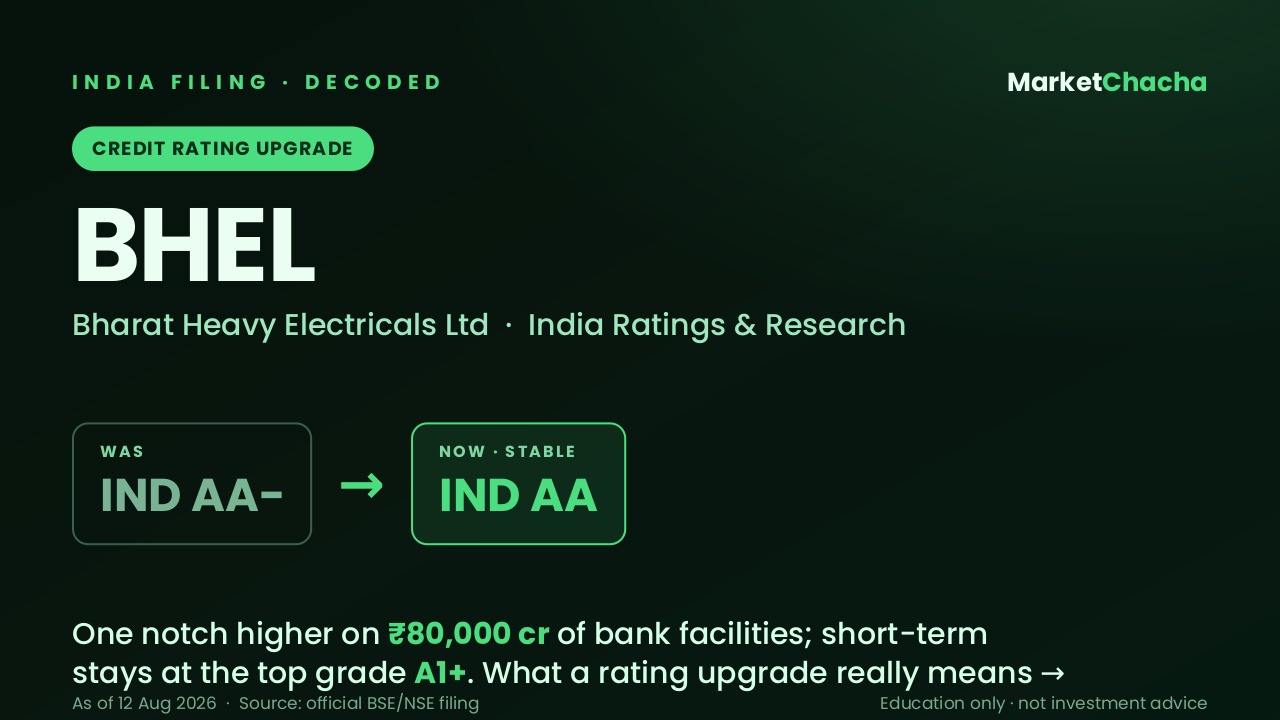
Bharat Heavy Electricals Ltd (BHEL) told the exchanges on 12 August 2026 that the rating agency India Ratings & Research has upgraded its long-term credit rating one notch to “IND AA / Stable” from “IND AA− / Positive”, while keeping its short-term rating at the top rung, “IND A1+”. In plain terms: an independent agency now judges BHEL slightly safer to lend to than it did before.
What was announced
This is a “credit rating” disclosure under Regulation 30 of SEBI’s listing rules. The specifics from the filing:
- Long-term rating: upgraded to IND AA (Stable) from IND AA− (Positive) — one notch higher.
- Short-term rating: reaffirmed at IND A1+, which is already the highest possible short-term grade, so it couldn’t go up.
- The ratings cover ₹80,000 crore of total bank-loan facilities and a ₹5,000 crore commercial paper / unsecured loan programme.
- India Ratings said the action reflects BHEL’s operational and financial performance up to FY2025–26 and Q1 FY2026–27.
One subtle point worth clearing up: the outlook moved from “Positive” to “Stable.” That is not a downgrade signal. A “Positive” outlook was the agency flagging that an upgrade was likely; now that the upgrade has actually happened, the outlook resets to “Stable” at the new, higher level. So both the rating and the outlook are good news here.
What this type of filing means
A credit rating is a report card on how likely a company is to repay its debt on time. It is about the bond/loan side of the business, not the share price. Agencies like India Ratings (Fitch’s India arm), CRISIL, ICRA and CARE grade borrowers on a scale that runs roughly AAA (safest) → AA → A → BBB and downwards. Adding a “+” or “−” fine-tunes each band, so the ladder near the top reads AAA, AA+, AA, AA−, A+… A rating upgrade means the company just climbed one rung. “A1+” is the separate, short-term scale used for money BHEL borrows for under a year (like commercial paper), and A1+ is the best score there.
Why it matters / potential impact
- Cheaper borrowing. A higher rating usually lets a company raise debt at a lower interest rate, because lenders see less risk. For a capital-heavy business like BHEL, even a small drop in interest cost across large borrowings helps margins.
- Easier access to money and guarantees. BHEL’s business runs on bank guarantees and working-capital lines for large power projects. A stronger rating makes banks more comfortable extending these, on better terms.
- An outside stamp on the turnaround. The agency explicitly cited improved operational and financial performance. So the upgrade is a third party confirming that BHEL’s recent order wins and results are translating into a healthier balance sheet.
What it does not do: it is not a comment on whether the shares are cheap or expensive, and it is not a buy or sell signal. A company can have a strong credit rating and an expensive stock at the same time.
Is it expensive?
On the equity side, BHEL trades at a P/E of roughly 59 with a market capitalisation of about ₹1.41 lakh crore (share price near ₹404). That P/E is rich in absolute terms — it is high partly because profits are still recovering off a low base, so a re-rating on the strength of the order book has run ahead of current earnings. For context among named peers: Cummins India (power and engine equipment) sits in a similar rich zone at a P/E around 63 (market cap ~₹1.5 lakh crore), while the diversified engineering major Larsen & Toubro is cheaper on earnings at a P/E around 34 (market cap ~₹5.5 lakh crore). So BHEL is priced optimistically, closer to Cummins than to L&T — this is honest framing, not a target or a recommendation.
The business
BHEL is India’s largest maker of power-generation equipment — boilers, turbines and generators for thermal, hydro, gas and nuclear plants — and it is majority-owned by the Government of India. Beyond power, its Industry segment supplies transmission gear, transportation (locomotives, metro propulsion), defence and aerospace equipment, and industrial systems. Because BHEL is diversified, a filing like this rating upgrade is company-wide: it reflects the health of the whole group’s balance sheet, not just one division.
Beginner takeaway
An independent agency now considers BHEL a slightly safer borrower, which typically means cheaper and easier access to debt — a quiet positive for a company that funds big, long projects. It says nothing about whether the stock is cheap, and the shares already trade at a rich valuation. Treat it as a balance-sheet health check, not a trading trigger.
FAQ
Does a rating upgrade mean the share price will go up? Not necessarily. Ratings are about debt repayment risk, not the stock. The share price already reflects a lot of optimism, and the two can move independently.
Why did the outlook change from “Positive” to “Stable” — isn’t that worse? No. “Positive” meant an upgrade was likely; once it happens, the outlook resets to “Stable” at the new higher rating. Both parts of this filing are favourable.
What’s the difference between IND AA and IND A1+? IND AA is the long-term rating (for multi-year loans and bonds). IND A1+ is the short-term rating (for borrowings under a year, like commercial paper) and is already the highest short-term grade.
Who is India Ratings & Research? It is a SEBI-registered credit rating agency and the Indian arm of the global agency Fitch. Other agencies that rate BHEL include CRISIL, ICRA and CARE.
As of 12 August 2026. Source: official BSE/NSE filing — read it directly here. We summarise filings for education and may make errors, so always verify against the official document. Educational content only — not investment advice, not a buy/sell recommendation.
This article is for educational and informational purposes only. It is not financial advice, investment recommendation, or a solicitation to buy or sell securities. Investing involves significant risks. I am not a SEBI-registered investment advisor. Readers should consult their own financial advisor and conduct their own research before making any investment decisions.
Comments
Join the conversation
Sign in to join the conversation.
Follow replies, add your view, and take part in the discussion.
Sign in to commentLoading comments...