

Sun Pharma: what its new Moody's Baa1 / S&P BBB+ rating actually means
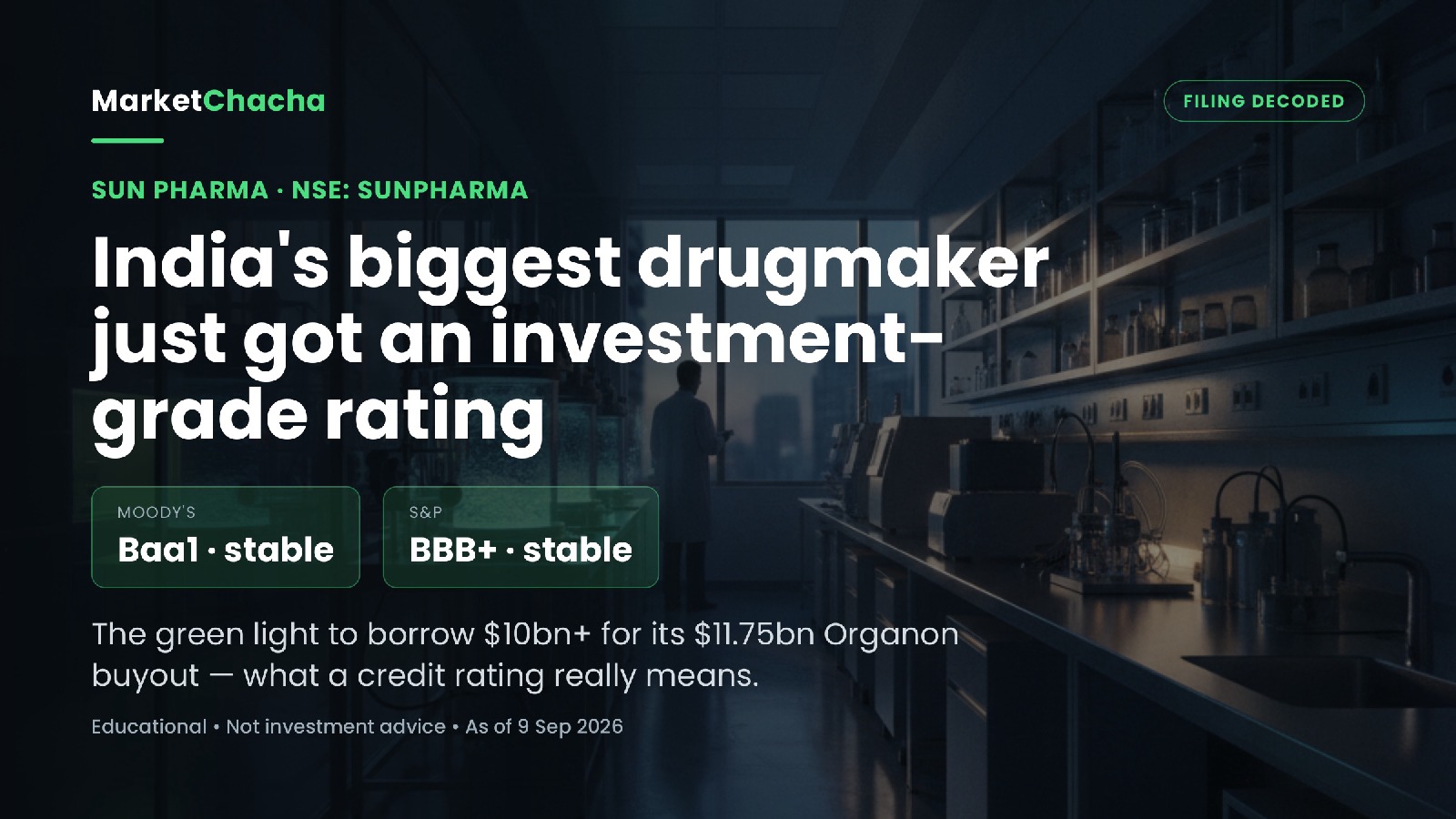
Sun Pharmaceutical Industries has told the exchanges that global rating agencies Moody's and S&P have assigned it international credit ratings — Baa1 from Moody's and BBB+ from S&P, both with a stable outlook. These are first-time international issuer ratings for India's largest drugmaker, and they land right as Sun prepares to fund its ~$11.75 billion all-cash acquisition of US company Organon largely with overseas debt.
What was announced
Sun Pharma filed a "credit rating" intimation under SEBI's disclosure rules. The substance: two of the three big global agencies have now formally rated Sun's creditworthiness.
- Moody's: Baa1, stable outlook.
- S&P: BBB+, stable outlook.
- Both sit firmly in investment grade — a notch or two above the "junk" cut-off.
Moody's cited Sun's robust global pharma franchise, its No. 1 position in India, a diversified geography and product base, a growing innovative-medicines portfolio, strong profitability and consistent free cash flow.
What this type of filing means
A credit rating is an outside agency's opinion on how likely a company is to pay back its debt on time — it is about lenders and bondholders, not equity investors. An international rating (in the global scale, like Baa1 / BBB+) is what lets a company borrow US dollars from foreign banks and bond markets at sensible interest rates. The scale runs, roughly: AAA/Aaa (safest) → BBB-/Baa3 (lowest investment grade) → BB+/Ba1 and below ("high yield" or junk). Baa1 and BBB+ are solid investment grade — meaning "adequate capacity to repay, moderate risk."
Why it matters / potential impact
The timing is the whole story. Sun is buying Organon (a US women's-health and biosimilars company) for $11.75 billion in cash, and is funding most of it with more than $10 billion of syndicated bank loans (roughly $1 billion each from 11 banks) plus its own cash. To raise that much dollar debt cheaply, Sun needs recognised international ratings — so these Baa1/BBB+ grades are effectively the green light and the price tag on its acquisition borrowing. Investment grade means lower interest cost and access to global bond markets later to refinance. Management has guided post-deal net debt to EBITDA of about 2.3x — a meaningful jump for a company that has historically been almost debt-free, which is exactly why the market watches the rating and outlook.
Is it expensive?
Sun Pharma trades at a trailing P/E of about 36, with a market cap around ₹4.6 lakh crore — by far the largest listed Indian pharma company. That is the richest valuation among the big three: Cipla is around 32x (market cap ~₹1.18 lakh crore) and Dr Reddy's is the cheapest at roughly 19–20x (~₹96,000 crore). So the market pays a clear premium for Sun — investors are paying up for its India No. 1 branded franchise and its higher-margin US specialty portfolio, not for cheapness. Honest framing: this is a premium-priced, high-quality name, not a bargain — and none of that is a target or a buy/sell call.
The business
Sun Pharma is India's largest pharmaceutical company. Its main slices are: US finished dosage (generics plus a growing high-margin specialty/branded book — dermatology and immunology drugs like Ilumya, Winlevi and Leqselvi, the real growth engine); India branded formulations, where it is ranked No. 1; emerging markets and rest-of-world generics; and active pharmaceutical ingredients (APIs). The Organon deal pushes Sun deeper into global women's health and biosimilars — so this is a company-wide strategic move, not a one-division event.
Beginner takeaway
A credit rating grades a company's ability to repay debt, not its share price. Sun getting Baa1/BBB+ investment-grade ratings is the practical step that lets it borrow the dollars to buy Organon at a reasonable interest cost. The number to keep an eye on going forward is Sun's debt level after the deal closes — it's moving from nearly debt-free to meaningfully leveraged.
FAQ
Does a credit rating change my shares or the EPS? No. A rating is an opinion for lenders about repaying debt. It doesn't issue new shares or directly change earnings per share — though cheaper borrowing can indirectly help profitability.
Is Baa1 / BBB+ a good rating? Yes — both are investment grade, comfortably above the junk threshold. They signal moderate risk and reliable repayment capacity, which is what dollar lenders want to see.
Why does a profitable, cash-rich company even need a rating? Because it's about to take on more than $10 billion of new debt for the Organon deal. Global banks and bond buyers price that debt off the rating, so a good rating directly lowers Sun's interest bill.
What is Organon and why buy it? Organon is a US-listed women's-health and biosimilars firm with 70-plus products in 140 countries and about $6.2 billion of annual revenue. The deal makes Sun a top-3 global women's-health player and adds scale in the US and biosimilars.
As of September 9, 2026. Filing dated September 8, 2026. Source: official BSE filing — read it directly here. We summarise filings for education and may make errors, so always verify against the official document. Educational content only — not investment advice, not a buy/sell recommendation.
This article is for educational and informational purposes only. It is not financial advice, investment recommendation, or a solicitation to buy or sell securities. Investing involves significant risks. I am not a SEBI-registered investment advisor. Readers should consult their own financial advisor and conduct their own research before making any investment decisions.
Comments
Join the conversation
Sign in to join the conversation.
Follow replies, add your view, and take part in the discussion.
Sign in to commentLoading comments...