

ITC Hotels: what their latest filing actually means
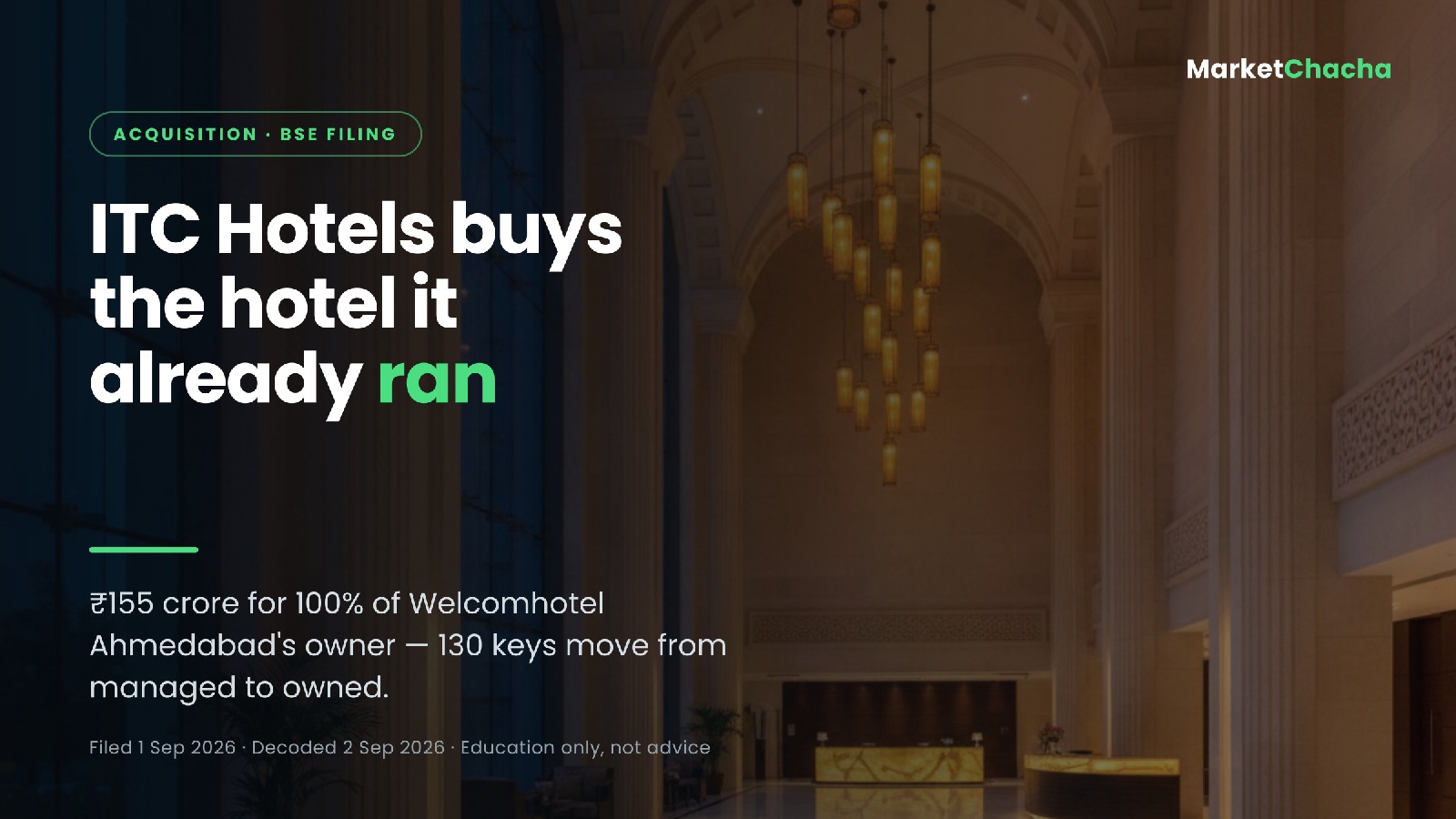
ITC Hotels told the exchanges on 1 September 2026 that it has completed the purchase of 100% of GHK Hospitality & Infrastructures Limited — the company that owns Welcomhotel Ahmedabad, a 130-key hotel that ITC Hotels was already running under a management contract. The price: an enterprise value of ₹155 crore, paid in cash. It is an acquisition disclosure under Regulation 30, and the interesting part is not the size — it is what changes about how one hotel shows up in ITC Hotels' accounts.
What was announced
- On 1 September 2026, ITC Hotels acquired 100% of the share capital of GHK Hospitality & Infrastructures Ltd. GHK is now a wholly owned subsidiary with effect from the same date.
- Cost: enterprise value of ₹155 crore on a cash-free, debt-free basis, subject to customary adjustments, under a Share Purchase and Share Subscription Agreement signed on 16 July 2026. Consideration is cash.
- Mechanics: 2,82,27,741 equity shares acquired in two parts — 1,54,54,545 shares by primary subscription (fresh shares issued by GHK, money going into GHK) and 1,27,73,196 shares bought from existing holders (money going to the sellers).
- What GHK is: incorporated 10 May 2007, registered in Ahmedabad, and its business is one asset — the hotel Welcomhotel Ahmedabad on Ashram Road, with 130 keys.
- GHK's turnover (audited): FY2023-24 ₹25.62 crore → FY2024-25 ₹31.23 crore → FY2025-26 ₹35.16 crore.
- ITC Hotels states this is not a related-party transaction, no promoter or group interest in the target, and no government or regulatory approval was required.
- The stated purpose: expand its owned asset portfolio in Ahmedabad across all market segments through an established hotel it already operated under an Operating Services Agreement.
What this type of filing means
This is a Regulation 30 acquisition disclosure. Under SEBI's Listing Obligations and Disclosure Requirements, a listed company must tell the exchanges about material events — and acquisitions come with a fixed annexure the company has to fill in: who the target is, what it does, what was paid, whether it is a related party, and the target's last three years of turnover. That standard format is a gift to a retail reader. You do not have to hunt for the numbers; the company is obliged to lay them out.
Two phrases in this filing are worth learning properly:
- "Enterprise value on a cash-free, debt-free basis" — enterprise value is what the whole business is worth to all its funders, before you sort out who is owed what. Saying "cash-free, debt-free" means the ₹155 crore is the agreed value of the operating asset itself; whatever cash GHK is holding and whatever loans it owes get settled separately at closing. So the actual cheque ITC Hotels writes for the equity can differ from ₹155 crore. This is the standard way private company deals are priced in India, and it is why headline deal values and cash outflows rarely match exactly.
- Primary subscription vs secondary purchase — in a primary issue, the target creates new shares and the buyer's money lands inside the target company (here, likely to clear GHK's debt or fund the asset). In a secondary purchase, the buyer buys existing shares and the money goes to the selling shareholders, not into the business. ITC Hotels did both. The split tells you part of the ₹155 crore recapitalised the hotel company and part bought out its previous owners.
Why it matters / potential impact
The commercial substance here is a shift from managing a hotel to owning it, and those two are very different businesses sitting under the same roof.
When ITC Hotels merely managed Welcomhotel Ahmedabad, it collected a management fee — a small slice of the hotel's revenue, with almost no capital tied up and almost no risk. Now that it owns GHK, the hotel's entire profit and loss consolidates into ITC Hotels: all ₹35.16 crore of FY26 revenue, all the room-night upside when Ahmedabad is busy, and equally all the costs, the depreciation on the building, and the downside when it is not. The management fee ITC Hotels used to earn becomes an internal transaction and gets eliminated on consolidation, so the net revenue addition is a bit less than ₹35 crore gross.
On the balance sheet, ₹155 crore of cash (or borrowing) converts into a fixed asset plus whatever goodwill arises. There is no dilution — this was paid in cash, not by issuing ITC Hotels shares, so existing shareholders' stakes are untouched.
Some rough arithmetic worth doing yourself, since the filing hands you the inputs:
- ₹155 crore ÷ 130 keys ≈ ₹1.19 crore per key. That is the price per hotel room, the standard yardstick in hotel M&A. Compare it to what it would cost to build a comparable 130-key hotel in Ahmedabad from scratch, plus the years of construction — that is the "buy vs build" question this deal answers.
- ₹155 crore ÷ ₹35.16 crore revenue ≈ 4.4× sales. Note this is EV to revenue, not to profit — the filing does not disclose GHK's EBITDA or net profit, so nobody outside can compute the more meaningful EV/EBITDA multiple from this document alone. Be honest about what you cannot know.
- Scale check: ₹155 crore is roughly 0.45% of ITC Hotels' market capitalisation, and 130 keys is under 1% of its Indian room count. This is a bolt-on, not a company-changing transaction. A reader should adjust expectations accordingly — one hotel does not re-rate a ₹34,000 crore company.
The strategic read is about direction of travel. ITC Hotels runs an "asset-right" model and has said it wants roughly one-third of its portfolio owned and the rest managed. Buying out an asset it already operates, in a city with year-round corporate and event demand, is that policy being executed in small steps. Owned hotels carry more capital and more earnings volatility, but they also capture the full operating leverage when occupancy and room rates rise — which is precisely why hotel companies fight over the owned-versus-managed mix.
Is it expensive?
Talking about the parent company now, not the target. As of 2 September 2026, ITC Hotels trades around ₹158.70, a market capitalisation of about ₹34,365 crore, on a trailing P/E of roughly 42× and a price-to-book of about 2.94× (Tickertape).
Set that against its closest listed peer, Indian Hotels Company (IHCL, the Taj group), at about ₹718, a market capitalisation near ₹1,03,911 crore, a P/E of roughly 49.85× and a price-to-book near 6.96× (Tickertape, 1 September 2026).
Honest framing: 42× earnings is a rich multiple in absolute terms — you are paying about forty-two rupees for every rupee of last year's profit. Indian listed hotel companies have carried premium multiples for a few years now, on the argument that room supply is growing slower than demand and that operating leverage in hotels is unusually powerful. On a relative basis ITC Hotels is cheaper than IHCL on both P/E and, much more sharply, on book value — 2.94× book versus nearly 7×. That gap is not free money; IHCL is roughly three times the size, has a longer track record as a standalone listed company, a stronger international brand footprint, and higher returns on capital. Whether ITC Hotels' discount is an opportunity or a fair reflection of a shorter listed history is exactly the judgement an investor has to make, and it is not one this post will make for you.
The business
ITC Hotels is the hotels arm of the ITC group, demerged and separately listed. It operates around 156 hotels with about 14,300 rooms in India across seven brands, spanning the luxury flagship ITC Hotels brand, the upper-upscale Welcomhotel, the mid-market Fortune, and the boutique Storii, with an overseas property in Sri Lanka. Its stated model is "asset-right": own about a third of the portfolio, manage the rest for third-party owners under long-term contracts, and grow the network without funding every building. Management has spoken of reaching roughly 250 hotels and 22,000 rooms by 2031.
Revenue comes overwhelmingly from the core hotel operation — rooms, food and beverage, banqueting — with a smaller and newer branded-residences stream. In the June 2026 quarter the company reported revenue of about ₹936 crore and consolidated net profit of about ₹182 crore, up roughly 36% year on year, while flagging uncertainty from West Asia conflict effects on air travel and input costs. So this Ahmedabad deal touches the owned-hotels slice of a business whose earnings are already dominated by hotel operations — it is not a diversified group where one division's news barely registers, but it is still a single 130-key property inside a 14,000-room network.
Beginner takeaway
A ₹155 crore acquisition inside a ₹34,000 crore company is not a reason to change your view of that company — but it is an excellent free lesson in how deals are actually structured, because SEBI forces the company to publish the terms in a standard table. Read this filing for the mechanics: cash-free debt-free pricing, primary versus secondary shares, and the difference between owning a hotel and merely operating it. When a much bigger acquisition lands one day, you will already know which numbers to look for and which ones the company has quietly not given you.
FAQ
ITC Hotels already ran this hotel — so what actually changed? The economics. Before, it earned a management fee off someone else's hotel with no capital at risk. Now it owns the hotel outright, so the property's full revenue, full costs, depreciation and profit all flow into ITC Hotels' consolidated accounts — more upside when the hotel does well, more exposure when it does not.
Does this acquisition dilute my shares if I own ITC Hotels? No. The filing states the consideration is cash. Dilution happens when a company issues new shares to pay for something; here no new ITC Hotels shares were created, so your percentage ownership is unchanged. The cost shows up as cash leaving the balance sheet rather than as a smaller slice of the company for you.
Why does the filing say "enterprise value" instead of just the price? Because ₹155 crore values the business as a whole before adjusting for the target's own cash and debt. The final money that changes hands for the shares gets adjusted for those items at closing, so the equity cheque may be higher or lower. It is the normal convention for private deals — and a good habit to notice, because headline deal values and actual cash outflows are often not the same number.
Is a 130-key hotel purchase big enough to move the stock? On the arithmetic, it is roughly 0.45% of the company's market value and under 1% of its Indian room inventory — so on its own, it is a small, incremental step rather than a re-rating event. It matters more as evidence of the owned-versus-managed strategy being executed than as a number that changes this year's earnings much.
As of 2 September 2026. Source: official BSE/NSE filing — read it directly here. We summarise filings for education and may make errors, so always verify against the official document. Educational content only — not investment advice, not a buy/sell recommendation.
This article is for educational and informational purposes only. It is not financial advice, investment recommendation, or a solicitation to buy or sell securities. Investing involves significant risks. I am not a SEBI-registered investment advisor. Readers should consult their own financial advisor and conduct their own research before making any investment decisions.
Comments
Join the conversation
Sign in to join the conversation.
Follow replies, add your view, and take part in the discussion.
Sign in to commentLoading comments...