

Why did Celsius (CELH) crash ~16% today? Record sales, shrinking core
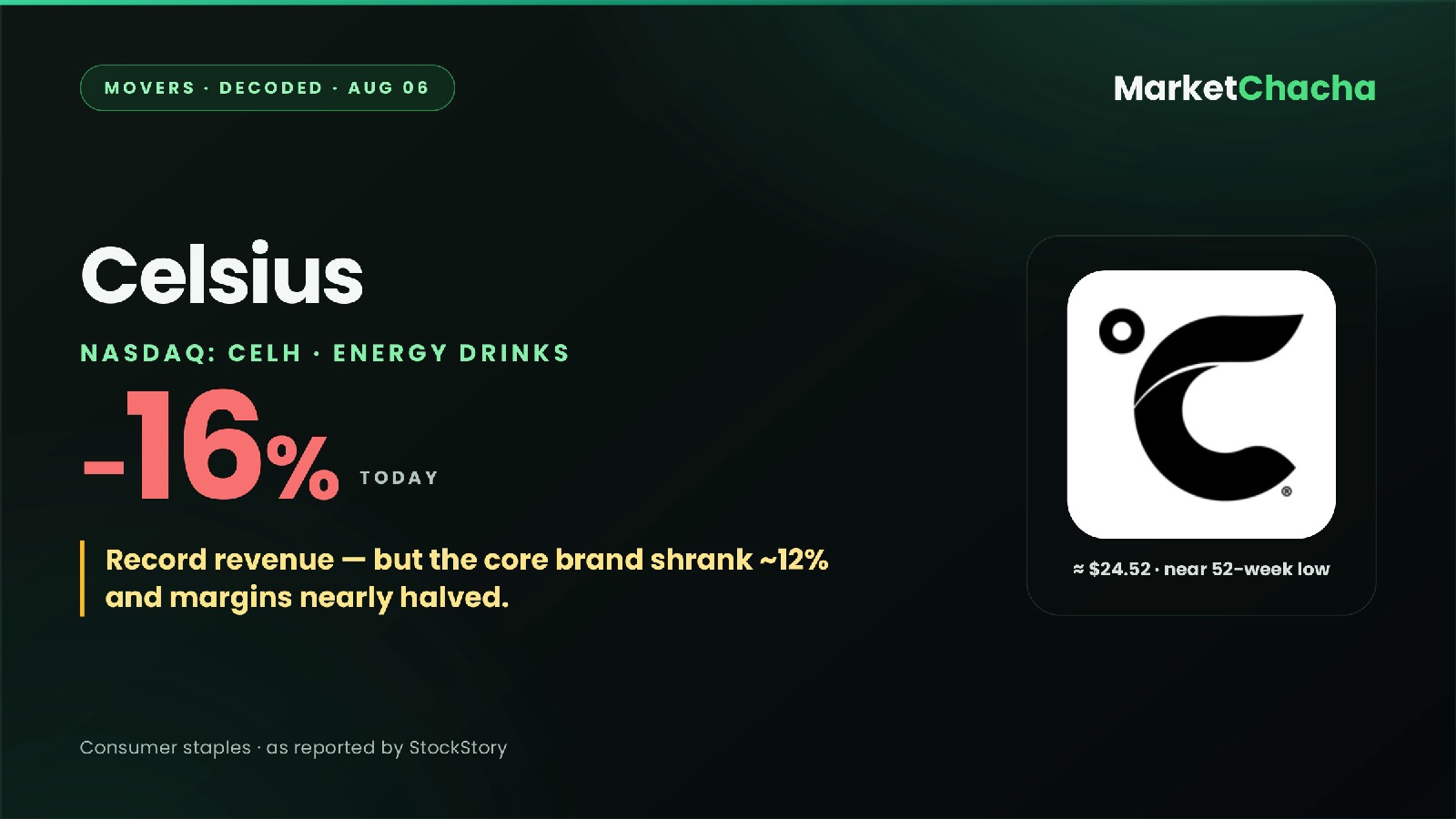
Celsius Holdings (NASDAQ: CELH) dropped about 15.9% to roughly $24.52 right after its Q2 numbers hit early Thursday, one of its worst days in a while and back near 52-week lows (as reported by StockStory / FinancialContent). Here's the twist: the company just posted record revenue. So why did the stock get hit so hard?
What happened
Celsius makes the CELSIUS energy drink — the one in the tall skinny cans with the "burns body fat" pitch — and last year it bought Alani Nu, the pastel-can brand big with women, for $1.8 billion. Bolt Alani Nu and the Rockstar distribution deal onto the base and total sales look great. This quarter, revenue rose 10.6% to a record $817.9 million. The problem: Wall Street wanted $872 million, so it was actually a 6.2% miss. Profit was worse — adjusted EPS came in at $0.36 versus the ~$0.42 expected (a 13.9% miss) and down about 23% from a year ago.
Why it moved
The number that spooked people is buried under the headline. Strip out the acquisitions and the flagship CELSIUS brand's revenue actually fell about 12% year-on-year (StockTitan). The growth engine everyone bought this stock for is going in reverse in its home market. Management blamed heavy trade and promotional spending — i.e. discounting to hold shelf space — plus shipment timing, soft sales in the club channel, and fewer new-flavor launches. That discounting shows up in the margins: gross margin slipped to 48.1% from 51.5%, and operating margin collapsed to 9.2% from 19.3% a year ago. Alani Nu did its job (about $364 million in the quarter), but a company paying up to defend its main brand while margins halve is not the growth story the multiple was priced for.
The business
Celsius is really three things now: the core CELSIUS brand, Alani Nu (bought in 2025), and a growing international arm, all riding PepsiCo's US distribution network. So today's catalyst isn't the whole company breaking — it's the biggest, most-watched slice (the CELSIUS brand) losing momentum while the newer pieces carry the top line.
Is it expensive?
Even after the drop, this isn't a cheap stock. At a ~$7.5 billion market cap, Celsius trades on a trailing P/E in the high-60s — the kind of multiple that only makes sense if profits keep compounding fast. On next year's hoped-for earnings the forward P/E is nearer ~19, which looks reasonable — but only if that growth actually shows up, and today's miss is exactly the thing that puts it in doubt. For contrast, giant Monster Beverage (MNST) — about $90 billion in market value — sits on a trailing P/E around 45 with steadier, slower growth. So Celsius is still being priced as the fast grower; the market's worry is that the "fast" part is fading.
Who it touches
- Monster Beverage & Keurig Dr Pepper: Celsius discounting to defend shelf space hints at a US energy-drink price fight — margin pressure the whole shelf feels.
- PepsiCo (PEP): it owns a stake in Celsius and distributes it, so softer CELSIUS volumes mean less lift for Pepsi too.
- High-multiple "growth" consumer names: a clean reminder that a record top-line can hide a shrinking core.
What to watch
The one thing that flips this: if the promo spending is a deliberate, short land-grab and the CELSIUS brand starts growing again in the back half — while Alani Nu keeps compounding — the margin hit reverses and that ~19x forward math works. If the flagship keeps shrinking, "record revenue" won't save the multiple.
As of ~8:00 AM ET, Thu Aug 6, 2026. Figures as reported by StockStory / FinancialContent, StockTitan, and Celsius's Q2 2026 results filing (SEC 8-K). For discussion and education only — not investment advice. Verify before acting.
This article is for educational and informational purposes only. It is not financial advice, investment recommendation, or a solicitation to buy or sell securities. Investing involves significant risks. I am not a SEBI-registered investment advisor. Readers should consult their own financial advisor and conduct their own research before making any investment decisions.
Comments
Join the conversation
Sign in to join the conversation.
Follow replies, add your view, and take part in the discussion.
Sign in to commentLoading comments...