

Dilip Buildcon: what their latest filing actually means
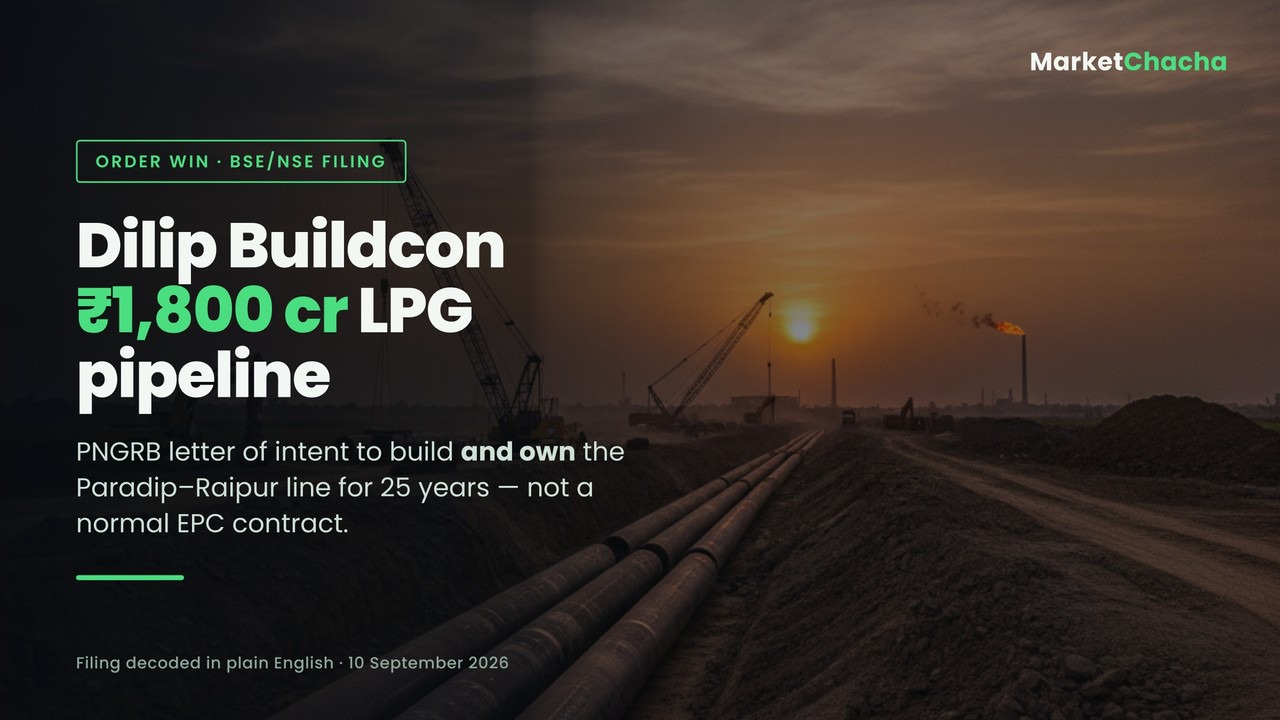
Dilip Buildcon has told the exchanges that it received a Letter of Intent (LOI) from the Petroleum and Natural Gas Regulatory Board (PNGRB) for an LPG pipeline running from Paradip in Odisha to Raipur in Chhattisgarh, a project the company values at roughly ₹1,800 crore. The intimation reached the exchanges late on 9 September 2026 and the stock reacted when trading opened on 10 September, gapping up and touching an intraday high of ₹439.70 — about 11.7% above the previous close — before easing back to around ₹414 (+5.5%) later in the session.
What was announced
The important detail is buried in the wording. This is not a construction contract handed to Dilip Buildcon by an oil company. PNGRB — the sector regulator — has authorised the company to design, finance, develop, construct, operate and maintain the pipeline itself.
- Route: Paradip (Odisha) to Raipur (Chhattisgarh).
- Indicative project value: about ₹1,800 crore.
- Construction period: 36 months (3 years).
- Operating period: 25 years thereafter.
- Commercial model: a common carrier pipeline that earns transportation tariffs under PNGRB's tariff framework.
- Purpose: move LPG to bottling plants inland, replacing road tankers.
What this type of filing means
Two concepts are worth separating here, because beginners routinely conflate them.
A Letter of Intent is not yet revenue. An LOI is a formal written statement that the awarding party intends to award the work. It normally precedes a definitive concession agreement or work order. Conditions can still be attached, financing still has to be arranged, and until the definitive documents are signed the project does not enter the order book in the way a signed contract does. Companies disclose LOIs under Regulation 30 of SEBI's LODR rules because the information is price-sensitive — but "received an LOI" and "started earning from it" are different milestones, sometimes months apart.
An authorisation to own an asset is a different animal from an EPC job. In a normal EPC (engineering, procurement, construction) contract, the builder builds, gets paid over 2–3 years, hands the asset over, and walks away. Here the company builds the pipeline and then keeps it for 25 years, collecting regulated transportation tariffs from whoever ships LPG through it. That converts a one-time construction margin into a multi-decade annuity — but it also means the company, not a customer, carries the cost of building it.
Why it matters / potential impact
- Revenue mix. Dilip Buildcon today is overwhelmingly a roads-and-EPC contractor. A regulated-tariff pipeline is a genuinely different kind of cash flow — longer, steadier, and not dependent on winning the next tender.
- Capital intensity is the catch. "Design, finance, develop" means the company funds the build. Screener.in shows consolidated debt of about ₹8,041 crore as of March 2026 against a market capitalisation near ₹6,411 crore. How this ₹1,800 crore project is financed — internal accruals, project debt at a special-purpose vehicle, or equity — will matter more to shareholders than the headline number does. That detail is not in the announcement.
- Timing. Three years of construction before the 25-year tariff clock starts. Nothing here changes this year's profit and loss account.
- Context on the base business. In Q1 FY27 the company reported consolidated net profit down 50.67% year-on-year to ₹112.95 crore on revenue down 9.26% to ₹2,377.78 crore. A single order win, however structurally interesting, does not fix a soft quarter.
- Execution risk is real. Cross-country pipelines involve land acquisition, right-of-use approvals and statutory clearances across two states. Delays in infrastructure projects of this shape are common rather than exceptional.
Is it expensive?
On the numbers reported by Screener.in, Dilip Buildcon trades at a P/E of about 11.5 with a market capitalisation of roughly ₹6,411 crore and a price-to-book of about 0.95 — that is, slightly below its stated book value. ROCE is 13.1% and ROE 5.55%.
Compare that with NCC Ltd, a larger listed EPC peer: market capitalisation about ₹9,112 crore, P/E about 12.6, price-to-book 1.16, ROCE 16.8% and ROE 9.19%.
Plainly stated: Dilip Buildcon is not expensive on the headline multiple — it is cheaper than its peer on both earnings and book value. But cheap-looking infrastructure contractors are usually cheap for a reason, and here the reasons are visible in the same numbers: returns on equity roughly half NCC's, a debt load larger than the entire market capitalisation, and profits that just halved year-on-year. A low P/E on a leveraged, cyclical contractor is a statement about risk, not a bargain signal. This is framing, not a target price or a recommendation.
The business
Dilip Buildcon, founded in 2006 and based in Bhopal, is one of India's larger road-focused infrastructure contractors. Its revenue splits roughly as follows:
- EPC projects and road infrastructure (~93%): roads and highways, irrigation, airports, metro rail viaducts and mining excavation, built on an engineering-procurement-construction basis for government bodies and special-purpose vehicles.
- Annuity projects and others (~7%): hybrid-annuity, toll and annuity-plus-toll road projects the company holds an interest in.
So this pipeline LOI sits outside the company's main revenue engine. It is a new line of business rather than more of the existing one — which is exactly why the market treated it as news rather than as routine order flow.
Beginner takeaway
When a filing says a company will "design, finance, develop, construct, operate and maintain" something, read it twice — that company is becoming an owner, not just a builder. Owning an asset for 25 years can be far more valuable than building it for three, but it requires capital up front and the returns arrive slowly. And remember that an LOI is an intention to award, not signed revenue: the definitive agreement, the financing plan and the first tariff collection are the milestones worth tracking from here.
FAQ
Is a ₹1,800 crore order big for this company? It is meaningful in scale — the company's trailing twelve-month sales are around ₹8,741 crore per Screener.in — but it is spread over a three-year build, so it is not ₹1,800 crore of revenue landing in one year.
What is a "common carrier" pipeline? It means the pipeline must offer capacity to third-party shippers on regulated, non-discriminatory terms, and it earns a tariff set under PNGRB's framework rather than a freely negotiated price. Predictable, but capped.
Why did the stock give back some of its early gain? Gap-up openings on order-win news often fade during the day as traders who bought the headline take profits. Intraday price action of this kind tells you about positioning, not about the project's economics.
Does this change the company's earnings this year? No. Construction runs for 36 months and the 25-year tariff period starts only after that. Any near-term effect shows up in order book and capital-expenditure plans, not in this year's profit.
As of 10 September 2026. Source: official BSE/NSE filing — read it directly here. We summarise filings for education and may make errors, so always verify against the official document. Educational content only — not investment advice, not a buy/sell recommendation.
This article is for educational and informational purposes only. It is not financial advice, investment recommendation, or a solicitation to buy or sell securities. Investing involves significant risks. I am not a SEBI-registered investment advisor. Readers should consult their own financial advisor and conduct their own research before making any investment decisions.
Comments
Join the conversation
Sign in to join the conversation.
Follow replies, add your view, and take part in the discussion.
Sign in to commentLoading comments...