

IndiGo: what their latest filing actually means
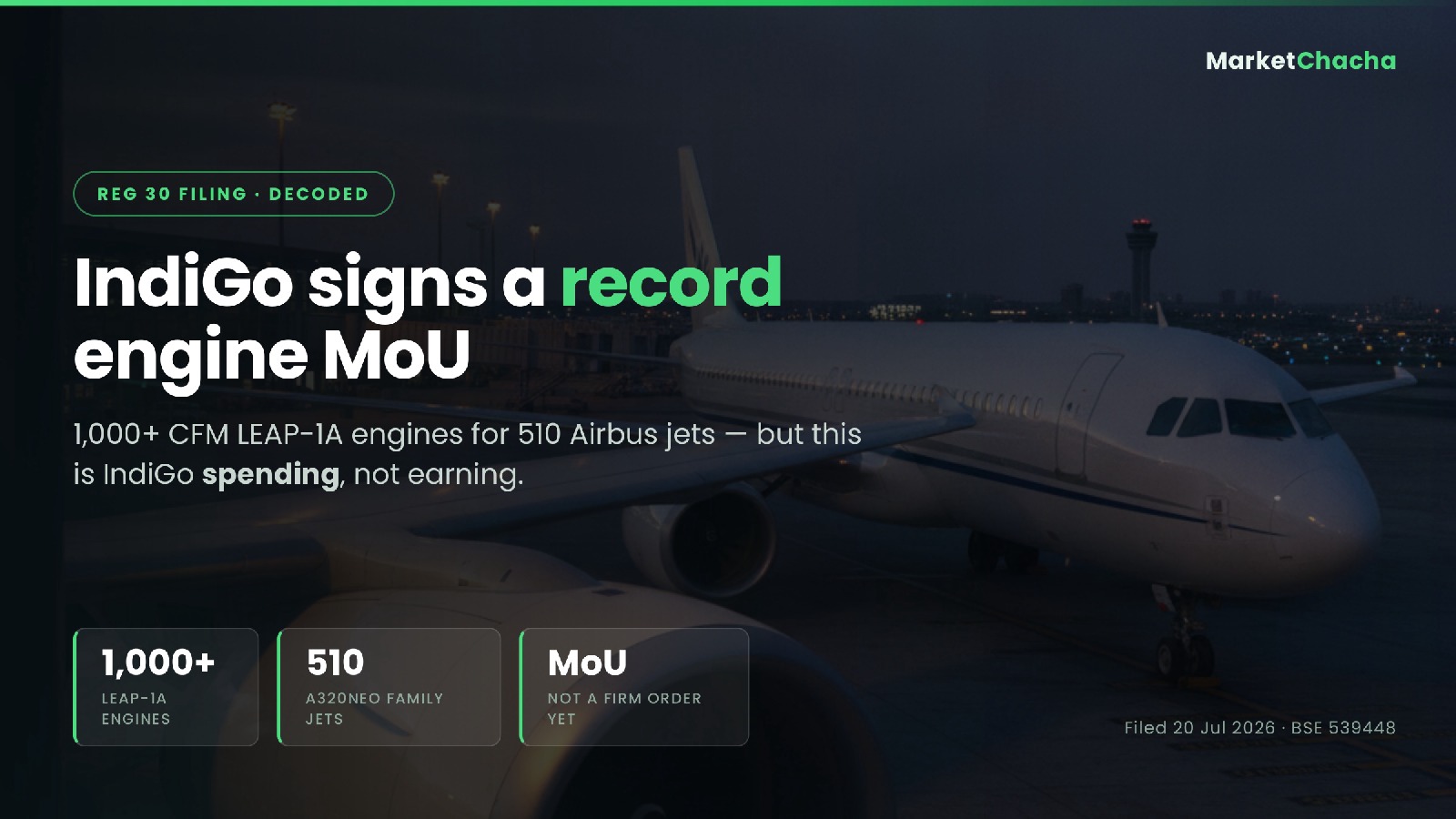
InterGlobe Aviation (IndiGo) told the exchanges on 20 July 2026 that it has signed a Memorandum of Understanding with CFM International for over 1,000 LEAP-1A engines to power 510 Airbus A320neo-family aircraft — the largest single order ever placed for the LEAP engine and a record for CFM. The deal also covers CFM's support in building IndiGo's upcoming engine MRO facility and a long-term spare-parts agreement. Here is the part most headlines skip: this is IndiGo committing to spend money, not win it.
What was announced
- 1,000+ CFM LEAP-1A engines, to power 510 Airbus A320/A321neo-family aircraft IndiGo has on order.
- CFM International is a 50/50 joint venture between Safran Aircraft Engines and GE Aerospace — so this order flows to those two companies, not to any Indian listed entity.
- The MoU also includes CFM support for IndiGo's upcoming engine MRO (maintenance, repair and overhaul) facility, plus a long-term material services agreement covering spare parts.
- Announced at the Farnborough Airshow. IndiGo has been a CFM customer since 2016 (CFM56-5B on A320ceo), and first ordered LEAP-1A engines in 2019.
- IndiGo's current fleet already exceeds 375 A320/A321-family aircraft; total fleet was 441 aircraft as of 31 March 2026.
- The filing does not disclose a rupee or dollar value. That is normal for aircraft and engine deals — list prices are published, but airlines negotiate very large confidential discounts, so a headline number would be misleading anyway.
What this type of filing means
This came in as a Regulation 30 disclosure under SEBI's LODR rules. Reg 30 is the catch-all obligation for listed companies to tell the exchanges about any event a reasonable investor would consider material — before or at the same time as telling the media. That is why the press release lands on BSE and NSE first.
Two distinctions matter here, and beginners routinely miss both:
- An MoU is not a firm order. A Memorandum of Understanding records that both sides intend to do a deal and have agreed the broad shape of it. The commercial contract — final pricing, delivery schedule, escalation clauses, penalties — is signed later. The press release itself says the MoU is "paving the way to" the agreement. Deals at this scale almost always do get firmed up, but until they do, nothing is contractually locked. Watch for a follow-up filing confirming the definitive agreement.
- IndiGo is the buyer here, not the seller. When a company like L&T or BEL files an "order win", that order is future revenue arriving. When an airline announces an engine order, it is announcing future capital and maintenance spending going out. The economic benefit to IndiGo is indirect: securing engine supply, locking pricing, and cutting future maintenance costs. The direct revenue benefit accrues to GE Aerospace and Safran.
Why it matters / potential impact
Supply security is the real prize. IndiGo has spent the last few years dealing with grounded aircraft caused by engine availability problems across the industry. An airline can order all the aircraft it wants, but a jet without a working engine earns nothing while still costing lease and financing charges. Contracting 1,000+ engines and spares alongside the airframes is IndiGo trying to make sure its 510 incoming aircraft can actually fly.
The MRO piece may matter more than the engine count. Today Indian carriers send most heavy engine work overseas, which means foreign-currency bills and aircraft sitting idle in transit. An in-house engine MRO built with CFM's support could shorten turnaround times and shift some of that cost into rupees. It is also a slow build — facilities like this take years to certify and ramp.
On the balance sheet: large aircraft and engine commitments show up as contractual obligations and, as deliveries happen, as leases and debt. IndiGo's capital commitments are already very large. This does not change the near-term P&L, but it deepens a long, fixed, mostly dollar-denominated obligation for a company that earns in rupees — the same currency mismatch that hurt it badly last year.
Timing context: IndiGo is signing a decade-plus growth commitment straight after its worst financial year in a long time. That is either confidence in the structural growth of Indian air travel, or a reminder that fleet decisions are made on a horizon far longer than one bad year. Reasonable people read it both ways.
Is it expensive?
IndiGo currently has no meaningful P/E, because it does not currently have positive trailing earnings. FY26 (year ended March 2026) was a loss year: revenue from operations grew about 5% to roughly ₹84,960 crore, but the company posted a net loss of about ₹2,390 crore, versus a profit of roughly ₹7,260 crore in FY25. Q4 FY26 alone was a ₹2,537 crore loss, with EBITDA margin collapsing to about 3.7% from 27.5% a year earlier — management pointed to sharp rupee depreciation, higher maintenance and airport costs, and labour-law changes. On trailing numbers the P/E screens as negative (around −83 on recent quotes), which simply means "not applicable", not "cheap".
Market cap is roughly ₹1.98 lakh crore (about ₹5,220 a share as of mid-July 2026). So the market is valuing IndiGo at roughly 2.3x annual revenue while it is currently loss-making — that is not a cheap multiple. It only makes sense if you believe margins revert toward the high-20s EBITDA the airline was printing before FY26.
Peer comparison is genuinely hard in Indian aviation, because there is essentially one listed peer. SpiceJet carries a market cap of roughly ₹1,700 crore — barely 1% of IndiGo's — and also screens on a negative P/E (around −2.1), with the stock down roughly 70% over the past year. Comparing the two mostly tells you how completely IndiGo dominates the sector (roughly 64% domestic market share) rather than whether IndiGo is cheap. Airlines worldwide are cyclical, capital-hungry and thin-margined, which is why investors more often look at EV/EBITDAR or price-to-sales than P/E. None of this is a view on the share price.
The business
IndiGo is India's largest airline by a wide margin, carrying roughly two out of every three domestic passengers. It runs a low-cost, high-utilisation model built around a standardised Airbus A320-family fleet — one aircraft type keeps pilot training, spares and maintenance simpler and cheaper. Revenue comes mainly from passenger tickets, with growing contributions from ancillaries (seats, baggage, food), cargo, and a steadily expanding international network. It is a single-business company: unlike a diversified group where one division's order barely moves the needle, an engine deal of this size touches essentially the entire company.
Beginner takeaway
When you see "record order" attached to an airline, check which side of the table the company is sitting on. IndiGo is buying here, so the immediate revenue win belongs to GE Aerospace and Safran — IndiGo's benefit is supply security and cost control over the next decade. And read "MoU" carefully: it signals strong intent, not a signed contract, so the definitive agreement is the filing worth waiting for.
FAQ
Is an MoU legally binding? Generally not in the commercial sense — it sets out agreed intent and broad terms, while the binding obligations come in the definitive contract signed later. At this scale MoUs are rarely abandoned, but the details can still change.
Why doesn't the filing say how much the deal is worth? Engine and aircraft deals are priced confidentially. Published list prices bear little resemblance to what large customers actually pay, so quoting one would overstate the figure, sometimes by a lot.
Does this order increase IndiGo's revenue? No. It is a purchase commitment, so it represents future spending. Any benefit to IndiGo shows up indirectly, through aircraft availability and lower maintenance costs over many years.
Why does IndiGo need 1,000+ engines for 510 aircraft? Each A320-family jet uses two engines, which accounts for about 1,020. Airlines also hold spare engines so an aircraft is not grounded while one is being serviced — hence "1,000+" alongside a spare-parts agreement.
Is a big order a signal that the stock will rise? Not by itself. Orders describe the size of a company's future plans, not the profitability of them. IndiGo's near-term results will be driven far more by fuel prices, the rupee, fares and maintenance costs than by this MoU.
As of 21 July 2026. Filing dated 20 July 2026. Source: official BSE/NSE filing — read it directly here. Financial figures from IndiGo's FY26 reported results and publicly available market data (Screener.in / Trendlyne / Moneycontrol). We summarise filings for education and may make errors, so always verify against the official document. Educational content only — not investment advice, not a buy/sell recommendation.
This article is for educational and informational purposes only. It is not financial advice, investment recommendation, or a solicitation to buy or sell securities. Investing involves significant risks. I am not a SEBI-registered investment advisor. Readers should consult their own financial advisor and conduct their own research before making any investment decisions.
Comments
Join the conversation
Sign in to join the conversation.
Follow replies, add your view, and take part in the discussion.
Sign in to commentLoading comments...