

Why did silver fall 13% in a month — during a shooting war?
What happened
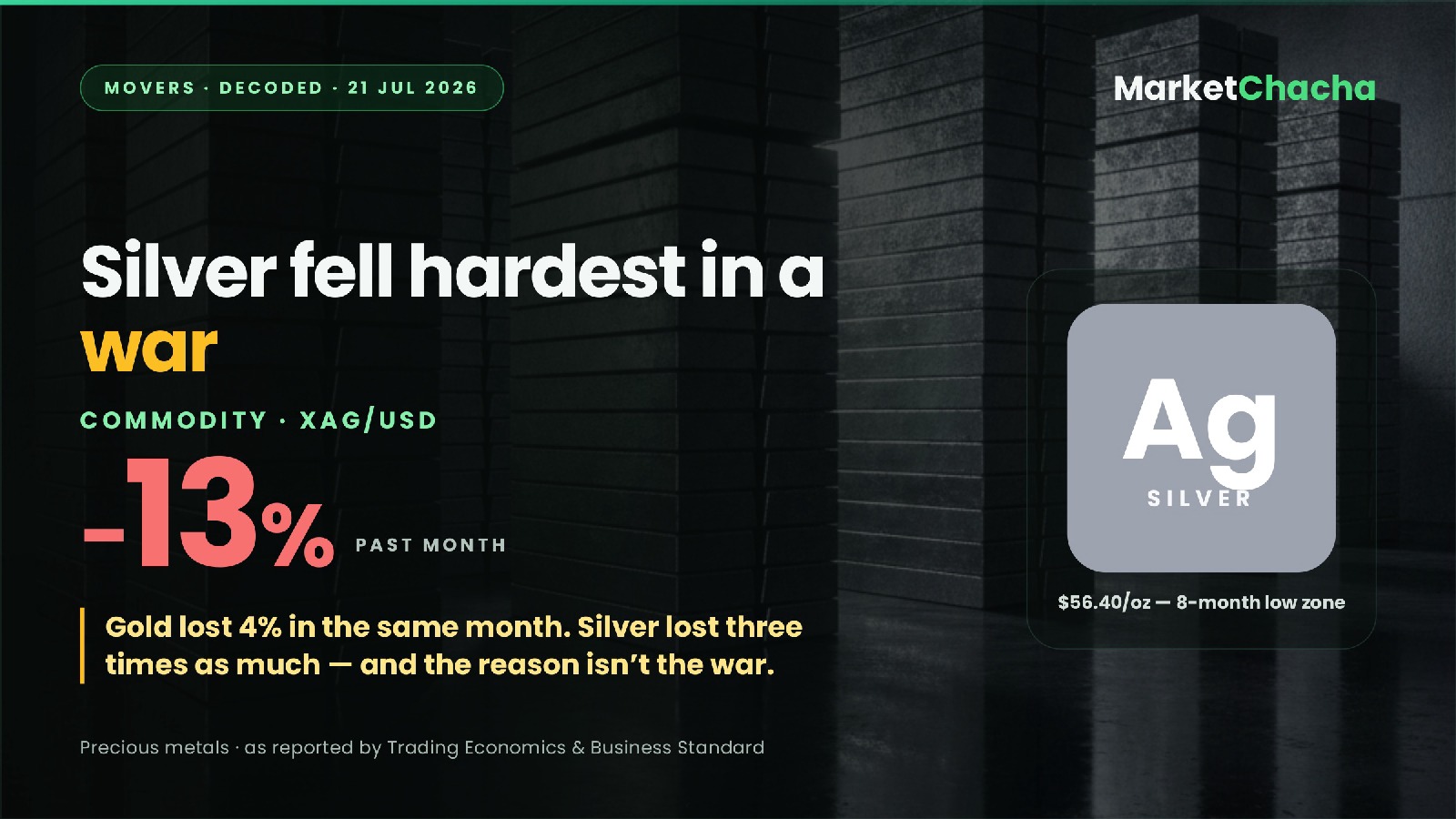
Silver was quoted at $56.40 an ounce on 20 July — up 0.90% on the day, but down 13.29% over the past month, as reported by Trading Economics. On Friday 17 July it traded near $55.50, its lowest level since late November 2025. Gold, over that exact same month, fell just 4.39% to $4,007.72.
Both metals fell during a shooting war. Silver fell three times as hard as gold. That gap is the whole story.
Why it moved
Silver does two jobs at once. Half of it is money — something you buy when you’re scared. The other half is a factory input, used in solar panels, electronics and medical devices. So when the market gets frightened about interest rates rather than war, the money half gets sold and the factory half gets sold again.
That’s what happened here. Brent crude has surged roughly 30% from its July lows as US–Iran strikes choked the Strait of Hormuz. The seven-day average of crude flows through the strait fell to about 5.5 million barrels a day, from around 9.4 million the week before (Bloomberg vessel-tracking data, cited by Business Standard). Costlier oil means stickier inflation. Stickier inflation means the US Federal Reserve hikes instead of cuts — markets now price an 80% chance of a December rate hike, up from 73% a week earlier.
Silver pays you nothing to hold it. When safe cash starts paying more, that becomes a real problem: a two-year US Treasury yielding 4.17% is competing for the same money.
The number that gives it away
If this were panic buying of a safe haven, money would be flooding into silver funds. It’s doing the opposite. Global silver ETF holdings stood at 784.06 million ounces on 15 July, after a year-to-date net outflow of 76 million ounces (−9.04%). Since the Iran war began on 28 February, investors have pulled out 48 million ounces. A war started — and they sold.
Supply isn’t tight either. The one-month LBMA lease rate sits at −0.17%, meaning nobody is scrambling to borrow physical metal. This is a rates-driven selloff, not a shortage.
The slower problem underneath
Solar manufacturers, worn down by silver’s price swings, are pushing to replace silver paste with copper-based alloys in high-efficiency panels. That substitution could shave 2–3% off silver demand this year, though rising AI and data-centre demand may offset part of it. Small today — but this is the kind of thing that compounds quietly for years.
Who this touches in India
- Silver ETF and MCX holders — the drawdown is real. Silver is still up 44.92% year-on-year, but it now sits roughly 54% below its all-time high of $121.64, set in January 2026.
- Solar manufacturers — Waaree, Vikram Solar, Websol and peers buy silver paste by the tonne. Cheaper silver is a direct input-cost win.
- Jewellers — Kalyan, Senco and Titan get cheaper metal, but a falling price also makes shoppers wait for an even lower one.
- Everyone else — India’s rates are set by the RBI, not the Fed. But a hawkish Fed keeps the dollar firm and the rupee soft (it opened at 96.43 on Tuesday), which quietly raises the cost of every barrel and every imported component.
What would flip it
A credible US–Iran ceasefire. Oil falls, the inflation scare fades, the December hike gets priced out, and the pressure on silver lifts almost overnight. Mirae Asset Sharekhan’s commodities desk reads silver as technically oversold, with support near $54 and resistance at $58–$60 — a narrow band, so it won’t take much to move either way.
As of 11:40 AM IST, 21 July 2026. Prices as reported by the sources cited. Sources: Trading Economics, Business Standard. For discussion and education only — not investment advice. Verify before acting.
This article is for educational and informational purposes only. It is not financial advice, investment recommendation, or a solicitation to buy or sell securities. Investing involves significant risks. I am not a SEBI-registered investment advisor. Readers should consult their own financial advisor and conduct their own research before making any investment decisions.
Comments
Join the conversation
Sign in to join the conversation.
Follow replies, add your view, and take part in the discussion.
Sign in to commentLoading comments...