

Why is Chime (CHYM) up ~10% today? It just bought the bank behind its own accounts
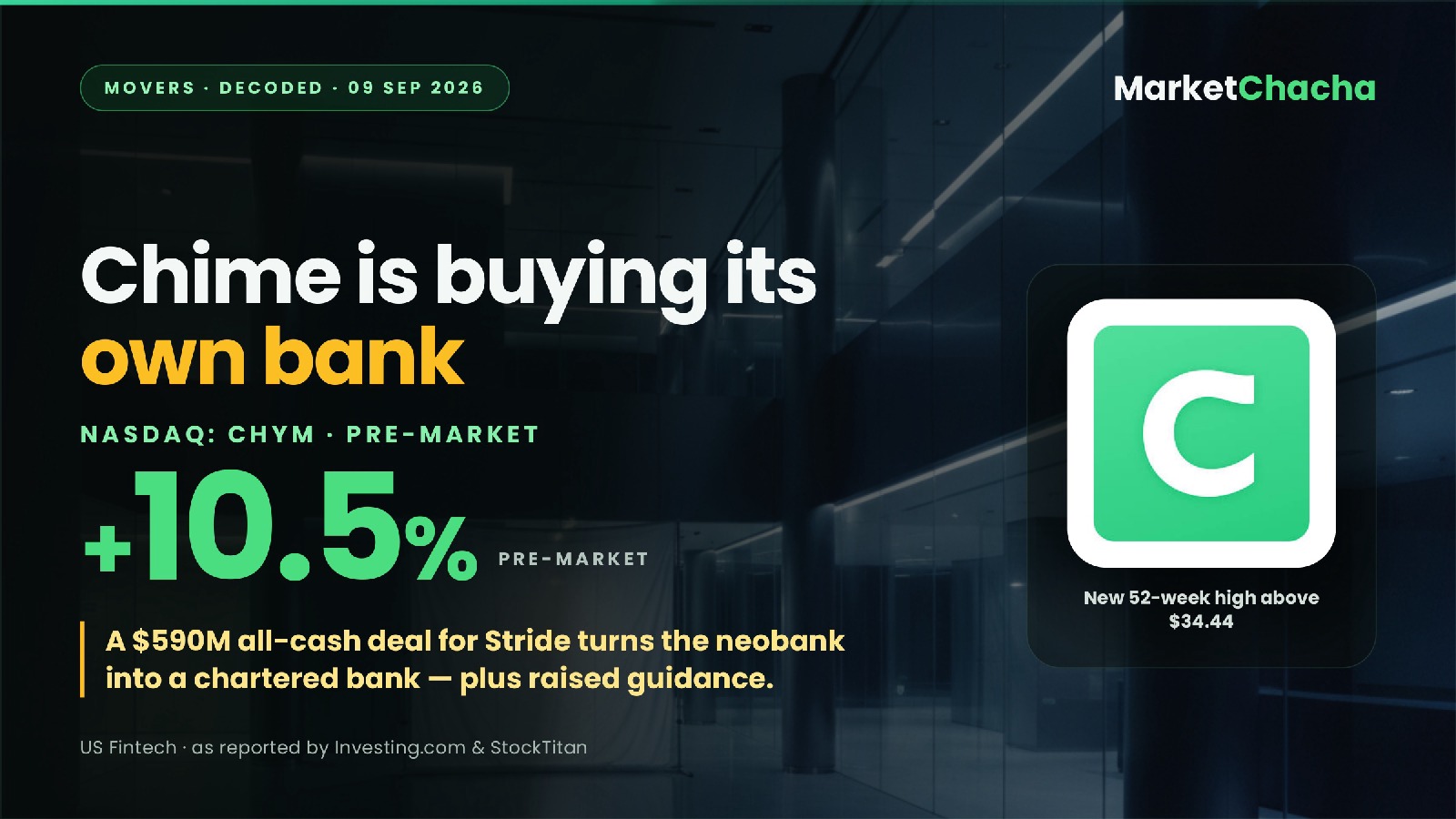
Chime, the app millions of Americans use as their everyday bank account, just announced it's buying the actual bank sitting behind those accounts. The stock jumped about 10.5% in pre-market trading, pushing past its old 52-week high of $34.44, after the company said late on September 8 it will acquire Stride Bank for $590 million in cash, as reported by Investing.com and StockTitan. On a day when the S&P 500 was flat and the Dow had just dropped over 1% on oil and Middle East worries, this was a pure company-story move.
What happened
Here's the setup most people don't realise. Chime isn't a bank. It never has been. It's a technology company, and when you deposit money into "Chime", that money actually sits at a real, chartered partner bank. For over seven years that partner has been Stride Bank, a 112-year-old national bank founded in 1913 in Enid, Oklahoma. Chime paid Stride fees for the privilege of using its banking license.
Now Chime is buying Stride outright for $590 million in cash — roughly 1.5x Stride's tangible book value — and folding it in as a wholly owned subsidiary called Chime Bank, N.A. In plain terms: the tenant is buying the building it was renting.
Why it moved
Two things fired at once, and it's worth keeping them separate.
First, the strategy shift. Owning the bank means Chime stops paying sponsor-bank fees to a third party, gets a lower cost of funds, and can build lending products faster without a middleman. Chime says the deal will be immediately accretive to earnings per share once it closes and should deliver more than $100 million in net synergies. It's also a faster route to a full bank than applying for a brand-new charter from scratch, which can take years.
Second — and this is what really lit the fuse — Chime raised its guidance the same day. It now expects Q3 revenue of $705 million (up ~30% year-on-year) and full-year 2026 revenue of $2.76–$2.77 billion, up roughly 26–27%, with adjusted EBITDA of $481–$489 million. A strategic story is nice; a strategic story with numbers attached is what moves a stock 10%.
The analyst reaction piled on: Morgan Stanley lifted its target to $40 (Overweight), Loop Capital started coverage at Buy with a Street-high $45, and even cautious UBS nudged its target to $31 while staying Neutral.
The business
Chime makes money mostly from interchange — the small fee merchants pay every time one of its 10 million-plus active members swipes a Chime debit or credit card — plus a growing lending arm (its MyPay advances and instant loans). It deliberately avoids overdraft and monthly fees, which is how it won over younger and lower-income customers the big banks often ignore. The model is "payments-led and asset-light", and management says that won't change — Chime plans to keep total assets under $10 billion so it stays out of the heaviest tier of bank regulation.
Is it expensive?
Chime is not a profit-and-earnings story yet, so a normal P/E doesn't exist — in its last full year (FY2025) it posted revenue of about $2.2 billion and a net loss of roughly $1.0 billion (EPS around −$4.27), weighed down heavily by post-IPO stock-based comp. So investors value it on sales, not profit. At a market cap near $12.8 billion, it trades at roughly 5–6x trailing revenue (closer to ~4.6x on this year's guided sales) — a growth-stock multiple that only makes sense if that ~27% revenue growth keeps up.
For comparison, the obvious listed peer SoFi is nearly twice the size at around $23 billion market cap, is already GAAP-profitable, and runs a much broader product shelf (loans, investing, credit cards). So Chime is the smaller, faster-growing, not-yet-profitable name against SoFi's larger, profitable one — you're paying up for the growth and the just-announced path to better economics, not for earnings today.
Who it touches
- The Bancorp Bank — Chime's other sponsor bank. As Chime consolidates its banking onto its own charter, third-party sponsor banks lose a large fintech client; it's a reminder that the "banking-as-a-service" middleman model can get bought out from under you.
- SoFi and other neobanks — this raises the bar. Owning a charter is now the aspiration, and rivals will be asked why they don't.
- Traditional banks — a fee-free challenger with 10M+ members and its own charter is a more direct competitor for primary checking accounts.
The one real risk
The deal isn't done. It needs sign-off from the Office of the Comptroller of the Currency and the Federal Reserve, and it's only expected to close in the first half of 2027. Becoming a bank holding company also means heavier, ongoing regulatory scrutiny. If approval drags or comes with conditions, the "$100 million synergy" math and the day-one EPS boost both slip — and a stock priced for growth doesn't forgive delays cheaply.
As of pre-market, 09 Sep 2026 (ET). Sources: Investing.com, StockTitan, Chime (Business Wire). For discussion and education only — not investment advice. Verify before acting.
This article is for educational and informational purposes only. It is not financial advice, investment recommendation, or a solicitation to buy or sell securities. Investing involves significant risks. I am not a SEBI-registered investment advisor. Readers should consult their own financial advisor and conduct their own research before making any investment decisions.
Comments
Join the conversation
Sign in to join the conversation.
Follow replies, add your view, and take part in the discussion.
Sign in to commentLoading comments...