

Vedanta: what their latest filing actually means
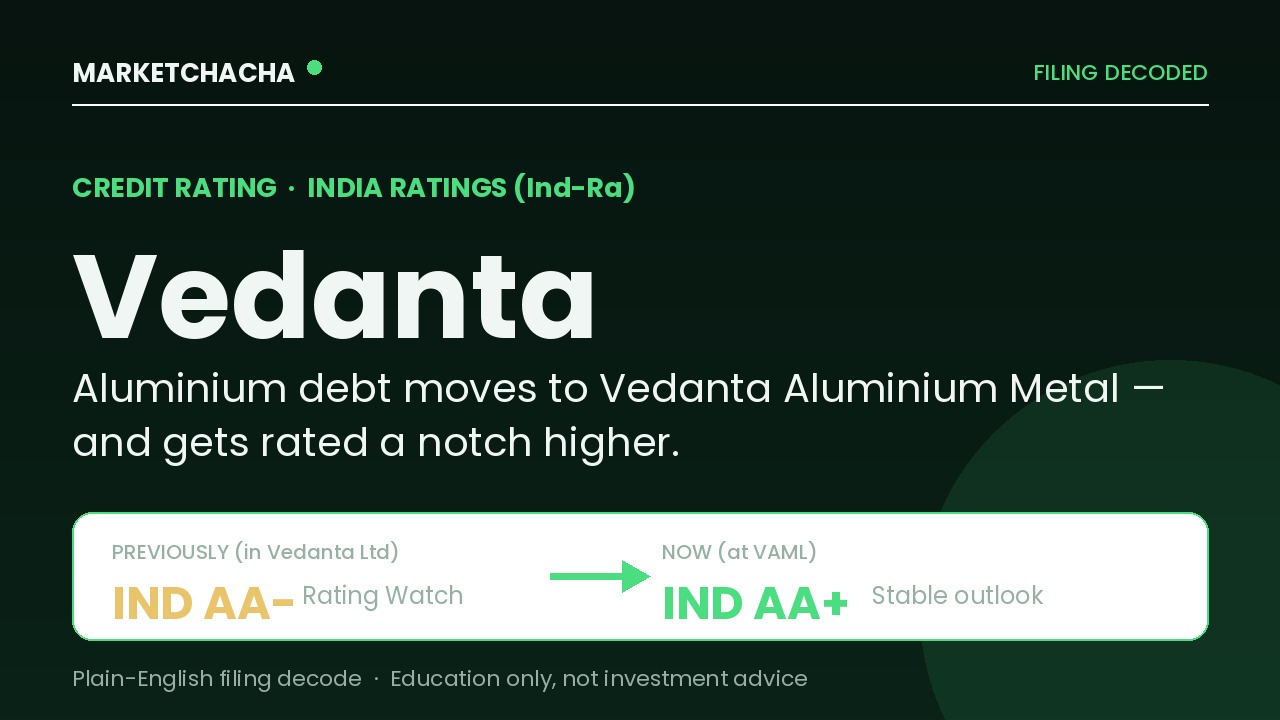
Vedanta Ltd filed a credit-rating intimation with the exchanges: rating agency India Ratings & Research (Ind-Ra), in a release dated 13 August 2026, has withdrawn the ratings on a set of Vedanta's non-convertible debentures (NCDs) — because that debt has been moved to Vedanta Aluminium Metal Ltd (VAML) under the group's demerger, where it now carries a higher IND AA+/Stable rating.
What was announced
As part of the Vedanta group demerger, certain NCDs (bonds) that used to sit on Vedanta Ltd's books were transferred to Vedanta Aluminium Metal Ltd, the newly separate aluminium company. Because those instruments are no longer Vedanta Ltd's liability, Ind-Ra has removed (withdrawn) their rating from the Vedanta Ltd portfolio.
- Where the debt sat before: in the Vedanta Ltd portfolio, rated IND AA- and on "Rating Watch with Developing Implications."
- Where it sits now: in Vedanta Aluminium Metal Ltd, rated IND AA+/Stable.
- The Vedanta Ltd action: the rating on those specific NCDs is simply withdrawn from Vedanta Ltd, since the debt has left its balance sheet.
So the same bonds effectively moved up from AA- (on watch) to AA+ (stable) once they landed at the aluminium company — while for Vedanta Ltd itself, this is a clean-up: that liability is gone from its ledger.
What a credit-rating filing actually means
A credit rating is a rating agency's opinion of how likely a borrower is to repay its debt on time. It runs on a scale, from safest to riskiest: AAA → AA → A → BBB (all "investment grade"), then BB and below ("speculative" / high-yield), down to D (default). Within a band, a + or - fine-tunes it, so the ladder near the top reads AAA, AA+, AA, AA-, A+ and so on.
- AA+ vs AA-: both are strong investment grade, but AA+ is three notches higher than AA- — a meaningfully safer rung, one step below the top AAA.
- "Rating Watch with Developing Implications": the agency has flagged that a specific event (here, the demerger) could push the rating up or down, and it is waiting to see how it settles. It is a "watch this space" tag, not a verdict.
- "Withdrawn": the agency stops rating that instrument — often for a neutral reason like the debt being repaid, restructured, or (as here) transferred to another entity. Withdrawal by itself is not a downgrade.
- Ratings attach to instruments, not just companies: that is why a single NCD series can be rated, moved, and re-rated as it changes hands within a group.
Why it matters
Ratings are not cosmetic — they set the price of money. A higher rating (AA+) generally means a company can borrow at a lower interest rate and refinance more easily, because lenders see less risk. It also widens the buyer pool: many mutual funds, insurers and pension funds have rules that only let them hold bonds above a minimum rating.
For the demerged group, the logic is tidy: the aluminium-related debt now sits with the aluminium company (VAML) that owns the underlying plants and cash flows, and it is rated on that business's own strength. For Vedanta Ltd, removing this slice of debt from its books is part of the balance-sheet clean-up the demerger was meant to achieve. None of this is a signal about the share price — it is about how the group's borrowings are organised and priced after the split.
Is it expensive?
Vedanta Ltd trades around ₹271 a share for a market cap of roughly ₹1.08 lakh crore, on a trailing P/E of about 7–10× (sources vary, because post-demerger earnings are still being cleanly separated). That is a low multiple — but low P/Es are normal for cyclical, debt-heavy metals companies, and a chunk of Vedanta's optically low ratio also reflects the demerger, which stripped value out into four separately listed companies.
For context, diversified-metals peer Hindalco Industries trades on a P/E of roughly 14.5× with a market cap near ₹2.38 lakh crore and price-to-book around 1.7×. Vedanta looks cheaper on the headline number, but that "cheapness" carries a well-known discount for high leverage, a holding-company structure and the moving parts of the demerger — so it is not automatically better value. Honest reading: optically cheap, for reasons — not a buy or sell call.
The business
After the demerger (effective 1 May 2026, with four new companies listed on 15 June 2026), the group was split into five separately listed entities. Vedanta Ltd is now the residual company built around zinc (via its majority stake in Hindustan Zinc) and critical minerals. The aluminium (Vedanta Aluminium Metal), oil & gas, power and iron & steel businesses are now their own listed companies. That is the key context for today's filing: it concerns aluminium debt that has left Vedanta Ltd and moved to the standalone aluminium company — so it affects how the group's borrowings are arranged, not the day-to-day operations of Vedanta Ltd's own zinc business.
Beginner takeaway
A rating being "withdrawn" from Vedanta Ltd sounds alarming, but here it is routine demerger housekeeping — the debt moved to the aluminium company, where it is actually rated higher (AA+/Stable). The useful lesson is that credit ratings sit on specific bonds and follow those bonds around, and a higher rating quietly lowers a company's cost of borrowing.
FAQ
Does "ratings withdrawn" mean Vedanta is in financial trouble? No. In this case the rating was removed because the debt was transferred to another group company in the demerger, not because of any repayment problem. The same bonds are now rated AA+/Stable at Vedanta Aluminium Metal.
Is AA+ a good rating? Yes — it is high investment grade, just one notch below the top AAA, and three notches above the AA- these bonds previously carried in the Vedanta Ltd portfolio.
What is an NCD? A Non-Convertible Debenture is a bond a company issues to raise money; it pays fixed interest and stays as debt — unlike a convertible, it does not turn into shares. Its rating tells lenders how safe that specific loan is.
Why does one rating agency rate the same debt differently for two companies? Because the rating reflects the strength of whichever company is on the hook. Sitting inside the standalone aluminium business (with its own assets and cash flows), the debt is judged safer than it was as one line item on the pre-demerger Vedanta Ltd.
As of 14 August 2026. Filing dated 13 August 2026. Source: official BSE filing — read it directly here (the underlying rating rationale is published by India Ratings). We summarise filings for education and may make errors, so always verify against the official document. Educational content only — not investment advice, not a buy/sell recommendation.
This article is for educational and informational purposes only. It is not financial advice, investment recommendation, or a solicitation to buy or sell securities. Investing involves significant risks. I am not a SEBI-registered investment advisor. Readers should consult their own financial advisor and conduct their own research before making any investment decisions.
Comments
Join the conversation
Sign in to join the conversation.
Follow replies, add your view, and take part in the discussion.
Sign in to commentLoading comments...