

Why did GameStop (GME) drop ~12% today? Its $1.4B debt-for-stock swap, decoded
What happened
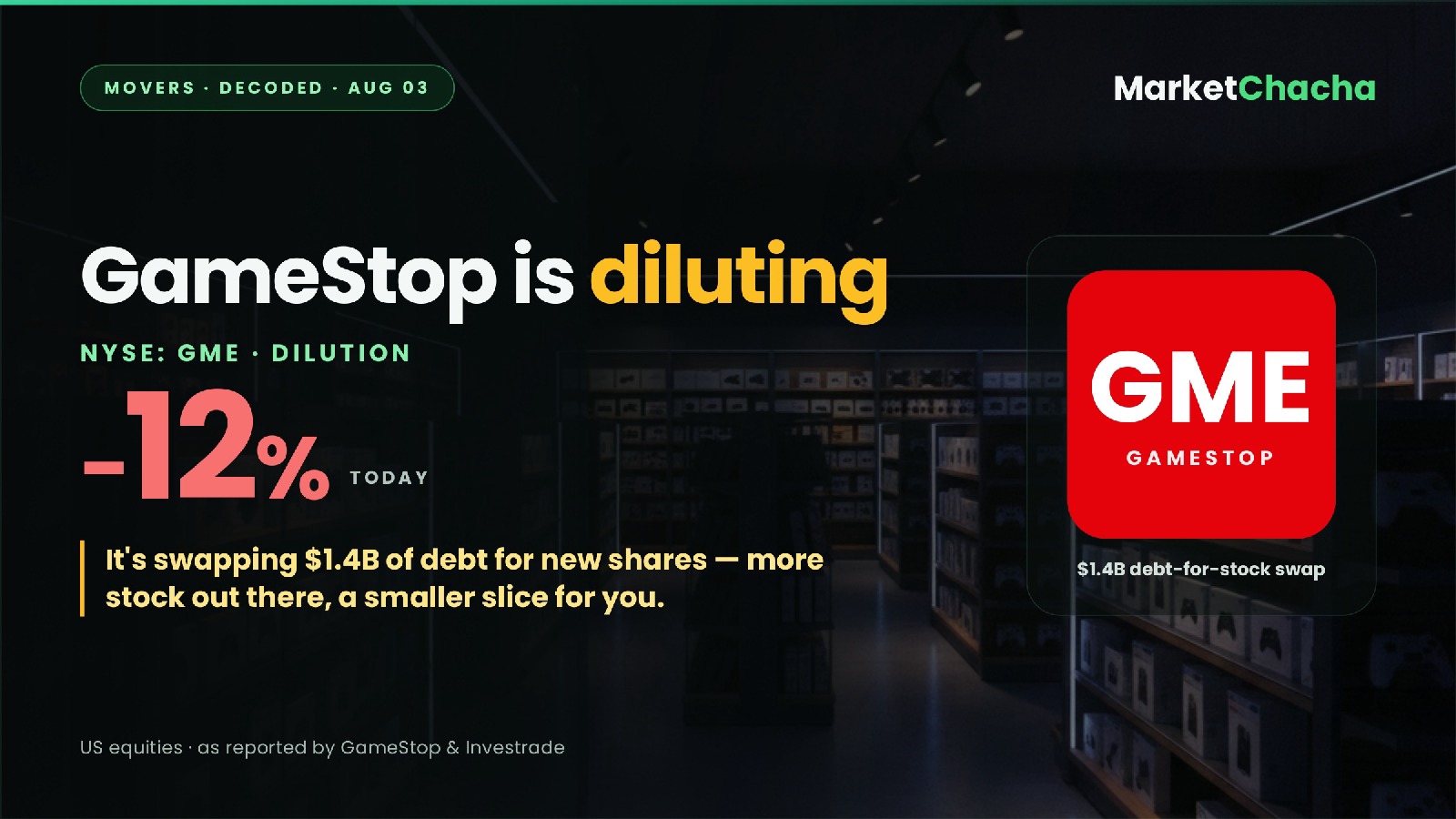
GameStop (NYSE: GME) fell about 12% on Monday after the company said it will privately swap roughly $1.4 billion of its convertible bonds for new shares of stock. Specifically, it's exchanging about $400 million of its 0.00% notes due 2030 and $1.0 billion of its 0.00% notes due 2032 for Class A common stock. GameStop gets no cash from this — it's simply handing bondholders equity instead of money.
Why it moved — dilution, in plain English
Here's the mechanism. Those bonds were convertible — a loan that can turn into shares. By exchanging them now, GameStop wipes about $1.4 billion of debt off its balance sheet, but it does that by printing new shares. More shares means each existing share owns a slightly smaller slice of the same company. That's dilution, and it's why the stock dropped even though cutting debt sounds like good news.
Two details made holders grumpier. First, these were 0.00% coupon notes — GameStop was paying no interest on them, so swapping them for stock saves it nothing in cash. Second, GameStop is sitting on roughly $6.3 billion of cash; it could have simply paid the bonds off instead of issuing shares. Choosing dilution when you have the cash to avoid it is what stung. There's a sting in the tail, too: the number of new shares is set by GameStop's average price over the 35 trading days starting today (with a floor). The lower the stock trades in that window, the more shares get issued — a feedback loop that can weigh on the price into the ~Sep 23 close.
Is it expensive?
Normal valuation tools barely work here. GameStop's market cap is about $9.8 billion, but most of its actual profit is interest earned on its cash pile, not money made selling games — so its P/E (well over 100x on paper) doesn't mean what it usually does. A cleaner way to look at it: back out the ~$6.3bn cash and 4,710 bitcoin (about $0.4bn) and investors are paying roughly $3 billion on top of the balance sheet for a shrinking retailer plus a bitcoin-treasury bet plus its famous retail following.
The closest listed comparison isn't another game shop — it's Strategy (MSTR), the software-firm-turned-bitcoin-holder that also trades on its balance sheet rather than its business. Both are valued for what they own and what they might do, not for boring store or software earnings.
The business
GameStop is still a bricks-and-mortar chain selling video games, consoles, accessories and collectibles — a business in slow decline as gaming goes digital. Under chairman Ryan Cohen it has morphed into a cash-rich holding company that raised billions selling stock in the meme era and now parks money in Treasuries and bitcoin. So today's move is about the balance sheet and share count, not about how many games it sold last quarter.
Who it touches
- Existing GME shareholders: a cleaner, near debt-free balance sheet — paid for with dilution today.
- The bondholders: they swap paper that only paid off if the stock rose into equity they can sell now.
- Other retail-army and bitcoin-treasury names (AMC, and MSTR-style holders): a live reminder that these companies can and do issue stock, and that dilution is the price of their fortress balance sheets.
What to watch
The one thing that flips the read: how many shares actually get printed. That's decided by the 35-day average price and the floor, and it closes around Sep 23. If the stock holds up, fewer shares; if it slides, more. Also watch whether GameStop keeps choosing dilution over its cash for future moves — that tells you how it really thinks about your ownership.
As of ~12:45 pm ET, Aug 3, 2026. Sources: GameStop, Seeking Alpha, Investrade/Hammerstone, stockanalysis.com. For discussion and education only — not investment advice. Verify before acting.
This article is for educational and informational purposes only. It is not financial advice, investment recommendation, or a solicitation to buy or sell securities. Investing involves significant risks. I am not a SEBI-registered investment advisor. Readers should consult their own financial advisor and conduct their own research before making any investment decisions.
Comments
Join the conversation
Sign in to join the conversation.
Follow replies, add your view, and take part in the discussion.
Sign in to commentLoading comments...