

Why is PG&E down ~19% today? California just deleted its wildfire liability shield
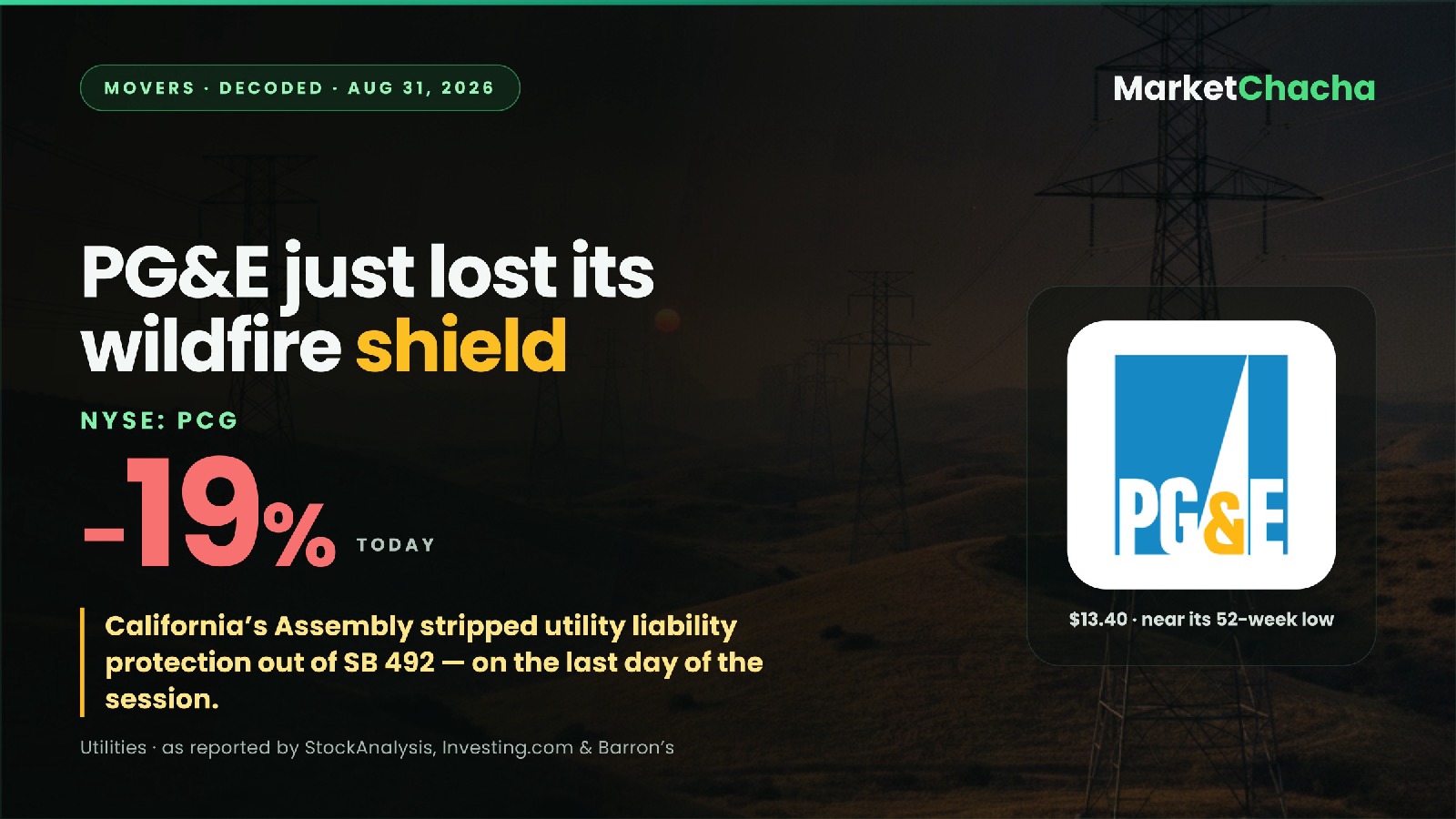
PG&E (NYSE: PCG) is down about 19% to $13.40, sitting on a 52-week low of $13.09, as reported by StockAnalysis. Edison International is worse: −22.9% to $54.13. Sempra, the third California utility, is off just 3.8%. That spread tells you the story better than the headline does.
What happened
Today is the last day of California's legislative session. Governor Newsom had pushed a wildfire package that would have capped what utilities pay when their equipment starts a fire. Over the weekend the State Assembly amended SB 492 and took the protective parts out. Per TradingPedia, the bill that emerged has no $6bn per-event liability cap, no ban on insurer subrogation, no mechanism to refill the state's $21bn Wildfire Fund once it's drained, and it does not repeal the fund's 2028 sunset.
Why it moved — the mechanism
Here's the jargon that matters. Subrogation is when your home insurer pays your fire claim, then turns around and sues whoever caused the fire to get its money back. In California, if a utility's power line sparks a blaze, the utility is on the hook for the damage even if it did nothing negligent — a doctrine called inverse condemnation. So insurers sue the utility. Newsom's proposal would have shut that door. The Assembly left it open.
The $21bn Wildfire Fund was supposed to be the buffer. It may not be big enough. State documents reported by the LA Times show the Eaton Fire's insured property losses alone could reach $15.2bn — about 72% of the whole fund from one fire — with a UCLA study putting total losses at $24bn to $45bn. A fund with no refill mechanism and a 2028 expiry, facing claims that size, is not much of a shield.
The analysts moved fast. BMO cut PG&E to Market Perform from Outperform and dropped its target to $21 from $28, now modelling uncapped wildfire liability past 2030 and lifting its estimated hit from $6 to $10 per share. Wells Fargo went to Equal Weight from Overweight; Mizuho cut PG&E, Edison and Sempra.
The business
PG&E Corporation is a holding company with essentially one asset: Pacific Gas and Electric Company, a regulated utility delivering electricity and natural gas across northern and central California. Two revenue lines, one state, one regulator. There is no overseas arm, no unregulated trading desk, nothing to offset a bad California outcome. That's exactly why it fell 19% and Sempra — which also runs businesses in Texas and Mexico — fell 3.8%.
Is it expensive?
PG&E now trades at a P/E of 9.6 (forward 7.9) on a $29.5bn market cap. Edison International is at 5.6x trailing on $20.8bn. Sempra is at 24.4x. Regulated utilities normally earn high-teens multiples precisely because their earnings are boring and predictable. Single-digit P/Es on two of them isn't the market calling them cheap — it's the market saying it doesn't believe the "E". PG&E filed for Chapter 11 in 2019 over wildfire claims and only exited in July 2020, so the tail risk here isn't theoretical.
Who it touches
- Edison International — the most exposed, because Southern California Edison faces direct Eaton Fire liability. Hence the bigger drop.
- Sempra — hit, but cushioned by its non-California earnings.
- California home insurers — the winners today. Keeping subrogation means they can still recover from utilities instead of eating the losses.
- Utility bondholders and ratepayers — higher perceived liability means a higher cost of capital, which eventually shows up in rate filings.
What to watch
The one thing that flips this: the session isn't technically over. If a floor amendment restores the liability cap or the fund backstop before the gavel drops tonight, today's move reverses fast. If it closes as amended, the next question is whether Sacramento comes back to it in January — and whether the 2028 sunset becomes the new deadline everyone trades around.
As of 11:45 am ET, 31 Aug 2026. Sources: StockAnalysis (PCG), TradingPedia, Investing.com, Benzinga, California SB 492 (official bill text). For discussion and education only — not investment advice. Verify before acting.
This article is for educational and informational purposes only. It is not financial advice, investment recommendation, or a solicitation to buy or sell securities. Investing involves significant risks. I am not a SEBI-registered investment advisor. Readers should consult their own financial advisor and conduct their own research before making any investment decisions.
Comments
Join the conversation
Sign in to join the conversation.
Follow replies, add your view, and take part in the discussion.
Sign in to commentLoading comments...