

Why Optics Stocks Are Rising in the AI Era
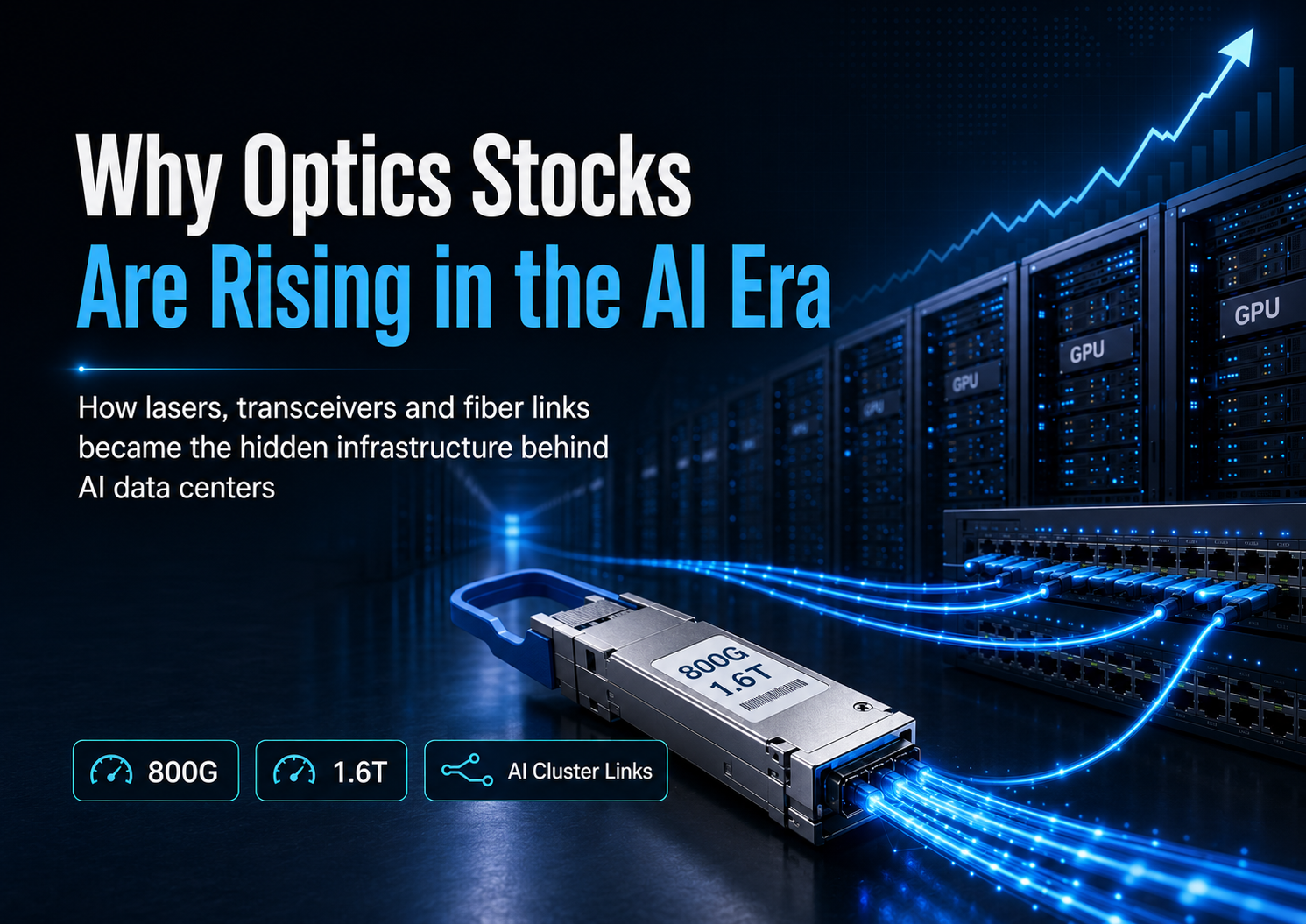
How lasers, transceivers and fiber links became the hidden infrastructure behind AI data centers
Everyone knows the AI trade started with chips.
Nvidia became the face of the boom. GPUs became the new oil. Hyperscalers started spending hundreds of billions on data centers. But as AI clusters became bigger, investors began noticing something important:
AI does not only need faster chips. It needs faster connections between chips.
That is why optics stocks have suddenly become exciting.
Companies involved in optical transceivers, lasers, fiber cables, photonics, and high-speed networking are benefiting because modern AI data centers are not just buildings full of servers. They are giant interconnected machines where thousands, and eventually hundreds of thousands, of GPUs must communicate with each other at extremely high speed.
The hidden hero behind that communication is light.
The simple idea: AI needs data to move at light speed
A normal data center moves information between servers, storage systems, and users. But an AI data center is different.
When a large AI model is trained, the work is split across many GPUs. One GPU handles one part of the calculation, another GPU handles another part, and all of them must constantly exchange information.
Think of it like a classroom of 10,000 students solving one giant math problem together. If they cannot talk to each other quickly, the whole classroom slows down.
That is exactly what happens inside an AI cluster.
A GPU may be powerful, but if data cannot move quickly between GPUs, racks, switches, and buildings, expensive AI hardware sits underused. In AI infrastructure, networking is not a side feature. It becomes part of the performance engine.
This is where optics comes in.
What are optics in a data center?
In simple terms, optics means using light to move data.
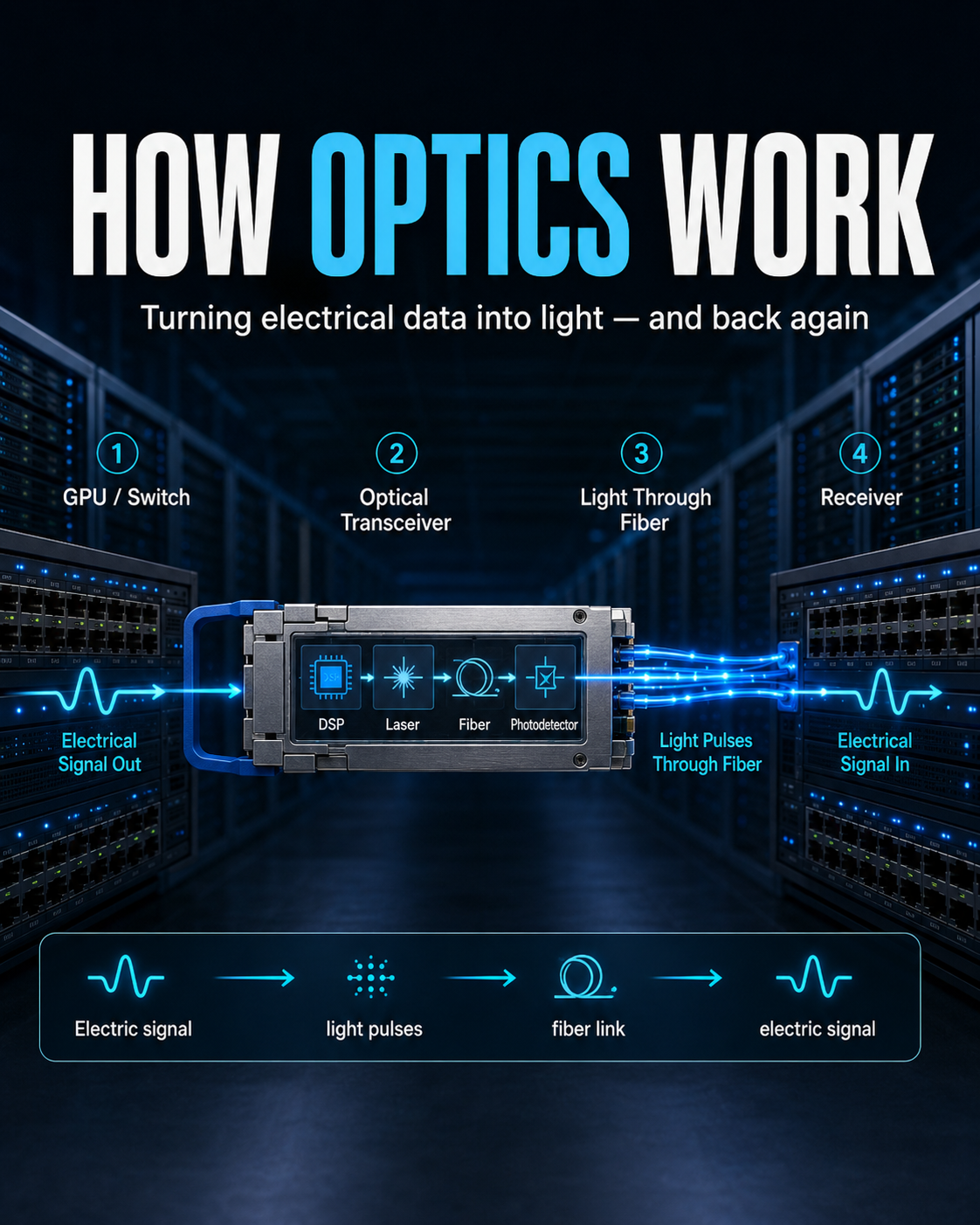
Inside a data center, data often begins as an electrical signal. But electrical signals over copper cables face limits, especially when bandwidth increases and distance gets longer. Optical systems convert that electrical data into light pulses, send those pulses through fiber, and then convert them back into electrical signals at the other end.
A simplified flow looks like this:
GPU or switch → electrical signal → optical transceiver → light through fiber → receiver → electrical signal again
The small but important device doing this conversion is called an optical transceiver.
It usually sits inside a switch or server port. One side connects to electronic hardware. The other side connects to fiber-optic cable. Inside the transceiver are components such as lasers, modulators, photodetectors, digital signal processors, and optical engines.
To a beginner, it may look like a small metal plug.
To an AI data center, it is a traffic controller for light-speed data.
Why copper is not enough anymore
Copper cables are still useful, especially for short distances. But AI clusters are pushing bandwidth requirements so high that copper becomes less attractive over distance.
Optical fiber offers three big advantages:
First, it can carry very high bandwidth.
Second, it can move data over longer distances with lower signal loss.
Third, it can be more power-efficient when connecting racks, rows, rooms, or even multiple data centers.
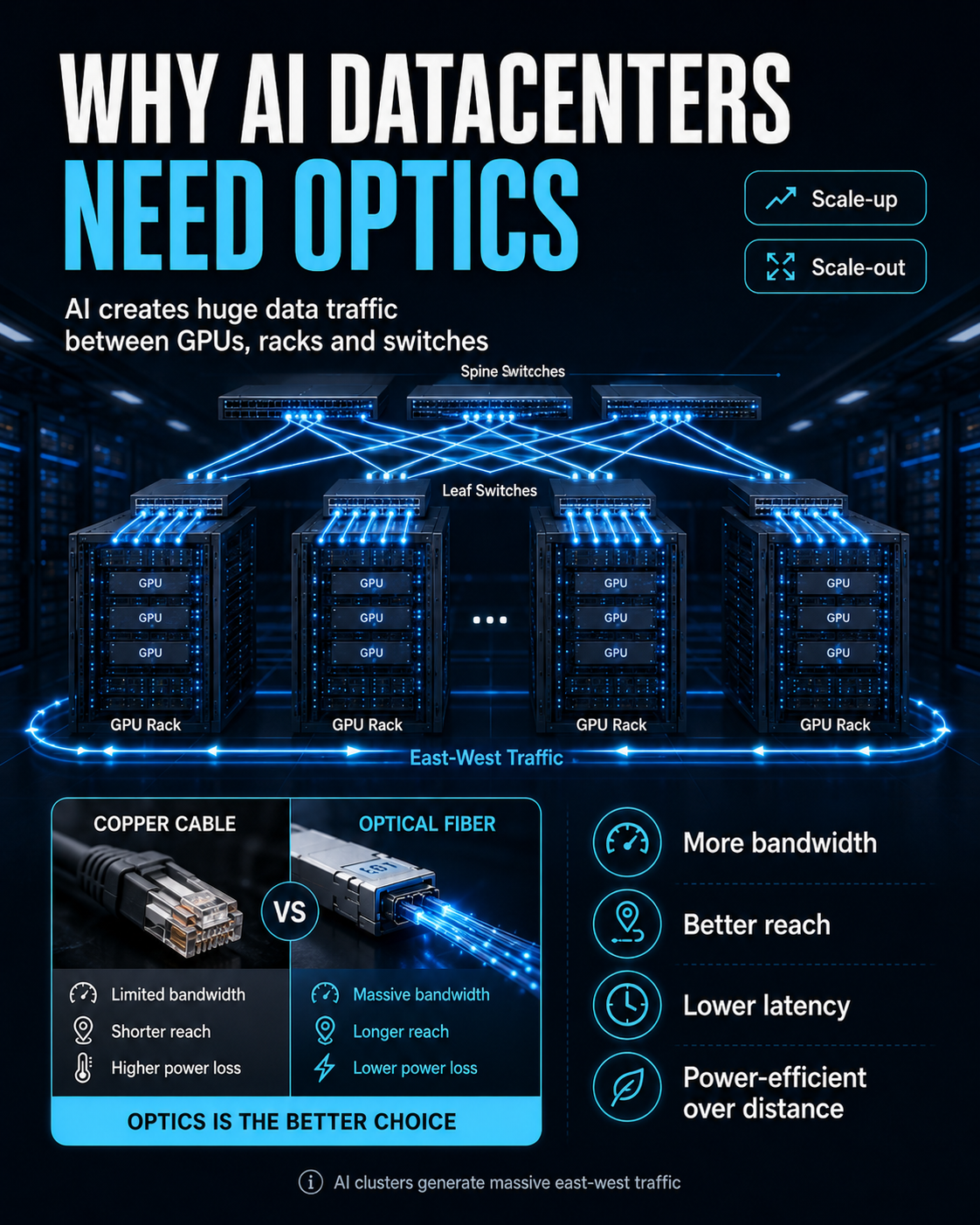
This matters because modern AI systems create massive east-west traffic.
North-south traffic means data moving from users to a data center and back. East-west traffic means data moving inside the data center — between GPUs, servers, racks, and switches.
AI training creates a huge amount of east-west traffic because GPUs need to constantly exchange model parameters and intermediate results. More GPUs usually means more communication. More communication means more optical links.
That is the basic reason optics has become an AI infrastructure story.
The AI cluster example
Imagine a company wants to train a large AI model.
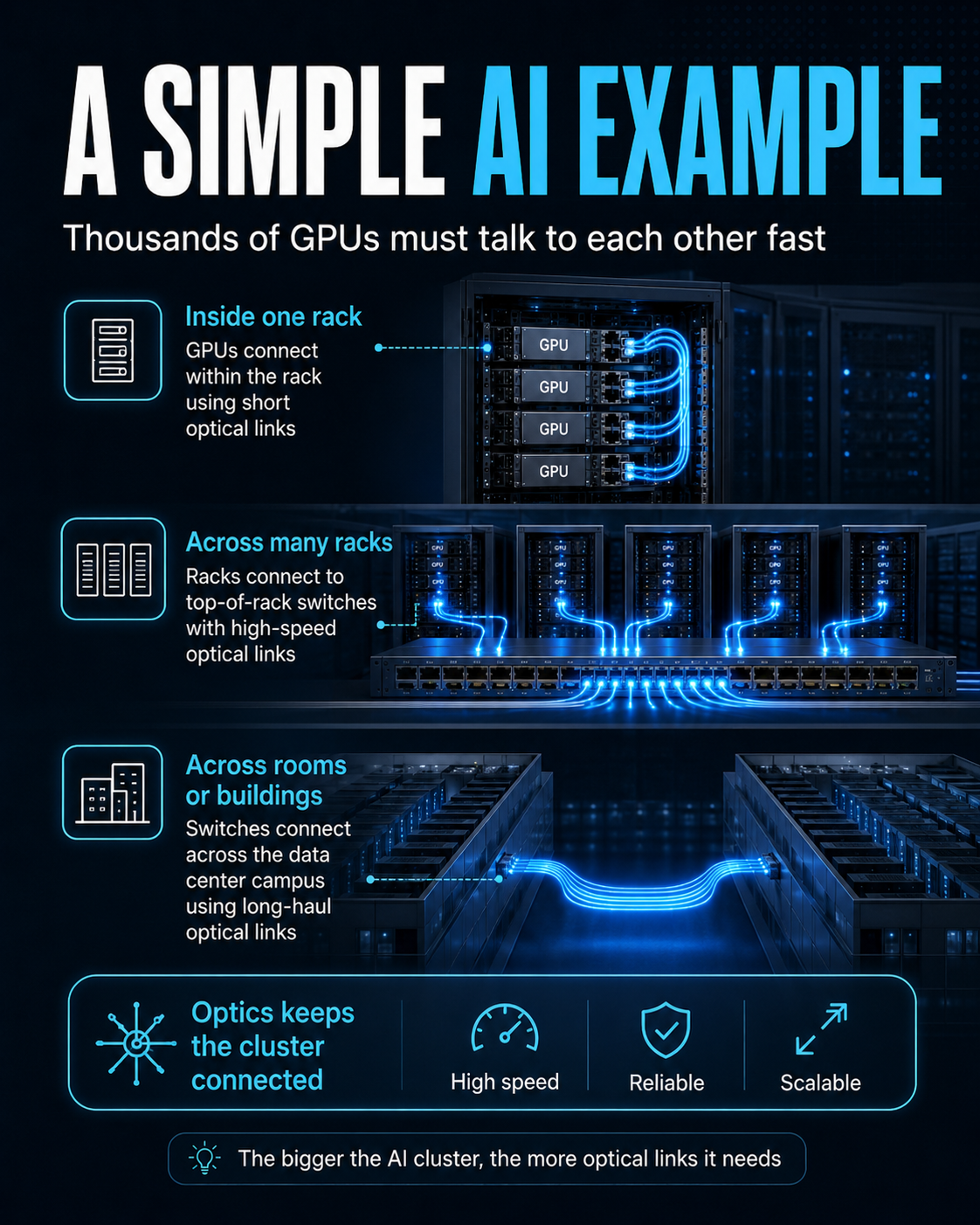
It starts with one rack of GPUs. Inside that rack, GPUs need to talk to each other. Then the company adds more racks. Now each rack needs to connect to top-of-rack switches. Then the company adds rows of racks. Now those switches connect to spine switches. Then the company spreads workloads across multiple rooms or buildings. Now it needs data center interconnects.
At each stage, the networking problem grows.
More GPUs create more data movement.
More racks create more switching demand.
More distance creates more need for fiber.
More speed creates more demand for advanced optical transceivers.
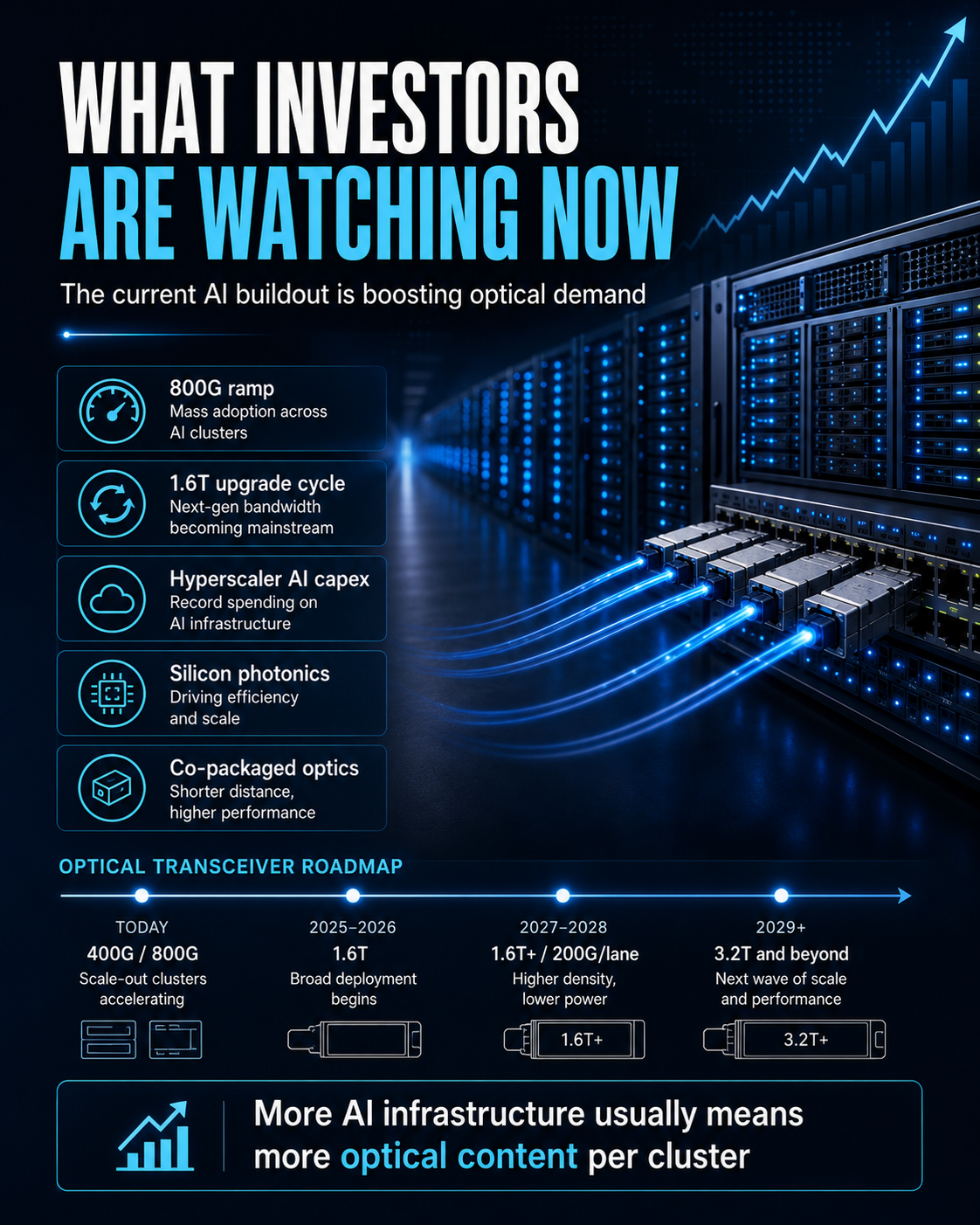
That is why investors are watching terms like 400G, 800G, 1.6T, silicon photonics, and co-packaged optics.
These are not just technical buzzwords. They are the roadmap of how AI data centers scale.
What do 400G, 800G and 1.6T mean?
These numbers refer to data transmission speed.
400G means 400 gigabits per second.
800G means 800 gigabits per second.
1.6T means 1.6 terabits per second.
The bigger the AI cluster, the more bandwidth it needs. Many AI data centers are moving from 400G to 800G, and the market is already preparing for 1.6T and beyond.
This is important because every upgrade cycle can create demand for new optical modules, better lasers, better fiber management, more advanced switches, and higher-density connectivity.
A simple investor way to think about it:
AI chips create compute demand.
Compute demand creates networking demand.
Networking demand creates optical demand.
Why optics stocks are rising
Optics stocks are rising because investors are realizing that AI infrastructure has more winners than just GPU companies.
The first AI trade was about compute.
The second AI trade is about power, cooling, memory, networking, and connectivity.
Optics sits directly inside the connectivity bucket.
When hyperscalers build bigger AI clusters, they need more optical transceivers, lasers, fiber cables, optical engines, and networking equipment. That demand can benefit companies across the value chain.
The market is especially interested in companies exposed to:
800G transceiver ramp
Many AI clusters are moving toward 800G connectivity for higher bandwidth.
1.6T upgrade cycle
Next-generation AI networks are preparing for 1.6T modules as bandwidth requirements rise.
Silicon photonics
This uses semiconductor-style manufacturing techniques to integrate optical functions more efficiently.
Co-packaged optics
This brings optical connectivity closer to switching chips, potentially reducing power and improving performance as bandwidth scales.
Data center interconnect
As AI training spreads across multiple buildings or regions, optical networking becomes even more important.
The optics value chain: who benefits?
The optics opportunity is not one single company. It is a chain.
Different companies participate in different parts of the system.
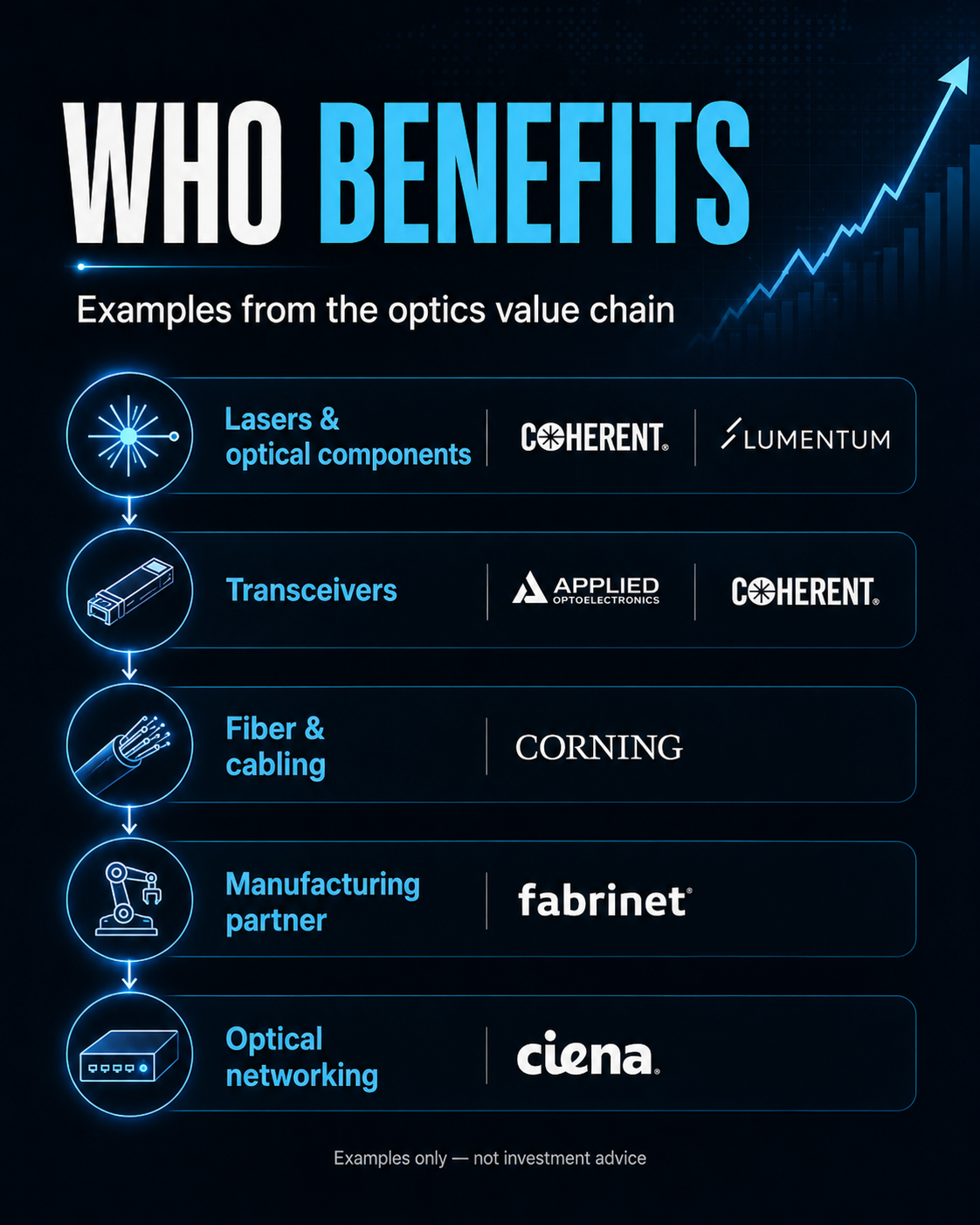
1. Lasers and optical components
Lasers are essential because optical data transmission depends on controlled light signals. Companies that make lasers, photonic components, and optical engines can benefit as speed and complexity increase.
Examples: Coherent, Lumentum
These companies are important because AI data centers need reliable, high-speed, power-efficient optical components at scale.
2. Optical transceivers
Transceivers are the modules that convert electrical signals into optical signals and back again. They are one of the most direct ways to play AI data-center optics.
Examples: Applied Optoelectronics, Coherent, Lumentum
As data centers upgrade from 400G to 800G and 1.6T, transceiver suppliers can see strong demand if they win hyperscaler orders and execute manufacturing well.
3. Fiber and cabling
Fiber is the physical highway for light. AI data centers need huge amounts of fiber to connect racks, rooms, buildings, and campuses.
Example: Corning
Corning is known by many people for glass, but its optical communications business is highly relevant to AI infrastructure. Fiber demand becomes more important as data centers grow denser and more distributed.
4. Manufacturing partners
Some optics companies design products but rely on specialist manufacturing partners to scale production.
Example: Fabrinet
Fabrinet is an important name because precision optical manufacturing is difficult. As demand for optical modules increases, manufacturing capacity and execution become valuable.
5. Optical networking and transport
AI infrastructure also needs systems that move data between data centers and across longer distances.
Example: Ciena
Ciena is relevant when the story moves beyond one rack or one room and into data center interconnect, metro networks, and long-distance optical transport.
Why this is not just a short-term hype story
The optics story is powerful because it is tied to a real physical bottleneck.
AI models are getting larger.
Training clusters are getting bigger.
Inference workloads are increasing.
Data centers are becoming denser.
Hyperscalers are planning multi-year infrastructure buildouts.
As this happens, networking becomes a limiting factor. If the network is slow, the AI cluster becomes inefficient. If the cluster is inefficient, expensive GPUs are wasted.
That is why optics has moved from the background to the center of the AI infrastructure conversation.
In the past, optical networking was often seen as a telecom or cloud infrastructure category. Today, it is increasingly seen as an AI enabler.
Why silicon photonics matters
Silicon photonics is one of the most important long-term ideas in this space.
Traditional optical systems use separate optical and electronic components. Silicon photonics tries to bring optical functions onto silicon-based platforms, making it easier to scale, integrate, and manufacture high-speed optical systems.
The long-term goal is simple:
Move more data, use less power, take less space, and scale more efficiently.
This matters because power is becoming one of the biggest constraints in AI data centers. If optical connectivity can reduce power per bit while increasing bandwidth, it becomes extremely valuable.
What is co-packaged optics?
Co-packaged optics, or CPO, is a more advanced idea.
Today, many optical modules are pluggable. They sit at the edge of a switch. But as speeds increase, moving electrical signals from the switch chip to a pluggable module can become less efficient.
Co-packaged optics brings optical engines closer to the switching chip.
The potential benefits are:
Lower power consumption
Shorter electrical distance
Higher bandwidth density
Better performance for next-generation AI networks
CPO is still developing, but investors are watching it because it could change how high-end AI networking equipment is built.
The investor thesis in one line
The cleanest way to understand the optics trade is this:
Every new AI cluster needs more than GPUs. It needs a nervous system. Optics is part of that nervous system.
GPUs are the brainpower.
Memory stores the information.
Power keeps everything alive.
Cooling prevents overheating.
Networking connects the system.
Optics lets the network scale.
That is why optics companies are suddenly getting more attention.
A simple working example
Suppose a hyperscaler builds a new AI cluster with thousands of GPUs.
Each GPU connects to other GPUs through switches. Each rack connects to top-of-rack switches. Multiple racks connect to spine switches. The cluster may also connect to storage systems and other data-center buildings.
To support this, the company may need:
800G optical transceivers
1.6T-ready modules
High-density fiber cables
Laser components
Optical engines
Switching systems
Data center interconnect solutions
Precision manufacturing capacity
This is why a single AI data center can create demand across multiple optics categories.
The bigger the cluster, the more optical content it may require.
Key companies investors are watching
Coherent
Coherent is exposed to optical components, lasers, silicon photonics, and high-speed transceivers. It is one of the names investors associate with AI-related optical networking.
Lumentum
Lumentum provides lasers and datacom products used in high-speed data-center connectivity. Its products are tied to bandwidth, latency, and power efficiency requirements in AI and cloud infrastructure.
Applied Optoelectronics
Applied Optoelectronics is closely watched because of its exposure to 800G and 1.6T data-center transceivers. If AI customers continue upgrading bandwidth, companies like AAOI can become high-beta beneficiaries.
Fabrinet
Fabrinet is not always the first name beginners think of, but it plays an important role as a manufacturing partner for complex optical and electro-optical products. In a capacity-constrained market, manufacturing scale matters.
Corning
Corning benefits from the physical fiber and connectivity layer. AI data centers need high-density fiber infrastructure, and Corning is a major name in optical fiber and cabling.
Ciena
Ciena is more connected to optical networking systems and data center interconnect. As AI workloads spread across campuses, regions, and multiple data centers, transport networking becomes more important.
What could go wrong?
The optics trade is exciting, but it is not risk-free.
Investors should watch several risks.
1. Valuation risk
Many AI-related stocks can rise quickly. If expectations become too aggressive, even good companies can fall after small disappointments.
2. Customer concentration
Some optics suppliers depend heavily on a few large hyperscale customers. Losing one order or facing a delay can hurt revenue.
3. Margin pressure
Optical modules can be competitive. If many suppliers chase the same opportunity, pricing pressure can reduce profits.
4. Execution risk
Moving from 400G to 800G to 1.6T is technically difficult. Companies must scale production while maintaining quality.
5. Technology shifts
New architectures like co-packaged optics could create winners and losers. A company strong in one generation may not automatically dominate the next.
6. AI capex slowdown
If hyperscalers reduce AI spending, delay data-center projects, or face power constraints, optics demand could slow.
Why beginners should care
For new investors, the optics story teaches an important lesson:
The biggest investment opportunities are often not only in the most obvious company.
During a gold rush, people talk about the miners. But the companies selling tools, transportation, energy, and infrastructure can also benefit.
In the AI gold rush, chips are the miners’ pickaxe. But optics is part of the railway system carrying the output.
Without fast networking, AI factories do not run efficiently.
That is why investors are now looking beyond GPUs and asking:
Who connects the GPUs?
Who makes the optical modules?
Who supplies the lasers?
Who manufactures the systems?
Who builds the fiber backbone?
Who connects data centers together?
Those questions lead directly to optics.
Final takeaway
Optics stocks are rising because the AI boom is becoming an infrastructure boom.
The first wave was about compute.
The next wave is about everything needed to make compute useful.
AI data centers need chips, memory, power, cooling, networking, fiber, lasers, transceivers, and optical systems. As clusters grow larger, the value of high-speed connectivity increases.
In simple words:
AI needs chips to think.
AI needs optics to communicate.
That is why optics has become one of the most important hidden themes in the AI market.
Examples only. This article is for education and research, not investment advice.
This article is for educational and informational purposes only. It is not financial advice, investment recommendation, or a solicitation to buy or sell securities. Investing involves significant risks. I am not a SEBI-registered investment advisor. Readers should consult their own financial advisor and conduct their own research before making any investment decisions.
Comments
Join the conversation
Sign in to join the conversation.
Follow replies, add your view, and take part in the discussion.
Sign in to commentLoading comments...