

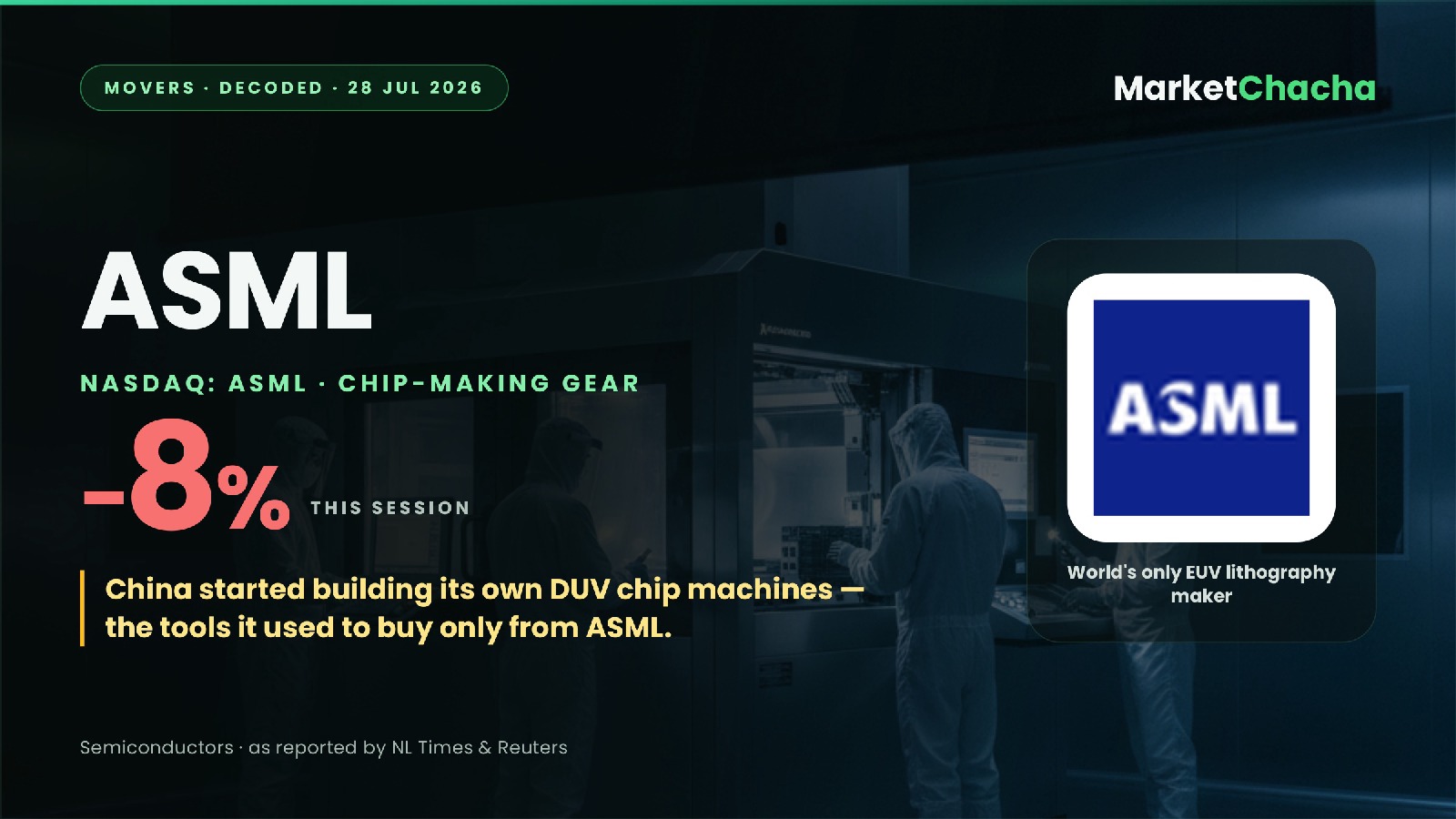
Why did ASML just drop ~8%? China started building its own chip machines
What happened
ASML — the Dutch company that builds the machines almost every advanced chip on earth is printed with — got hit hard. Its Amsterdam-listed shares ended about 8.5% lower (as reported by NL Times), one of its steepest single-session drops of the year, after a report that China has quietly started building the same kind of machines at home.
Why it moved
Reuters reported that a state-backed Shanghai venture (tied to SMEE, China's main homegrown lithography effort) has begun low-volume production of its own immersion DUV lithography tools. DUV — deep ultraviolet — is the workhorse machine that prints mainstream 28-nanometre chips. It sits one rung below the cutting-edge EUV machines that only ASML makes. The plan: roughly 5 units this year and about 20 in 2027, with the first machines going to SMIC, Hua Hong and CXMT to be tested on real production lines.
Here's why that lands on ASML in particular. After US and Dutch export rules banned ASML from selling its top EUV machines to China, Chinese fabs loaded up on its DUV machines instead — and China swelled to roughly 20% of ASML's revenue. If China can build its own DUV tools, that's the exact slice of the business at risk.
The catch the headline skips
The Chinese tools aren't close to matching ASML yet. Reports put them about one generation behind on throughput, overlay accuracy and reliability, and some critical parts still come from Japanese suppliers. For scale: ASML shipped around 131 immersion DUV systems last year — China's target of 5 is a rounding error. So this isn't a hole in ASML's 2026 numbers. It's the market re-pricing how long ASML's China moat lasts.
The business
ASML isn't one product. It's the world's only maker of EUV machines (the multi-hundred-million-dollar tools behind every leading-edge AI and phone chip), plus the DUV machines under threat here, plus metrology and inspection systems, plus a big, high-margin installed-base services arm that keeps earning money long after a machine ships. Today's news hits one leg — DUV in China — not the EUV monopoly that drives most of the profit.
Is it expensive?
Yes, in absolute terms. Even after the drop ASML trades near a trailing P/E of ~60 (about 39x forward), at a market cap around half a trillion euros (per reported figures). That's a price that already assumes years of near-flawless growth. The twist: its wafer-gear peers are just as stretched — Applied Materials and Lam Research both sit near 45–60x earnings after this year's AI re-rating. So ASML isn't wildly pricier than the group; the whole chip-toolmaker shelf is priced for perfection, which is exactly why a single "moat crack" headline can knock 8% off in a day.
Who it touches
- Chinese fabs (SMIC, Hua Hong, CXMT) — a domestic supply option means less exposure to Western export bans.
- Other Western tool makers — Applied Materials, Lam Research, KLA and Japan's Tokyo Electron all face the same slow-burn "can China copy this?" question.
- India's chip push — new fabs like Tata Electronics and Micron's Sanand plant still depend on imported lithography; over time a cheaper Chinese DUV option could widen who they're able to buy from, though nowhere near soon.
What to watch
The real tell isn't the share price — it's whether those first Chinese machines actually pass validation at SMIC and Hua Hong and can run at volume and yield. Until they print good chips reliably, ASML's lead holds. Also watch ASML's next read on its China revenue mix (about 14% of Q2 system sales, down from 19% in Q1) for signs Beijing is already trimming orders.
As of ~12:35 pm ET, 28 Jul 2026. Sources: NL Times, Bloomberg, TrendForce, Investing.com. For discussion and education only — not investment advice. Verify before acting.
This article is for educational and informational purposes only. It is not financial advice, investment recommendation, or a solicitation to buy or sell securities. Investing involves significant risks. I am not a SEBI-registered investment advisor. Readers should consult their own financial advisor and conduct their own research before making any investment decisions.
Comments
Join the conversation
Sign in to join the conversation.
Follow replies, add your view, and take part in the discussion.
Sign in to commentLoading comments...