

Vedanta (VEDL): the full file — the numbers, the owners, and what the filings actually show
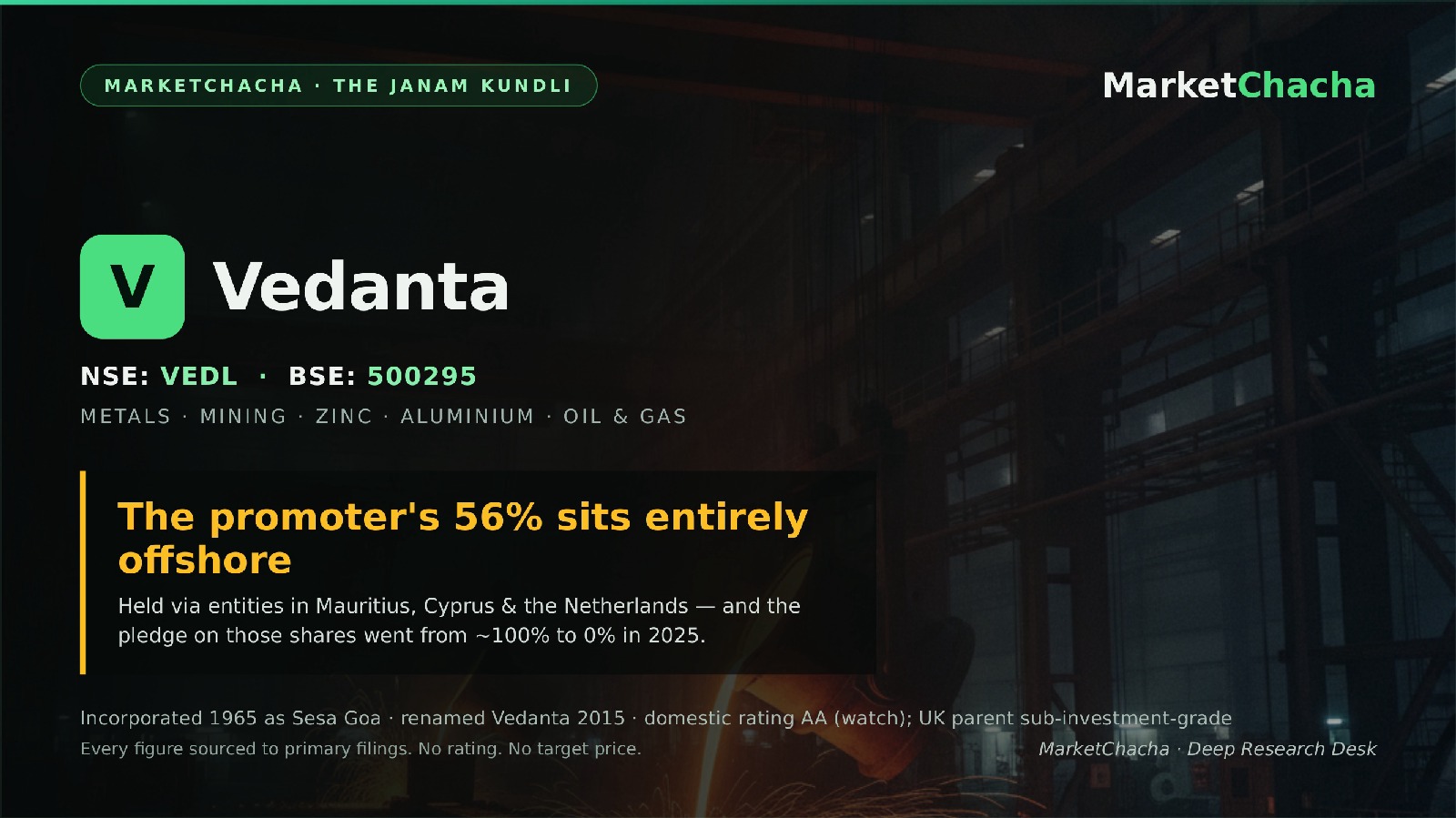
Vedanta Limited digs metal and pumps oil: it mines and refines zinc, lead, silver, aluminium, iron ore and copper, and produces oil & gas, selling the output to smelters, cable-makers, refiners and the open commodity market in India and abroad. It is the listed Indian arm of a group ultimately controlled from London and the Caribbean, and almost every number in its file has a second story sitting behind it — a group reorganisation, an offshore holder, a dividend, a pledge. This is the whole file, top to bottom, from the 1965 birth certificate to the demerger that split the company apart in April 2026 — facts and primary sources only, no rating and no target price.
Origin — the company's birth certificate
Vedanta Limited was incorporated on 26 June 1965 as Sesa Goa Limited, an iron-ore miner and exporter based in Goa. The name that trades today is the product of two changes: to Sesa Sterlite Limited on 18–20 September 2013, and to Vedanta Limited on 22 April 2015. The 2013 renaming followed one of the largest corporate consolidations in Indian mining history: between 2012 and 2013 the London-listed Vedanta Resources group folded Sesa Goa, Sterlite Industries, Madras Aluminium, Sterlite Energy and Vedanta Aluminium into a single vehicle. Sesa Goa — the old iron-ore company — was the legal shell that survived, which is why a diversified metals-and-oil giant carries a 1965 incorporation date from a Goan iron-ore business. Control of Sesa Goa had passed to the Vedanta group (through Twin Star Holdings) in 2007. In 2017 the group merged its oil & gas company, Cairn India, into Vedanta Limited, adding the oil barrel to the metal.
The business — what they actually sell
Vedanta is a diversified natural-resources group. Its largest earner is aluminium: the company describes itself as India's largest primary aluminium producer with roughly a 46% domestic market share, an annual smelter capacity of about 2.4 million tonnes and a 3.5 MTPA alumina refinery at Lanjigarh, Odisha. Aluminium was about 38% of revenue and, on the FY26 numbers, close to half of group EBITDA. The second pillar is zinc, lead and silver, run through the separately-listed subsidiary Hindustan Zinc — a high-margin, cash-rich business and India's dominant zinc miner. The rest is oil & gas (through Cairn, averaging about 87 thousand barrels of oil equivalent per day in FY26), iron ore (the old Sesa business in Goa and Karnataka), copper (the Sterlite Copper custom smelter, closed since 2018), commercial power (Talwandi Sabo, BALCO), steel (ESL Steel) and newer bets in display glass and semiconductors. By geography, India is roughly 65% of revenue, with the balance across Malaysia, China, the UAE and others.
Who actually buys from them
Vedanta sells commodities, so its customers are industrial buyers and traders rather than a handful of named accounts. The company does not disclose a single-customer concentration figure of the kind a contract manufacturer would — for a producer of LME-priced metals and crude, revenue is driven by global commodity prices and volumes, not by one buyer. That is itself the finding: Vedanta's earnings are a leveraged bet on commodity prices, visible in the swing from a peak-cycle FY22 to a weak FY24 and back up in FY26. The clearest customer-side dependency is the reverse one — a large share of the group's own realisations depend on prices set on the London Metal Exchange and on the price of crude, neither of which Vedanta controls.
Where it is actually made — plants & supply chain
Vedanta's assets are physical and mostly disclosed by location. Aluminium is smelted at Jharsuguda and, via BALCO, at Korba, fed by the Lanjigarh alumina refinery in Odisha; the group has long depended on securing bauxite and, critically, on captive coal and power for the aluminium smelters, one of its most-discussed cost and supply exposures. Zinc-lead-silver comes from Hindustan Zinc's Rajasthan mines (Rampura Agucha and others). Oil & gas is centred on the Rajasthan (Barmer) block. Iron ore is in Goa and Karnataka; the Sterlite Copper smelter at Tuticorin (Thoothukudi), Tamil Nadu, has been shut since 2018. Overseas, the group holds Konkola Copper Mines in Zambia, zinc assets in Namibia and South Africa (Zinc International) and a gold operation in the UAE (Fujairah Gold). Aluminium's reliance on imported alumina/bauxite in some years and on coal availability is the supply-chain pinch-point the filings and calls return to most often.
Five years of numbers
The table below is the whole diversified group, FY22 to FY26, before the demerger split it. Two things stand out: revenue is cyclical but has grown, and the profit line swings hard with the commodity cycle — a peak in FY22, a trough in FY24 (dragged down by high interest and a 63% tax rate that year), and a strong recovery to FY26.
| ₹ crore (consolidated) | FY22 | FY23 | FY24 | FY25 | FY26 |
|---|---|---|---|---|---|
| Revenue | 1,32,732 | 1,47,308 | 1,43,727 | 1,50,725 | 1,74,075 |
| EBITDA | 44,824 | 34,431 | 35,312 | 43,541 | 55,976 |
| EBITDA margin | ~34% | ~23% | ~25% | ~29% | ~32% |
| Net profit (incl. minority) | 23,710 | 14,503 | 7,539 | 20,535 | 25,096 |
| Cash from operations (CFO) | 34,963 | 33,065 | 35,654 | 39,562 | 39,499 |
| Dividend payout | 89% | 357% | 259% | 113% | 76% |
Revenue compounded at roughly 7% a year over these four years; EBITDA in FY26 (₹55,976 cr, up about 29% year-on-year) was a record. A note on why third-party screens show a negative five-year sales CAGR: from the December-2024 quarter Vedanta began presenting the businesses being demerged as discontinued operations, so the "continuing operations" revenue line on data sites drops sharply (to about ₹62,717 cr in FY25 and ₹78,437 cr in FY26). We use the whole-group figures from the annual reports and earnings releases above so the five-year story is like-for-like. The single most important earnings-quality check is cash conversion, and here it is unambiguous.
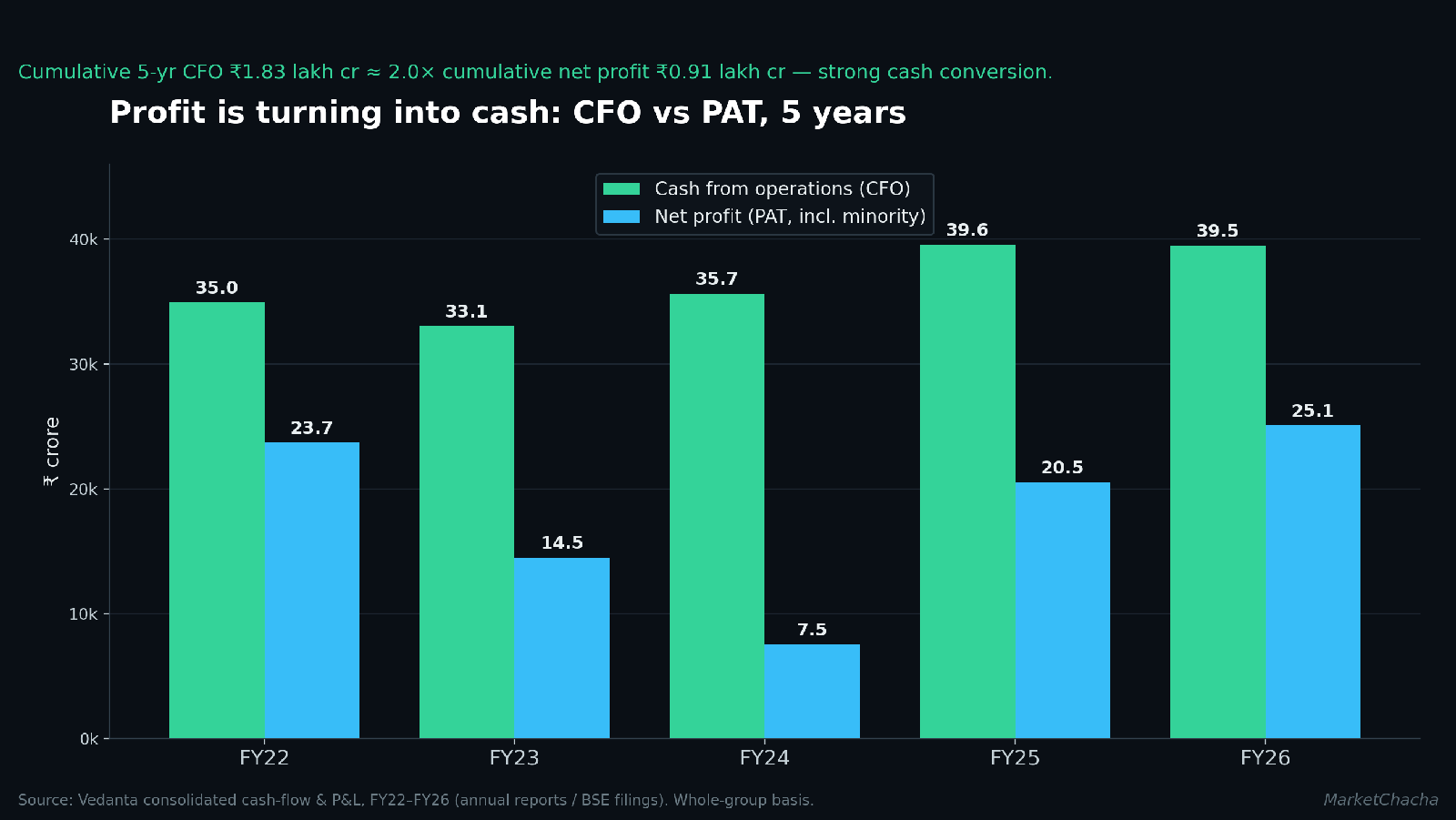
Over FY22–FY26 the group generated about ₹1.83 lakh crore of operating cash against roughly ₹0.91 lakh crore of net profit — a cumulative CFO-to-PAT of about 2.0×. Reported profit is not just becoming cash; it is over-converting, which is what you expect from a capital-heavy business with very large depreciation (₹8,000–11,000 cr a year) and profits shared with sizeable minority holders (chiefly the public shareholders of Hindustan Zinc). On this measure Vedanta is the opposite of the companies where profit never turns into cash.
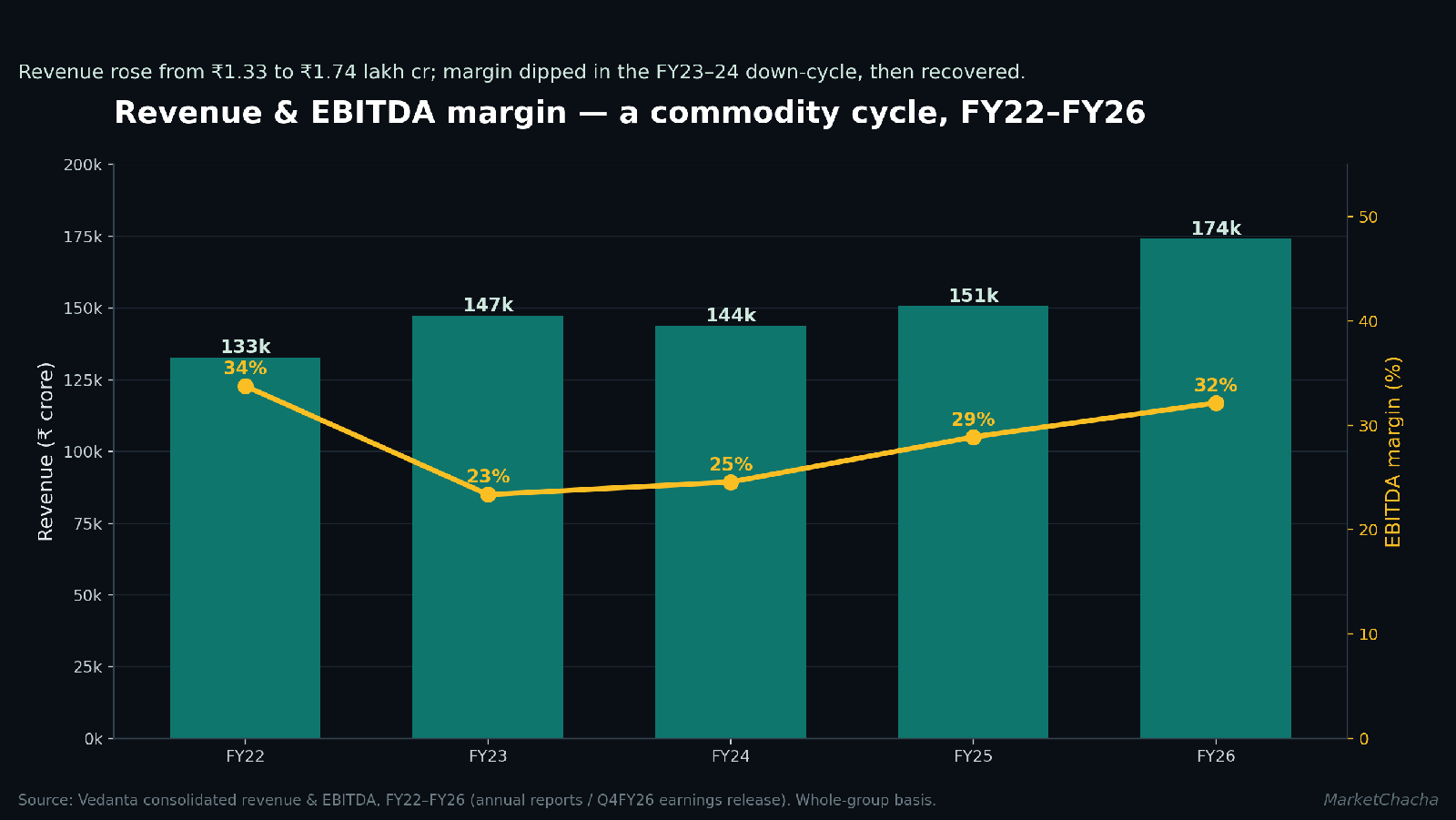
The financial-statements block (FY26 vs FY25, whole group). Revenue rose ₹23,350 cr (+15.5%), from ₹1,50,725 cr to ₹1,74,075 cr. EBITDA rose ₹12,435 cr (+28.6%) to ₹55,976 cr, lifting margin by roughly three points as aluminium costs fell (hot-metal cost of production about $1,752/t, the lowest in five years) and zinc/silver realisations held. Net profit rose ₹4,561 cr (+22%) to ₹25,096 cr. On the balance sheet the headline mover is debt: gross borrowings fell from ₹91,479 cr (FY25) to ₹32,947 cr (FY26) — a drop of nearly two-thirds — as the demerger moved debt to the separated entities and the group deleveraged, taking net-debt-to-EBITDA to about 0.95× from 1.22× a year earlier; note that the reported ₹1.49 lakh crore "other liabilities" line in FY26 also swelled as items were reclassified around the reorganisation. Cash flow: CFO was essentially flat at ₹39,499 cr; free cash flow was about ₹18,747 cr after heavier investing outflows. On earnings quality, one line deserves a flag — "other income" of about ₹14,000 cr now sits inside pre-tax profit (roughly 45–55% of continuing-operations PBT in FY25 and FY26), materially higher than the ₹1,832–5,241 cr seen in FY22–FY24. Other income at a group like this is largely treasury and investment income on a big liquid book, which is a legitimate source of profit; because it is non-operating, we separate it here so readers can see how much of recent PBT is core mining-and-metals versus financial income. The number itself is disclosed; its composition is worth reading in the notes.
The latest quarter, decoded
These quarterly figures are on the post-reorganisation continuing-operations basis (the residual Vedanta — zinc, silver, oil & gas and other retained businesses), so they are comparable to each other but smaller than the pre-demerger group above.
| ₹ crore | Q1FY27 (Jun-26) | Q4FY26 (Mar-26) | QoQ | Q1FY26 (Jun-25) | YoY |
|---|---|---|---|---|---|
| Revenue | 24,205 | 24,609 | -1.6% | 15,754 | +53.6% |
| Operating profit | 8,501 | 7,559 | +12.5% | 4,276 | +98.8% |
| Other income | 3,166 | 5,503 | -42.5% | 2,737 | +15.7% |
| Profit before tax | 9,813 | 11,036 | -11.1% | 5,288 | +85.6% |
| Net profit | 7,918 | 9,352 | -15.3% | 4,457 | +77.6% |
The decode: operations improved — operating profit rose both sequentially (+12.5%) and sharply year-on-year, with margin at about 35%. The quarter-on-quarter dip in net profit is not an operating miss; it is driven by the swing in other income (₹5,503 cr → ₹3,166 cr), the same non-operating line flagged above. Year-on-year the residual business shows a large jump on both operations and a re-based comparison. When one line can move PBT by a fifth in a quarter, it is worth watching which way "other income" points next quarter.
Who owns it — and where those owners are registered
This is the heart of a Vedanta kundli. Promoters hold 56.38% (Mar 2026 shareholding pattern; 54.72% by the June 2026 filing after further sell-down), and — a verified fact worth stating plainly — every rupee of that promoter stake is held through entities registered outside India. The named holders are Twin Star Holdings Ltd (Mauritius, 40.02%), Vedanta Holdings Mauritius II Ltd (Mauritius, 12.60%), Vedanta Holdings Mauritius Ltd (Mauritius, 2.75%), Welter Trading Ltd (Cyprus, 0.98%) and Vedanta Netherlands Investments B.V. (Netherlands, 0.04%). Above them sits Vedanta Resources Ltd (United Kingdom), and above that the Agarwal family's Volcan Investments. Mauritius has historically been the largest single source of FPI inflows into India because of the old India–Mauritius tax treaty, and an offshore holding structure is entirely legal and extremely common; it is disclosed here because the chain matters — the debt, dividends and rating actions that move this share price often originate at the UK parent, not at the Indian company.
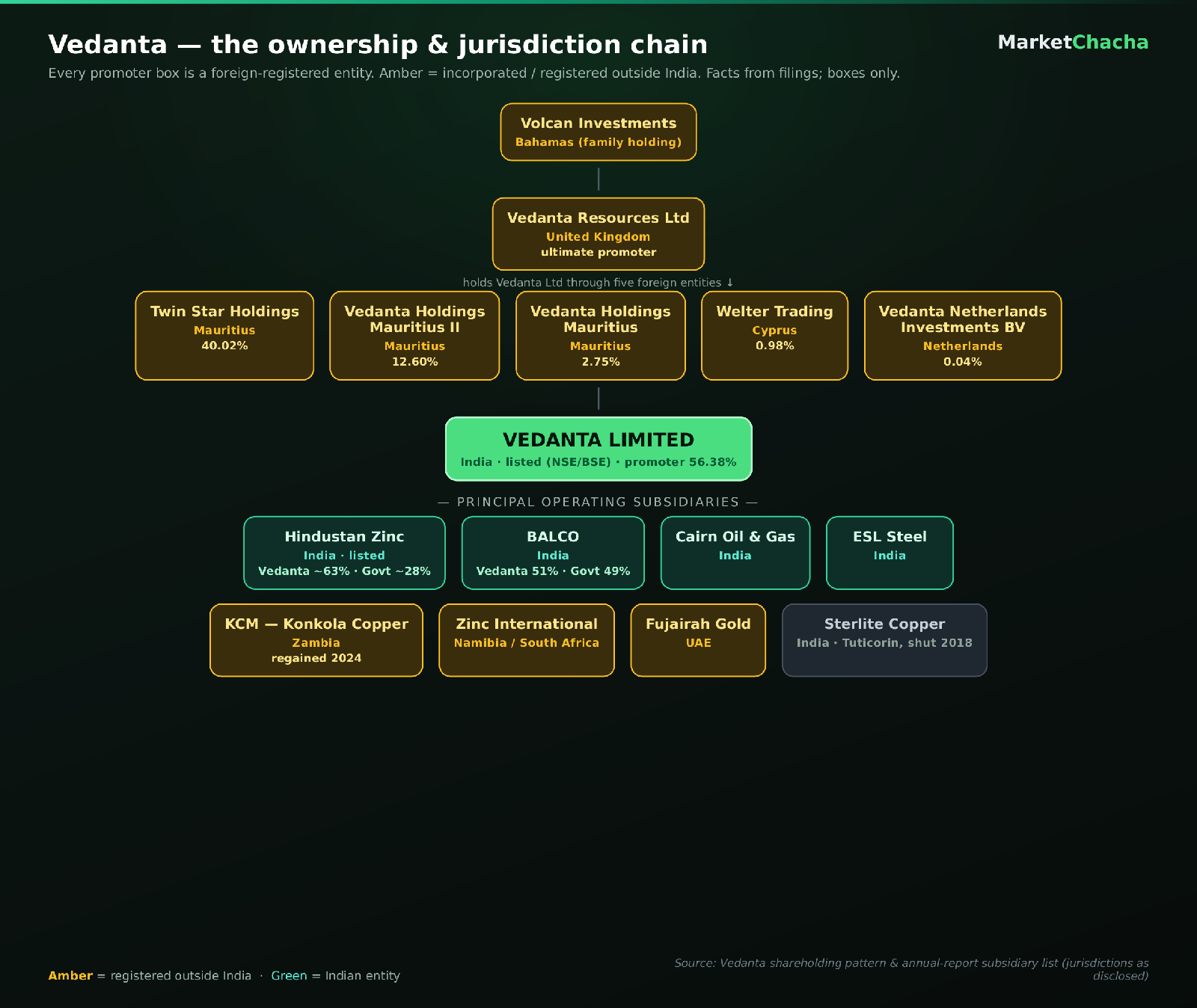
The other side of the register is domestic and diffuse. Institutions hold about 27.4%: FPIs about 13.9% (spread across roughly 1,000 investors, so no single foreign fund dominates), mutual funds 6.90% (largest: ICICI Prudential Balanced Advantage at 1.90%, SBI Arbitrage at 1.04%) and insurers 5.72%, of which LIC alone owns 4.73%. The public holds about 16%, and the number of shareholders has ballooned from roughly 3.35 lakh in FY17 to about 26 lakh by June 2026 — a very large, mostly-retail base. One public holder to note factually is PTC Cables Pvt Ltd at 1.91%.
Then there is the pledge — and its disappearance.
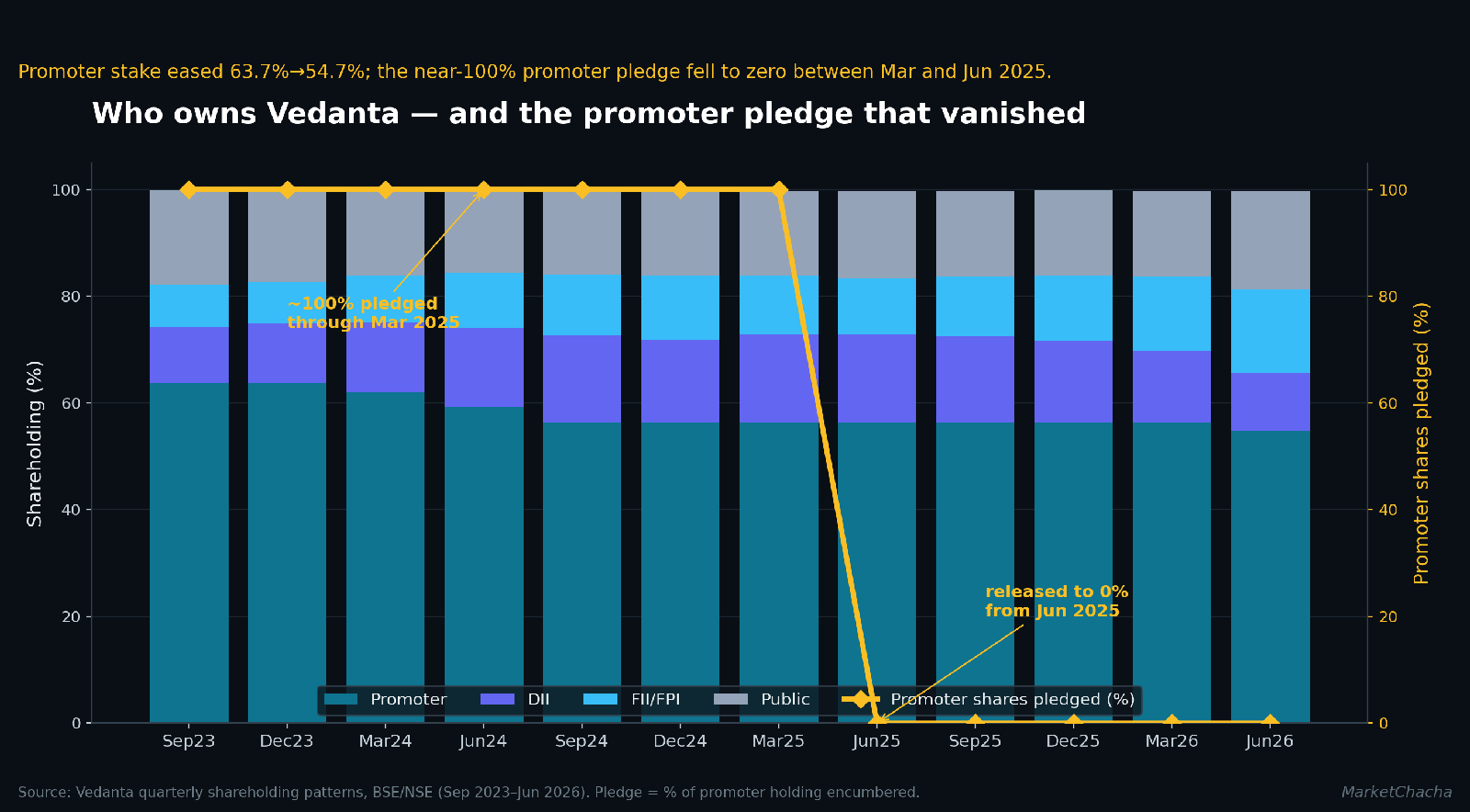
Through the March-2025 quarter, the shareholding patterns show 99.99% of the promoter holding pledged or encumbered — essentially the entire promoter block. In the June-2025 quarter that figure drops to 0.00%, and it has stayed there. Pledging promoter shares is legal and common as a funding tool; it becomes material because pledged shares can be sold by lenders if the price falls, and near-total encumbrance leaves little cushion. The release of that pledge in mid-2025 — alongside the parent's deleveraging — is one of the largest single changes in this company's ownership record, and it is a hard, checkable fact from the exchange filings.
Capital history — every time they raised or returned money
The equity story is one of consolidation, high dividends and, recently, dilution. The share was long ago sub-divided to a face value of ₹1. The transformative "issuances" were the 2013 group merger that created Sesa Sterlite and the 2017 merger of Cairn India, both share-swap deals. In 2020 the promoter attempted to delist Vedanta at an indicative floor of ₹87.50; the reverse book-building did not clear at a price the promoter accepted and the delisting failed — public shareholders effectively held the line, and the stock trades many times that level today. In FY25 the company raised fresh equity (a QIP of about ₹8,500 cr), which is why the equity capital line steps up from ₹372 cr to ₹391 cr, and the promoters separately sold down their stake from about 63.7% to 56.4% across 2023–24. On returns, Vedanta is one of the market's highest-yielding large-caps: dividend payout was 357% of profit in FY23 and 259% in FY24 — dividends exceeding earnings — moderating to 76% in FY26, with a total FY26 dividend of ₹34 per share (about ₹13,300 cr). High payouts benefit every shareholder in proportion to holding, including the ~44% non-promoter float; they also, by design, send the majority of the cash offshore to the promoter chain, where it has been used to service the UK parent's debt. Both statements are true at once.
Who runs it, and the wider web
The group is chaired by Anil Agarwal, its founder; Navin Agarwal is a long-standing executive figure and Priya Agarwal Hebbar sits on the board. The company reappointed Arun Misra as CEO on 30 July 2026 and approved new ESOP/ESPP plans the same day. On the auditor — a check we run on every file — Vedanta's statutory auditor in recent years was S.R. Batliboi & Co. LLP (an EY network firm); the board has approved MSKA & Associates LLP as incoming statutory auditor for a five-year term. Auditor rotation is mandatory under the Companies Act after two five-year terms, so a change of this kind can be routine; we note it because an auditor change is exactly the sort of fact worth recording, and the incoming and outgoing firms are both large, established auditors.
The regulatory and surveillance record
Several items here are material and purely factual. Sterlite Copper, Tuticorin: the Tamil Nadu government ordered the smelter shut in May 2018 following protests in which police firing killed 13 people; in 2024 the Supreme Court dismissed Vedanta's plea to reopen the plant, citing "serious violations," and dismissed its review petition in November 2024, making the closure effectively permanent. Konkola Copper Mines, Zambia: seized and placed into liquidation by the Zambian state in 2019, the asset was regained in July 2024 after Vedanta paid about $246 million to settle with creditors. Credit ratings — the split-screen: the Indian company Vedanta Limited carries an investment-grade domestic rating (CRISIL and ICRA at "AA," on rating watch with developing implications in 2026), while the UK parent Vedanta Resources has spent years in sub-investment-grade territory — Moody's cut it to Caa2 in September 2023 and S&P moved it to "selective default" in January 2024 after a bond-maturity extension, before ratings improved as the group deleveraged. That contrast — a solid Indian operating company beneath a highly-geared offshore parent — is the single most important structural fact about the group. Short-seller report: on 9 July 2025 the US firm Viceroy Research disclosed a short position against Vedanta Resources' debt and published a report critical of the group's structure, leverage and dividend policy; Vedanta rejected the report as "a malicious combination of selective misinformation and baseless allegations" and reaffirmed its governance and deleveraging commitments. We report the existence of the report and the company's denial as facts and take no view on the claims. On exchange surveillance, Vedanta is a large, highly-liquid Nifty constituent and does not appear on the current ASM/GSM surveillance lists — the absence is itself a clean data point.
Forensic checks — what the accounts show
| Check | What we found | A benign explanation |
|---|---|---|
| 5-yr CFO ÷ net profit | ~2.0× (₹1.83 lakh cr CFO vs ₹0.91 lakh cr PAT, FY22–26) | Very strong; heavy depreciation + minority interest lift CFO above PAT |
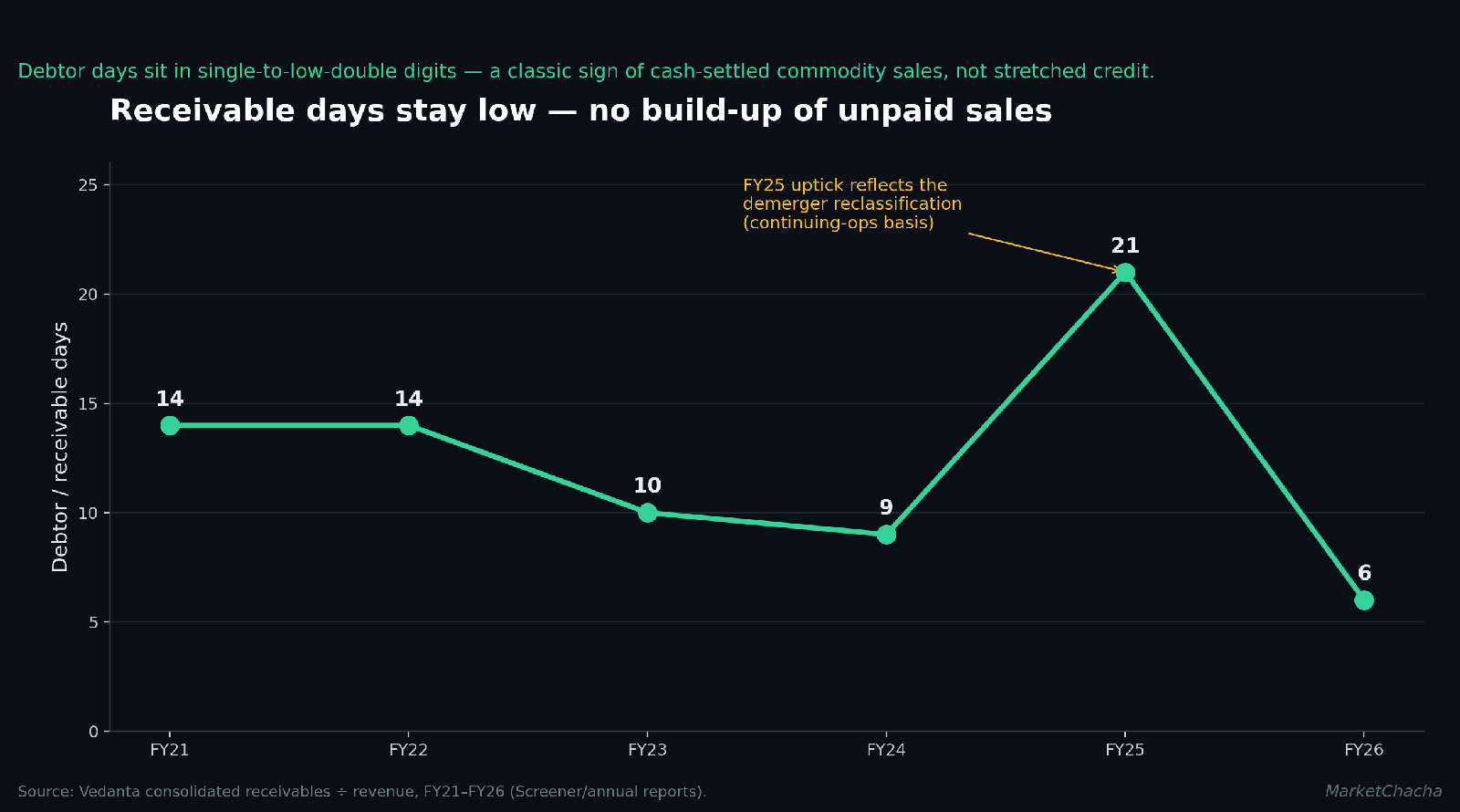
| Receivable days | 6–14 days most years (FY25's 21 is a demerger-reclassification artefact) | Cash-settled, LME-priced commodity sales — short credit is normal |
| Other income % of PBT | ~45–55% in FY25–FY26 (₹12,739 cr / ₹14,186 cr), up from <15% earlier | Large treasury/investment book; legitimate but non-operating — read the notes |
| Implied interest rate on debt | ~11% in FY24 (interest ₹9,465 cr on ~₹84,000 cr avg debt) | Consistent with the group's leverage and a sub-investment-grade parent |
| Gross borrowings | ₹53,583 cr (FY22) → ₹91,479 cr (FY25) → ₹32,947 cr (FY26) | Debt rose through the cycle, then fell as the demerger split and deleveraged the group |
| Promoter pledge | ~100% of promoter shares pledged through Mar-2025 → 0% from Jun-2025 | Pledging is a legal funding tool; the release followed parent deleveraging |
| Promoter jurisdiction | 56% held entirely via Mauritius, Cyprus & Netherlands entities under the UK parent | Offshore FPI structures are legal and common; disclosed as fact |
| Auditor | S.R. Batliboi & Co. LLP; MSKA & Associates LLP approved as incoming auditor | Mandatory rotation can force a change; both are major firms |
| Dividend payout | 357% (FY23), 259% (FY24), 76% (FY26); yield ~16% | Legal, proportional to all holders; also funds the promoter chain's debt |
| Contingent liabilities | ~₹31,673 cr disclosed | Largely tax and regulatory disputes; standard for a group this size |
What we could not verify
We did not independently open every underlying primary document for each line and relied in places on the consolidated series aggregated by Screener and on the company's own earnings releases, cross-checked against the reported figures; the audited annual reports are the ultimate authority and are linked below. We did not verify the exact composition of the large "other income" line, the beneficial ownership behind the offshore promoter vehicles (which such structures often do not make publicly identifiable), the precise segment-level related-party amounts, or the final legal-entity allocation of assets and debt after the April-2026 demerger and the newly-announced real-estate demerger. Where the demerger changed the presentation basis (continuing vs discontinued operations), we have said so rather than splice mismatched series.
What would change the picture
Concrete, checkable things to watch: the next annual report and auditor's report under the incoming auditor (any qualification or emphasis of matter); the next shareholding pattern (whether promoter pledge stays at zero and whether the stake keeps drifting down); the composition and size of "other income" relative to operating profit; the parent's (Vedanta Resources) rating trajectory and refinancing; the legal-entity debt and dividend flows after the demerger, including the just-announced separation of the real-estate business; and any movement onto exchange surveillance lists. Each is disclosed in a document you can read.
Sources
- Vedanta Ltd shareholding patterns (promoter entities, pledge, FPI/DII, shareholder count), BSE/NSE — BSE 500295; compiled view: Trendlyne.
- Vedanta Ltd consolidated financials (12-yr P&L, balance sheet, cash flow, ratios) — Screener.
- Annual Report FY2026 (BSE) — PDF; FY2025 — PDF; FY2024 — PDF.
- Q4 & FY26 earnings release / press release — Vedanta.
- Name change (Sesa Sterlite → Vedanta), 22 Apr 2015 — Vedanta press release; Sesa Goa 1965 history — Sesa Goa.
- NCLT approval of demerger into five entities, Dec 2025 — Business Standard.
- Sterlite Copper Tuticorin — Supreme Court refuses reopening (2024) — LiveLaw.
- Konkola Copper Mines, Zambia — $246m to regain control (Jul 2024) — Mining.com.
- Vedanta Resources rating — S&P "selective default" after bond extension (Jan 2024) — Business Standard.
- Viceroy Research report and Vedanta's rebuttal (Jul 2025) — Business Standard; publisher: Viceroy.
- Credit rating updates (2026) — ICRA and CRISIL (via Screener documents).
FAQ
Is Vedanta Limited the same as Vedanta Resources? No. Vedanta Limited is the India-listed operating company (NSE: VEDL, BSE: 500295). Vedanta Resources Ltd is its UK-based parent, which owns about 56% of Vedanta Limited through offshore entities and carries a much lower credit rating than the Indian company.
Why did the promoter pledge go from ~100% to zero? Through March 2025, exchange filings showed essentially all promoter shares pledged; from the June 2025 quarter the pledge is reported at 0%. Pledging is a legal funding tool, and the release coincided with the parent group reducing debt. It is a fact from the shareholding patterns, not an accusation.
Are the offshore promoter entities a red flag? They are a disclosed fact. Holding an Indian listed company through Mauritius, Cyprus and Netherlands vehicles is legal and very common for FPI structures; the reason we name every jurisdiction is that the group's debt and dividend decisions run through this chain, so knowing the map helps readers follow the money.
How can dividends exceed profits? In FY23 and FY24 Vedanta's dividend payout was above 100% of net profit, funded from cash reserves and subsidiary dividends (notably Hindustan Zinc). High payouts benefit all shareholders proportionally and also route the majority of cash to the promoter chain; both are true and both are disclosed.
What is the demerger? Vedanta split its businesses into separately-listed companies (aluminium, power, oil & gas, iron & steel and a residual Vedanta holding zinc/silver), approved by the NCLT in December 2025 and effective from 30 April 2026; a further demerger of the real-estate business was announced on 30 July 2026. This changed how revenue is presented (continuing vs discontinued operations), which is why data screens show a discontinuity.
Does Vedanta carry any recommendation here? No. This desk issues no buy, sell, hold, target price or rating — only sourced facts.
Independent research for education and discussion only. Not investment advice, not a recommendation, and not a rating — we issue no buy/sell calls and no target prices. Every figure is sourced from the primary documents linked above; figures can be restated and we can make mistakes, so always verify against the original. Nothing here alleges wrongdoing by any company or individual: where a fact raises a question we state the fact, cite it, and give the benign explanation alongside. Offshore holding structures, pledging and preferential allotments are all legal and common — they are disclosed here as facts, not as accusations.
This article is for educational and informational purposes only. It is not financial advice, investment recommendation, or a solicitation to buy or sell securities. Investing involves significant risks. I am not a SEBI-registered investment advisor. Readers should consult their own financial advisor and conduct their own research before making any investment decisions.
Comments
Join the conversation
Sign in to join the conversation.
Follow replies, add your view, and take part in the discussion.
Sign in to commentLoading comments...