

Vertiv (VRT): the full file — the numbers, the owners, and what the filings actually show
Vertiv Holdings Co (NYSE: VRT) designs, builds and services the equipment that keeps a data centre running: the uninterruptible power supplies, switchgear and busway that deliver clean electricity to the servers, and the air- and liquid-cooling systems that carry the heat away. It makes money by selling that hardware — split roughly 82% product, 18% recurring service — to hyperscale cloud operators, colocation providers, telecoms and enterprises, and increasingly to the operators building AI computing capacity.
What the record shows is a five-year transformation: a debt-heavy, low-margin industrial carve-out that was losing money in 2018–2020 has become a business earning a ~13% net margin, converting profit into cash at almost 1.8× over five years, and sitting on a $15bn order backlog. This file walks the company from its birth certificate to its latest quarter, entirely from primary filings, and decodes the one number that looks too good — a 169% jump in reported profit — which turns out to be an accounting artefact, not the business.
Origin — the company's birth certificate
Vertiv is not a start-up; it is a collection of businesses that Emerson Electric assembled over decades under the name Emerson Network Power (power and cooling brands such as Liebert and Chloride). In 2016 Emerson sold that division to the private-equity firm Platinum Equity for roughly $4 billion, and it was renamed Vertiv. Platinum ran it privately for four years, then took it public on 7 February 2020 by merging it into GS Acquisition Holdings Corp, a blank-cheque SPAC co-sponsored by an affiliate of Goldman Sachs and by David M. Cote, the former chairman and CEO of Honeywell. The deal valued Vertiv at about a $5 billion enterprise value. Cote became — and remains — Vertiv's Executive Chairman. The company's ultimate holding entity, Vertiv Holdings Co, is incorporated in Delaware, with its operating hub in Westerville, Ohio.
The business — what they actually sell
Vertiv reports three geographic segments. In FY2025, of $10,229.9m of net sales, 62% came from the Americas, 20% from Asia Pacific and 18% from Europe, the Middle East & Africa. By type, products were $8.39bn and services $1.84bn. The product families are power management (UPS systems, switchgear, busbar, DC power), thermal management (precision air cooling and, increasingly, liquid cooling for high-density AI racks), integrated rack and modular/prefabricated data-centre systems, and monitoring and management software. Services — installation, maintenance, spares — are the smaller but stickier annuity. The company employs roughly 34,000 people across more than 40 countries and runs about 30 manufacturing and assembly facilities; it says it has roughly doubled capacity on key product lines since late 2021 to meet demand.
Who actually buys from them
Vertiv's disclosed dependency is on a single end-market — the data centre — where the fastest-growing buyers are hyperscale and colocation operators building AI capacity. In its 10-K the company describes a deliberate diversification strategy "to avoid over concentration or a significant dependence on a particular supplier or region." It does not disclose any single customer above 10% of revenue in the FY2025 filing, and it does not name its largest customers. The risk it flags is therefore not one named account but the concentration of demand in AI data-centre spending: the same wave that drove Q4-2025 organic orders up ~252% and lifted backlog to $15.0bn is a wave that can also recede. Order figures the company reports are large and lumpy — the Q4-2025 book-to-bill was about 2.9× — so a single quarter's orders should be read as a signal of a multi-year build, not a run-rate.
Where it is actually made — plants & supply chain
Vertiv manufactures and assembles at roughly 30 sites worldwide, close to its three regional markets, and has been adding capacity — including in the Americas — specifically for liquid cooling and high-density power. Its inputs are the usual industrial bill of materials: power electronics and semiconductors, sheet metal and enclosures, copper, compressors and refrigerant systems, batteries, and increasingly the pumps, manifolds and coolant-distribution units used in liquid cooling. The company does not publish a single-source supplier list, and it is explicit that component availability (notably electronics) is a risk. Several of its recent acquisitions were about owning more of that supply chain — see the capital history below.
Five years of numbers
The five-year arc is the story: revenue has doubled, and margins have roughly tripled off a low base.
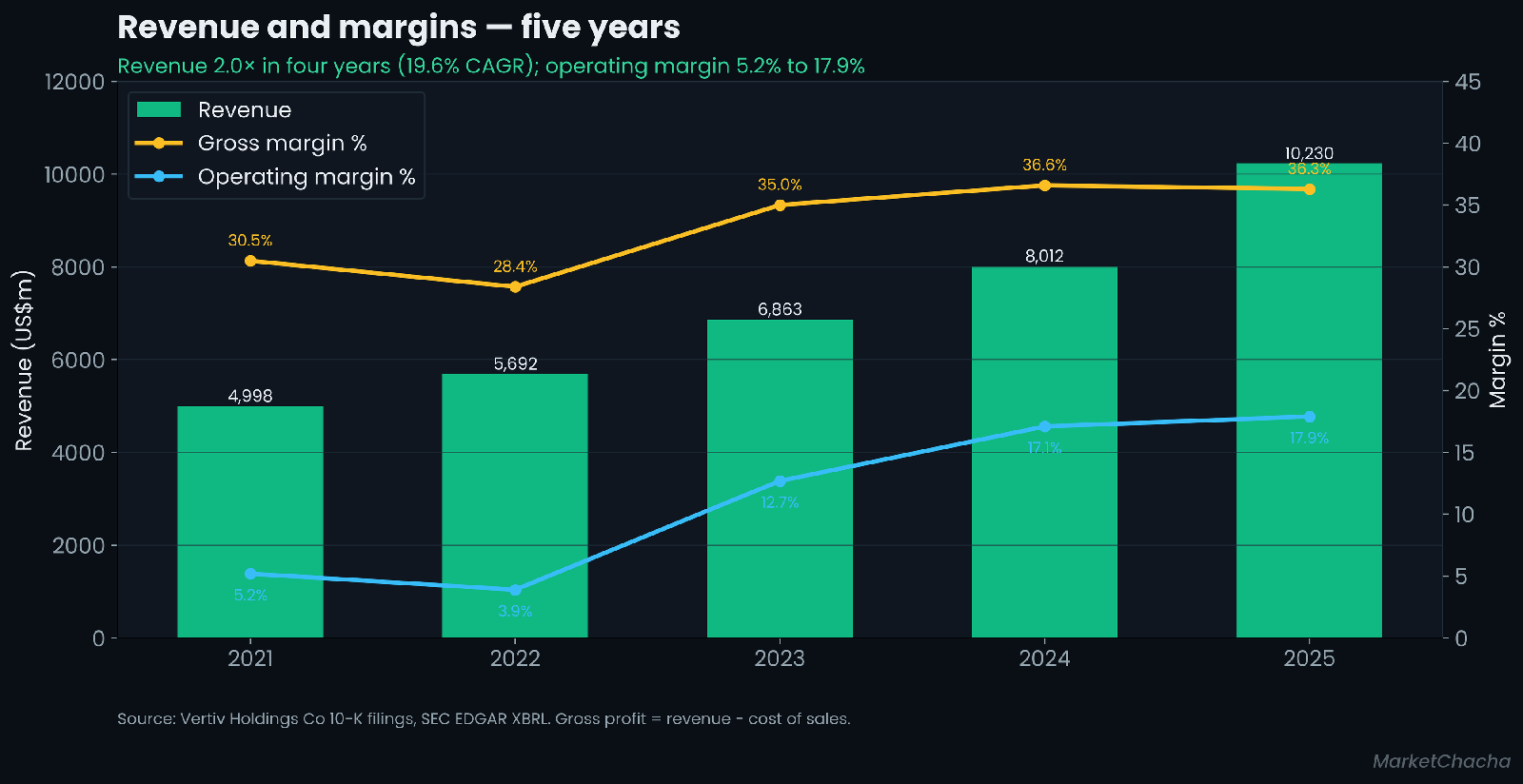
| FY (US$m) | 2021 | 2022 | 2023 | 2024 | 2025 |
|---|---|---|---|---|---|
| Revenue | 4,998 | 5,692 | 6,863 | 8,012 | 10,230 |
| Gross profit | 1,523 | 1,616 | 2,400 | 2,934 | 3,715 |
| Gross margin | 30.5% | 28.4% | 35.0% | 36.6% | 36.3% |
| Operating income | 260 | 223 | 872 | 1,367 | 1,830 |
| Operating margin | 5.2% | 3.9% | 12.7% | 17.1% | 17.9% |
| Net income (GAAP) | 120 | 77 | 460 | 496 | 1,333 |
| Operating cash flow | 211 | (153) | 901 | 1,319 | 2,114 |
| Diluted EPS ($) | 0.33 | (0.04) | 1.19 | 1.28 | 3.41 |
Revenue compounded at 19.6% a year over 2021–2025; diluted EPS at ~79% a year off a tiny base. On the market side, on a split/dividend-adjusted basis the shares closed 2020 at $18.58 and 2025 at $161.94 — a +771% five-year run, roughly a 54% annual CAGR — though the path was violent: −45% in 2022 (year low ~$8.18), then +252% in 2023 and +137% in 2024. The stock reached an all-time closing high of $376.15 on 14 May 2026 and has since traded back toward the low-$200s (52-week range $118.70–$379.94). At about $223–240 it carries a P/E near 54× trailing-twelve-month earnings — roughly 70× on FY2025 GAAP EPS of $3.41 — and a price/book near 23×; for context, power-management peer Eaton (ETN) traded near a 42× trailing P/E in mid-2026. We state these multiples as facts, not judgements.
Financial-statements block — income statement, FY2025 vs FY2024:
| US$m | FY2024 | FY2025 | Δ | % |
|---|---|---|---|---|
| Revenue | 8,011.8 | 10,229.9 | +2,218.1 | +27.7% |
| Cost of sales | 5,077.6 | 6,514.7 | +1,437.1 | +28.3% |
| SG&A | 1,374.0 | 1,617.8 | +243.8 | +17.7% |
| Amortisation of intangibles | 195.4 | 211.5 | +16.1 | +8.2% |
| Operating income | 1,367.4 | 1,829.7 | +462.3 | +33.8% |
| Interest expense | 150.4 | 86.1 | −64.3 | −42.8% |
| Change in FV of warrants (non-cash) | 449.2 | 0.0 | −449.2 | −100% |
| Pretax income | 765.4 | 1,741.9 | +976.5 | +127.6% |
| Income tax | 269.6 | 409.1 | +139.5 | +51.7% |
| Net income | 495.8 | 1,332.8 | +837.0 | +168.8% |
| Diluted EPS ($) | 1.28 | 3.41 | +2.13 | +166.4% |
Balance sheet, FY2025 vs FY2024: total assets rose 33.7% to $12,212m; the two lines moving more than ~40% are goodwill (+53.9% to $2,033.7m), from acquisitions, and shareholders' equity (+61.9% to $3,941.3m), from retained earnings plus the warrant settlement. Cash rose 40.8% to $1,728m and receivables 31.6% to $3,109m. Notably, total debt was essentially flat at $2,913m (−0.5%) — the growth was funded by cash generation, not new borrowing.
Cash flow, FY2025 vs FY2024: operating cash flow $2,113.8m (up from $1,319.3m); investing −$1,500.8m (up sharply on acquisitions plus capex); financing −$72.3m. Free cash flow (CFO − capex) was ~$1,894m, up from ~$1,152m.
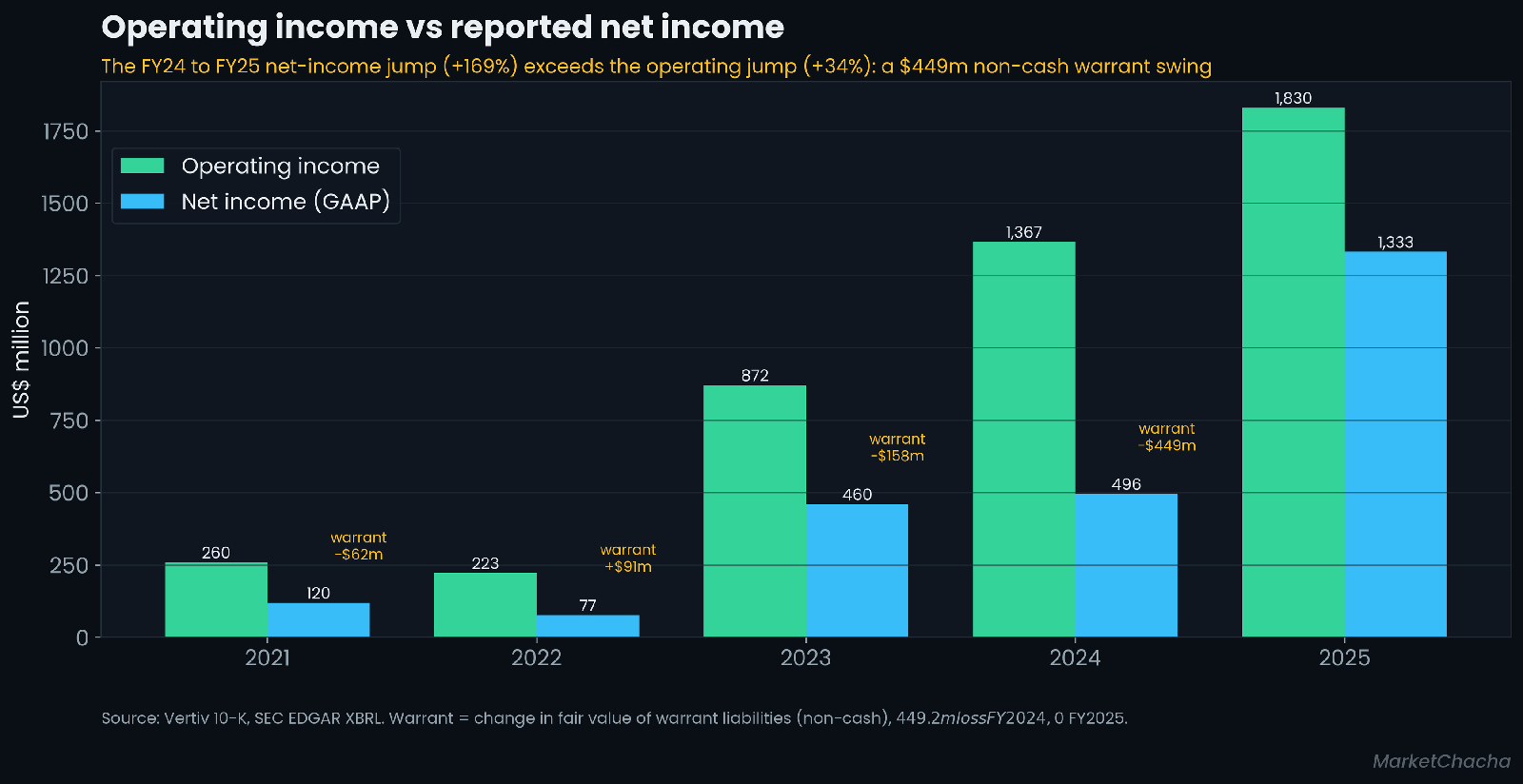
Material variances and earnings quality. Almost all of the operating improvement is genuine: operating income rose 33.8% on 27.7% higher revenue, i.e. operating leverage, with gross margin holding near 36%. But the 168.8% jump in net income is not an operating story — it is dominated by two below-the-line items. First, a $449.2m non-cash charge in FY2024 for the change in fair value of the SPAC warrants vanished to zero in FY2025 (the warrants were settled). Second, interest expense fell 42.8%. Strip both out and the underlying earnings growth is closer to the ~34% operating gain than to the headline 169%. This is a benign, well-disclosed accounting effect — but a reader who anchors on "profit tripled" without reading the warrant line will overstate the run-rate.
The latest quarter, decoded
For the quarter ended 30 June 2026 (Q2-2026):
| US$m | Q2-2025 | Q1-2026 | Q2-2026 | QoQ | YoY |
|---|---|---|---|---|---|
| Revenue | 2,638.1 | 2,649.5 | 3,274.3 | +23.6% | +24.1% |
| Operating income | 442.4 | 440.1 | 637.9 | +44.9% | +44.2% |
| Net income | 324.2 | 390.1 | 497.8 | +27.6% | +53.5% |
The quarter is high quality in the sense that matters here: operating income grew faster than revenue (+44% vs +24% year on year), so the profit came from the core business and operating leverage, not from a one-off below the operating line. With the warrants gone, there is no longer a large non-cash swing distorting the bottom line. The item to keep watching is receivables, which have grown with the order book — see the forensic checks.
Who owns it — and where those owners are registered
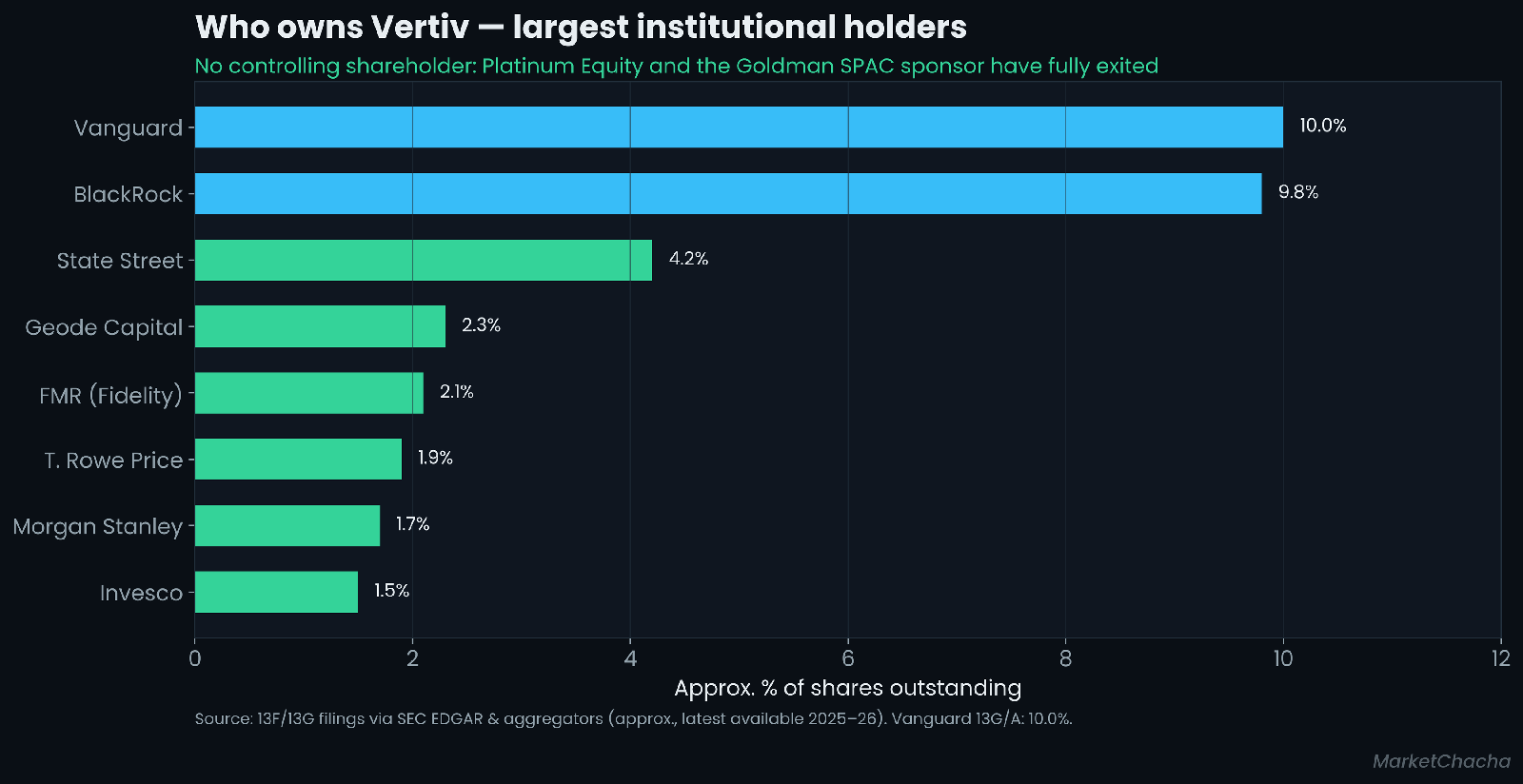
The most important ownership fact is what is absent: Vertiv has no controlling shareholder. Platinum Equity, which took it public, sold down and exited, and the Goldman-affiliated SPAC sponsor's stake unwound with the warrants. The register is now a diffuse institutional one. Based on the latest 13F/13G filings, the largest holders are Vanguard (~10.0%, per its Schedule 13G/A), BlackRock (~9–10%), State Street, Geode, Fidelity (FMR), T. Rowe Price, Morgan Stanley and Invesco — the standard index-and-active roster, all US-registered managers. No single active manager dominates.
On insider activity, the disclosed pattern is net selling with no open-market buying. Executive Chairman David Cote sold 40,000 shares on 26 February 2026 at about $255.29 (~$10.2m); across insiders, roughly 490,000 shares were sold over a recent three-month window and about 1.26m over eighteen months, against zero purchases. The benign reading is straightforward: these are executives and a founder-chairman monetising a stock that has risen enormously, typically through pre-arranged 10b5-1 plans, and there is no controlling block whose sell-down would shift control. It is still a fact worth stating plainly, because sustained insider selling with no buying is information, whatever its cause.
Where the entities are registered
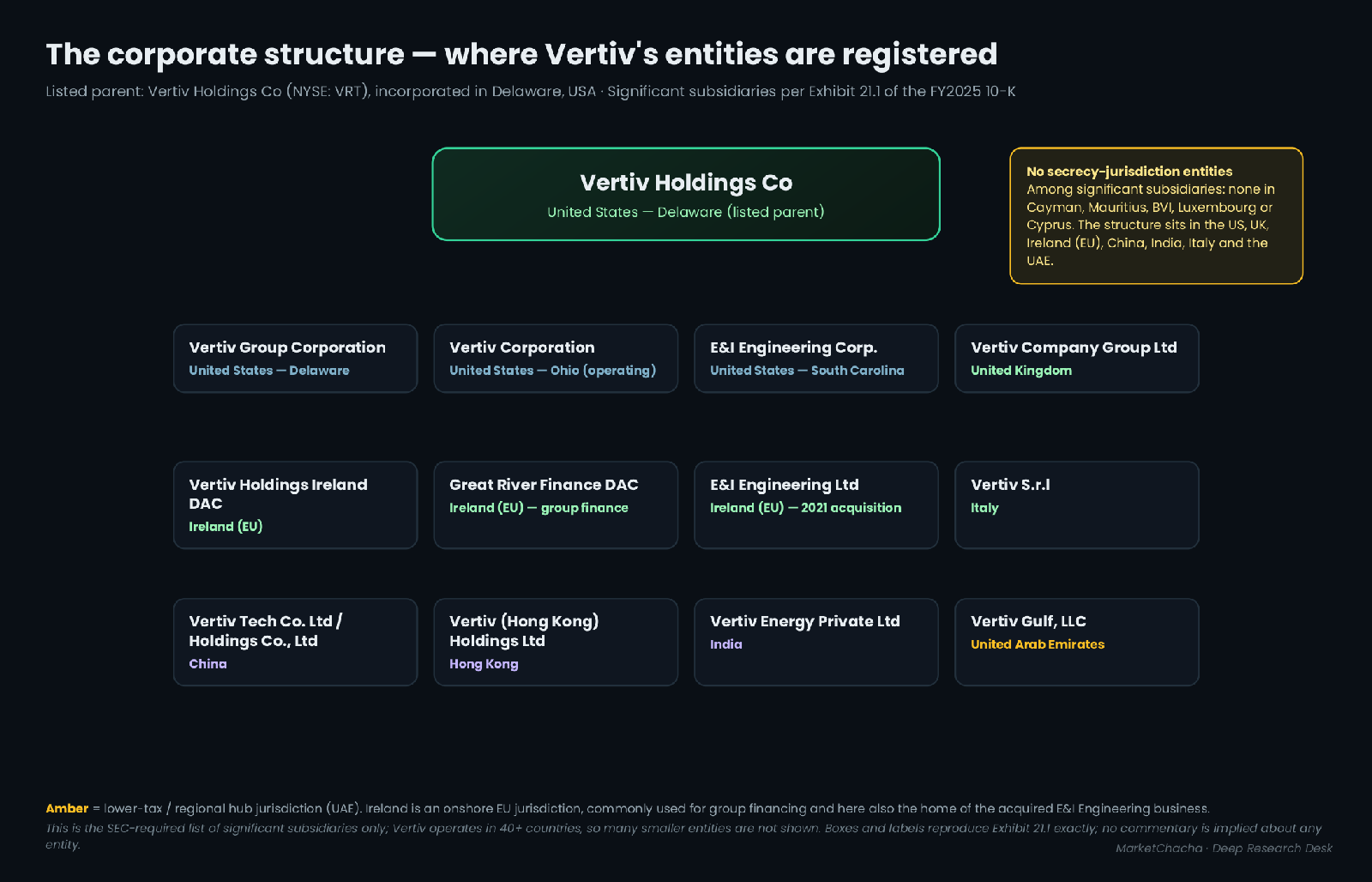
Vertiv's corporate structure is onshore and unremarkable — itself a finding worth recording. The Exhibit 21.1 list of significant subsidiaries in the FY2025 10-K shows entities in the United States (Delaware, Ohio, South Carolina), the United Kingdom, Ireland, Italy, China, Hong Kong, India and the United Arab Emirates. There are no entities in Cayman, Mauritius, the British Virgin Islands, Luxembourg or Cyprus on that list. Ireland appears four times — including a group-finance vehicle (Great River Finance DAC) and E&I Engineering, the Irish switchgear maker Vertiv acquired in 2021; Ireland is an onshore EU jurisdiction commonly used for group financing, not a secrecy jurisdiction. A UAE entity (Vertiv Gulf, LLC) serves the Middle East. We name these as facts; nothing here implies anything about any entity.
Capital history — every time they raised money and moved it
Vertiv's capital history is a SPAC history, and the single most important artefact in the numbers comes from it. When the company went public in 2020 it inherited public and private warrants. Under US GAAP those warrants were carried as a liability and remeasured to fair value every quarter, so as the share price rose the liability rose and created a non-cash loss — $143.7m in 2020, $61.9m in 2021, a $90.9m gain in 2022, then $157.9m and $449.2m of losses in 2023 and 2024. The warrants were largely exercised or settled by 2024 — about $644.2m was reclassified from warrant liability into equity that year — which is why the 2025 income statement is finally clean of the effect. Separately, Platinum Equity exited through secondary offerings in 2020–2022 (sales by an existing holder, not new cash to the company). Vertiv has done no stock splits. In November 2023 the board authorised a $3 billion, four-year share-repurchase programme; the company bought back $599.9m of stock in 2024 but paused buybacks in 2025 (spending on acquisitions instead), and pays a small and rising dividend ($66.6m in 2025, a ~0.09% yield). On M&A, 2023–2025 brought a run of bolt-ons to own more of the cooling supply chain — CoolTera (liquid-cooling CDUs, 2023), Great Lakes (racks) and ThermoKey (heat rejection), the assets of BiXin Energy (chillers), and, in 2025, PurgeRite (fluid management) in a deal reported at roughly $1bn. That 2025 spending is what pushed goodwill up ~$713m in the year.
Who runs it, and the wider web
Executive Chairman: David M. Cote (ex-Honeywell), who has led the board since the 2020 listing. CEO: Giordano Albertazzi, a long-time Vertiv/Emerson executive, since 1 January 2023. CFO: David Fallon, CFO since 2017, retired in 2025; Craig Chamberlin (previously CFO of Wabtec's Transit segment) became EVP & CFO effective 10 November 2025 — a routine, disclosed succession, not a mid-cycle departure. The independent auditor is Ernst & Young LLP, which has audited Vertiv across every year of its public life (FY2020–FY2025); PricewaterhouseCoopers was the pre-listing predecessor auditor. We found no auditor resignation, no qualified opinion and no going-concern language in the period reviewed.
The regulatory and surveillance record
As a US NYSE-listed company, Vertiv is not subject to the Indian ASM/GSM surveillance framework. We found no SEC enforcement action, AAER or litigation release naming Vertiv in the period reviewed, and no Item 4.01 auditor-dismissal 8-K. On credit, the signal is positive: Moody's upgraded Vertiv to Ba1 from Ba2 in the third quarter of 2025 — one notch below investment grade — reflecting deleveraging; the company reported net leverage of roughly 0.5× and liquidity around $2.7bn. Ordinary-course legal proceedings (commercial, IP, product) exist as in any large manufacturer; none is disclosed as individually material. An activist investor, Starboard Value, disclosed a stake in October 2022 and pressed for the margin improvement that the subsequent numbers delivered.
Forensic checks — what the accounts show
| Check | What we found | A benign explanation |
|---|---|---|
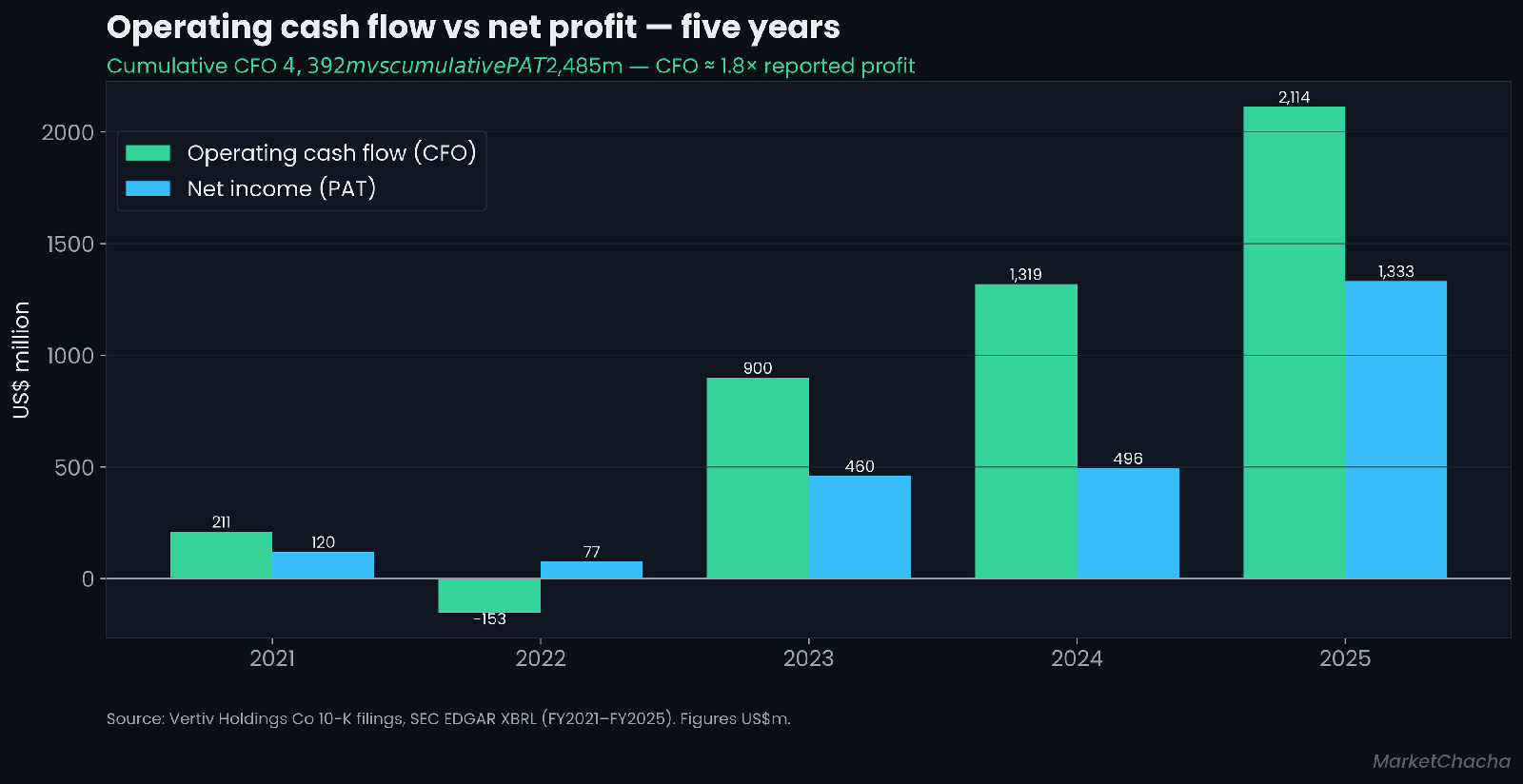
| 5-yr CFO ÷ PAT | ≈ 1.8× (cumulative CFO $4,392m vs PAT $2,485m). Reported profit is more than fully backed by cash. | Strong; helped by customer advances/deposits on a fast-growing order book and working-capital timing. Watch if it reverses as the backlog ships. |
| Cash vs interest cost | Cash $1,728m; interest expense fell to $86.1m (2025) from $150.4m (2024) on flat debt. | Rising interest income on a growing cash pile plus term-loan repricing/hedges; interest income is not separately isolated in the XBRL data. |
| Implied interest rate | ≈ 5.1% (2024) → ≈ 3.0% (2025) on ~$2.9bn average debt. | Same as above — the fall is the item to watch, not an accusation. |
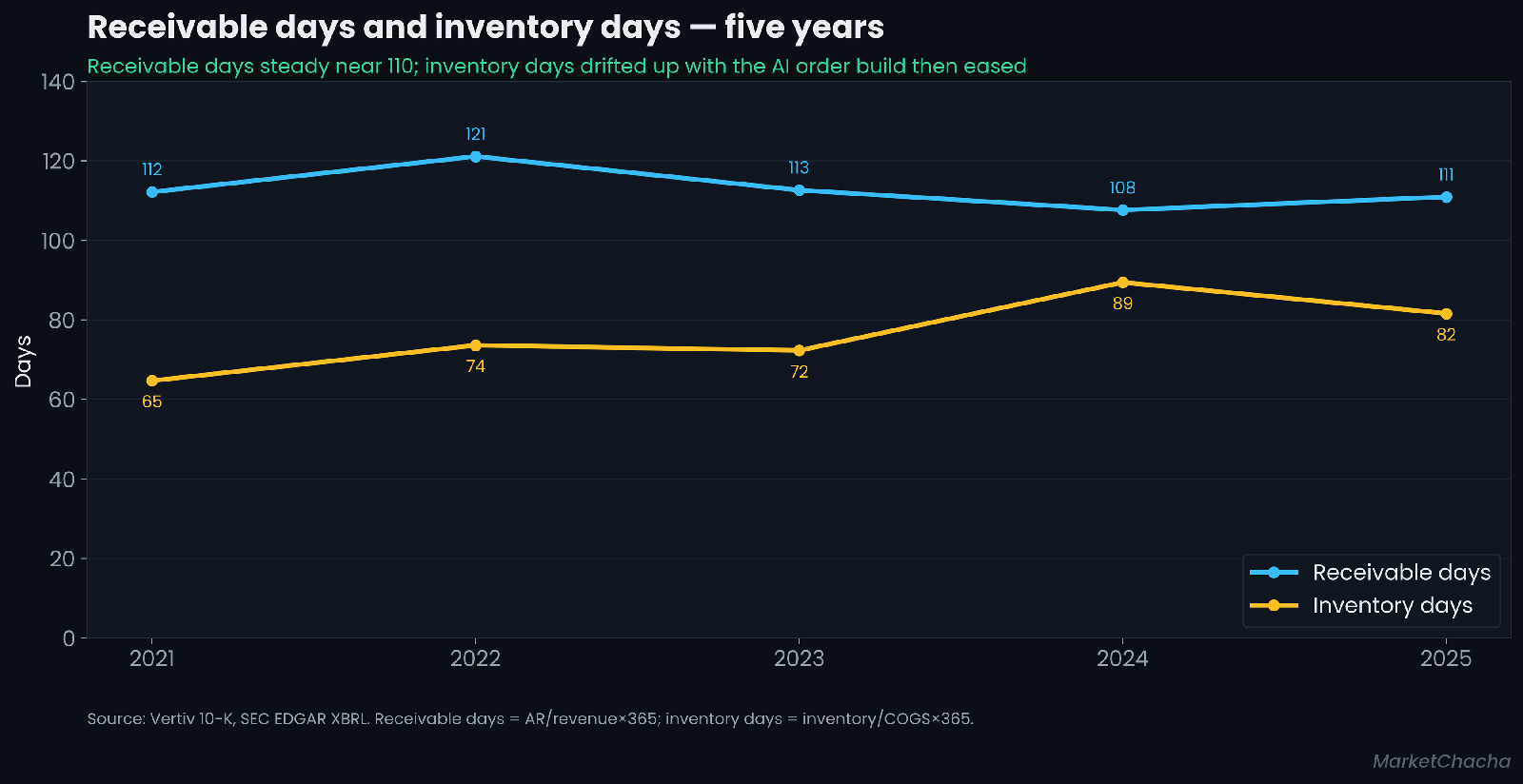
| Receivable / inventory days | Receivable days steady ~110; inventory days 65 → 82 (peaked 89 in 2024). Receivables grew 32% in FY2025 vs revenue 28%. | Broadly in line with growth; the AI order build lifted inventory then eased. Keep watching receivables vs sales. |
| Other income as % of pretax | The only large non-operating item was the non-cash warrant swing: a $449.2m loss in 2024 (≈59% of pretax) → $0 in 2025. | SPAC-warrant accounting, now resolved; FY2025 pretax is essentially operating income less interest — high quality. |
| Auditor | Ernst & Young throughout FY2020–FY2025; no change, resignation or qualification found. | Continuity; a clean audit history. |
| Subsidiaries & jurisdictions | Onshore: US/UK/Ireland/Italy/China/HK/India/UAE. No Cayman/Mauritius/BVI/Luxembourg among significant subs. | Ireland = onshore EU + the E&I acquisition; UAE = regional hub. Unremarkable structure. |
| Dilution & buybacks | Shares ~381m → 385m (modest). SPAC-warrant overhang settled by 2024. $599.9m repurchased in 2024; buybacks paused in 2025. | Low ongoing dilution; capital redirected to M&A rather than repurchases in 2025. |
| Insider trading | Insiders net sellers, zero buys; Chairman Cote sold ~$10.2m in Feb 2026. | Post-run monetisation via 10b5-1 plans; no controlling block. |
| Capex vs D&A | Capex below depreciation every year (0.3× → 0.7×); capex ~2% of sales. | Asset-light assembler; capex rising as it adds cooling/power capacity. |
| Goodwill | Goodwill + intangibles ≈ $2.03bn = ~17% of assets, up $713m in 2025 on acquisitions. | Growth partly bought; watch for any future impairment if acquired lines underperform. |
What we could not verify
Several things are simply not disclosed, and we flag them rather than guess. Vertiv does not name its largest customers or publish a customer-concentration percentage, so we cannot quantify hyperscaler dependency beyond the end-market level. It does not publish a single-source supplier list, so specific supply-chain choke points are not verifiable from the filings. Interest income is not broken out separately in the XBRL data, so the exact split between lower interest cost and higher interest income in 2025 is inferred, not read directly. The $15bn backlog and order-growth figures are company-reported operational metrics, not audited financial-statement lines. And the institutional-ownership percentages are drawn from third-party 13F/13G aggregations that lag by a quarter.
What would change the picture
The concrete, checkable things to watch next: the next quarterly order and backlog print (a book-to-bill falling below 1.0× would signal the AI order wave cresting); the receivables line versus revenue (a sustained jump in receivable days would be the first accounting tell if growth outruns collections); the gross-margin trend as liquid cooling scales; any goodwill impairment on the 2023–2025 acquisitions; whether the company restarts the $3bn buyback or keeps spending on M&A; the next auditor's report for any change in tone; and further rating actions (a move to investment grade would be a genuine milestone). None of these is a prediction — they are the lines on which the story will actually be told.
Sources
- Vertiv Holdings Co, Form 10-K FY2025 (filed 13 Feb 2026) — SEC EDGAR: https://www.sec.gov/Archives/edgar/data/1674101/000167410126000008/vrt-20251231.htm
- Vertiv Holdings Co, Exhibit 21.1 — List of Subsidiaries (FY2025 10-K): https://www.sec.gov/Archives/edgar/data/1674101/000167410126000008/exhibitno211vrt02132026.htm
- SEC EDGAR XBRL company facts (5-year financials), CIK 0001674101: https://data.sec.gov/api/xbrl/companyfacts/CIK0001674101.json
- Vertiv Holdings Co, Form 10-K FY2022 and FY2020 (auditor references) — SEC EDGAR: https://www.sec.gov/cgi-bin/browse-edgar?action=getcompany&CIK=0001674101&type=10-K
- Vertiv Q3-2025 results / backlog, orders, Moody's upgrade — PR Newswire: https://www.prnewswire.com/news-releases/vertiv-reports-strong-third-quarter-results-including-organic-orders-60-diluted-eps-122-adjusted-eps-63-raises-2025-guidance-302591333.html
- Vertiv Q4-2025 results (backlog $15.0bn, orders +252%) — Vertiv IR: https://investors.vertiv.com/news/news-details/2026/Vertiv-Reports-Strong-Fourth-Quarter-with-Organic-Orders-Growth-of-252-and-Diluted-EPS-Growth-of-200-Adjusted-Diluted-EPS-37/default.aspx
- Vertiv announces CFO succession (Fallon → Chamberlin) — PR Newswire / Vertiv IR: https://www.prnewswire.com/news-releases/vertiv-announces-cfo-retirement-reaffirms-second-quarter-and-full-year-2025-guidance-302466989.html
- GS Acquisition Holdings / Vertiv SPAC merger background — SPACInsider: https://www.spacinsider.com/news/uncategorized/gs-acquisition-holdings-announces-combination-vertiv
- Starboard Value stake in Vertiv (Oct 2022) — CNBC: https://www.cnbc.com/2022/10/29/activist-starboard-takes-a-stake-in-vertiv-and-an-opportunity-to-boost-margins-is-in-sight.html
- Institutional ownership (Vanguard 13G/A ~10%, BlackRock, etc.) — Fintel: https://fintel.io/so/us/vrt
- David Cote insider sale (26 Feb 2026, ~$10.2m) — Benzinga: https://www.benzinga.com/insights/news/26/03/51002148/david-cote-executes-sell-order-offloads-10-21m-in-vertiv-holdings-stock
- Share-price history (split/dividend-adjusted annual closes) — Macrotrends: https://www.macrotrends.net/stocks/charts/VRT/vertiv-holdings/stock-price-history
- CoolTera / liquid-cooling acquisitions — DataCenterDynamics: https://www.datacenterdynamics.com/en/news/vertiv-acquires-data-center-liquid-cooling-company-cooltera/
- Eaton (ETN) P/E for peer context — GuruFocus / FinanceCharts: https://www.financecharts.com/stocks/ETN/value/pe-ratio
FAQ
Why did Vertiv's net profit jump 169% in 2025 when revenue rose only 28%? Because 2024's profit was depressed by a $449.2m non-cash charge for the change in fair value of its SPAC warrants, and that charge went to zero in 2025 once the warrants were settled. Operating income — the real-business number — rose a more modest ~34%.
Does Vertiv have a controlling shareholder? No. Platinum Equity, which took it public, and the Goldman-affiliated SPAC sponsor have both exited. Ownership is now diffuse institutional, led by Vanguard (~10%) and BlackRock (~9–10%).
Does Vertiv use offshore tax-haven subsidiaries? Its list of significant subsidiaries shows entities in the US, UK, Ireland, Italy, China, Hong Kong, India and the UAE — and none in Cayman, Mauritius, BVI or Luxembourg. Ireland (EU) hosts a group-finance vehicle and the acquired E&I business.
Is the cash real? Over five years Vertiv converted cumulative profit of $2,485m into $4,392m of operating cash flow — about 1.8×. On this measure reported earnings are more than fully backed by cash, helped by advances on a growing order book.
What is the $15 billion backlog? It is the company-reported value of unfilled orders at end-2025, up 109% year on year, driven by hyperscale and colocation data-centre demand. It is an operational metric, not an audited financial-statement figure.
Is this a buy? This report takes no view. It contains no rating, no target price and no recommendation — only sourced facts and computed ratios so you can decide for yourself.
Independent research for education and discussion only. Not investment advice, not a recommendation, and not a rating — we issue no buy/sell calls and no target prices. Every figure is sourced from the primary documents linked above; figures can be restated and we can make mistakes, so always verify against the original. Nothing here alleges wrongdoing by any company or individual: where a fact raises a question we state the fact, cite it, and give the benign explanation alongside. Offshore holding structures, pledging and preferential allotments are all legal and common — they are disclosed here as facts, not as accusations.
This article is for educational and informational purposes only. It is not financial advice, investment recommendation, or a solicitation to buy or sell securities. Investing involves significant risks. I am not a SEBI-registered investment advisor. Readers should consult their own financial advisor and conduct their own research before making any investment decisions.
Comments
Join the conversation
Sign in to join the conversation.
Follow replies, add your view, and take part in the discussion.
Sign in to commentLoading comments...