

US retail sales cooled to +0.2% in June — but strip out gas and the consumer looks fine
The US consumer didn't fall off a cliff in June — but the spending engine did downshift. Here's what the number actually says, and the one line the headline quietly buries.
The numbers
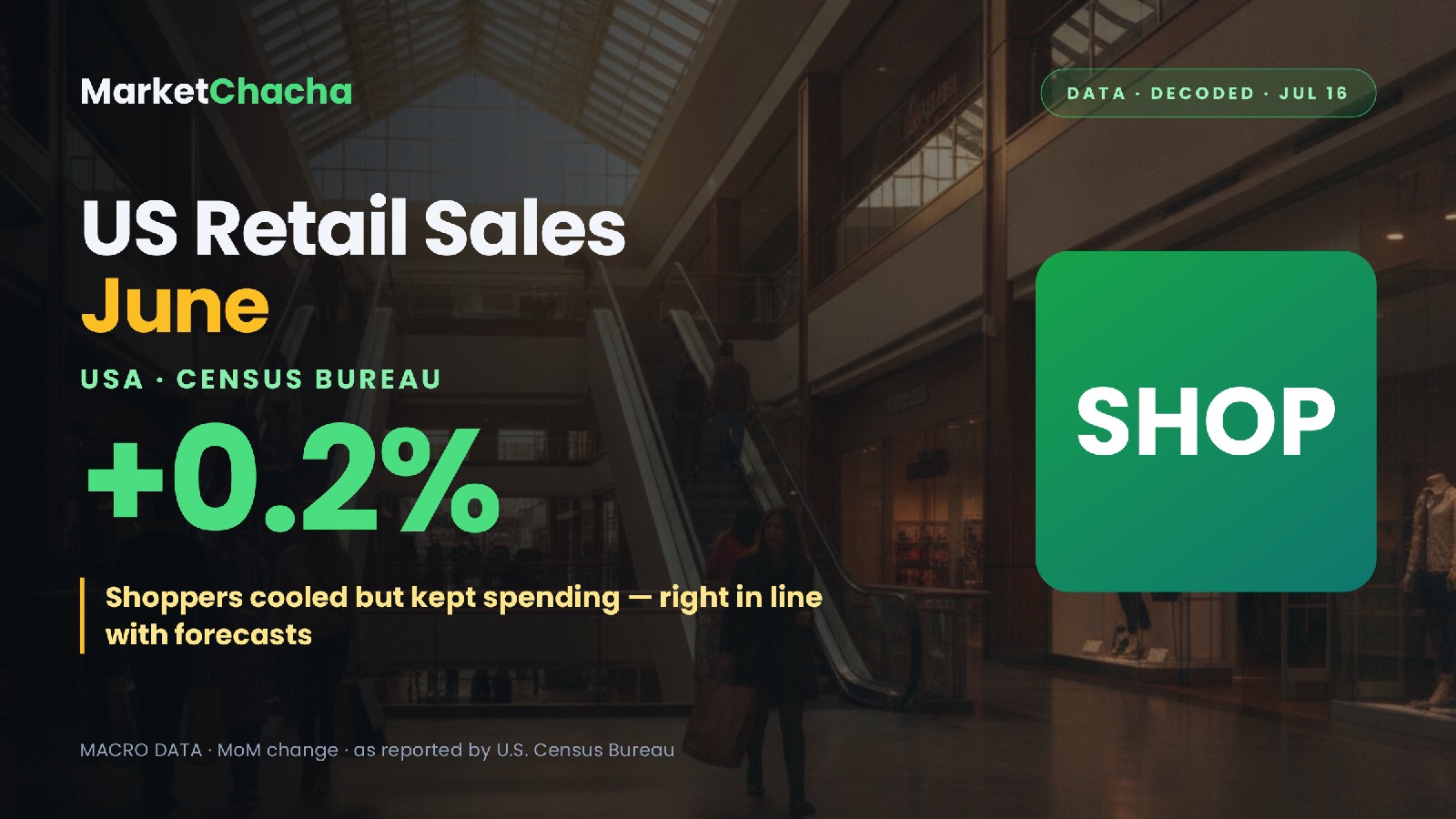
US retail and food-services sales rose +0.2% in June to $768.6 billion, matching the +0.2% economists had penciled in, per the Census Bureau and the AP. That's a sharp slowdown from May, which was revised up to +1.0% (from +0.9%). Year over year, sales were up +6.7%.
One caveat the Census Bureau flags itself: the monthly gain carries a ±0.4% margin of error, so statistically June is basically indistinguishable from flat. The details tell the real story:
- Online (nonstore): +1.9% — the standout, juiced by Amazon's late-June Prime Day.
- Sporting goods, hobby & books: +1.3% — World Cup spending showing up in the till.
- Autos & parts: +1.9% — still doing heavy lifting on the topline.
- Gas stations: −5.3% — pump prices fell hard, dragging the dollar figure down.
- Clothing −0.3%, grocery −0.2%, health & personal care −0.8% — everyday categories softened.
- Restaurants & bars: +0.1% — near flat, a sign shoppers turned a touch choosier on dining out.
What it means
Here's the thing the headline hides: retail sales are measured in dollars, not units, and aren't adjusted for inflation. So when gasoline prices tumble, the gas-station line drops even if people bought the same gallons — mechanically pulling the whole number down for a good reason (cheaper fuel leaves more cash for everything else). Strip gas out and sales rose +0.7%; strip autos and gas, still +0.4%. In other words, the underlying consumer looks firmer than the flat +0.2% suggests.
Layer in the same-morning jobs read — weekly jobless claims fell to 208,000, below the 217,000 expected, as reported by Bloomberg — and you get a labor market that's still holding. Cooling-but-alive spending, a firm job market, and the soft June CPI (3.5%) and PPI (5.5%) from earlier this week add up to the same picture: a soft landing that's still on the table.
Who it touches
- The Fed (Jul 29 FOMC): An in-line, softening consumer plus cooling inflation lets policymakers stay patient — it doesn't force a rate cut, but it keeps the door open rather than slamming it.
- E-commerce & marketplaces: The +1.9% online pop rode Prime Day; watch whether that's a pull-forward that leaves July looking thin.
- Discretionary vs staples: Money flowed to autos, online and experiences (World Cup) while grocery, clothing and drugstores dipped — a classic "trade spending around, don't stop it" month.
- Rate-sensitive corners: With the print landing on forecast, bond yields had little reason to lurch — the bigger swing factor stays the Fed's tone.
What to watch
The next tell is tomorrow's University of Michigan consumer-sentiment reading (July, preliminary) — does confidence back up the spending? After that, the July 29 FOMC decision is the one that turns all this soft data into an actual rate call. The next retail sales print (July data) lands August 14.
As of 9:20 AM ET (6:50 PM IST), Jul 16, 2026. Sources: U.S. Census Bureau (Advance Retail Sales, CB26-113), AP via WRAL, Bloomberg. For discussion and education only — not investment advice. Verify before acting.
This article is for educational and informational purposes only. It is not financial advice, investment recommendation, or a solicitation to buy or sell securities. Investing involves significant risks. I am not a SEBI-registered investment advisor. Readers should consult their own financial advisor and conduct their own research before making any investment decisions.
Comments
Join the conversation
Sign in to join the conversation.
Follow replies, add your view, and take part in the discussion.
Sign in to commentLoading comments...