

Sun Pharma: what their latest filing actually means
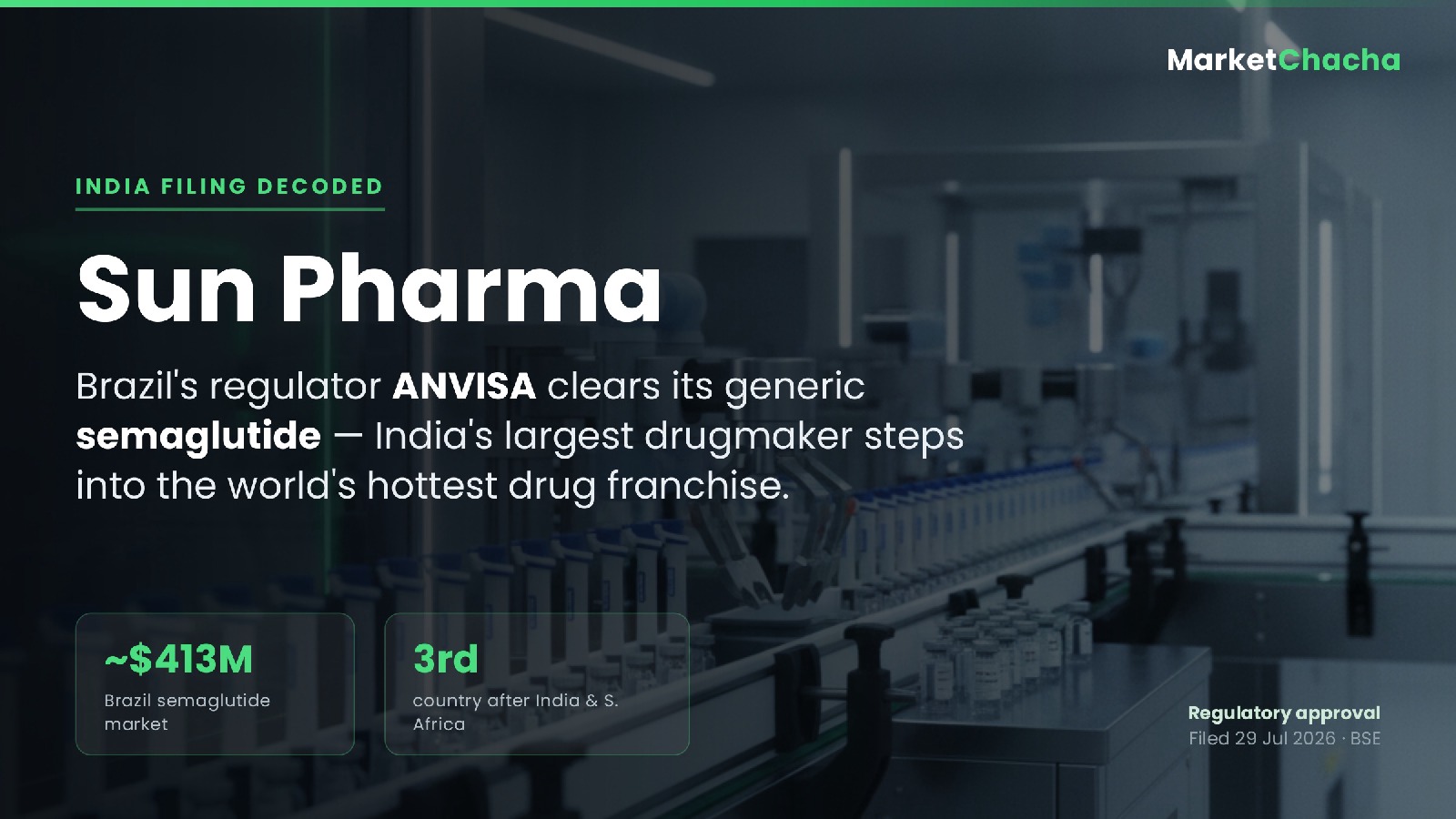
Sun Pharmaceutical Industries has told the exchanges that Brazil's drug regulator, ANVISA, has approved it to manufacture and market a generic version of semaglutide — the molecule behind the world's best-selling diabetes and weight-loss injections — in Brazil. In plain terms: India's largest drugmaker has just been cleared to sell its own copy of a blockbuster drug in one of the first big markets where that drug is opening up to competition.
What was announced
ANVISA has approved Sun Pharma's generic semaglutide injection for adults with type 2 diabetes (as an add-on to diet and exercise). Key details from the filing and company release:
- It will be sold under the brand Seemasun, commercialised in Brazil in partnership with local player Hypera Pharma.
- Format: pre-filled, once-weekly multi-dose pens in 2 mg/1.5 mL and 4 mg/3 mL strengths.
- Brazil's semaglutide market is worth roughly US$413 million a year (IQVIA, moving-annual-total to June 2026).
- This is Sun's third semaglutide market entry, after India and South Africa.
One nuance worth knowing: a marketing approval is not the same as a shelf date. In Brazil, pharmacy pricing still has to clear a separate price regulator (CMED) before sales scale, and ANVISA cleared several semaglutide rivals around the same time — so this is an early foot in the door, not a monopoly.
What this type of filing means
This is a regulatory product approval disclosure — a company telling the market that a health authority has given it permission to make and sell a specific drug in a specific country. For a generics company, an approval is the starting gun: it converts years of R&D and factory investment into a product that can actually earn revenue. "Generic" means the same active molecule as the original branded drug (here, Novo Nordisk's Ozempic/Wegovy), made by another company once patents in that market allow it. Semaglutide's patents are beginning to expire in markets like Brazil, Canada and India well before the US, which is why Indian drugmakers are racing to get approvals in these countries first.
Why it matters / potential impact
Weight-loss and diabetes drugs (the GLP-1 class) are the single hottest theme in global pharma, and semaglutide is the crown jewel. Being early to a legal generic gives Sun a shot at real volumes and, potentially, high-margin sales before the market floods with copies. But two things keep this grounded: the Brazil market is small relative to Sun's overall size, and it is competitive from day one (multiple approvals, plus the pending price clearance). The strategic value is less about Brazil alone and more about Sun assembling an early, multi-country generic-semaglutide franchise that could matter a lot as bigger markets open up. No price prediction here — just the mechanics of the opportunity.
Is it expensive?
Sun Pharma is valued at roughly ₹4.7 lakh crore (about ₹4.66–4.76 trillion) and trades at a trailing P/E of around 38–42x (~40x). That is a rich, premium multiple — not a cheap stock — but it is the kind of premium the market has long paid for India's biggest, highest-quality pharma with a growing branded-specialty portfolio. For context, fellow semaglutide contender Dr Reddy's Laboratories is far smaller at about ₹95,000 crore market cap and trades cheaper, in the high-20s P/E. So Sun is both several times larger and more expensively valued than a direct rival chasing the same drug — investors are paying up for scale and franchise quality, which also means less room for disappointment. This is honest framing, not a buy or sell call.
The business
Sun Pharma is India's largest pharmaceutical company. Its revenue comes from several buckets: India branded formulations (it is the No.1 firm by domestic prescriptions), a large US business (generics plus a fast-growing branded specialty portfolio — skin, eye and other niche drugs), emerging markets (where Brazil and South Africa sit), rest of world, and active pharmaceutical ingredients (APIs). The Brazil semaglutide approval lands inside the emerging-markets/global-generics slice — so this news affects one product in one country, not the whole company at once.
Beginner takeaway
Sun Pharma got the green light to sell its own version of the famous "Ozempic" molecule in Brazil. It is a genuine positive that shows Sun is early to a huge global drug trend, but Brazil by itself is a small piece of a very large company, and rivals got cleared too. Treat it as one building block in a bigger semaglutide story, not a game-changer on its own.
FAQ
What exactly is semaglutide? It is the active ingredient in Novo Nordisk's Ozempic (diabetes) and Wegovy (weight loss) — the GLP-1 injections that have become a global phenomenon. Sun's approval here is for type 2 diabetes.
Can Sun start selling it in Brazil immediately? Not quite. ANVISA's marketing approval is a big step, but pharmacy sales in Brazil also need a separate price clearance, and Novo's patent position differs by market — so actual timing and volumes depend on those.
Will this add a lot to Sun's profits? On its own, probably not much — Brazil's semaglutide market is about US$413 million and Sun is a ₹4.7-lakh-crore giant. The real prize is building an early generic-semaglutide position across many countries as patents expire.
Is a generic as good as the original? A generic is the same molecule approved by the regulator to work comparably; the differences are usually the brand name, the pen device and (often) a lower price rather than the drug itself.
As of 30 July 2026. Source: official BSE filing dated 29 July 2026 — read it directly here. We summarise filings for education and may make errors, so always verify against the official document. Educational content only — not investment advice, not a buy/sell recommendation.
This article is for educational and informational purposes only. It is not financial advice, investment recommendation, or a solicitation to buy or sell securities. Investing involves significant risks. I am not a SEBI-registered investment advisor. Readers should consult their own financial advisor and conduct their own research before making any investment decisions.
Comments
Join the conversation
Sign in to join the conversation.
Follow replies, add your view, and take part in the discussion.
Sign in to commentLoading comments...