

HFCL (NSE: HFCL): the full file — the numbers, the owners, and what the filings actually show
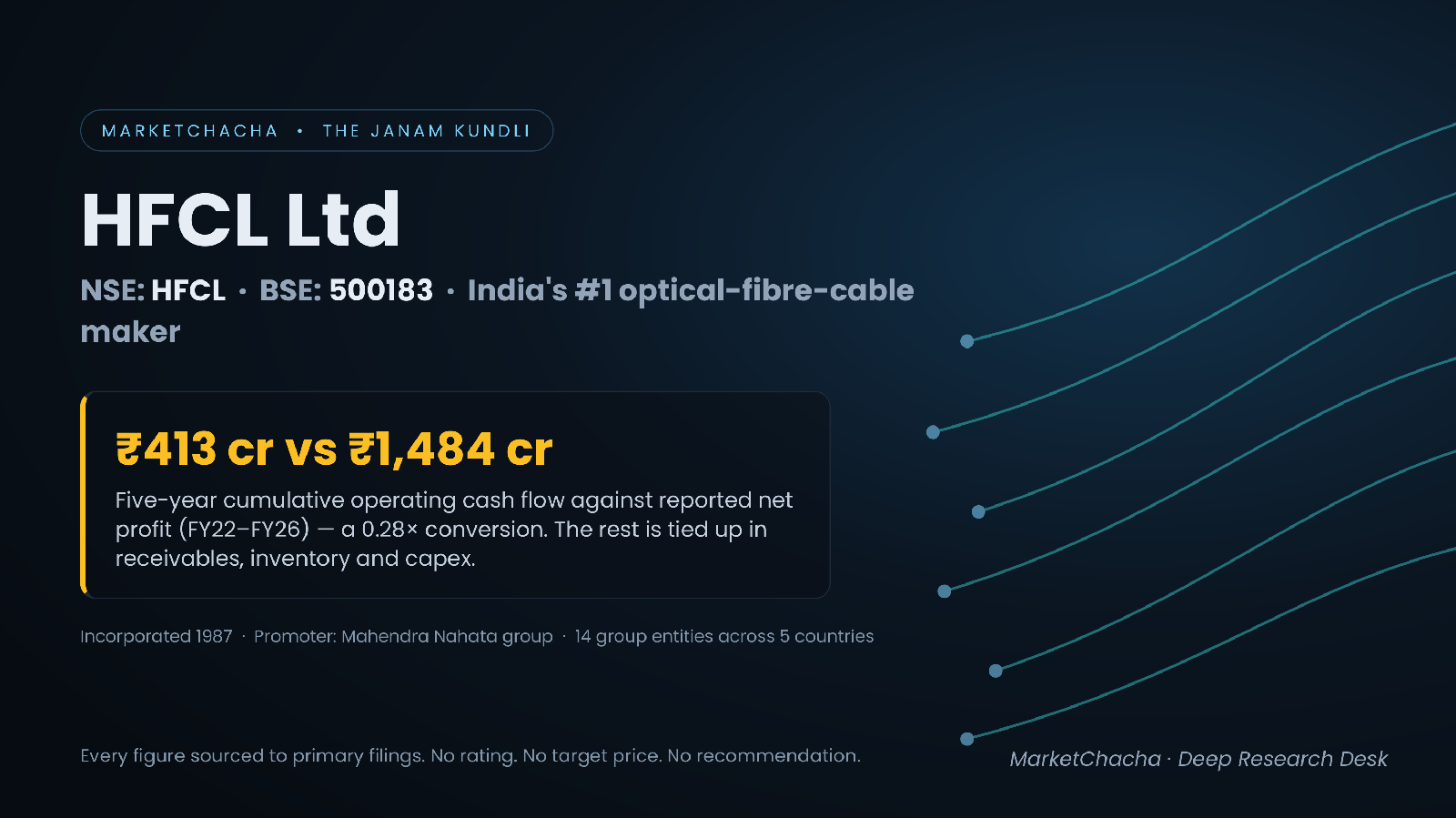
HFCL Limited makes the physical plumbing of India's networks — optical fibre, optical fibre cable, and telecom equipment such as routers, Wi-Fi access points and unlicensed-band radios — and it also builds networks turnkey for the government and for telcos. It earns money three ways: selling products (about 59% of FY26 revenue), executing network-services and EPC contracts, and, increasingly, operations-and-maintenance. What the record shows is a company that grew revenue barely faster than inflation for five years, that reports steady profits which have historically not converted fully into cash, whose promoters have steadily reduced their stake and whose long-term credit rating was downgraded in September 2025 — even as the stock more than doubled in a year.
This is a forensic life story — a janam kundli — built entirely from primary filings. We issue no rating, no target and no opinion on the shares. We state what the documents say and, where a number raises a question, we give the benign reading alongside.
Origin — the company's birth certificate
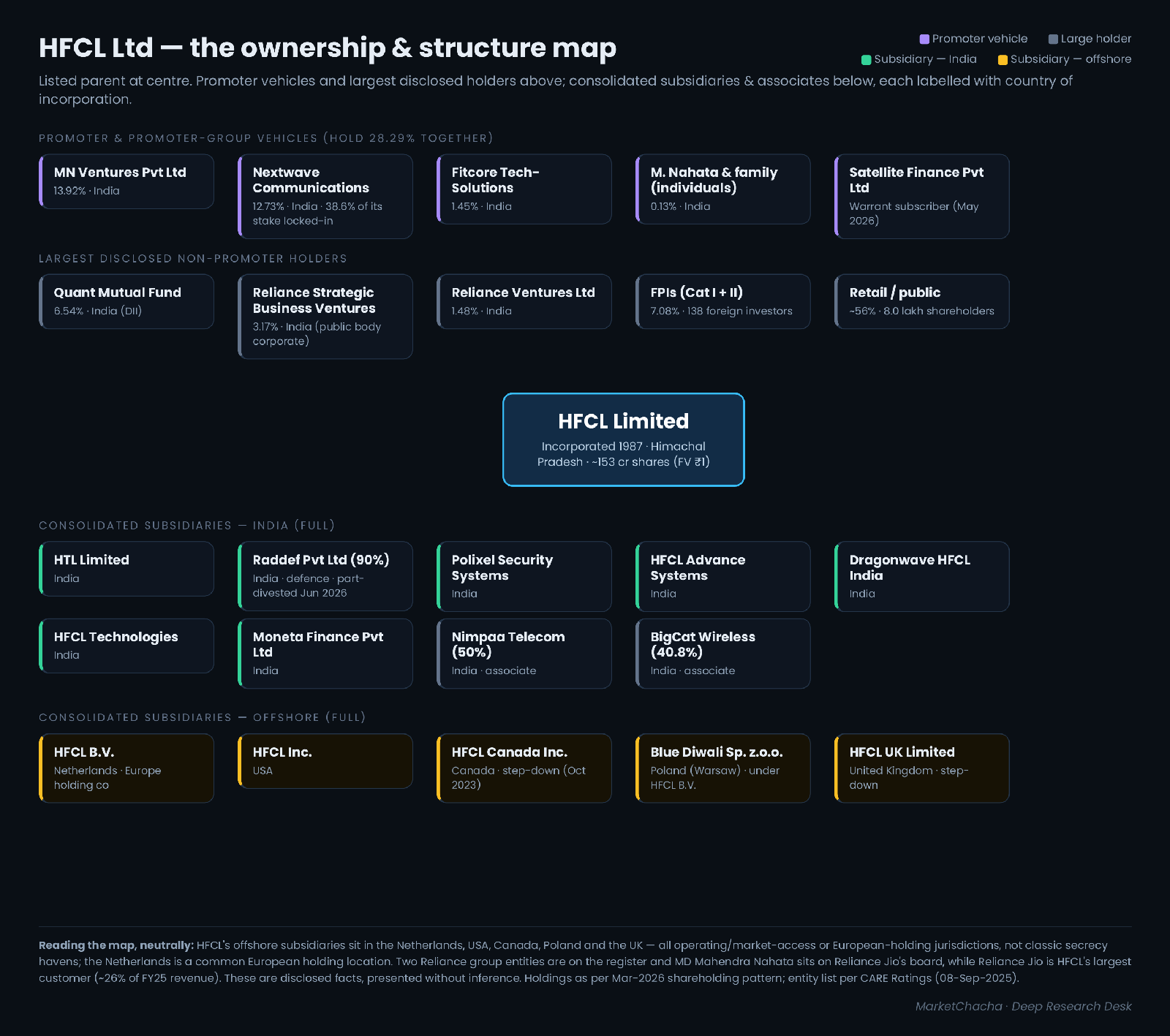
Himachal Futuristic Communications Limited was incorporated in May 1987 as a public limited company in Himachal Pradesh, set up to assemble telecom equipment at a plant in Solan. It was co-founded by Mahendra Nahata along with Deepak Malhotra and Vinay Maloo. Over the decades it moved from equipment assembly into optical fibre, optical fibre cable, transmission and access equipment, defence electronics and turnkey network build-out; it now styles itself simply "HFCL Limited." It remains a Nahata-family promoted company — the promoter group holds 28.29% as of the March 2026 shareholding pattern, through vehicles including MN Ventures Private Limited (13.92%), Nextwave Communications Private Limited (12.73%) and Fitcore Tech-Solutions Private Limited (1.45%), plus small individual holdings of Mahendra and Anant Nahata.
The business — what they actually sell
Two engines. First, Telecom Products (about 59% of FY26 revenue): telecom and networking gear — point-to-point and point-to-multipoint unlicensed-band radios, indoor and outdoor Wi-Fi 5/6/7 access points — and optical fibre and optical fibre cable, where HFCL describes itself as the number-one OFC supplier in India, along with data-centre cabling and installation products. Second, the network-services / turnkey (EPC) business, which designs and rolls out fibre backbone, backhaul and fibre-to-the-home networks, plus a growing defence line. As of 30 June 2025 the consolidated order book was Rs 10,480 crore — about 2.57x FY25 revenue — of which roughly 82% is from government entities; segment-wise about 28% products, 38% network services and 34% operations-and-maintenance, with defence about 12% and exports about 4% (source: CARE Ratings press release, 8 September 2025).
Who actually buys from them
HFCL's customer base is concentrated, and the concentration is disclosed. Its single largest customer is the Reliance group: Reliance Jio and group contributed about 26% of revenue in FY25 (about 29% the year before), down from roughly 63% as far back as FY18, per CARE. The second-largest is BSNL at about 21% of FY25 revenue. Other named clients include Larsen & Toubro, RVNL and Vodafone. The relationship with Reliance is unusually deep and is worth stating precisely because it is a fact, not an inference: HFCL's managing director Mahendra Nahata has sat on the board of Reliance Jio Infocomm Limited since 2010; two Reliance group entities (Reliance Strategic Business Ventures, 3.17%, and Reliance Ventures, 1.48%) appear on HFCL's own share register; and Reliance is simultaneously HFCL's biggest customer. Each of these is disclosed in the ratings rationale and the shareholding pattern. We name them and stop. On 17 June 2026 HFCL announced a fresh Rs 2,666 crore BharatNet Phase-III order from RVNL for Uttar Pradesh (West), including ten years of maintenance — a government contract that lengthens revenue visibility and, being turnkey, working-capital intensity.
Where it is actually made — plants & supply chain
HFCL's manufacturing is real and physical. As of 30 June 2025 it reported optical-fibre capacity of 24.94 million fibre-km and OFC capacity of 25.60 million fibre-km, with plants in Goa and Hyderabad and the original Solan (Himachal Pradesh) site, plus a defence-equipment line at Hosur, Tamil Nadu. It is expanding: a planned capex of roughly Rs 325–350 crore over two years includes a large increase in intermittently-bonded-ribbon (IBR) cable capacity from about 1.73 to 19.01 million fibre-km, and a subsidiary is setting up a roughly Rs 580 crore optical-fibre preform facility — backward integration into the key raw material (optical fibre), which CARE notes now covers HFCL's entire internal requirement. What is not disclosed in granular form is the full external supply chain for other inputs and single-source dependencies; HFCL states it remains exposed to price volatility in externally-sourced raw materials, but does not name each supplier.
Five years of numbers
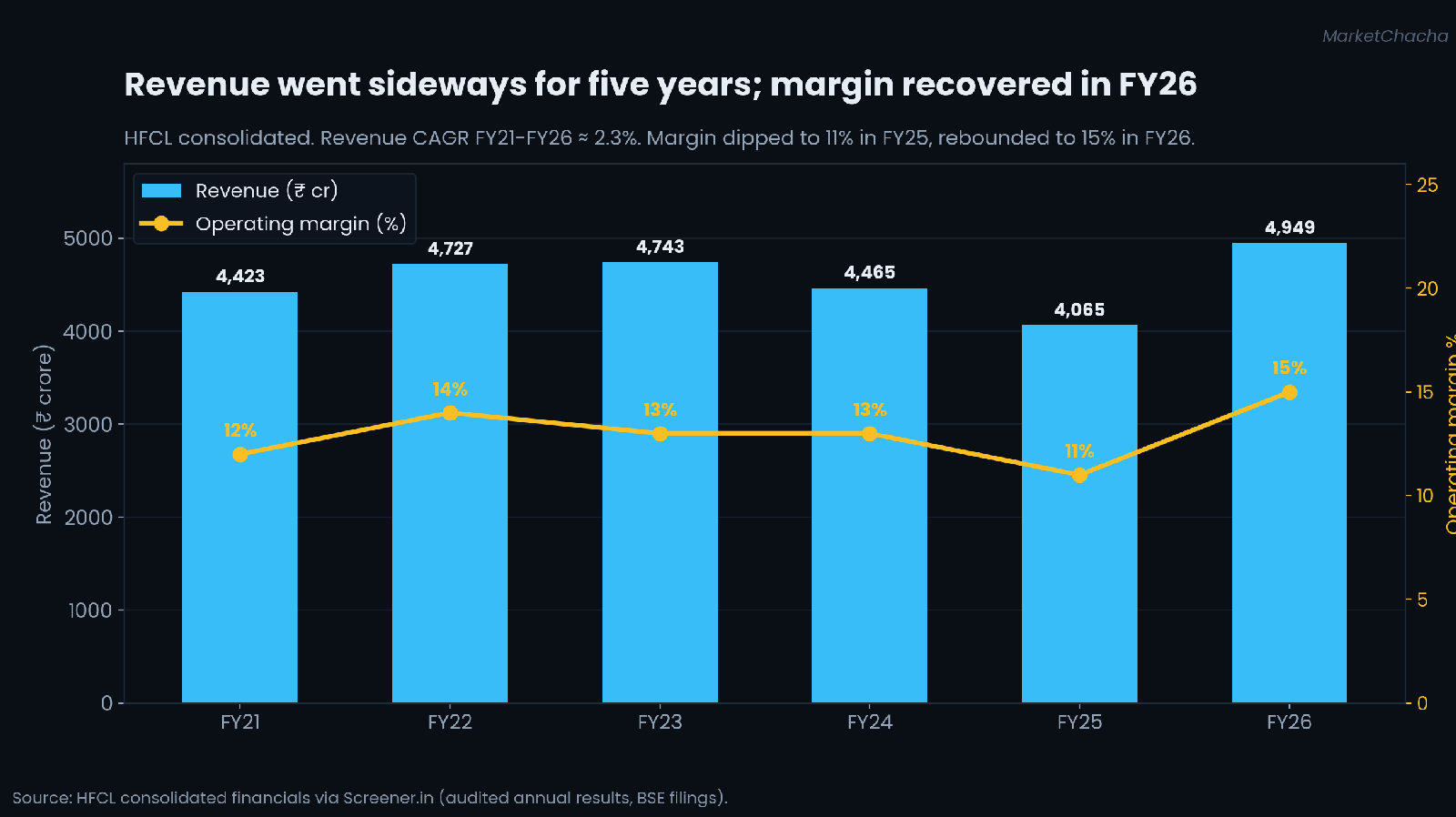
Revenue essentially flat-lined between FY20 and FY26, dipping in FY25 before a strong FY26 rebound. Profit was steady until an FY25 stumble and then a sharp FY26 recovery. Operating margin sat in the 11–15% band. The consolidated series (Rs crore):
| FY (Mar) | Revenue | Op. profit | OPM | Net profit | EPS (Rs) | CFO |
|---|---|---|---|---|---|---|
| FY2021 | 4,423 | 550 | 12% | 246 | 1.86 | 145 |
| FY2022 | 4,727 | 650 | 14% | 326 | 2.27 | 205 |
| FY2023 | 4,743 | 619 | 13% | 318 | 2.18 | 235 |
| FY2024 | 4,465 | 582 | 13% | 338 | 2.29 | -45 |
| FY2025 | 4,065 | 449 | 11% | 173 | 1.23 | 396 |
| FY2026 | 4,949 | 762 | 15% | 329 | 2.04 | -378 |
The arithmetic of growth (consolidated, via Screener.in): revenue CAGR FY21–FY26 about 2.3%; net-profit CAGR about 6.0%; EPS CAGR about 1.9% (EPS lags profit because the share count rose — see capital history). Against that pedestrian operating record, the market has been anything but pedestrian: HFCL's own price CAGR is reported at about 26% over five years and roughly +142% over the year to mid-2026, with the stock ranging between about Rs 59.8 and Rs 220 in the trailing 52 weeks and trading near Rs 200–220 by mid-July 2026 (source: Screener.in; Trendlyne). At that price the shares change hands at roughly 99x trailing earnings and about 6.3x book. For context, not comparison-as-judgement, the closest listed OFC peer, Sterlite Technologies, reported FY26 revenue of about Rs 4,745 crore and profit of about Rs 56 crore and trades on a very high P/E (its earnings are depressed) and about 11.6x book (source: Screener.in). We draw no conclusion from these multiples; we state them.
Now the single most important check on any set of accounts: does reported profit become cash? Over the five years FY2022–FY2026, HFCL reported cumulative net profit of Rs 1,484 crore but generated cumulative operating cash flow of only Rs 413 crore — a conversion of about 0.28x. Two of the six years (FY24 and FY26) show negative operating cash flow. This is the chart to sit with:
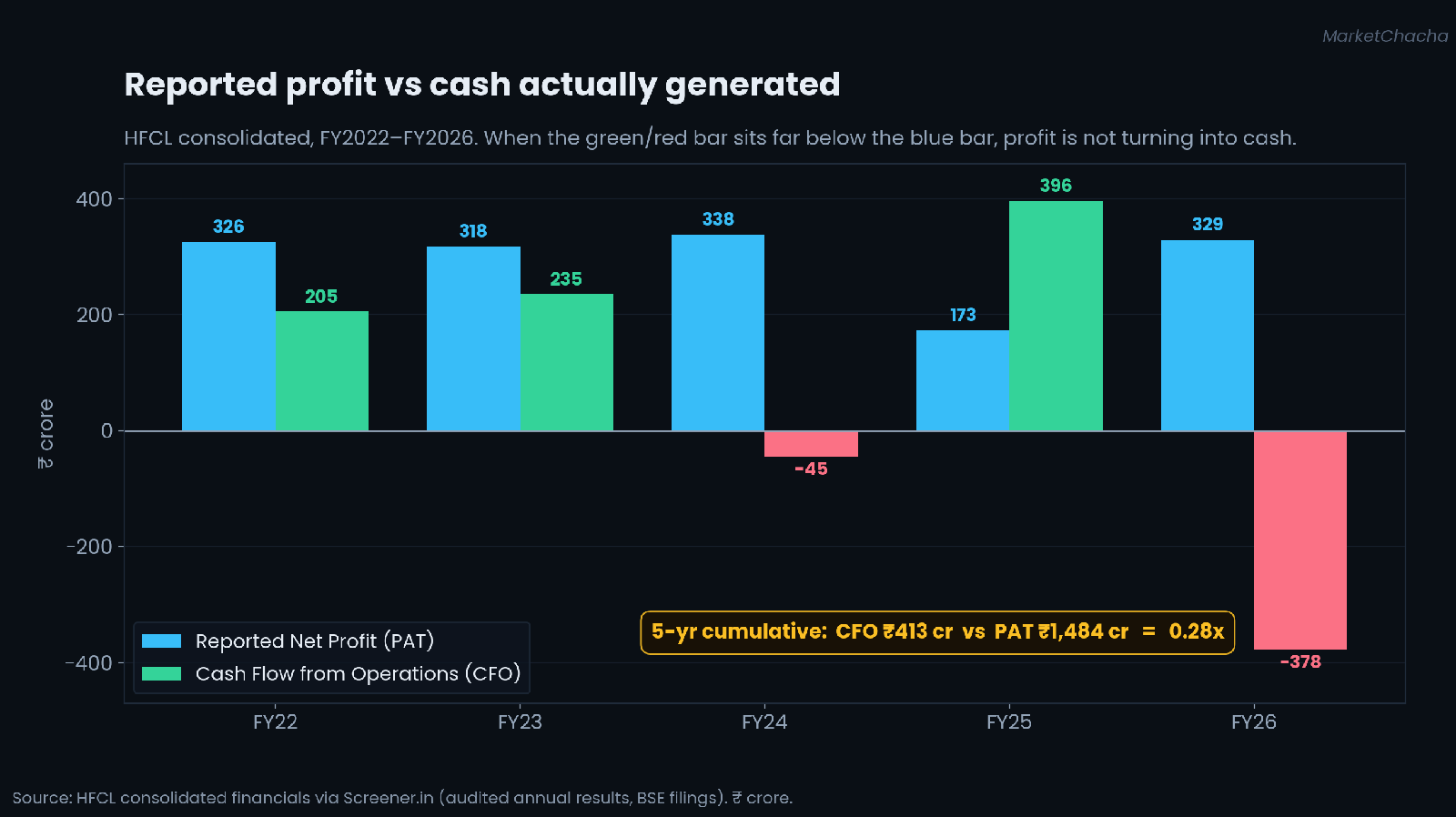
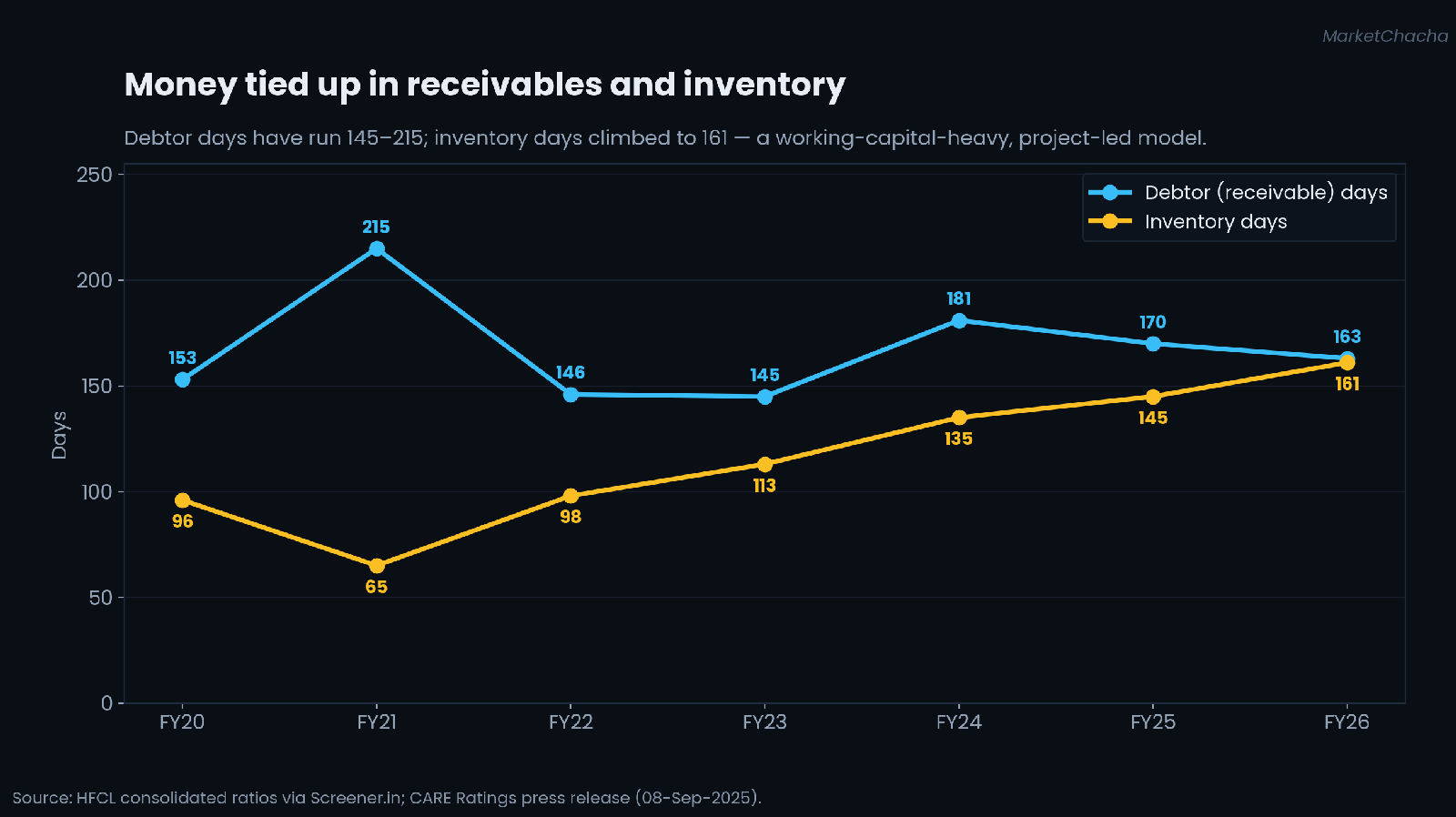
The benign reading — and it is a substantial one. HFCL is a working-capital-heavy, project-led business selling to government and large telcos on long payment cycles. The cash is not missing; it is visibly parked in receivables, inventory, unbilled revenue and fixed assets, every rupee of which is disclosed. CARE puts the FY25 operating cycle at 214 days and notes gross debtors of Rs 2,302 crore, unbilled revenue of Rs 652 crore and a jump in security deposits to Rs 421 crore. FY26's deeply negative operating cash flow coincided with a revenue surge in the March 2026 quarter (see below), which locked fresh money into receivables and inventory just as sales accelerated. This is a genuine cash-conversion question a reader should track — but it has a coherent, disclosed operating explanation, and it is a different animal from the "profits with no cash and no explanation" pattern that has undone other companies.
The latest quarter, decoded
The March 2026 quarter (Q4 FY26) was the strongest in the series: revenue of about Rs 1,824 crore, up roughly 127% from Rs 801 crore a year earlier; operating margin about 17%; net profit about Rs 184 crore (EPS Rs 1.17). That capped a full-year FY26 of Rs 4,949 crore revenue (+22%) and Rs 329 crore profit (+90% over the depressed FY25). The rebound reflects a recovery in optical-fibre-cable demand after a weak FY25, bulk product orders from Reliance Jio and BSNL, and the start of BharatNet Phase-III execution. The same acceleration is what pushed FY26 operating cash flow sharply negative, because turnkey execution consumes working capital before it is billed and collected. Whether the company can grow into its order book without a permanent step-up in receivables is, on the evidence, the central operating question — and it is the one CARE flags as its key monitorable.
Who owns it — and where those owners are registered
The ownership story has three moving parts, all documented in the quarterly shareholding patterns.
First, the promoters have been shrinking. Promoter holding fell from 39.24% (June 2023) to 28.29% (March 2026) — down about 11 percentage points. Part of that is arithmetic dilution from fresh share issuance; part is a reduction in promoter shares. Second, the institutional mix churned: domestic institutions rose from under 3% to a peak above 14% and then fell back to 8.57% by March 2026, dominated by Quant Mutual Fund's roughly 6.54% (about 100 million shares); foreign investors (FIIs/FPIs, 138 of them) hold about 7.08%. Retail and public holders now own about 56%, spread across roughly 8.0 lakh shareholders. Third — and most striking — the promoter pledge collapsed: pledged promoter shares ran at roughly 44–50% of the promoter holding from 2023 through March 2025, then dropped to about 1.1% from the June 2025 quarter and have stayed near 1.15% since.
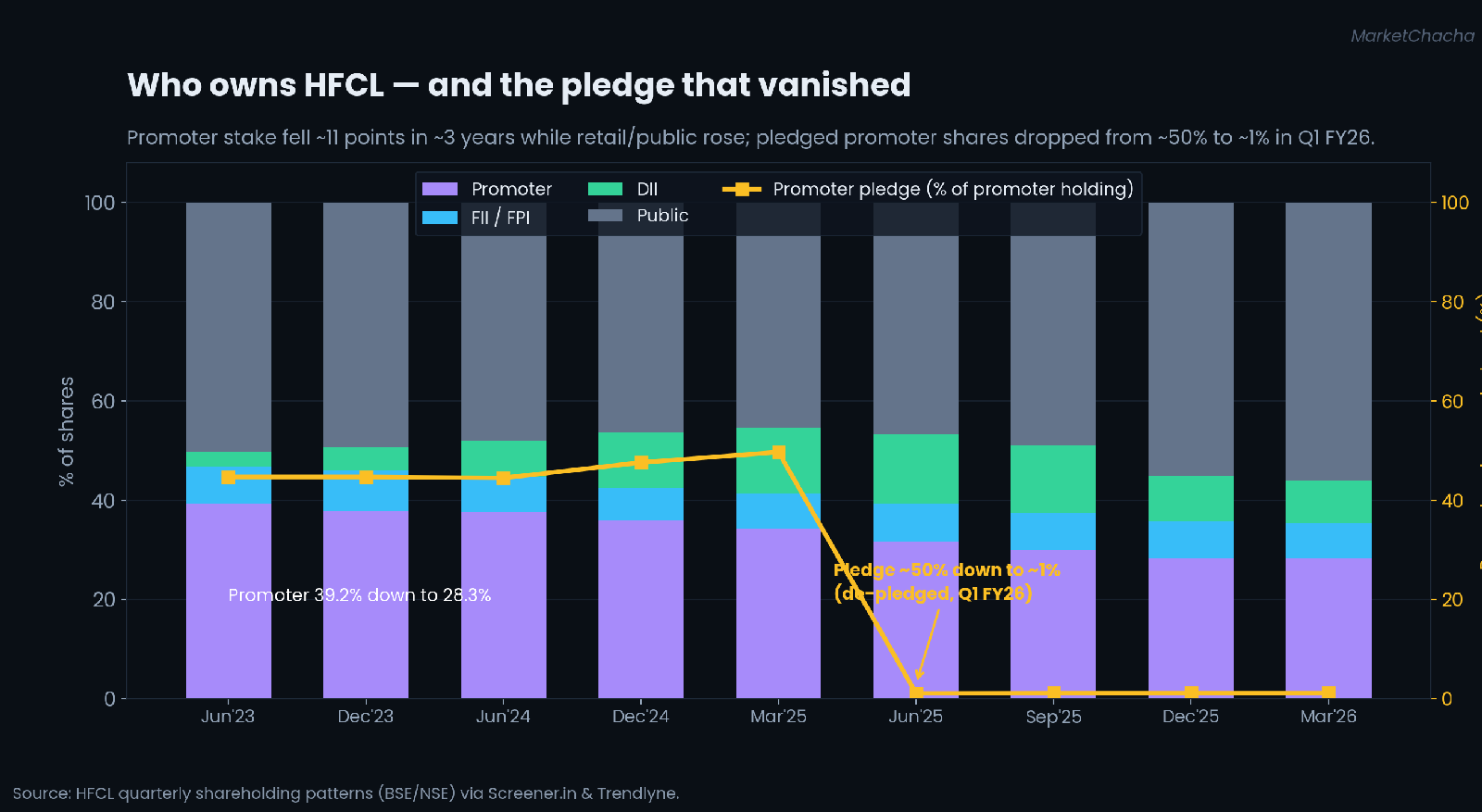
Pledging is legal and common as a promoter-funding tool; a high pledge becomes material only because a sharp price fall can trigger lender selling. The de-pledging here removes that specific risk and is, directionally, a de-risking event — we note it as a fact without characterising motive. On the jurisdiction chain: HFCL consolidates fourteen entities (per CARE's Annexure-6). Seven subsidiaries are Indian (HTL Limited, Raddef Private Limited [90%], Moneta Finance, HFCL Advance Systems, Polixel Security Systems, Dragonwave HFCL India, HFCL Technologies) and two are Indian associates (Nimpaa Telecommunications, 50%; BigCat Wireless, 40.79%). Five subsidiaries are offshore: HFCL B.V. (Netherlands, the European holding company), HFCL Inc. (USA), HFCL Canada Inc., Blue Diwali Sp. z.o.o. (Warsaw, Poland — under HFCL B.V.) and HFCL UK Limited. These are operating or market-access jurisdictions and a Dutch European-holding company — common, ordinary structures rather than classic secrecy havens. We name each and its country, and leave it there.
Capital history — every time they raised money
HFCL has been a repeat issuer of equity. It listed decades ago; in December 2021 it raised Rs 600 crore through a qualified institutional placement. The consolidated equity capital (face value Re 1) grew from about Rs 128 crore (128 crore shares) in FY21 to about Rs 153 crore (153 crore shares) in FY26 — dilution of roughly 19.5% over five years through QIPs, warrant conversions and preferential issues. The most recent event is a promoter-group capital injection: at an EGM on 24 April 2026 (passed with over 99% of votes in favour), shareholders approved a preferential issue of 7.5 crore warrants to promoter entities NextWave Communications and Satellite Finance, allotted by the board on 25 May 2026. The warrant exercise price is Rs 74; subscribers paid 25% upfront (Rs 18.50 per warrant, about Rs 138.75 crore), with roughly Rs 555 crore payable if all warrants convert to shares. Preferential pricing in India is set by the SEBI ICDR formula (a VWAP-based floor as of a defined relevant date); the Rs 74 price was fixed under that framework earlier in 2026, before the stock's later run toward Rs 200+. Separately, the March 2026 shareholding pattern shows about 38.56% of NextWave's stake (about 75 million shares) under lock-in, consistent with an earlier preferential allotment to that promoter vehicle. Repeated preferential issuance to promoter-linked entities is a legal and common mechanism; we describe what HFCL's filings show and make no claim about intent.
Who runs it, and the wider web
Mahendra Nahata is managing director, with over 35 years in telecom and, as noted, a seat on Reliance Jio's board since 2010; Anant Nahata is also on the register and active in the group. CARE describes the board as one executive director, two non-executive directors and three independent directors, with five committees (audit; nomination, remuneration and compensation; stakeholder relationship; CSR; risk management). Notably, HFCL is audited jointly by two statutory-audit firms — Oswal Sunil & Company and S. Bhandari & Co. LLP — both of which were present at the 38th AGM on 15 September 2025. A joint audit is a governance feature, not a red or green flag in itself; we state it. We found no auditor resignation or qualified opinion reported in the period we reviewed, and CARE's rationale explicitly records "status of non-cooperation with previous CRA: not applicable."
The regulatory and surveillance record
HFCL has a documented regulatory history, and honesty requires stating it plainly and carefully. HFCL was among the companies whose share-price movements in 1999–2001 were examined in connection with the Ketan Parekh market episode. SEBI told the Joint Parliamentary Committee that funds of the order of Rs 700 crore had been routed by the company toward Parekh; SEBI issued show-cause notices to HFCL, its directors and associates in 2004; and in 2010 HFCL settled the proceedings through a SEBI consent order, paying about Rs 10 crore without admission or denial of guilt (source: Moneylife, summarising the SEBI consent order). A consent settlement is a legal disposition and, by its terms, is not a finding of wrongdoing; we report the record and the settlement together and draw no further conclusion.
On the current record: on 8 September 2025 CARE Ratings downgraded HFCL's long-term bank facilities from CARE A; Stable to CARE A-; Stable, and its short-term facilities from CARE A1 to CARE A2+. The rationale cited weaker FY25 profitability, delay in operations-and-maintenance revenue from the Network-for-Spectrum project, and net debt/EBITDA rising to 4.85x in FY25 from 2.57x in FY24, with the working-capital cycle stretching to 214 days. The outlook is Stable and CARE lists real strengths — the order book, the Reliance relationship, backward integration and European anti-dumping-duty exemption. A previous non-convertible-debenture rating was withdrawn in July 2023. HFCL is also rated by Infomerics (last action referenced March 2025). Because HFCL's shares trade in the equity-derivatives (F&O) segment, they fall outside the scope of the exchanges' Graded Surveillance Measure and long-term Additional Surveillance Measure frameworks, which target smaller, less liquid securities; we did not find HFCL on any current GSM/ASM list, consistent with its size and index membership.
Forensic checks — what the accounts show
| Check | What we found | Source | A benign explanation |
|---|---|---|---|
| 5-yr cumulative CFO ÷ PAT | Rs 413 cr ÷ Rs 1,484 cr = 0.28x; two of six years negative CFO | Screener (consolidated cash flow & P&L) | EPC/turnkey model + capex cycle; cash sits in disclosed receivables, inventory, unbilled revenue and fixed assets |
| Cash pile vs interest earned | Free cash about Rs 116 cr (Mar 2025); company is a net borrower | CARE PR (08-Sep-2025) | Small cash relative to debt — the "idle cash earning nothing" tell does not apply here |
| Implied interest rate on debt | Finance cost Rs 242 cr ÷ avg borrowings ~Rs 1,633 cr ≈ 14.8% (FY26) | Screener | Year-end borrowings understate intra-year peak fund-based use (~89%) plus acceptances/LC/BG; true coupon is lower |
| Receivable & inventory days | Debtor days 145–223; inventory days up to 161; WC cycle 214 days (FY25) | Screener; CARE PR | ~53% of debtors are strong counterparties (BSNL, L&T, RJIL) on long government cycles |
| Related-party transactions | Promoter-group warrant subscriptions (NextWave, Satellite Finance) are related-party capital deals; full RPT note amounts not extracted | EGM notice; board allotment (May 2026) | Preferential issues to promoters are legal and disclosed; amounts and pricing were shareholder-approved |
| Promoter pledge & holding | Pledge ~50% (Mar 2025) → ~1.15%; holding 39.2% → 28.3% | Quarterly shareholding patterns | De-pledging removes forced-sale risk; holding fall partly reflects dilution |
| Auditor | Joint statutory auditors (Oswal Sunil & Co.; S. Bhandari & Co. LLP); no resignation/qualification found | 38th AGM (15-Sep-2025); CARE PR | Joint audit is a governance choice; CARE records no CRA non-cooperation |
| Subsidiaries & jurisdictions | 12 subsidiaries + 2 associates; offshore in Netherlands, USA, Canada, Poland, UK | CARE PR Annexure-6 | Operating / market-access jurisdictions plus a Dutch European-holding company |
| Dilution / preferential allotments | Shares +~19.5% over 5 yrs; 7.5 cr warrants at Rs 74 pending conversion | Screener; exchange filings | QIP + warrants fund capex; ICDR-formula pricing, shareholder-approved |
| Other income as % of PBT | 22.5% (FY24), 26.7% (FY25), 15.4% (FY26) | Screener | Higher share in the weak FY25 as core profit fell, not because other income spiked |
| Capex vs depreciation | Fixed assets Rs 852 cr → Rs 1,617 cr (FY25–FY26); depreciation Rs 106 → Rs 157 cr; FCF Rs -723 cr (FY26) | Screener | Heavy expansion phase (fibre, IBR cable, defence, preform) capitalised in FY26 |
What we could not verify
Several things we flag as gaps rather than guess. We did not extract the exact rupee amounts and counterparties in the FY25 related-party-transactions note from the annual report; we describe the promoter warrant deals as the visible related-party capital transactions but cannot quote the full RPT schedule. We did not independently reconcile the auditors' report line-by-line, nor confirm the terms of the earlier preferential allotment that left about 75 million NextWave shares under lock-in. We took the FY26 annual figures from Screener's rendering of the consolidated results and the June-2025 order-book, capacity and customer-concentration figures from CARE; both trace to HFCL filings, but figures can be restated and should be checked against the audited annual report when published. We did not locate a current exchange ASM/GSM listing for HFCL and infer its exclusion from its F&O status; a reader can verify directly on the NSE/BSE surveillance pages. Finally, the beneficial ownership behind the promoter vehicles and the offshore subsidiaries is disclosed only to the extent Indian and foreign law requires; we did not attempt to look through those structures.
What would change the picture
Concrete, checkable things to watch: the next few quarters of operating cash flow — does FY26's negative CFO reverse as BharatNet receivables are collected, or does it persist? The receivables line and the operating cycle — CARE's own positive trigger is the average collection period falling below 100 days on a sustained basis. The next credit-rating action — whether CARE's A- holds, improves or slips further given net debt/EBITDA at 4.85x. The conversion of the 7.5 crore promoter warrants (and any further preferential issuance), which will lift the share count. The next shareholding pattern — whether promoter holding stabilises at 28% or keeps falling, and whether the pledge stays near zero. And the audited FY26 annual report, for the RPT schedule, contingent liabilities and any change of auditor or emphasis of matter.
Sources
- HFCL consolidated financials, quarterly and annual (FY2015–FY2026), Screener.in: https://www.screener.in/company/HFCL/consolidated/
- HFCL quarterly shareholding patterns (BSE/NSE) via Trendlyne: https://trendlyne.com/equity/share-holding/543/HFCL/latest/hfcl-ltd/
- CARE Ratings press release, HFCL Limited, 8 September 2025 (rating downgrade to CARE A-/A2+, order book, customer concentration, working-capital metrics, list of consolidated entities): https://www.careratings.com/upload/CompanyFiles/PR/202509120958_HFCL_Limited.pdf
- Infomerics rating press release, HFCL Limited, 31 March 2025: https://www.infomerics.com/admin/uploads/pr-HFCL-Limited-31mar25.pdf
- HFCL annual reports (BSE), FY2015–FY2025 (filing index): https://www.bseindia.com/stock-share-price/hfcl-ltd/HFCL/500183/financials-annual-reports/
- Moneylife, "SEBI settles Himachal Futuristic case with consent order" (2010 consent order, Rs 10 crore, no admission): https://www.moneylife.in/article/sebi-settles-himachal-futuristic-case-with-consent-order/3635.html
- HFCL 38th AGM transcript, 15 September 2025 (joint statutory auditors): https://www.hfcl.com/wp-content/uploads/2025/09/HFCL%20Limited-AGM-Sept15-2025-TRANSCRIPT.pdf
- HFCL EGM notice (preferential warrant issue), 1 April 2026, and EGM transcript, 24 April 2026: https://nsearchives.nseindia.com/corporate/AHMED_01042026112130_HFCL_STX_EGM_Notice_2026.pdf
- HFCL Q4/FY26 board-meeting outcome and results, 30 April 2026 (BSE): https://www.bseindia.com/stock-share-price/hfcl-ltd/HFCL/500183/corp-announcements/
- HFCL 2021 QIP (Rs 600 crore), Business Standard, December 2021: https://www.business-standard.com/article/companies/telecom-gear-manufacturer-hfcl-raises-rs-600-crore-through-qip-issue-121121400409_1.html
- Sterlite Technologies (peer) financials and valuation, Screener.in: https://www.screener.in/company/STLTECH/consolidated/
- HFCL entry, Wikipedia (incorporation and founder background, cross-checked to filings): https://en.wikipedia.org/wiki/HFCL
FAQ
What does HFCL actually do? It manufactures optical fibre, optical fibre cable and telecom equipment (radios, Wi-Fi access points, routers) and builds telecom networks turnkey for the government and telcos; products were about 59% of FY26 revenue. It describes itself as India's number-one OFC supplier.
Why did its credit rating get downgraded? On 8 September 2025 CARE cut HFCL's long-term rating from CARE A to CARE A- (and short-term from A1 to A2+), citing weaker FY25 profitability, a delayed O&M revenue stream, higher working capital and net debt/EBITDA rising to 4.85x. The outlook is Stable.
Why is cumulative cash flow so much lower than profit? Over FY22–FY26 cumulative operating cash flow was about Rs 413 crore against Rs 1,484 crore of reported profit (0.28x). HFCL is a working-capital-heavy, project-led business selling on long government cycles; the cash is tied up in disclosed receivables, inventory, unbilled revenue and a capex build-out, and FY26 collections lagged a Q4 revenue surge.
Why has the promoter stake fallen? Promoter holding dropped from about 39% (June 2023) to 28.29% (March 2026), partly through equity issuance (QIP, warrants, preferential allotments) that dilutes the promoter percentage and partly through reduced promoter shares. Separately, pledged promoter shares fell from about 50% to roughly 1%.
Are the offshore subsidiaries a concern? HFCL consolidates subsidiaries in the Netherlands, USA, Canada, Poland and the UK. These are operating/market-access jurisdictions plus a Dutch European-holding company — ordinary structures, disclosed in the ratings annexure. We report them as facts, not as a concern.
Is this a buy or a sell? Neither — we do not issue recommendations, ratings or target prices. This is a compilation of verified, sourced facts so you can decide for yourself.
Independent research for education and discussion only. Not investment advice, not a recommendation, and not a rating — we issue no buy/sell calls and no target prices. Every figure is sourced from the primary documents linked above; figures can be restated and we can make mistakes, so always verify against the original. Nothing here alleges wrongdoing by any company or individual: where a fact raises a question we state the fact, cite it, and give the benign explanation alongside. Offshore holding structures, pledging and preferential allotments are all legal and common — they are disclosed here as facts, not as accusations.
This article is for educational and informational purposes only. It is not financial advice, investment recommendation, or a solicitation to buy or sell securities. Investing involves significant risks. I am not a SEBI-registered investment advisor. Readers should consult their own financial advisor and conduct their own research before making any investment decisions.
Comments
Join the conversation
Sign in to join the conversation.
Follow replies, add your view, and take part in the discussion.
Sign in to commentLoading comments...