

Korea's August chip exports tripled to $46.65bn — and the Kospi closed up 0.23%
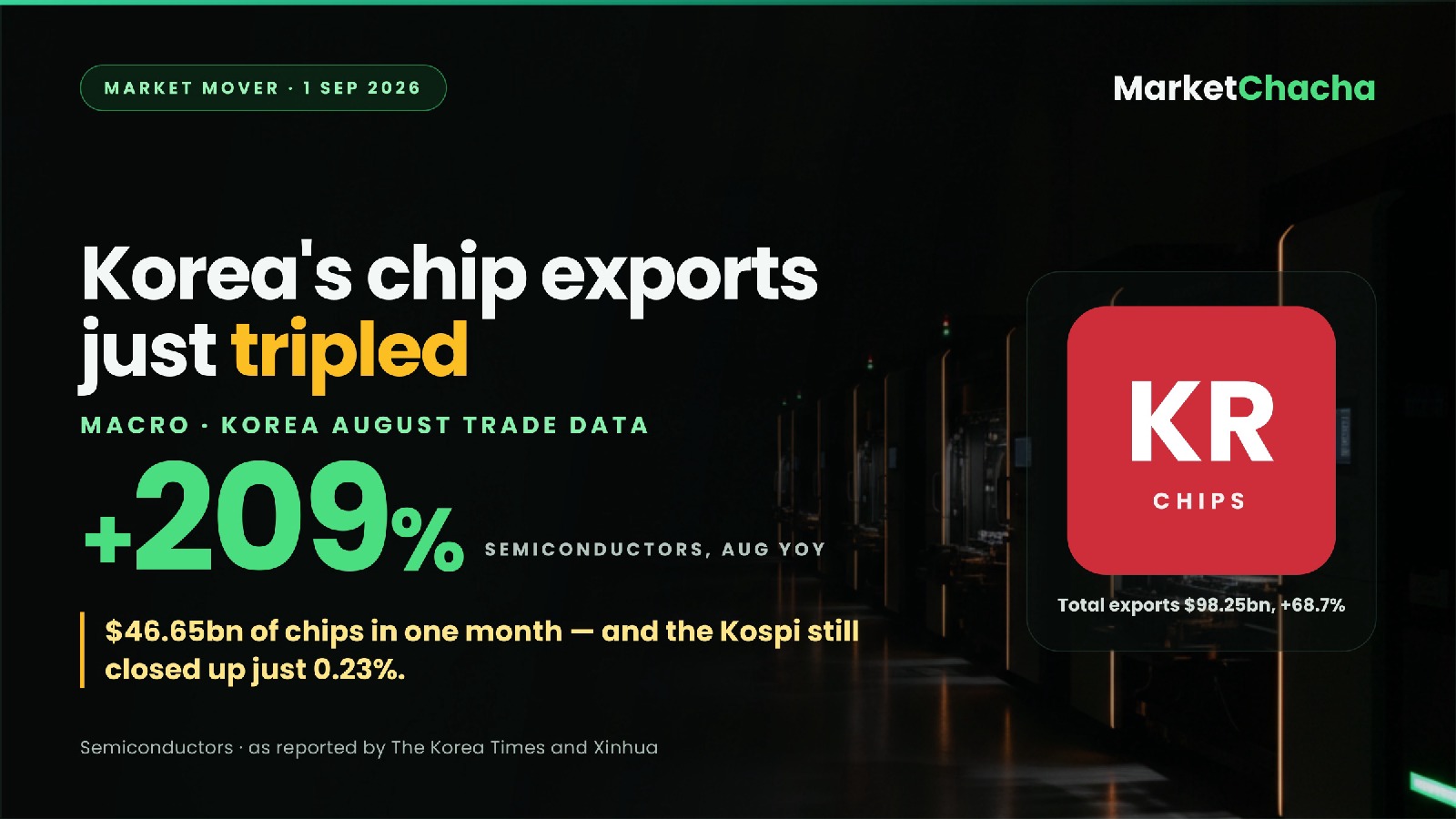
Korea publishes its trade data on the 1st of the month, days before anyone else — which makes it the cleanest real-time read on AI hardware demand anywhere. Today's print was a monster. August semiconductor exports came in at $46.65bn, up 209% year-on-year, on total exports of $98.25bn (+68.7%), per the Ministry of Trade, Industry and Resources as reported by The Korea Times and Xinhua.
Chips are now roughly 47% of everything Korea sells to the world — the third straight month above $40bn. And this isn't a calendar trick: daily average exports were $4.47bn, up 72.5%, so the working-day count doesn't explain it. Imports rose 22.5% to $63.51bn, leaving a $34.75bn trade surplus.
Where the chips went
China took $24.1bn (+119.3%), the US $16.5bn (+89.3%), ASEAN $19.09bn (+75.4%). The ministry pinned it directly on AI infrastructure spending by hyperscalers — it named Google and Amazon. The one line that doesn't fit the boom: autos fell 29.8% to $3.85bn, on summer-holiday shutdowns and partial wage strikes.
So why did Seoul barely move?
The Kospi closed at 6,835.8, up just 0.23% (+15.78 points) — after opening 0.52% lower and sitting 1.28% down intraday, per Seoul Economic Daily. Samsung Electronics added 0.38%, SK hynix 1.14%; the Kosdaq actually fell 1.56% to 821.25.
Here's the uncomfortable bit: nobody outside the companies was buying. Foreigners net sold ₩850bn, institutions ₩373.4bn, retail ₩440bn. The bid came from the issuers themselves — Samsung bought back 2 million of its own shares, SK hynix 650,000, and "other corporations" net bought ₩1.67tn. A record export print got absorbed by a buyback floor, not by fresh money.
The read-through
Micron is the only non-Korean HBM supplier at scale, so Korea's monthly number is close to a leading indicator for what Micron's memory bin does next — the same hyperscaler orders that filled $46.65bn of Korean shipments are the orders Micron books a quarter later. Korean-listed equipment suppliers into Samsung and SK hynix fab capex sit on the same curve.
The risk that flips it: concentration. Nearly half the export bill is one product line. Watch the $40bn-a-month chip line — it has now held three months running. If the next monthly print, due at the start of October, breaks back under it, the supercycle loses its cleanest piece of evidence — and with foreigners already net sellers, the only bid left under 6,800 is a buyback programme with a finite budget.
As of 1 Sep 2026, ~7:50 pm IST (Kospi and MOTIE figures as of the 1 Sep close). Sources: The Korea Times, Xinhua, Seoul Economic Daily. For discussion and education only — not investment advice. Verify before acting.
This article is for educational and informational purposes only. It is not financial advice, investment recommendation, or a solicitation to buy or sell securities. Investing involves significant risks. I am not a SEBI-registered investment advisor. Readers should consult their own financial advisor and conduct their own research before making any investment decisions.
Comments
Join the conversation
Sign in to join the conversation.
Follow replies, add your view, and take part in the discussion.
Sign in to commentLoading comments...