

US industrial production stalls at 0.0% — but factory output fell 0.3%, and utilities did the rescuing
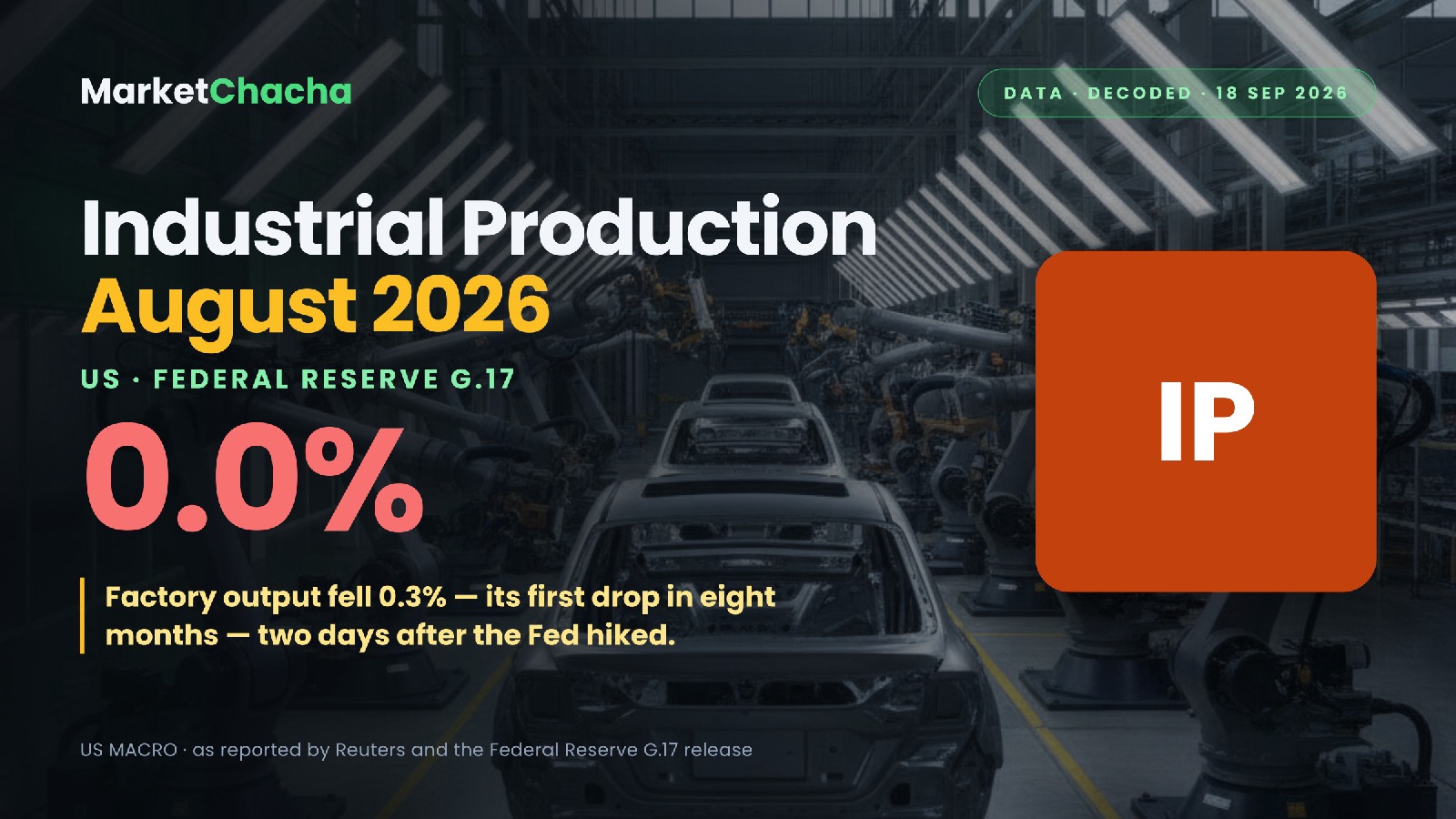
The Fed's G.17 release landed at 9:15 am ET Friday and the headline looked boring. It wasn't. Industrial production printed flat at 0.0% in August against a +0.3% consensus — and that flat number is hiding a factory sector that went backwards.
The numbers
Total output was 0.0% month-on-month, missing the +0.3% forecast and slowing from an unrevised +0.2% in July. Year-on-year it's up 1.4%.
Manufacturing is the real story. Factory output fell 0.3% against a Reuters poll looking for +0.3% — a 0.6-point miss, and the first decline after seven straight months of gains. It's up just 0.9% from a year ago. The breakdown, as reported by Reuters:
- Motor vehicles and parts: −1.2%, the second consecutive monthly drop
- Computers and peripherals: −1.4% on the month, though still +5.5% year-on-year
- Semiconductors and components: −0.1% on the month, but +12.4% year-on-year
- Communications equipment: +0.8%
- Durable goods: −0.5%; nondurables: unchanged
- Mining: +0.1%, with oil and gas drilling +0.9%
- Utilities: +1.8%
Capacity utilisation for all industry held at 76.3% — 3.1 points below its 1972–2025 average. Manufacturing utilisation slipped 0.3 points to 75.7%, 2.5 points under its long-run norm.
What it means
The headline buries this: the only reason total production printed 0.0% instead of negative is utilities jumping 1.8%. Utilities output is mostly a weather story — heating and cooling demand — not a signal about the economy. Strip it out and the productive core shrank.
Capacity utilisation is the number worth learning. It measures how much of America's installed factory capacity is actually in use. Running well below the historical average means idle machines — and idle machines mean firms neither need to spend on new capacity nor enjoy the pricing power of being sold out. Manufacturing at 75.7% and falling is a soft-demand signal.
That collides with what the Fed did two days earlier: it raised rates 25 basis points to 3.75%–4.00% — its first hike since 2023 — because inflation, not growth, is the problem. Policy is tightening into a goods economy that already stopped growing. That's the textbook shape of a stagflation argument, and it's why a "flat" print got attention.
The split inside manufacturing shows where the economy still works. Semiconductors at +12.4% year-on-year mean the AI buildout is carrying the industrial complex almost single-handedly. Autos, down two months running, are what higher borrowing costs look like once they reach a showroom.
Who it touches
- Automakers. Output down 1.2% for a second month is a production-side read on demand at Ford and General Motors. Cars are the most rate-sensitive big purchase most households make, and rates just rose again.
- Semis. The +12.4% annual run rate sits behind AI capex enthusiasm for Nvidia and Micron — though the −0.1% monthly dip says the line isn't vertical.
- Hardware. Computers down 1.4% on the month is a softer read for Dell and HP on the non-AI side of the business.
- Capital goods. Utilisation below its long-run average removes the pressure to expand capacity — the demand pipeline for equipment makers like Caterpillar.
- Bonds. Weak real-economy data normally pulls yields down, but with the Fed hiking on inflation, this print sharpens the growth-versus-prices tension rather than settling it.
What to watch
Two things decide whether August was a blip or a turn. First, the September manufacturing print: one fall after seven gains is noise, two is a trend. Second, the next ISM manufacturing reading and the CPI that follows — the Fed has told us it's watching prices, not output, so a sliding factory sector alongside hot inflation makes its job harder, not easier.
Watch the auto line in particular. A third straight decline there would be the clearest sign yet that the resilient US consumer is flinching at the cost of credit.
Full schedule: MarketChacha calendar
As of 4:15 pm ET, 18 September 2026. Figures as reported by the Federal Reserve G.17 release and Reuters. Sources: Federal Reserve G.17, Reuters, Trading Economics. For discussion and education only — not investment advice. Verify before acting.
This article is for educational and informational purposes only. It is not financial advice, investment recommendation, or a solicitation to buy or sell securities. Investing involves significant risks. I am not a SEBI-registered investment advisor. Readers should consult their own financial advisor and conduct their own research before making any investment decisions.
Comments
Join the conversation
Sign in to join the conversation.
Follow replies, add your view, and take part in the discussion.
Sign in to commentLoading comments...