

MaxLinear beat Q2 and raised guidance — so why did it drop ~10%?
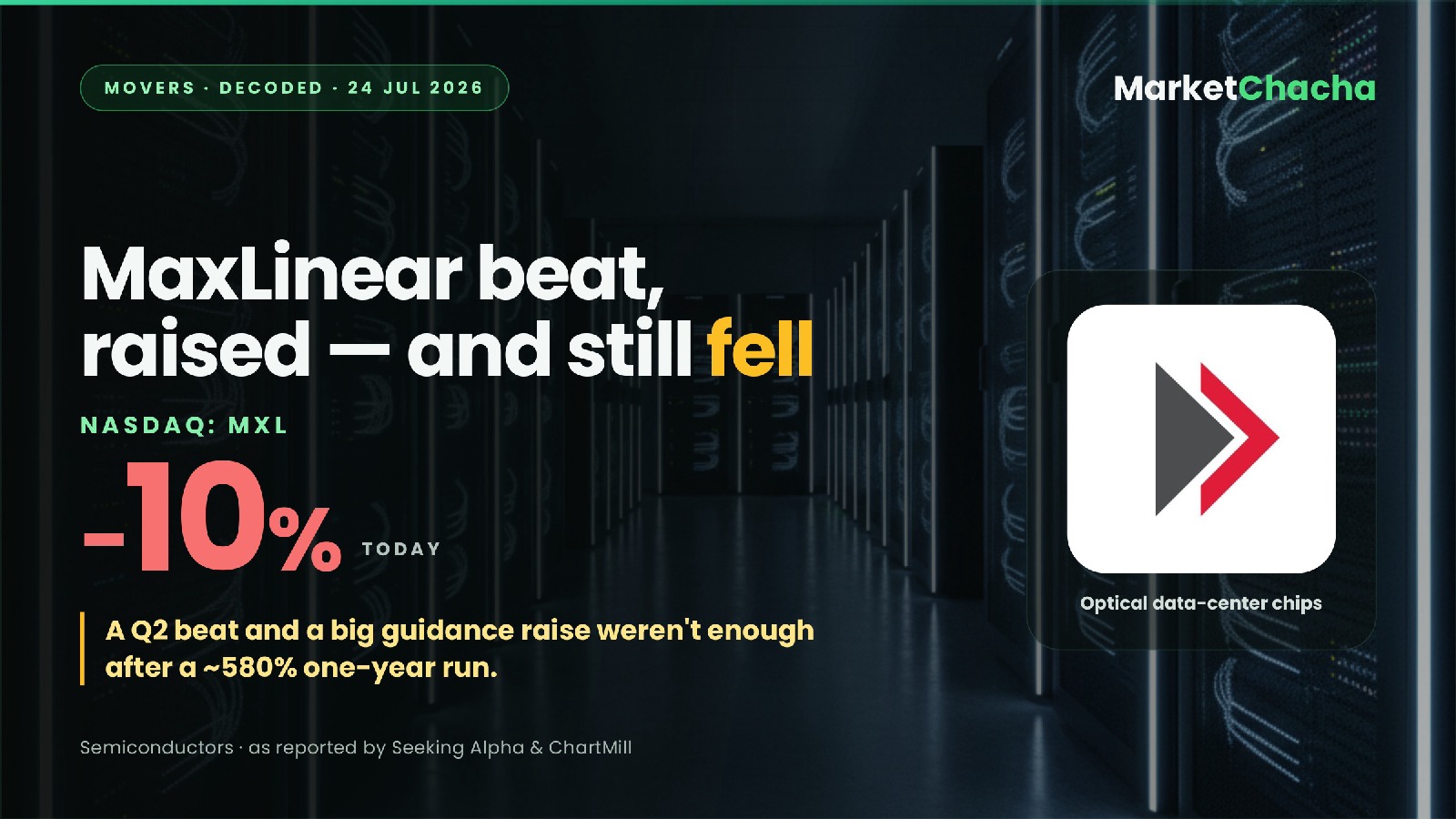
MaxLinear (NASDAQ: MXL) is down about 10% on Friday — it fell roughly 9.85% in the pre-market and had already dropped about 11% in Thursday's after-hours session, once its results hit the wire. Here's the twist that makes it worth decoding: the quarter was good, and the company raised its outlook. Good news, red stock. That combination confuses people, so let's take it apart.
What happened
MaxLinear reported Q2 after Thursday's close. Revenue came in at $168.8 million, up about 55% from a year earlier and just ahead of the roughly $166.3 million analysts expected. Non-GAAP earnings were $0.35 a share, a $0.02 beat (on a GAAP basis it eked out $1.8 million of net income, or $0.02 a share). Then the part that should have been the fireworks: it guided Q3 revenue to $210–$220 million — well above the ~$173.8 million the street had penciled in — and lifted its full-year 2026 optical data-center revenue target to $210–$230 million. Its data-center-oriented infrastructure line grew about 145% year over year. On paper, that's a beat and a big raise.
Why it fell anyway
Two things. First, expectations. MXL is up roughly 579% over the past year — a near-6x move. When a stock has run that hard, "beat and raise" isn't the bar; crushing the whisper number is. A revenue beat of only ~1.5% over consensus, even with a strong forward guide, doesn't clear a stock that's priced for perfection. That's the mechanism behind "sell the news": the good news was already in the price, so buyers who chased it took profits.
Second, the fine print. On the call, management flagged that wafer, packaging and test costs keep climbing as it scrambles to secure supply for the data-center ramp. For a company that's still losing money on a trailing basis, rising input costs push the "when does this actually turn profitable?" question further out — and that's exactly what a nervous, high-multiple crowd fixates on. Add a beta near 4 (it swings about four times as hard as the market), and a normal profit-taking day turns into a 10% drop.
Is it expensive?
You can't put a normal P/E on it, and that's the point. MaxLinear's trailing P/E is negative (about −57) — it lost roughly $132 million over the last twelve months on about $509 million of revenue, so there are no trailing earnings to value. At a market cap of around $7 billion (per Stockanalysis), the whole price rests on the forward data-center story landing, not on money it makes today. Compare the obvious peer, Credo Technology (CRDO), another optical-connectivity name riding the same AI-interconnect wave: Credo trades at a steep P/E around 100x — but at least it has a P/E, having tripled FY26 revenue to $1.3 billion with about $662 million of non-GAAP profit. So MXL isn't "cheap after the drop"; it's a pre-profit bet on a ramp, which is why it moves violently in both directions.
The business — and why today is just one slice
MaxLinear is a fabless communications-chip company, and it's wider than the AI headline suggests. Its revenue comes from several buckets: broadband (chips inside cable, fiber/PON and DSL home gateways plus Wi-Fi), connectivity and Ethernet, infrastructure — the hot part, the optical data-center interconnect DSPs that move data between AI servers — and industrial & multi-market. The 145% growth and the guidance raise are almost entirely the optical/data-center slice. The bigger, slower, more cyclical broadband base is the legacy core. So don't read today as "MaxLinear is an AI company" — it's a broadband chipmaker with a fast-growing AI-optics arm that now drives the stock.
Who else it touches
- Optical-connectivity peers — Credo (CRDO), Astera Labs (ALAB), Marvell (MRVL): MXL's raised optical guide is a positive demand read-through for the group even though MXL itself sold off. The demand signal and the stock reaction are two different things.
- Optical-module makers that build MXL's DSPs into transceivers — Coherent (COHR), Lumentum (LITE), and Asian module suppliers like InnoLight and Eoptolink — ride the same order flow.
- Every fabless chipmaker feels the wafer/packaging/test cost inflation MXL called out; it's an industry-wide margin headwind, not a MaxLinear-only problem.
- India read-through is indirect but real: the country's data-center build-out leans on the same optical-interconnect gear, so demand strength here supports the AI-infrastructure supply chain Indian players are wiring into.
The one risk that flips it
The whole ~$7 billion valuation leans on the optical data-center ramp arriving on schedule. Because there's no trailing profit to cushion a miss, if a big hyperscaler order slips a quarter or the ramp timing pushes out, there's nothing to fall back on — and with beta near 4, the downside is fast. Today's 10% drop on good news is the warning: when a stock is priced for a flawless ramp, "great" only counts if it's also "better than everyone already assumed."
As of ~10:30 am ET (8:00 pm IST), Fri 24 Jul 2026. Figures as reported by Seeking Alpha, ChartMill and Public.com. For discussion and education only — not investment advice. Verify before acting.
This article is for educational and informational purposes only. It is not financial advice, investment recommendation, or a solicitation to buy or sell securities. Investing involves significant risks. I am not a SEBI-registered investment advisor. Readers should consult their own financial advisor and conduct their own research before making any investment decisions.
Comments
Join the conversation
Sign in to join the conversation.
Follow replies, add your view, and take part in the discussion.
Sign in to commentLoading comments...