

Nvidia Q2 FY27 results: what the numbers say
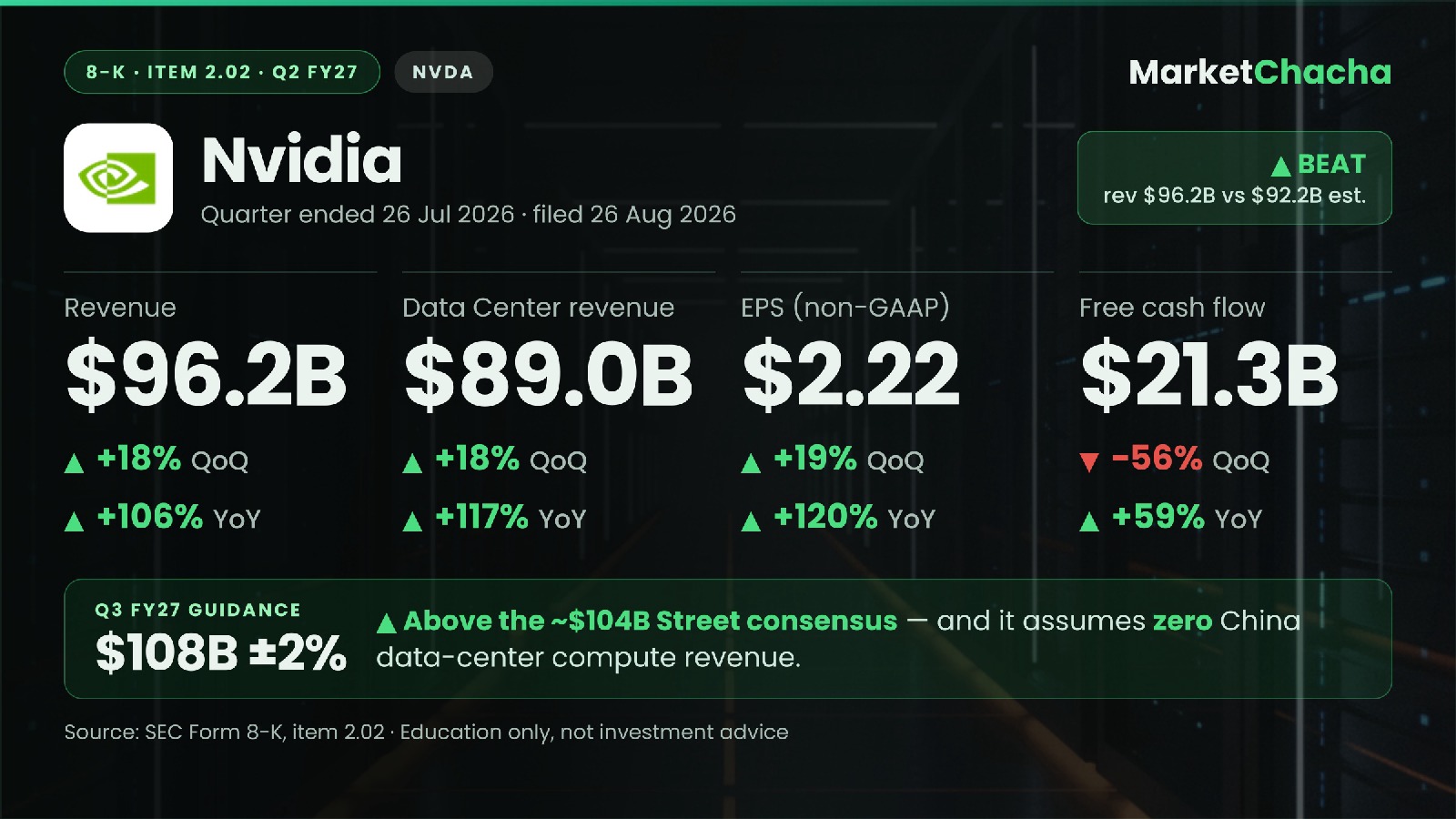
Nvidia filed an 8-K after the bell on 26 August 2026 with its second-quarter fiscal 2027 results (the three months to 26 July 2026). Revenue was $96.2bn, up 106% year on year, it beat on every headline line, and it guided the current quarter to $108bn — while explicitly assuming no data-centre compute revenue from China at all.
The numbers
- Revenue: $96.221bn, up 18% from Q1 and up 106% year on year (from $46.743bn). Street consensus was around $92.2bn, so a roughly $4bn beat.
- Data Center: $89.0bn, up 18% sequentially and up 117% year on year — against consensus near $85.7bn. This is now 92% of the company. Edge Computing was $7.2bn, up 27%.
- EPS: non-GAAP diluted EPS $2.22 versus consensus of about $2.09 — a beat. GAAP diluted EPS was $2.46.
- The odd bit: GAAP EPS is higher than non-GAAP here, which is the reverse of the usual pattern. The gap is a $7.77bn unrealised gain on equity securities that GAAP counts and Nvidia's non-GAAP measure strips out. Nvidia's marketable equity holdings have grown to $42.8bn from $12.9bn a year ago, and it bought $15.8bn more during the quarter.
- Margins: GAAP and non-GAAP gross margin both 75.0%, up from 72.4% a year ago. Operating income $63.7bn, up 124%.
- Cash: operating cash flow was $24.1bn and free cash flow $21.3bn — well below the $59.7bn of GAAP net income, and down from $50.3bn of operating cash flow in Q1. Investment gains are non-cash, and a business scaling this fast ties up cash in receivables and inventory.
- Guidance: Q3 FY27 revenue of $108bn, plus or minus 2%, against a Street figure closer to $104bn. Gross margin guided to 74.0%. The outlook assumes zero Data Center compute revenue from China.
- Capital returns: about $26.0bn returned via buybacks and dividends in the quarter, with roughly $99.0bn left on the repurchase authorisation.
What was filed: the 8-K item 2.02
An 8-K is the event-driven form — filed when something specific happens, rather than on the fixed calendar of a 10-Q or 10-K. Each one is tagged with numbered items describing the event.
Item 2.02 — Results of Operations and Financial Condition is how a company releases quarterly results. The 8-K itself is a short cover page; the numbers sit in an attached exhibit (EX-99.1, the press release), which is why Item 9.01 — Financial Statements and Exhibits appears alongside it. Two useful things to know:
- The results exhibit is furnished, not filed — a narrower liability standard than the audited statements in the 10-Q that arrives a few weeks later. The 10-Q is where segment detail, customer concentration and risk-factor updates show up.
- Regulation G requires any non-GAAP figure in that exhibit to be reconciled to the nearest GAAP figure in the same document. That reconciliation table is where the $7.77bn equity-securities gain above becomes visible.
Why it matters
The guidance is the news, not the quarter. A beat on a quarter that ended a month ago tells you about demand that has already been filled. Guiding to $108bn — roughly 12% sequential growth on top of an 18% sequential quarter — is a statement about supply the company believes it can ship next quarter. The detail that the figure excludes any China data-centre compute matters because it means the number does not depend on export policy loosening; if China access returned, it would be additional rather than assumed.
The equity portfolio is becoming a real part of the story. Nvidia is investing on a large scale in companies across the AI buildout, and the filing shows $42.4bn of equity purchases in the first half alone. Two consequences for a reader of the accounts: GAAP net income now swings with marks on those stakes rather than with chip demand alone, and some of that capital flows to firms that are themselves customers — a circularity worth watching, though the filing does not break out how much revenue is linked to it. The press release also describes partnerships with several large asset managers to mobilise third-party capital for AI infrastructure, described as subject to definitive agreements — meaning not yet binding.
Watch cash conversion and concentration. Operating cash flow of $24.1bn against $59.7bn of net income is the number that will get scrutinised on the call. Some of that gap is simply the non-cash investment gain; the rest is working capital. Separately, with Data Center at 92% of revenue and a handful of hyperscalers and AI labs doing most of the buying, the revenue base is narrow — the 10-Q will show customer concentration more precisely than this press release does.
Beginner takeaway
Nvidia beat expectations and guided above them, so the quarter itself is straightforward. The two things a beginner should take from the filing are structural: GAAP earnings here are inflated by investment marks that have nothing to do with selling chips, and the forward guide deliberately assumes no China revenue. Reading the reconciliation table and the guidance assumptions tells you more than the headline EPS does.
FAQ
Why is GAAP EPS higher than non-GAAP EPS this time? Because the largest adjustment is a gain rather than a cost. Nvidia's non-GAAP measure removes the $7.77bn unrealised gain on its equity stakes, which GAAP includes — so taking the adjustment out lowers the number instead of raising it.
What does "assumes no China Data Center compute revenue" mean? It means the $108bn guide is built without counting anything from data-centre compute sales into China. Export restrictions have made that market unpredictable, so the company has set the expectation at zero rather than forecasting it.
Should I worry that cash flow is far below net income? It is worth understanding rather than worrying about in isolation. Non-cash investment gains inflate net income without producing cash, and rapid growth consumes cash through inventory and receivables. It becomes a concern only if the gap persists for several quarters without a working-capital explanation.
Where do I find the segment and customer detail? Not in this 8-K. The Form 10-Q, filed a few weeks after results, contains the fuller breakdown including customer concentration and updated risk factors.
As of 26 August 2026. Source: official SEC filing — read it directly here. We summarise filings for education and may make errors, so always verify against the official document. Educational content only — not investment advice, not a buy/sell recommendation.
This article is for educational and informational purposes only. It is not financial advice, investment recommendation, or a solicitation to buy or sell securities. Investing involves significant risks. I am not a SEBI-registered investment advisor. Readers should consult their own financial advisor and conduct their own research before making any investment decisions.
Comments
Join the conversation
Sign in to join the conversation.
Follow replies, add your view, and take part in the discussion.
Sign in to commentLoading comments...