

ICICI Bank: what their latest $750M dollar-bond filing actually means
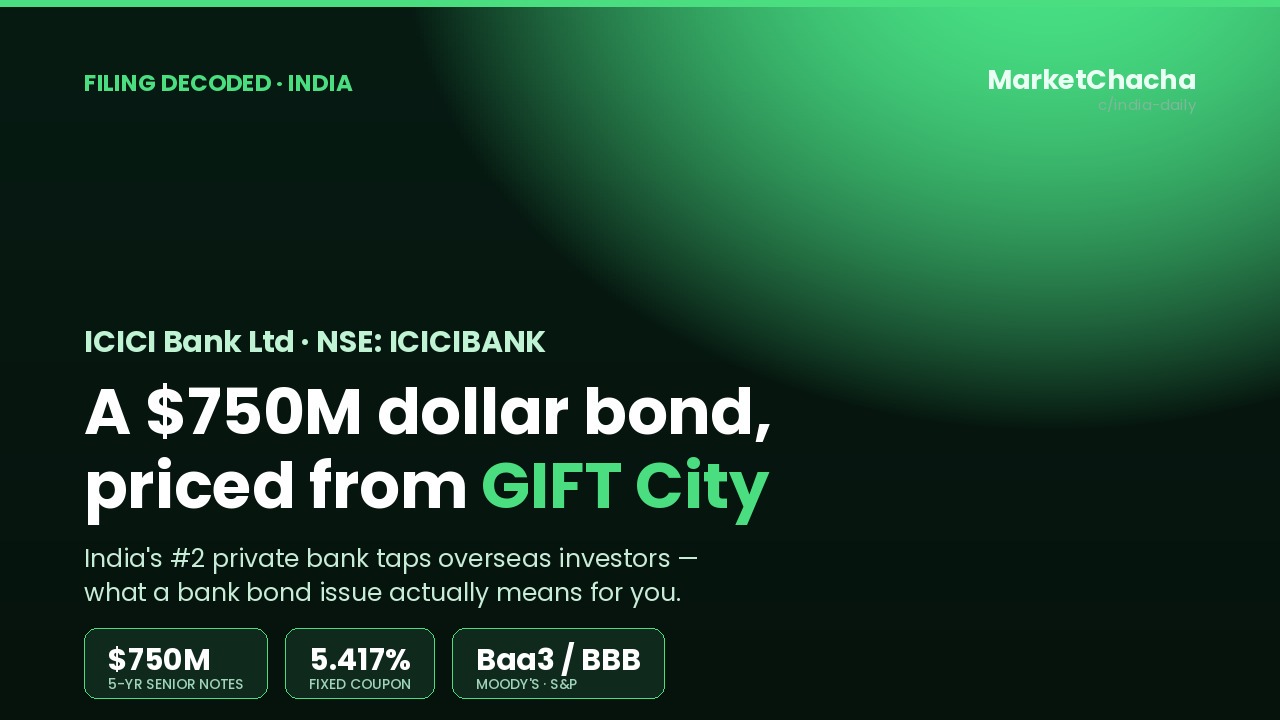
ICICI Bank told the stock exchanges on 18 August 2026 that it has priced US$750 million of 5-year "senior unsecured" bonds aimed at overseas investors, carrying a fixed interest rate of 5.417%. Separately, the bank's board meets on 21 August 2026 to consider raising its overall limit for borrowing abroad. In plain English: India's second-largest private bank is borrowing dollars from global lenders, and wants room to borrow more.
What was announced
Two linked things:
- The bond itself. ICICI Bank, acting through its IFSC Banking Unit at GIFT City (India's international finance hub in Gujarat), priced US$750 million of Senior Unsecured Fixed Rate Notes. Tenor is 5 years (allotment 21 August 2026, maturity 21 August 2031), the coupon is a fixed 5.417% paid twice a year, and the notes will list on the India International Exchange (GIFT), NSE IFSC and the Singapore Exchange. They were issued under the bank's existing US$7.5 billion Global Medium Term Note (GMTN) programme — a pre-approved shelf that lets it raise dollars in tranches. Global rating agencies Moody's (Baa3) and S&P (BBB) rated the notes investment-grade, broadly in line with India's sovereign rating. Proceeds go toward general corporate purposes.
- The board meeting. A board meeting is scheduled for 21 August 2026 to consider revising the ceiling on how much the bank can raise via bonds/notes/offshore certificates of deposit in overseas markets — essentially topping up the tank so more issuances like this one are possible.
What this type of filing means
A few pieces of jargon, decoded:
- Bond / note: a loan the company takes from investors. The buyer lends ICICI money today and gets fixed interest (the "coupon") until the bond matures, when the principal is returned.
- Senior unsecured: "senior" means these lenders are near the front of the queue to be repaid if things go wrong; "unsecured" means no specific asset is pledged as collateral — you're lending on the strength of the bank's overall creditworthiness.
- Dollar bond via GIFT City: the money is raised in US dollars from international investors, routed through the bank's offshore unit at GIFT City. Banks do this to diversify where they borrow and to fund dollar needs.
- GMTN programme: think of it as a reusable borrowing licence. Rather than seeking fresh approvals each time, the bank sets up one large programme (here US$7.5 billion) and draws smaller amounts from it whenever markets are favourable.
Crucially, a bond issuance is debt, not equity. ICICI is not selling new shares here, so existing shareholders are not diluted — unlike a QIP or rights issue.
Why it matters / potential impact
For a large, well-rated bank, a dollar bond is fairly routine plumbing rather than a dramatic event — which is why the share price barely moved on the news. What it signals is useful, though: strong international demand and a coupon of ~5.4% suggest global investors are comfortable lending to ICICI at rates close to what they'd charge the Indian government. That reflects the bank's healthy capital, profitability and asset quality. The trade-off is that these are foreign-currency borrowings, so the bank must manage the risk that the rupee weakens against the dollar over the five years (banks typically hedge this). More borrowing headroom, if approved on 21 August, simply gives ICICI flexibility to fund growth and dollar-denominated lending.
Is it expensive?
ICICI Bank trades around ₹1,408 a share with a market capitalisation of roughly ₹10.2 lakh crore — one of India's most valuable companies. On valuation it sits at a P/E of about 19.5 and a price-to-book (P/B) of about 2.9. For a bank, P/B matters as much as P/E, and ~2.9x is on the richer end — the market is paying a clear premium for ICICI's high return on equity and clean loan book. For comparison: State Bank of India (India's largest bank, ~₹9.7 lakh crore market cap) trades far cheaper at roughly 12x earnings and 1.6x book, while HDFC Bank sits in between near 15x earnings. So ICICI is the priciest of the big three on these measures — investors are effectively paying up for quality and consistency, not for a bargain. This is framing, not a recommendation.
The business
ICICI Bank is India's second-largest private-sector bank. Its core is lending — retail loans (home, auto, personal, credit cards) and corporate/business banking — funded by customer deposits, with fee income on top. It also owns some of India's best-known financial franchises as subsidiaries: ICICI Prudential Life Insurance, ICICI Lombard General Insurance, ICICI Securities and ICICI Prudential AMC (mutual funds). This particular filing affects only the parent bank's funding (how it borrows) — it does not change the insurance or broking businesses.
Beginner takeaway
ICICI Bank is borrowing US$750 million from overseas investors at 5.417% for five years, and clearing the way to borrow more. It's a normal financing move — no new shares, no dilution, and no big surprise for the stock. The interesting signal is that global lenders will fund ICICI at near-sovereign rates, a quiet vote of confidence in the bank's health.
FAQ
Does this issuance affect me as a shareholder? Not directly. It's debt, not equity, so your ownership isn't diluted. Over time, cheap, well-managed borrowing helps a bank fund growth, which is a mild positive.
Why borrow in dollars instead of rupees? To diversify funding sources, tap deep global bond markets, and match dollar-denominated needs. The bank takes on currency risk in exchange, which it typically hedges.
Is a 5.417% coupon good or bad? It's a market rate for a 5-year investment-grade dollar bond. A relatively low spread over US benchmarks signals that investors see ICICI as a safe borrower.
What is the 21 August board meeting for? To consider raising the ceiling on how much ICICI can borrow overseas — housekeeping that gives it room for future issuances, not a decision to raise equity.
As of 19 August 2026. Filing dated 18 August 2026 (board meeting scheduled 21 August 2026). Source: official BSE filing — read it directly here. We summarise filings for education and may make errors, so always verify against the official document. Educational content only — not investment advice, not a buy/sell recommendation.
This article is for educational and informational purposes only. It is not financial advice, investment recommendation, or a solicitation to buy or sell securities. Investing involves significant risks. I am not a SEBI-registered investment advisor. Readers should consult their own financial advisor and conduct their own research before making any investment decisions.
Comments
Join the conversation
Sign in to join the conversation.
Follow replies, add your view, and take part in the discussion.
Sign in to commentLoading comments...