

Boeing (BA): the full file — the numbers, the owners, and what the filings actually show

The Boeing Company builds commercial jetliners, military aircraft, satellites and weapons systems, and sells parts, maintenance and training to the airlines and governments that operate them. In the year to 31 December 2025 that produced $89,463 million of revenue and $2,235 million of profit attributable to shareholders — Boeing's first annual profit since 2018.
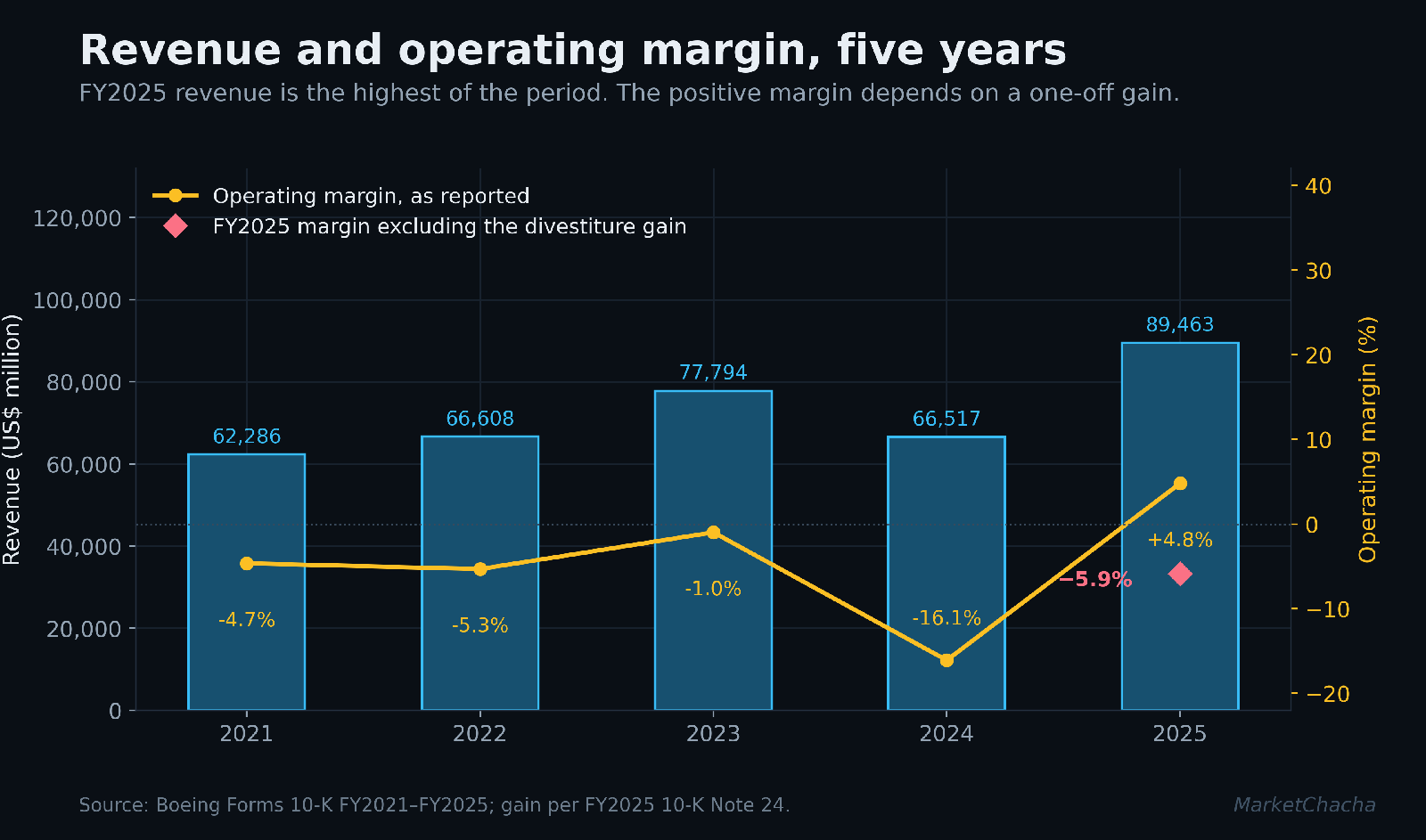
That profit contains one item worth stating up front. Boeing's own segment note discloses a $9,566 million gain on the Digital Aviation Solutions divestiture, recorded inside earnings from operations. Reported operating earnings for the year were $4,281 million. Subtract the gain and the arithmetic gives −$5,285 million. This report walks the whole file — 1916 to the June 2026 quarter — and links every document.
Origin — the company's birth certificate
Boeing states it plainly in Item 1 of the 10-K: “Boeing was originally incorporated in the State of Washington in 1916 and reincorporated in Delaware in 1934.” Its SEC identifier is CIK 0000012927, its EIN 91-0425694, and its SIC code 3721 (Aircraft). Principal executive offices moved to 929 Long Bridge Drive, Arlington, Virginia. EDGAR records no former names for the registrant.
Two securities trade on the New York Stock Exchange: the common stock under BA, and the 6.00% Series A Mandatory Convertible Preferred Stock under BA-PA. There is no holding company above the listed entity and no promoter vehicle: the 2026 proxy records that all directors and executive officers as a group owned less than 1% of the common stock as at 17 February 2026.
The business — what they actually sell
Three reportable segments. FY2025 figures, from the Note 24 segment reconciliation:
| Segment | FY2025 revenue ($m) | FY2025 segment operating earnings ($m) | Backlog at 31 Dec 2025 ($m) |
|---|---|---|---|
| Commercial Airplanes (BCA) | 41,494 | (7,079) | 567,290 |
| Defense, Space & Security (BDS) | 27,234 | (128) | 84,786 |
| Global Services (BGS) | 20,923 | 13,474 | 29,720 |
BGS's $13,474 million includes the $9,566 million divestiture gain; the residue is roughly $3,908 million. Both aircraft-building segments lost money at the operating line in 2025. Total company backlog was $682,207 million, of which Boeing expects about 13% to convert to revenue through 2026 and about 55% through 2029.
Commercial deliveries, from the BCA program table: 600 aircraft in 2025 (447 of them 737s), against 348 in 2024 and 528 in 2023. The 737 rate “recovered from below 38 aircraft per month at the beginning of the year to 42 per month during the fourth quarter”, after the FAA and Boeing jointly agreed in October 2025 that the key performance indicators supported the increase. Boeing plans 47 per month in 2026 “with the concurrence of the FAA”.
Two programs carry disclosed reach-forward losses. The 777X, launched in 2013 and now expecting first delivery in 2027, recognised additional reach-forward losses of $4.9 billion in 2025 and $3.5 billion in 2024. The 767 commercial programme, which Boeing expects to complete by 2027, recorded $384 million and $580 million.
Who actually buys from them
Boeing does not name any single commercial customer above 10% of revenue. What it does disclose is government concentration, and it is large:
- U.S. government revenue (including Foreign Military Sales) was 35% of consolidated revenue in 2025, 42% in 2024, 37% in 2023.
- Within BDS, 91% of segment revenue came from the U.S. government in each of 2025, 2024 and 2023. Within BGS, 31%.
- Non-U.S. customers accounted for 46% of total revenues and 60% of Commercial Airplanes revenue from customer contracts in 2025.
By customer location in 2025: United States $48,083m, Asia $16,466m, Europe $11,419m, Middle East $7,023m, Canada $1,781m, Africa $1,625m, Latin America and Caribbean $1,479m, Oceania $1,587m. Boeing also discloses that aircraft order cancellations during 2025 totalled $11,094 million, primarily 777X, 737 and 787.
Where it is actually made — plants and supply chain
Item 2 gives the physical footprint: approximately 111 million square feet of floor space at 31 December 2025, of which about 86% is in the United States — 80.7m sq ft owned, 28.2m leased, 2.1m government-owned (including 1.75m sq ft of rent-free space furnished by the U.S. government). Named major locations include Greater Seattle, Wichita, Greater Charleston, Greater Los Angeles, Tulsa, Portland, Salt Lake City, St. Louis, Philadelphia, Mesa, Huntsville, Oklahoma City, Heath (Ohio), San Antonio, Jacksonville, Miami; and outside the US, China, Australia, Canada, Malaysia, Mexico, Great Britain, Germany and India.
The single largest supply-chain event of the period was structural: on 8 December 2025 Boeing completed the acquisition of Spirit AeroSystems Holdings, exchanging approximately $4.7 billion of Boeing shares for all of Spirit's outstanding shares, paying off certain Spirit debt and assuming the rest. Spirit supplies 737, P-8 and KC-46 fuselages and major structures for the 767, 777 and 787, and employs about 15,000 people. A previously external single-source dependency is now consolidated.
Labour is disclosed as a named risk with a track record: approximately 72,000 employees, 40% of the workforce, are union-represented under 32 agreements with nine US unions. IAM District 751 struck for 53 days in 2024, halting most commercial production; IAM District 837 (about 3,200 St. Louis employees) struck for 101 days in 2025, disrupting F/A-18, F-15, T-7A, MQ-25 and Weapons.
Not disclosed: the 10-K does not name individual suppliers other than Spirit, does not quantify purchases from any single supplier, and does not give a product-level revenue split within segments.
Five years of numbers
| US$ million | 2021 | 2022 | 2023 | 2024 | 2025 |
|---|---|---|---|---|---|
| Revenue | 62,286 | 66,608 | 77,794 | 66,517 | 89,463 |
| Operating earnings/(loss) | (2,902) | (3,547) | (773) | (10,707) | 4,281 |
| Net profit/(loss) to shareholders | (4,202) | (4,935) | (2,222) | (11,817) | 2,235 |
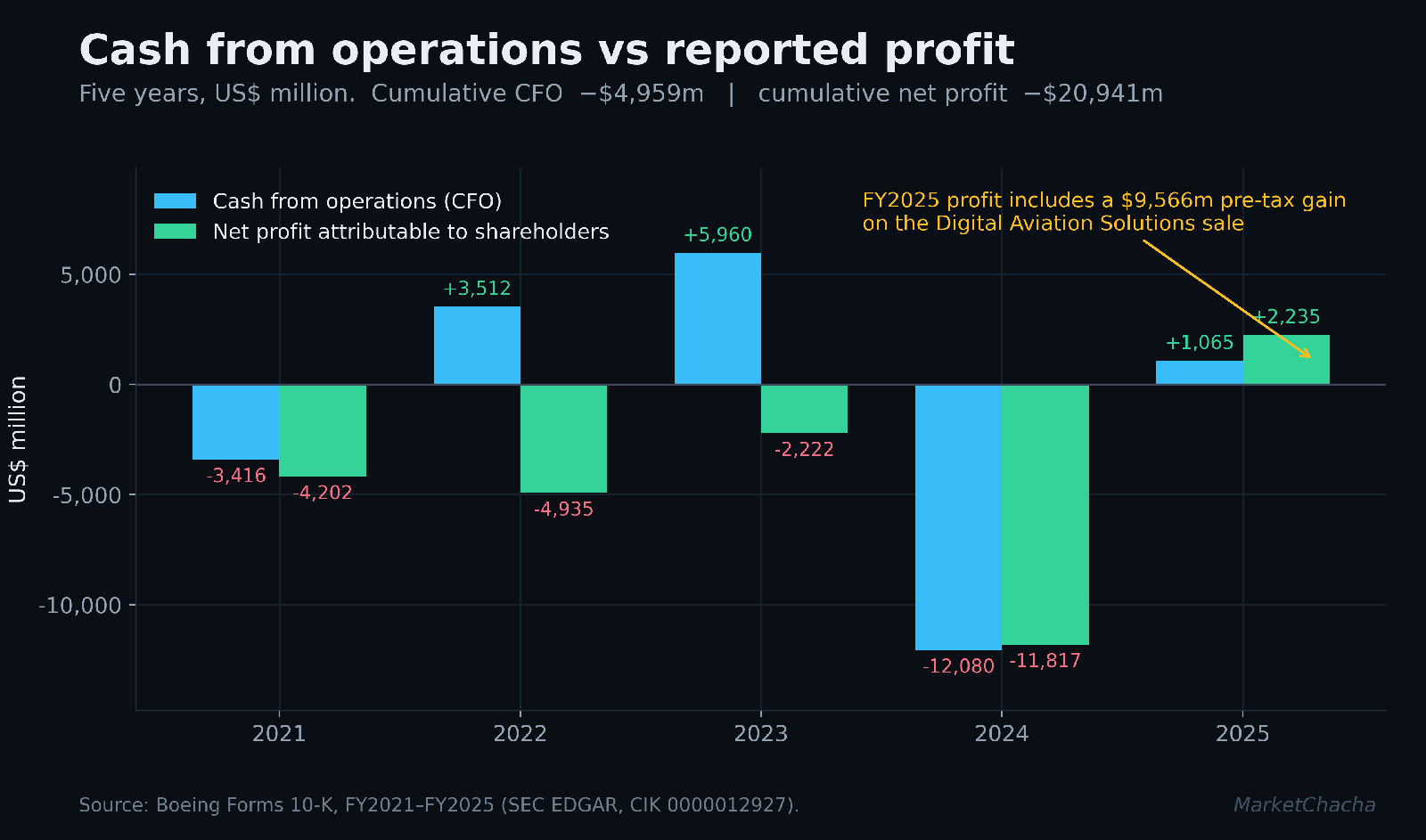
| Cash from operations | (3,416) | 3,512 | 5,960 | (12,080) | 1,065 |
| Free cash flow (company-defined) | (4,396) | 2,000 | 4,433 | (14,310) | (1,877) |
| Diluted EPS ($) | (7.15) | (8.30) | (3.67) | (18.36) | 2.48 |
| Total shareholders' equity | (14,999) | (15,883) | (17,233) | (3,908) | 5,454 |
The arithmetic. Revenue compounded from 62,286 to 89,463 over four years = +9.5% a year. Profit and EPS CAGRs are not computable: the base year is a loss. Cumulative five-year cash from operations is −$4,959 million; cumulative five-year profit is −$20,941 million; cumulative company-defined free cash flow is −$14,150 million.
Five-year shareholder return, from Boeing's own audited pay-versus-performance table: $100 invested in Boeing common stock on 31 December 2020 was worth $94 (2021), $89 (2022), $122 (2023), $83 (2024) and $101 at end-2025 — a total return of +1%, or about +0.2% a year. The same $100 in the S&P 500 Aerospace & Defense index was worth $230, about +18.1% a year.
Income statement — FY2025 vs FY2024
| US$ million | FY2025 | FY2024 | Δ abs | Δ % |
|---|---|---|---|---|
| Revenues | 89,463 | 66,517 | +22,946 | +34.5% |
| Cost of sales | (85,174) | (68,508) | (16,666) | +24.3% |
| Gross profit | 4,289 | (1,991) | +6,280 | n/m |
| General & administrative | (6,090) | (5,021) | (1,069) | +21.3% |
| Research & development, net | (3,615) | (3,812) | +197 | −5.2% |
| Gain on Digital Aviation Solutions divestiture | 9,566 | — | +9,566 | n/m |
| Earnings/(loss) from operations | 4,281 | (10,707) | +14,988 | n/m |
| Operating margin | 4.8% | −16.1% | excluding the gain: −5.9% | |
| Other income, net | 1,125 | 1,222 | (97) | −7.9% |
| Interest & debt expense | (2,771) | (2,725) | (46) | +1.7% |
| Earnings/(loss) before tax | 2,635 | (12,210) | +14,845 | n/m |
| Income tax (expense)/benefit | (397) | 381 | (778) | n/m |
| Attributable to shareholders | 2,235 | (11,817) | +14,052 | n/m |
| Net margin | 2.5% | −17.8% | — | — |
| Diluted EPS ($) | 2.48 | (18.36) | +20.84 | n/m |
Balance sheet — 31 Dec 2025 vs 31 Dec 2024
| US$ million | 2025 | 2024 | Δ abs | Δ % |
|---|---|---|---|---|
| Cash & equivalents | 10,921 | 13,801 | (2,880) | −20.9% |
| Short-term & other investments | 18,479 | 12,481 | +5,998 | +48.1% |
| Inventories | 84,679 | 87,550 | (2,871) | −3.3% |
| Property, plant & equipment, net | 15,361 | 11,412 | +3,949 | +34.6% |
| Goodwill | 17,275 | 8,084 | +9,191 | +113.7% |
| Total assets | 168,235 | 156,363 | +11,872 | +7.6% |
| Advances & progress billings | 59,404 | 60,333 | (929) | −1.5% |
| Short-term debt & current LTD | 8,461 | 1,278 | +7,183 | +562.1% |
| Long-term debt | 45,637 | 52,586 | (6,949) | −13.2% |
| Total debt | 54,098 | 53,864 | +234 | +0.4% |
| Total liabilities | 162,778 | 160,277 | +2,501 | +1.6% |
| Total shareholders' equity | 5,454 | (3,908) | +9,362 | n/m |
Cash flow — FY2025 vs FY2024
| US$ million | FY2025 | FY2024 | Δ abs |
|---|---|---|---|
| Cash from operations | 1,065 | (12,080) | +13,145 |
| Capital expenditure | (2,942) | (2,230) | (712) |
| Free cash flow | (1,877) | (14,310) | +12,433 |
| Cash from investing | 499 | (11,973) | +12,472 |
| Cash from financing | (3,763) | 25,209 | (28,972) |
The material variances and what drove them. Revenue rose 34.5% on deliveries of 600 aircraft against 348. Two balance-sheet lines moved more than 40%: goodwill more than doubled, the direct consequence of the Spirit share exchange, and short-term debt rose 562% as $7.2bn of long-term borrowings reclassified into the current bucket — total debt was essentially flat at $54.1bn. Equity swung from a $3,908m deficit to $5,454m positive, driven by the year's profit and by treasury shares reissued for Spirit. Financing swung $29.0bn because FY2024 contained a $23.9bn net capital raise that did not repeat.
Earnings quality. Pre-tax profit was $2,635m; the divestiture gain inside it was $9,566m. On that arithmetic the entire swing from loss to profit, and more, is attributable to a single asset sale. Other income of $1,125m — itself 43% of reported pre-tax profit and largely non-operating pension and interest income — is the second non-core contributor. Cash confirms the picture: operating cash flow of $1,065m against $2,235m of reported profit is a ratio of 0.48, and free cash flow stayed negative at −$1,877m in a reported-profit year. A benign reading: the sale was a real, all-cash transaction at $10.55bn, GAAP requires the gain to run through earnings, and reach-forward losses of $5,283m on 777X/767 were charged in the same year — the gain and the charges partly offset each other in the same period.
The latest quarter, decoded
| US$ million | Q2 FY26 | Q1 FY26 | QoQ | Q2 FY25 | YoY |
|---|---|---|---|---|---|
| Revenues | 24,560 | 22,217 | +10.5% | 22,749 | +8.0% |
| Cost of sales | 22,146 | 19,671 | +12.6% | 20,314 | +9.0% |
| Gross profit | 2,414 | 2,546 | −5.2% | 2,435 | −0.9% |
| Gross margin | 9.8% | 11.5% | — | 10.7% | — |
| G&A expense | 1,428 | 1,197 | +19.3% | 1,793 | −20.4% |
| R&D, net | 921 | 903 | +2.0% | 910 | +1.2% |
| Earnings from operations | 156 | 448 | −65.2% | (176) | n/m |
| Other income, net | 79 | 194 | −59.3% | 325 | −75.7% |
| Interest & debt expense | 600 | 616 | −2.6% | 710 | −15.5% |
| Loss before tax | (365) | 26 | n/m | (561) | +34.9% |
| Income tax expense | 63 | 33 | +90.9% | 51 | +23.5% |
| Loss to shareholders | (444) | (4) | n/m | (611) | +27.3% |
| Diluted EPS ($) | (0.67) | (0.11) | n/m | (0.92) | n/m |
Revenue grew both sequentially and year on year, but gross profit did not: cost of sales rose faster than revenue on both comparisons, so gross margin fell from 11.5% to 9.8% QoQ and from 10.7% YoY. Operating earnings stayed positive at $156m only because G&A was $365m lower than a year earlier — the year-ago quarter carried the $445m DOJ-related compensation charge. Below the operating line, other income fell 75.7% year on year, from $325m to $79m, and that decline is most of the reason the quarter still shows a pre-tax loss. EPS is struck after dividends on the mandatory convertible preferred stock, which is why the per-share loss is wider than net loss divided by shares. First-half operating cash flow was +$1,185m against −$1,389m a year earlier; capex was $2,008m, so half-year free cash flow was about −$823m. Note that advances and progress billings rose $4,660m in the half while inventories rose $3,859m — a large part of the operating cash improvement is customer prepayment, not margin.
Who owns it — and where those owners are registered
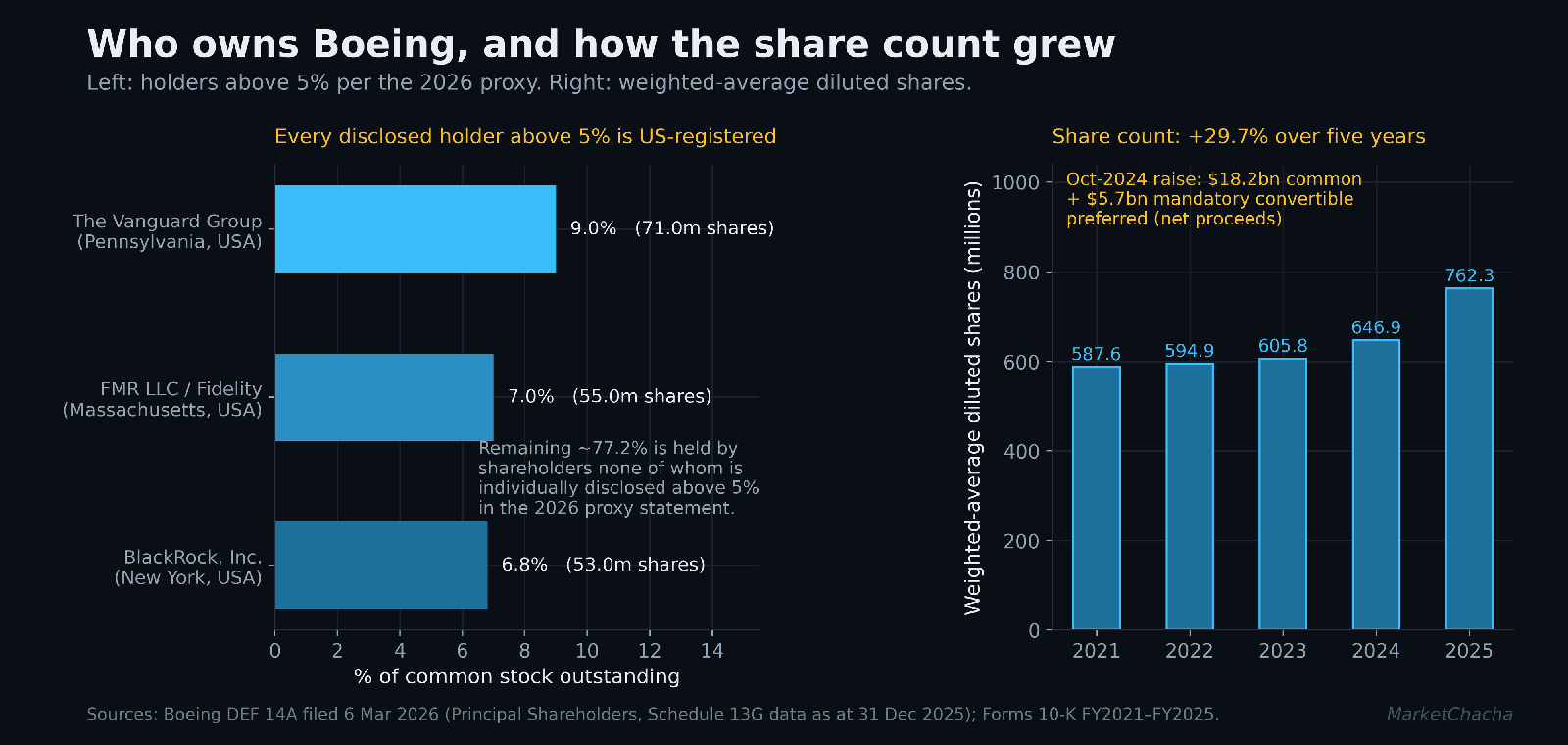
The 2026 proxy names every holder above 5%, based on Schedule 13G filings, against 784,669,191 shares outstanding at 31 December 2025:
- The Vanguard Group (Malvern, Pennsylvania) — 70,989,325 shares, 9.0%
- FMR LLC (Boston, Massachusetts) — 54,979,044 shares, 7.0%
- BlackRock, Inc. (New York) — 52,979,795 shares, 6.8%
Every disclosed holder above 5% is a US-registered manager. No offshore holding vehicle appears in the ownership disclosure, and no other holder is individually disclosed above 5% — roughly 77% of the register is diffuse. That is a verified finding, not a gap. There were 78,957 common shareholders of record at 23 January 2026, though for a US listing most shares are held in street name, so this figure is not a beneficial-holder count.
Insider dealing, from every Form 4 filed between 1 September 2025 and 31 August 2026: three open-market purchases totalling 4,154 shares for about $898,000 (directors Bradley Tilden and Mortimer Buckley, and CIDO Dana Deasy), against five open-market sales totalling 22,379 shares for about $5,251,000. Net open-market disposal of roughly 18,225 shares, about $4.35m. A further 44,862 shares were withheld to settle tax on vesting — those are not discretionary sales.
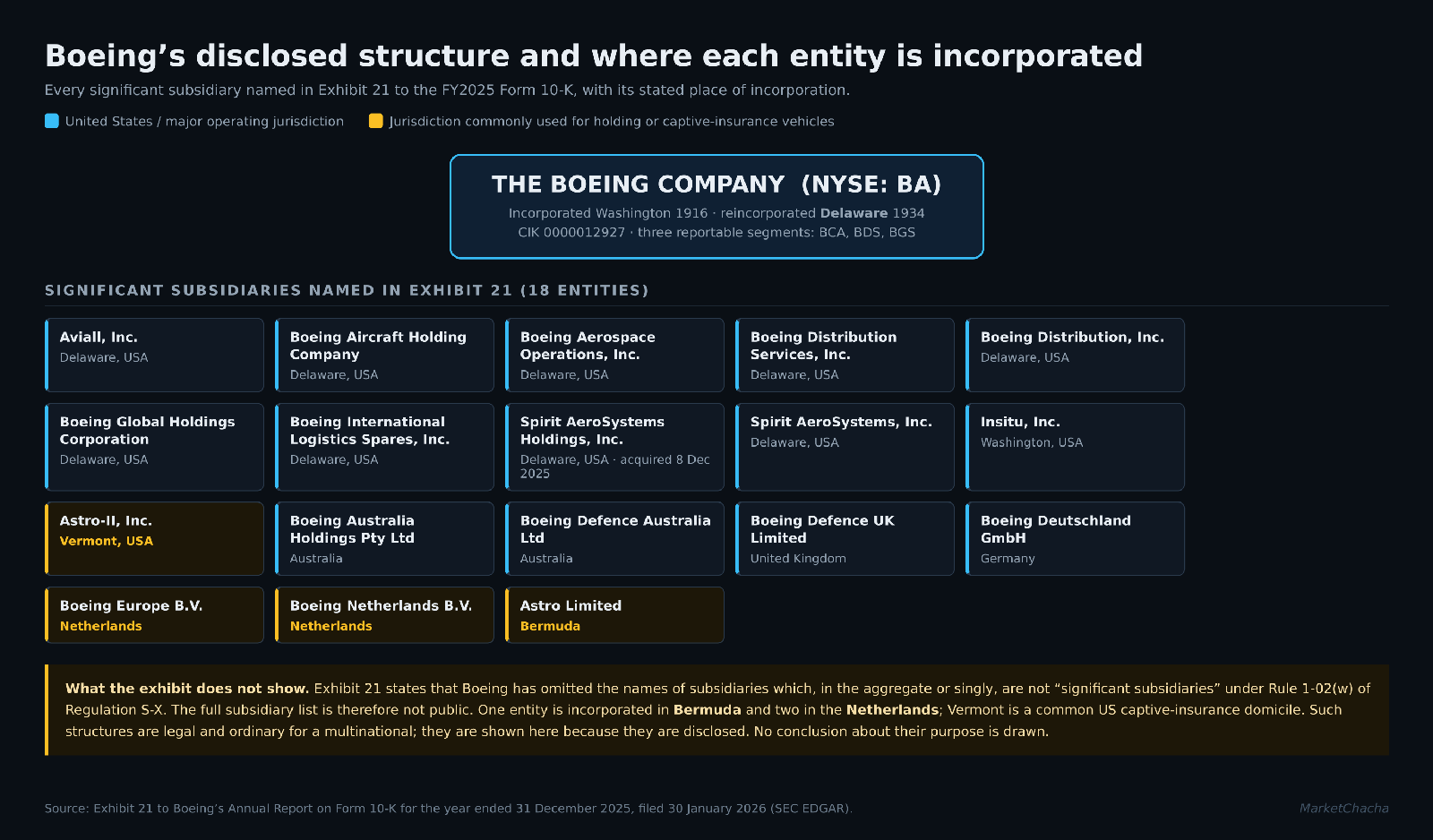
Jurisdictions. Exhibit 21 names 18 significant subsidiaries. Nine are Delaware, one Washington; two Australia, one UK, one Germany. Four sit in jurisdictions that merit naming: Astro Limited (Bermuda), Boeing Europe B.V. and Boeing Netherlands B.V. (both Netherlands), and Astro-II, Inc. (Vermont, a standard US captive-insurance domicile). Such structures are legal and ordinary for a multinational manufacturer; they are listed here because they are disclosed. Boeing states in the same exhibit that it has omitted the names of subsidiaries that are not “significant subsidiaries” under Rule 1-02(w) of Regulation S-X — so the complete subsidiary list is not public.
Capital history — every time they raised money
Boeing has been listed for decades; the recent capital history is what matters. From the consolidated statements of cash flows and equity:
- March 2020: the open-market common stock repurchase programme was terminated. It remains terminated: the only shares acquired in Q4 2025 were 33,665 transferred from employees for tax withholding.
- No common dividend appears in the financing section in any of FY2023, FY2024 or FY2025.
- October 2024: a capital raise producing $18,200m of net proceeds from common stock and $5,657m net from the 6.00% Series A Mandatory Convertible Preferred Stock — about $23.9bn combined. 5,750,000 preferred shares are issued, aggregate liquidation preference $5,750m at $1,000 per share, with dividends of up to $345m a year to the mandatory conversion date of 15 October 2027. Common stock ranks junior; no common dividend may be declared unless accumulated preferred dividends are paid. $331m of preferred dividends were paid in FY2025.
- December 2025: approximately $4.7 billion of Boeing shares issued to acquire Spirit AeroSystems.
- Dilution: weighted-average diluted shares went from 587.6 million (2021) to 762.3 million (2025), +29.7%. Shares outstanding were 790,370,020 at 21 July 2026. No preferential allotment to a related party appears in any filing reviewed.
- Debt: $54.1bn at 31 December 2025, reduced to $45.9bn by 30 June 2026. About $15.5bn of principal falls due over three years, alongside $15.2bn of airplane financing commitments.
Who runs it, and the wider web
CEO: Robert K. “Kelly” Ortberg, principal executive officer for the full year 2025 (2025 Summary Compensation Table total $23,581,389; compensation actually paid $31,921,725). His predecessor was David Calhoun. Independent Board Chair: Steve Mollenkopf, former CEO of Qualcomm — the roles are separate. CFO: Jesus “Jay” Malave, elected EVP and CFO in June 2025; Brian West ceased to serve as CFO effective 15 August 2025.
Twelve directors stood for election in 2026. Bradley D. Tilden joined in December 2025 as, in the company's words, “our 10th new independent director since 2019”. The Audit Committee is Lynne Doughtie (chair, former US chairman and CEO of KPMG), David Gitlin, Lynn Good and Akhil Johri (former CFO of United Technologies); all four are designated audit committee financial experts.
Auditor: Deloitte & Touche LLP, Seattle, which states it has “served as the Company's auditor since at least 1934”. FY2025 opinions on both the financial statements and internal control over financial reporting were unqualified, with no going-concern paragraph. Two critical audit matters were reported: cost estimates for fixed-price development contracts, and the 737 programme. FY2025 fees: audit $39.1m, audit-related $4.5m, tax nil, all other nil.
Related-person transactions. Boeing discloses that it “has not adopted a specific written policy for reviewing related-person transactions” and considers each on its facts. Three were disclosed for 2025: BlackRock affiliates received about $10.6m and $4.8m for investment management to the retirement and savings plan trusts; Fidelity affiliates about $1.0m for recordkeeping; and Boeing paid Lockheed Martin $2.0m in connection with a release of claims relating to Mr Malave's prior employment. Against $89,463m of revenue these total roughly 0.02%. The 10-K contains no related-party transactions note.
The regulatory and surveillance record
- Department of Justice. On 29 May 2025 Boeing and the DOJ entered a non-prosecution agreement to resolve, in the 10-K's words, “the Department's determination that Boeing did not fulfill its obligations under the January 2021 deferred prosecution agreement” relating to the October 2018 Lion Air 610 and March 2019 Ethiopian Airlines 302 accidents. It requires a $244m fine (expensed 2024) and $445m of additional compensation for family members (expensed Q2 2025), both held in escrow — $689m of restricted cash sat in escrow at 31 December 2025. The Northern District of Texas approved the DOJ's motion to dismiss on 6 November 2025; representatives of family members have appealed, and that appeal is pending before the Fifth Circuit.
- Other litigation. Fewer than five civil suits by family members remain; securities class actions are pending, including a class-certification motion in the Northern District of Illinois, and further investigations and actions arose from the January 2024 737-9 door plug accident. Boeing states it cannot reasonably estimate a range of loss on these.
- FAA. Following the door plug accident the FAA investigated the 737 quality control system and increased oversight. The 737 programme may only increase production rates or add production lines with FAA concurrence — a live, checkable external constraint on output.
- Credit ratings. Stated in the Q2 FY2026 10-Q: “We currently maintain investment grade credit ratings across all three credit rating agencies. In June 2026, Fitch affirmed the BBB− credit rating and revised the outlook to positive from stable. At S&P, we are rated BBB− with a stable outlook, and at Moody's, we are rated Baa3 with a stable outlook.” All three are the lowest investment-grade notch. Boeing also states it is in compliance with all debt and credit facility covenants.
- Auditor and officer changes. No Form 8-K Item 4.01 (auditor resignation or dismissal) appears in Boeing's EDGAR history over the last seven years. Officer changes are disclosed under Item 5.02, including the August 2025 CFO transition.
Forensic checks — what the accounts show
| Check | What we found | Source | A benign explanation |
|---|---|---|---|
| 1. 5-yr cumulative CFO ÷ PAT | Cumulative CFO −$4,959m; cumulative PAT −$20,941m. Ratio not meaningful (both negative). FY2025 alone: 1,065 ÷ 2,235 = 0.48 | 10-K FY2021–FY2025 | Cash exceeded profit cumulatively because charges (reach-forward losses) are non-cash. FY2025's low ratio reflects the non-cash divestiture gain being deducted. |
| 2. Implied yield on cash | Cash + short-term investments $29,400m at end-2025; other income $1,125m → 3.8% | 10-K FY2025 | Consistent with short-dated US rates. Other income also contains $176m of non-operating pension income, so the true cash yield is not separable from this line. |
| 3. Implied interest rate on debt | 2025: 2,771 ÷ avg debt 53,736 = 5.16%; 2024 5.16%; 2023 4.52%; 2022 4.42% | 10-K FY2022–FY2025 | Normal for BBB−/Baa3 paper. No anomaly. |
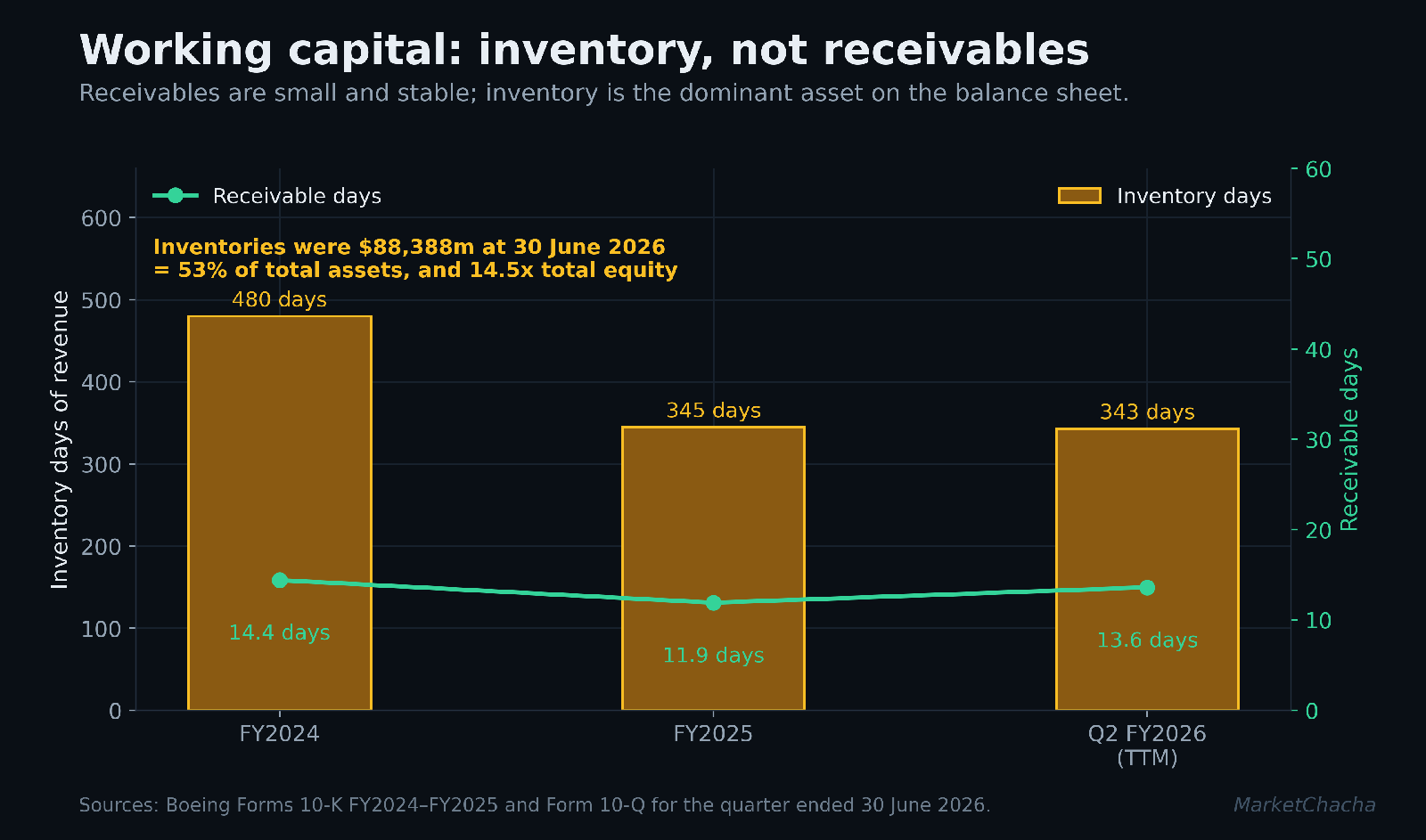
| 4. Receivable and inventory days | Receivables 11.9–15.5 days across five years; 13.6 days on TTM at Q2 FY26. Inventory 480 days (FY24), 345 (FY25), 343 (TTM) | 10-K; 10-Q Jun-2026 | Receivables are tiny because aircraft are paid via advances. Long inventory is structural to aircraft manufacturing and improved as deliveries recovered. |
| 5. Related-party transactions | ~$18.4m disclosed for 2025 = 0.02% of revenue. No written RPT policy. | DEF 14A 2026 | Immaterial in size, and all counterparties are index managers or an employment matter. |
| 6. Insider net activity (12 months) | Purchases $0.90m vs sales $5.25m → net selling ~$4.35m. Insiders as a group own <1%. | Forms 4; DEF 14A | Volumes are trivial against a ~$181bn market capitalisation; two directors bought in the open market in 2026. |
| 7. Auditor | Deloitte & Touche LLP, no change, no Item 4.01 in seven years, unqualified opinion on statements and ICFR, no going-concern note. Non-audit fees ~10% of audit fees. | 10-K FY2025; DEF 14A | Long tenure can itself be debated, but the audit-fee mix supports independence. |
| 8. Subsidiaries and jurisdictions | 18 significant subsidiaries: 10 US, 2 Australia, 1 UK, 1 Germany, 2 Netherlands, 1 Bermuda, 1 Vermont. Non-significant subsidiaries omitted. | Exhibit 21, FY2025 10-K | Netherlands and Bermuda entities are common in aerospace group and insurance structures; Vermont is a standard captive domicile. |
| 9. Dilution | Diluted shares +29.7% in four years. Oct-2024 raise $23.9bn net; Dec-2025 Spirit share exchange ~$4.7bn. | 10-K FY2021–FY2025 | Both issuances were disclosed, at scale, and used to restore a negative equity position and buy a critical supplier. |
| 10. Other income as % of PBT | FY2025: $1,125m ÷ $2,635m = 43%. Q2 FY26 other income fell 75.7% YoY. | 10-K FY2025; 10-Q Jun-2026 | Largely non-operating pension income and interest on a $29bn cash pile — real, but not from selling aircraft. |
| 11. Capex vs D&A | 5-yr capex $8,901m vs D&A $9,773m → 0.91x. FY2025 alone 2,942 vs 1,953 = 1.51x. | 10-K FY2021–FY2025 | Under-investment during the crisis years; FY2025 shows reinvestment resuming as rates rise. |
| 12. Balance-sheet structure | At 30 Jun 2026: inventories $88,388m = 53% of total assets and 14.5x total equity; advances $64,059m = 10.5x equity; goodwill $17,554m = 2.9x equity; total equity $6,115m = 3.7% of assets. | 10-Q Jun-2026 | Aircraft manufacturing is inherently inventory-heavy and customer-prepaid. Equity is thin because of accumulated losses, not because assets were written away. |
Valuation, stated as arithmetic only. Using $228.65 — the price recorded on a Form 4 dated 17 August 2026 — and 790,370,020 shares, the market capitalisation is about $180.7bn. Against total shareholders' equity of $6,100m that is a price-to-book of about 29.6x; deduct the $5,750m preferred liquidation preference and common book equity is roughly $350m, at which point price-to-book stops being a usable measure. Price to FY2025 reported EPS of $2.48 is about 92x, and that EPS contains the divestiture gain. Named peer Lockheed Martin (NYSE: LMT), on the same method: $600.115 (Form 4, 12 August 2026) × 230,790,753 shares = about $138.5bn; FY2025 EPS $21.49 → 27.9x; equity $6,721m → 20.6x book. Both companies carry unusually small book equity, for different reasons — Boeing from accumulated losses, Lockheed from years of buybacks — which is why book multiples for either should be read with care.
What we could not verify
- The full subsidiary list. Exhibit 21 names only significant subsidiaries and expressly omits the rest.
- Named commercial customers. Boeing discloses government concentration but does not identify any individual airline or lessor as a >10% customer.
- Supplier concentration. No single supplier's share of purchases is quantified.
- Product-level revenue. Segment disclosure does not break revenue down by aircraft programme.
- Loss exposure on pending litigation. Boeing states it cannot reasonably estimate a range, so neither can we.
- Q4 FY2025 as a standalone quarter. It is derived here by subtracting nine-month figures from the audited full year; Boeing does not file a Q4 10-Q.
- Share prices. We used prices recorded on Forms 4 rather than a market feed; they are primary but are point-in-time transaction prices, not closing quotes.
- Beneficial ownership below 5% and the identity of holders behind street-name registrations.
What would change the picture
- The FY2026 operating line without a disposal. With no divestiture gain to book, FY2026 shows whether the aircraft business itself earns money.
- The 737 rate gate. Whether the FAA concurs with 47 per month, and whether a new production line is approved.
- 777X first delivery in 2027 — and whether further reach-forward losses are recognised before it. Two years running have added $4.9bn and $3.5bn.
- The Fifth Circuit ruling on the appeal against dismissal of the criminal information.
- Rating actions. Fitch's outlook is already positive at BBB−; an upgrade or a downgrade from the lowest investment-grade notch is a discrete, dated, checkable event.
- 15 October 2027, when the mandatory convertible preferred converts and the share count moves again.
- Free cash flow. It has been negative in four of the last five years on the company's own definition. Watch whether advances, not margin, keep carrying operating cash flow.
- The next auditor's report and whether the critical audit matters change.
Sources
- Boeing Annual Report on Form 10-K for the year ended 31 December 2025 (filed 30 January 2026)
- Exhibit 21 — List of Company Subsidiaries, FY2025 Form 10-K
- Boeing Quarterly Report on Form 10-Q for the quarter ended 30 June 2026 (filed 28 July 2026)
- Boeing Form 10-Q for the quarter ended 31 March 2026 (filed 22 April 2026)
- Boeing Form 10-Q for the quarter ended 30 September 2025
- Boeing Form 10-Q for the quarter ended 30 June 2025
- Boeing Definitive Proxy Statement (DEF 14A), filed 6 March 2026 — principal shareholders, auditor fees, related-person transactions, pay-versus-performance
- Boeing Form 10-K for the year ended 31 December 2024
- SEC XBRL company facts, Boeing (CIK 0000012927) — five-year financial series
- Boeing Forms 4 (insider transactions), EDGAR — 85 filings, 1 September 2025 to 31 August 2026
- Boeing Forms 8-K, EDGAR — checked for Item 4.01 auditor changes and Item 5.02 officer changes
- SEC XBRL company facts, Lockheed Martin (CIK 0000936468) — peer comparison
- SEC EDGAR submissions index, Boeing — state of incorporation, filing history, shares outstanding
FAQ
Did Boeing actually make a profit in 2025? Yes — $2,235 million attributable to shareholders, audited, its first annual profit since 2018. It also disclosed a $9,566 million pre-tax gain on the Digital Aviation Solutions divestiture inside operating earnings that year. Both facts are in the same 10-K.
Why is Boeing's book value so small? Total shareholders' equity was negative from 2019 through 2024 — a deficit of $17,233 million at end-2023 — because of accumulated losses. The October 2024 capital raise and the 2025 profit brought it back to $5,454 million at end-2025 and $6,100 million at 30 June 2026, against $165,870 million of assets.
Are there offshore entities? Exhibit 21 names one Bermuda subsidiary (Astro Limited) and two Netherlands subsidiaries, plus a Vermont entity of the kind commonly used for captive insurance. All three shareholders disclosed above 5% are US-registered managers. Boeing omits non-significant subsidiaries from the exhibit, so the full list is not public.
Does Boeing pay a dividend? Not on the common stock — no common dividend appears in the financing section of the cash flow statement for FY2023, FY2024 or FY2025. It paid $331 million of dividends on the 6.00% mandatory convertible preferred stock in FY2025, which converts on 15 October 2027.
What is the DOJ position now? A non-prosecution agreement was signed on 29 May 2025 requiring a $244m fine and a $445m compensation fund, both in escrow. A federal court approved dismissal of the criminal information on 6 November 2025; family representatives have appealed and the appeal is pending in the Fifth Circuit.
How has the stock done? Boeing's own audited pay-versus-performance table shows $100 invested at end-2020 was worth $101 at end-2025. The S&P 500 Aerospace & Defense index equivalent was $230.
Independent research for education and discussion only. Not investment advice, not a recommendation, and not a rating — we issue no buy/sell calls and no target prices. Every figure is sourced from the primary documents linked above; figures can be restated and we can make mistakes, so always verify against the original. Nothing here alleges wrongdoing by any company or individual: where a fact raises a question we state the fact, cite it, and give the benign explanation alongside. Offshore holding structures, pledging and preferential allotments are all legal and common — they are disclosed here as facts, not as accusations.
This article is for educational and informational purposes only. It is not financial advice, investment recommendation, or a solicitation to buy or sell securities. Investing involves significant risks. I am not a SEBI-registered investment advisor. Readers should consult their own financial advisor and conduct their own research before making any investment decisions.
Comments
Join the conversation
Sign in to join the conversation.
Follow replies, add your view, and take part in the discussion.
Sign in to commentLoading comments...