

Bharat Forge opens QIP at ₹1,947.70 floor, up to ₹2,500 cr — what it means
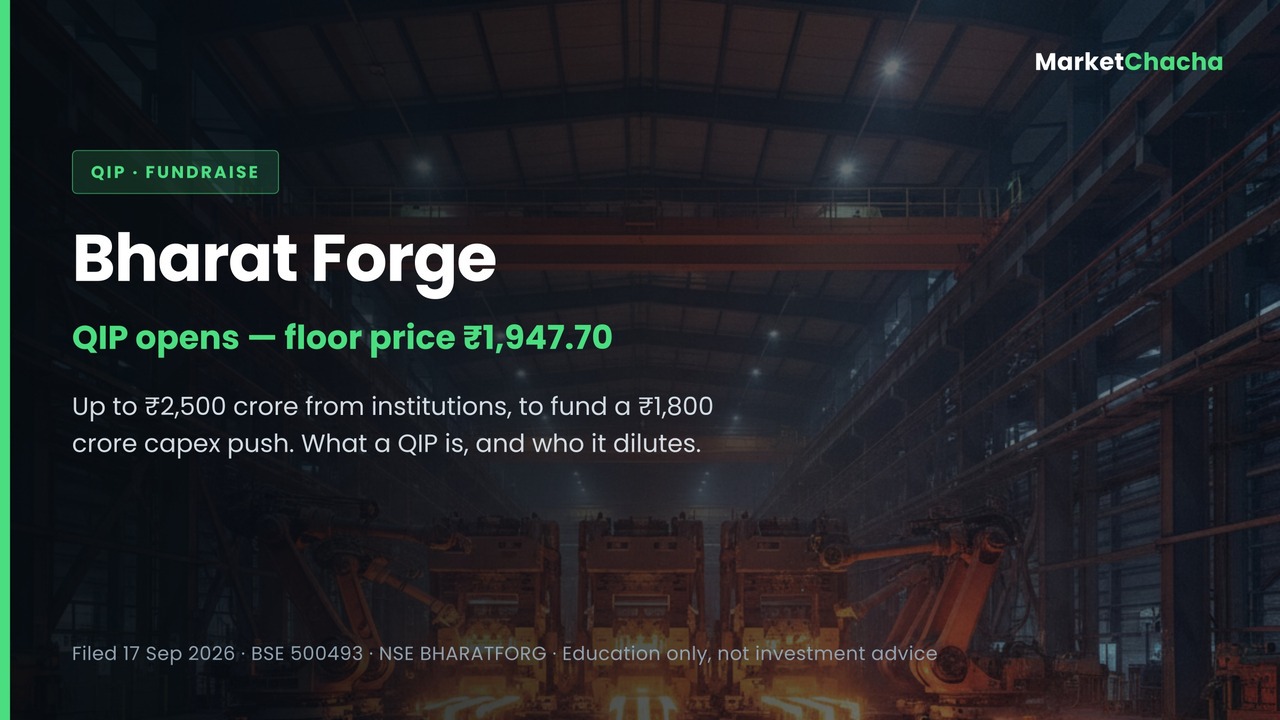
Bharat Forge has opened a Qualified Institutions Placement (QIP) — a share sale to large institutional investors — and fixed the floor price at ₹1,947.70 per share. Shareholders have cleared a raise of up to ₹2,500 crore, earmarked for a roughly ₹1,800 crore capex programme.
What was announced
In a filing dated 17 September 2026 (BSE scrip 500493), the company's Investment Committee adopted the Preliminary Placement Document, formally opened the issue, and set the floor at ₹1,947.70 per ₹2 face-value share.
- The floor follows SEBI's pricing formula, with 17 September 2026 as the "Relevant Date".
- A discount of up to 5% is permitted — the final price could land near ₹1,850.
- The size is not yet disclosed. ₹2,500 crore is the ceiling, not a confirmed number.
- Authority traces to a board approval on 10 August 2026 and a postal ballot dated 11 September 2026. The insider-trading window has been shut since 15 September.
What a QIP actually is
A QIP is the fastest legal route for a listed Indian company to raise fresh equity. Rather than a months-long public offer, it sells newly created shares straight to qualified institutional buyers — mutual funds, insurers, foreign institutions — usually within days.
Two things matter to a retail shareholder. The floor price is formula-driven, not chosen by management: SEBI ties it to a recent two-week average, which is why it sits close to the market price. And retail investors cannot participate. Unlike a rights issue, you get no right to buy in. New shares simply appear and your slice of the company shrinks slightly. That is dilution.
Why it matters
The dilution looks modest. Against roughly 47.8 crore shares outstanding (market cap ₹93,612 crore at about ₹1,958), a full ₹2,500 crore raise near the floor is roughly 2.5–3% new equity.
What it buys is the point. This is equity, not debt — no interest, no repayment date — funding capacity for large engines, power generation, semiconductors, aerospace, an energetics facility in Andhra Pradesh and a planned Odisha site. Management has guided to asset turnover above 1.5x and flagged a defence order book of ₹11,196 crore as of 30 June 2026 (Autocar Professional). Whether the dilution pays depends on whether that capex earns more than the equity costs. This is also a repeat: Bharat Forge raised ₹1,650 crore via QIP in December 2024 at a ₹1,323.54 floor (Business Standard).
The business
Bharat Forge is the Kalyani group's Pune-based forging and engineering flagship. Its base is forged crankshafts and axle beams for commercial vehicles — still a large revenue slice, tied to US and European truck cycles — and it has since pushed into defence (artillery, ammunition, armoured vehicles), aerospace, industrials and oil & gas. That mix is why this raise funds several divisions, not one.
Valuation, as reported
Screener.in shows a consolidated P/E of 92.7, market cap ₹93,612 crore, P/B 9.58, ROCE 12.6% and ROE 12.0%. On trailing standalone earnings GuruFocus showed a P/E of 127.61 as of 17 September 2026, against a 10-year median of 61.83 and a historical band of roughly 16.5 to 460 — this multiple has swung hard with the truck cycle. Named peer: Sundram Fasteners at a P/E of 41.5 on a ₹25,776 crore market cap, about a quarter of Bharat Forge's size. The stock traded near ₹1,963 (+2.3%) on the morning of 18 September (INDmoney, 15-minute delayed), within a 52-week range of ₹1,179–₹2,295.
Beginner takeaway
A QIP is a company selling new shares to institutions, fast, at a price the regulator's formula largely sets. You are diluted slightly and cannot buy in. The question is never "is dilution bad" but "does the money buy more than the shares given up". Watch for the follow-up filing with the final price and size — that is when you learn what institutions actually paid. Today's other filing-driven moves are on the movers page.
FAQ
Can I buy shares in the QIP? No. QIPs are open only to qualified institutional buyers. Retail investors buy on the open market as usual.
Does the floor price mean the stock will fall to ₹1,947.70? No. The floor is a regulatory minimum for the institutional sale, derived from recent average prices — not a forecast or a valuation.
Why does the trading window close before a QIP? Insiders know the issue is coming before the market does. Shutting the window stops them trading on that information — standard SEBI compliance, not a sign of trouble.
Is a QIP better than borrowing? Neither inherently. Debt costs interest and must be repaid but does not dilute; equity dilutes but carries no repayment risk. Related: Neogen Chemicals' ₹600 crore QIP and Yatharth Hospital's preferential issue. Dates ahead are on the calendar.
As of 18 September 2026. Source: official BSE/NSE filing — read it directly here. We summarise filings for education and may make errors, so always verify against the official document. Educational content only — not investment advice, not a buy/sell recommendation.
This article is for educational and informational purposes only. It is not financial advice, investment recommendation, or a solicitation to buy or sell securities. Investing involves significant risks. I am not a SEBI-registered investment advisor. Readers should consult their own financial advisor and conduct their own research before making any investment decisions.
Comments
Join the conversation
Sign in to join the conversation.
Follow replies, add your view, and take part in the discussion.
Sign in to commentLoading comments...