

Adani Ports: what their latest filing actually means
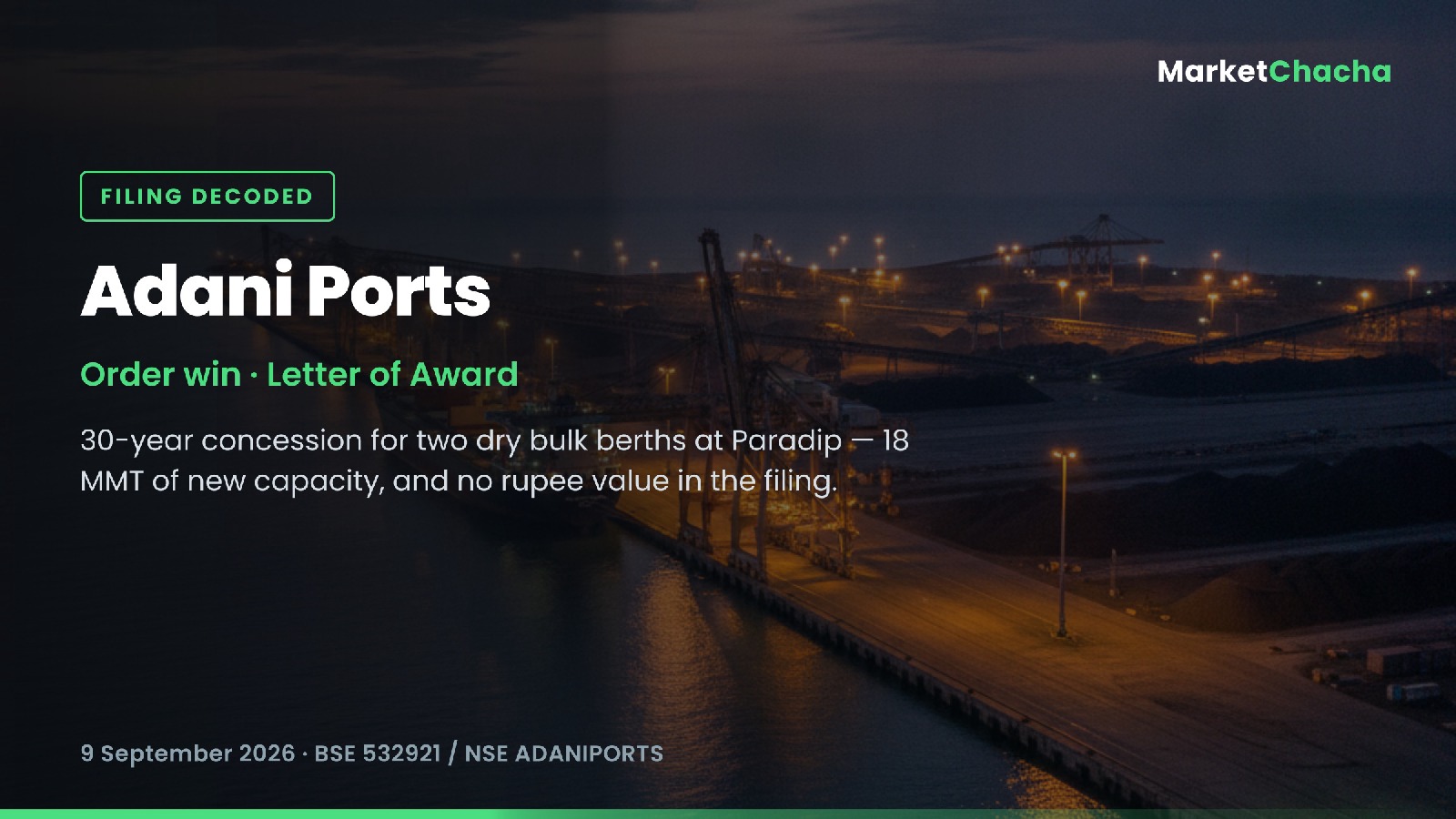
Adani Ports and Special Economic Zone (APSEZ) told the exchanges on 9 September 2026 that it has received a Letter of Award (LOA) from Paradip Port Authority to develop and operate two dry bulk berths at Paradip Port in Odisha, on a 30-year concession. It is an order-win filing — and, notably, one with no rupee value attached to it.
What was announced
- What: An LOA to mechanise, operate and maintain the CQ-I and CQ-II berths at Paradip Port, won through competitive bidding where APSEZ was the highest bidder.
- Structure: A 30-year concession on a BOT (Build, Operate and Transfer) basis, under the public-private partnership model. Ownership of the asset stays with the port authority; APSEZ gets the right to build and run it for 30 years, then hands it back.
- Capacity: Adds 18 million metric tonnes (MMT) of mechanised dry bulk capacity. APSEZ says this takes its domestic portfolio from 653 MMT to 671 MMT, and its network to 16 ports and terminals.
- Order size: The filing states the consideration is “not ascertainable as depends on the future cargo” — there is no headline contract value.
- Next step: The concession agreement is to be signed within 30 days of the LOA being issued.
- Context given by the company: Paradip is India's second-largest major port; APSEZ already runs about 140 MMT of capacity on the east coast across Haldia, Dhamra, Gopalpur and Gangavaram, and has a stated target of 1 billion tonnes of annual cargo throughput by 2030.
What this type of filing means
This is a Regulation 30 order-win intimation. SEBI's LODR rules require a listed company to tell the exchanges about any award of an order or contract that a reasonable investor would consider material — and to do it in a fixed format: who awarded it, the key terms, domestic or international, the execution timeline, and the size.
Two words in that format matter a lot here.
An LOA (Letter of Award) is the award notice, not the signed contract. It says “you won the bid.” The binding document is the concession agreement that follows — here, due within 30 days. Between LOA and signature there is normally little drama, but it is not the same as work having started.
A concession on BOT basis is how most Indian port and road infrastructure is awarded. The government body owns the underlying asset; the private operator spends the capital to build and mechanise it, earns the cargo-handling revenue for the concession term, usually shares a percentage of revenue with the authority, and returns the asset at the end. So the operator is buying a 30-year revenue stream, not a piece of land.
And when a filing says the size is “not ascertainable”, that is not evasion — it is the honest answer for a concession. A construction order has a fixed contract value; a concession's revenue depends entirely on how much cargo actually moves through the berth over three decades. That is precisely why concession wins are harder to value than order-book wins, and why you should be sceptical of any number circulating that the company itself did not put in the filing.
Why it matters / potential impact
- Scale, but incremental. 18 MMT on a 653 MMT domestic base is roughly a 2.8% capacity addition. Meaningful, not transformative — and capacity is not throughput. Revenue only arrives as cargo actually shows up.
- Geography is the real point. Paradip sits next to the mineral and steel belt of eastern India. APSEZ historically skewed west (Mundra). Adding a berth at India's second-largest major port deepens its east-coast position and its exposure to coal, limestone and iron-ore flows.
- Cash goes out before it comes in. BOT means APSEZ funds the mechanisation capex up front, with revenue building over years. Expect this to show in capital work-in-progress and cash flow well before it shows in the P&L. The filing gives no capex figure.
- Commodity-linked, not GDP-linked. Dry bulk volumes here track steel, power and mining activity. That is a more cyclical revenue stream than container handling.
- No dilution. This is an operating win, not a fundraise — no new shares, no change to your ownership percentage.
- What to watch: whether the concession agreement is actually signed inside the 30-day window, and whether APSEZ discloses the capex and expected commissioning timeline when it does.
Is it expensive?
As reported on Screener.in, APSEZ trades around ₹1,710 a share, a market capitalisation of about ₹3.95 lakh crore, a P/E of roughly 29.7 and a price-to-book of about 4.1x, on ROCE of 14.1% and ROE of 16.4%.
Roughly 30 times earnings is a full but not extreme multiple for an Indian large-cap infrastructure operator — it is well above the market's long-run average, and it embeds an expectation that capacity and throughput keep compounding. It is the price of a business with high margins, long concession-protected revenue and a dominant share of India's private port capacity; it is not a bargain multiple.
For comparison, listed peer JSW Infrastructure trades near ₹341, a market cap of about ₹79,500 crore, a P/E of about 51.3 and price-to-book near 6.4x, on similar ROCE (13.6%) and ROE (15.3%). So on reported earnings the smaller, faster-growing operator is roughly 70% more expensive than APSEZ — the market is paying up for JSW Infra's growth runway off a much lower base, while APSEZ is priced as the incumbent. Whether either multiple is deserved depends on cargo growth actually delivering; this is context, not a recommendation.
The business
APSEZ is India's largest private port operator and describes itself as an integrated transport utility. Its revenue comes from three broad places:
- Ports and terminals — the core. Cargo-handling charges across its Indian network (Mundra is the largest by far, plus Hazira, Dhamra, Gangavaram, Haldia, Gopalpur and others) and international assets including Haifa in Israel, Dar es Salaam in Tanzania and Colombo.
- Logistics — rail rakes, trucking, multimodal parks, warehousing and agri-silos that move cargo inland from the quay.
- SEZ and port-led development — land leasing and development income, principally at Mundra, plus marine services.
Important for reading this filing: Paradip is one berth concession inside the ports segment, in the dry bulk category. It does not touch the logistics or SEZ businesses, and it is a small slice of a very large port portfolio. Treat it as a bolt-on to the biggest division, not a company-level event.
Beginner takeaway
A 30-year port concession win is genuinely good news for a port operator's long-term footprint — but read what the filing does and does not say. It says 18 MMT of capacity and a 30-year term; it explicitly says the value cannot be estimated because it depends on future cargo. Capacity added today is optionality, not revenue.
The useful habit here is to size the news before reacting to it: 18 MMT against a 653 MMT base is under 3%. A headline that reads “Adani Ports wins Paradip berths” sounds much bigger than the arithmetic does.
FAQ
Is a Letter of Award the same as a signed contract? No. An LOA confirms the company won the bid; the binding concession agreement is signed afterwards — in this case, due within 30 days of the LOA.
Why does the filing not state how much the order is worth? Because it is a concession, not a fixed-price construction order. APSEZ earns from cargo handled over 30 years, so the total value depends on future volumes, which is exactly what the company wrote in the disclosure.
What does “BOT” mean for who owns the berth? Build, Operate and Transfer. The port authority owns the asset; APSEZ funds and builds the mechanisation, operates it for the concession period, and transfers it back at the end. APSEZ is buying operating rights, not the port.
Does 18 MMT of new capacity mean 18 MMT of new cargo? No. Capacity is the maximum a berth can handle; throughput is what actually moves. Utilisation ramps up over years and depends on demand from steel, power and mining customers in the hinterland.
As of 9 September 2026. Source: official BSE/NSE filing — read it directly here. We summarise filings for education and may make errors, so always verify against the official document. Educational content only — not investment advice, not a buy/sell recommendation.
This article is for educational and informational purposes only. It is not financial advice, investment recommendation, or a solicitation to buy or sell securities. Investing involves significant risks. I am not a SEBI-registered investment advisor. Readers should consult their own financial advisor and conduct their own research before making any investment decisions.
Comments
Join the conversation
Sign in to join the conversation.
Follow replies, add your view, and take part in the discussion.
Sign in to commentLoading comments...