

Why did Doximity (DOCS) nearly double today? A 7% grower, an AI search tool, and a big re-rate
What happened
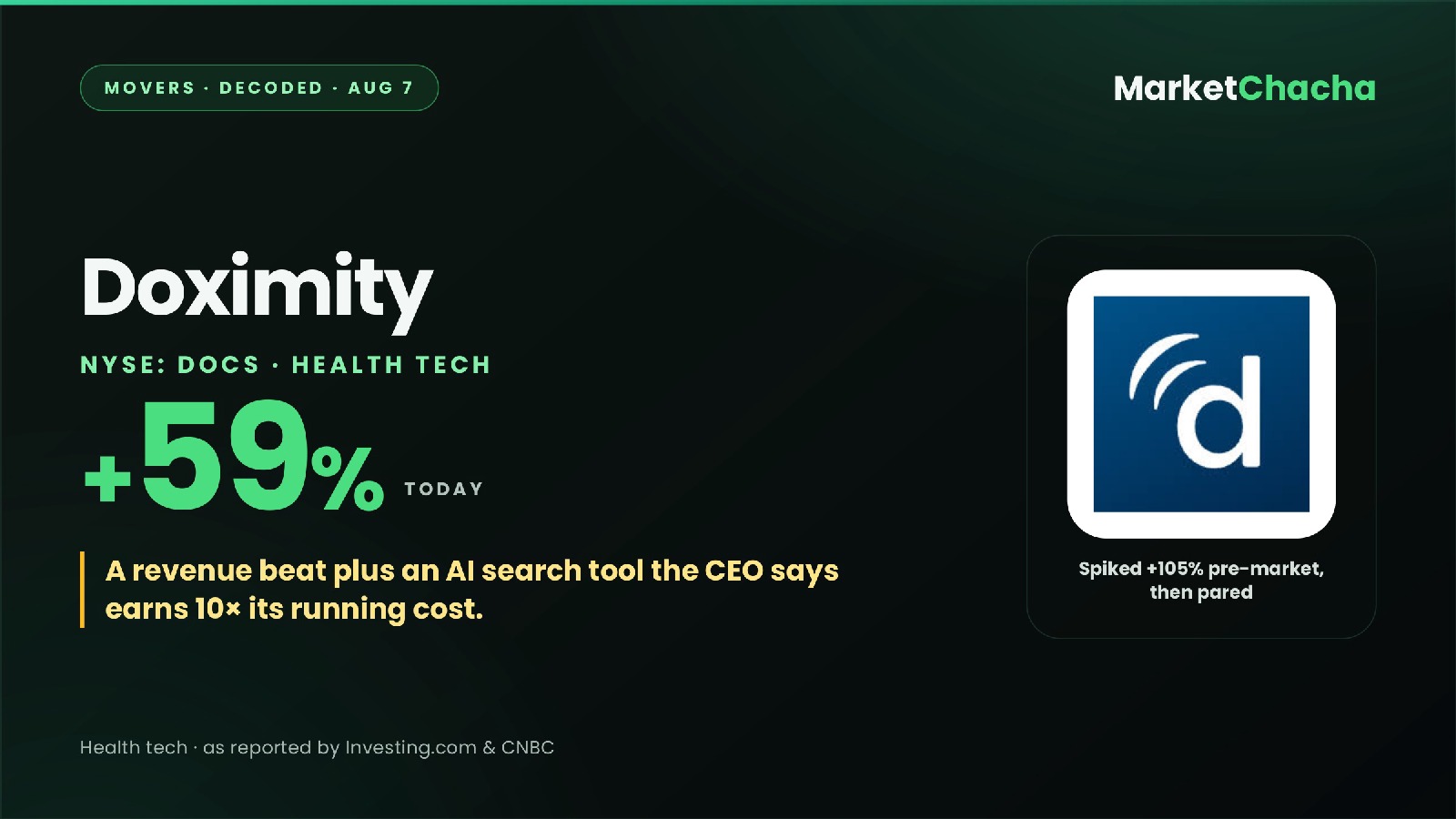
Shares of Doximity (NYSE: DOCS) went vertical after earnings. The stock closed Thursday at $20.66, then spiked as much as +105% to $42.39 in Friday's pre-market before cooling — during the regular session it traded around $32.80, up roughly 59%, as reported by Investing.com and Benzinga. For a company most people outside medicine have never heard of, that's one of the biggest single-day moves on the US market today.
Why it moved
Here's the twist: the headline numbers were only okay. Revenue was $156.6M, up just 7% year-over-year, beating the street's ~$151.7M — but earnings of 29 cents actually missed the 30-cent estimate by a penny. A 7% grower that misses on EPS doesn't normally double.
What lit the fuse was the AI story. CEO Jeff Tangney said the company's new AI search product earns more than 10× per search what it costs to run — a rare claim when most AI features lose money — and that its clinical assistant, Doximity Ask, topped US models on a physician-safety benchmark, beating Anthropic's latest model in the company's own testing. Management raised full-year revenue guidance to $671–681M (from $664–676M) and said most of the contracted AI-search revenue lands in fiscal Q3. In short, investors re-rated the whole company on a product that booked almost nothing this quarter.
The business
Doximity is basically LinkedIn for doctors. The company says more than 80% of US physicians are verified members. It doesn't charge them — it makes money by selling that audience: roughly 80% of revenue is marketing and advertising bought by pharma companies and hospitals, with the rest from workflow tools (its Dialer telehealth calling, e-fax, scheduling) and a hiring marketplace. About 93% of revenue is subscription at a ~92% gross margin. Today's AI catalyst is a new layer bolted onto that ad engine — not a new company — which is why one product's promise could move the entire stock.
Is it expensive?
Before the pop, DOCS was almost cheap by its own history: ~$3.8B market cap and a trailing P/E near 21, versus a five-year median around 51. After the ~59% jump it's worth about $6B with a trailing P/E back up near 34. Compare that to Veeva Systems (VEEV), the far-larger healthcare-software name at ~$37B and a trailing P/E around 32. So even post-jump, DOCS isn't obviously pricier than its blue-chip peer — but Veeva's multiple sits on steadier growth, while DOCS grew revenue just 7% last quarter. You're paying ~34× for a bet on the AI ramp, not for what the core ad business is doing right now.
Who it touches
- Digital-health peers — a profitable, self-funding AI product is a bullish read-through for names like Veeva (VEEV), Phreesia (PHR) and Teladoc (TDOC).
- Pharma advertisers — Doximity's paying customers; a stickier platform means more pricing power over their ad budgets.
- The "vertical AI" trade — proof a narrow, expert AI tool can earn many times its compute cost, which is the core bull case for specialist software.
What to watch
The one thing that flips this: the AI-search revenue is still mostly a promise. Q1 booked close to zero, and management points to fiscal Q3 for the bulk of it. If those conversions slip or land soft, a ~34× multiple on a 7% grower unwinds fast — and note the company also trimmed the midpoint of its adjusted-EBITDA guide by about $10M even as it lifted revenue. This is a story-and-multiple move, not a numbers blowout.
As of Fri Aug 7, ~12:45 PM ET. Sources: Investing.com, Benzinga, Schaeffer's, StockTwits. For discussion and education only — not investment advice. Verify before acting.
This article is for educational and informational purposes only. It is not financial advice, investment recommendation, or a solicitation to buy or sell securities. Investing involves significant risks. I am not a SEBI-registered investment advisor. Readers should consult their own financial advisor and conduct their own research before making any investment decisions.
Comments
Join the conversation
Sign in to join the conversation.
Follow replies, add your view, and take part in the discussion.
Sign in to commentLoading comments...