

CoreWeave (CRWV): the full file — the numbers, the owners, and what the filings actually show
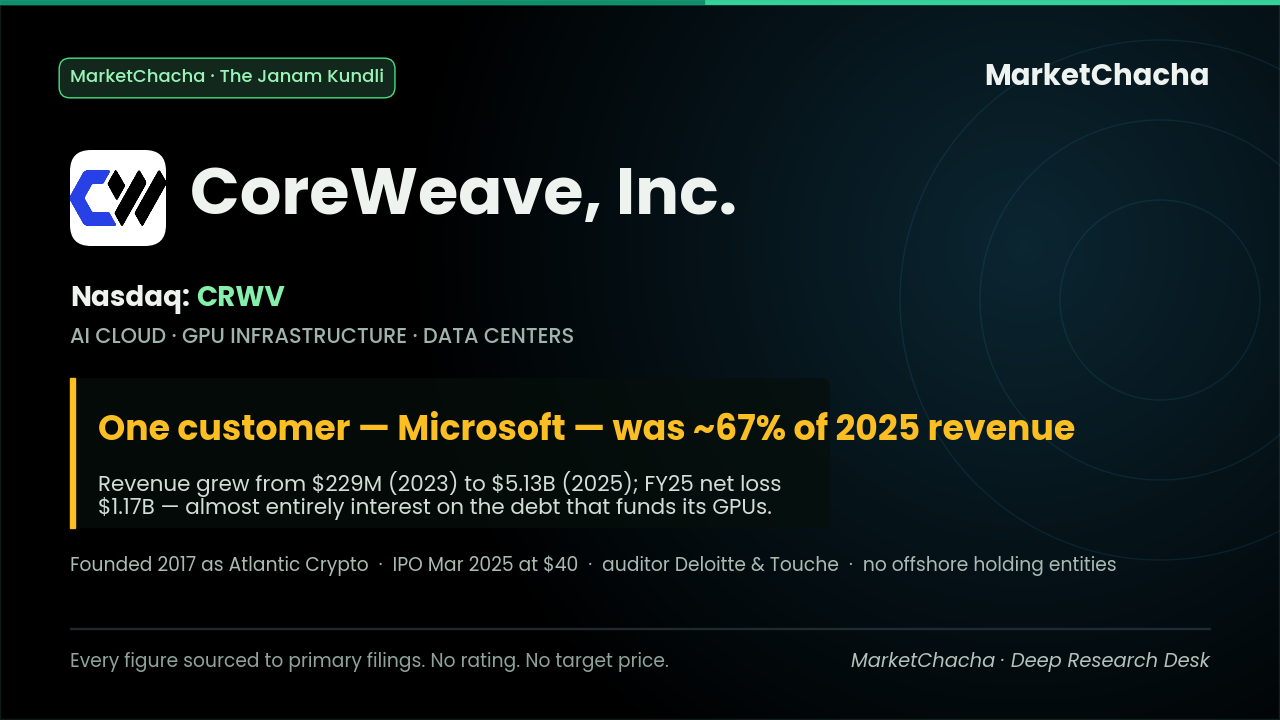
CoreWeave rents out artificial-intelligence compute: it buys enormous quantities of NVIDIA graphics processors, installs them in data centers, and sells access to that capacity to a handful of very large customers under multi-year contracts. It makes money on the spread between what those contracts pay and the cost of the chips, the power, the buildings and — increasingly — the interest on the debt used to buy the chips. The record shows a company that has grown revenue more than twenty-fold in two years, still reports a net loss, and now carries more than twenty billion dollars of debt against a business whose single largest customer was about two-thirds of last year's sales.
Origin — the company's birth certificate
CoreWeave was incorporated in Delaware in 2017 under the name Atlantic Crypto. Its three founders — Michael Intrator, Brian Venturo and Brannin McBee — came from commodities and energy-futures trading, and began by buying GPUs to mine Ethereum. When crypto prices fell in 2018, the company kept the hardware, bought more from distressed miners, and pivoted to renting GPU compute to other businesses. It was renamed CoreWeave in 2019 and rebuilt around NVIDIA's data-center chips. That founding path — from a crypto-mining side project into an AI-infrastructure balance sheet — matters, because the business is still fundamentally about owning depreciating hardware and financing it. The three founders remain in charge: Intrator is Chairman and CEO, Venturo is Chief Strategy Officer, and McBee is Chief Development Officer.
The company listed on the Nasdaq on 28 March 2025 under the ticker CRWV, selling 37.5 million Class A shares at $40.00 — below the marketed $47–$55 range — to raise roughly $1.5 billion at an initial valuation near $23 billion. The stock closed its first day flat at $40. As of 10 August 2026 it traded around $90.67, up about 127% from the IPO price but roughly 41% below its 52-week high of $153.20 (52-week range $60.55–$153.20).
The business — what they actually sell
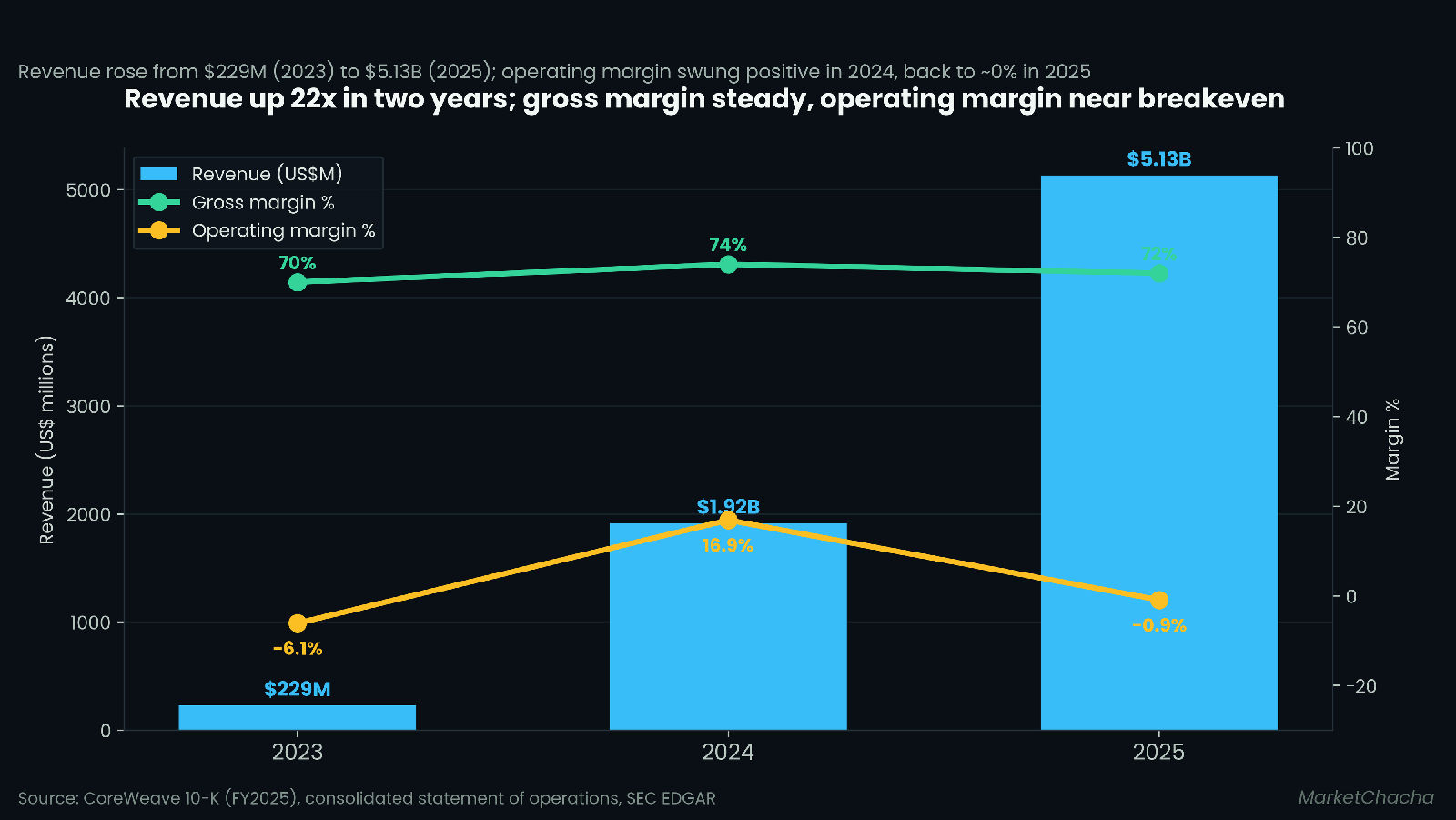
CoreWeave sells cloud access to GPU clusters, plus the software and networking that make those clusters usable for AI training and inference. As of 31 December 2025 it reported operating 43 data centers with over 850 MW of active power, and approximately 3.1 GW of total contracted power capacity to be deployed over future periods, across six countries. Revenue was $5.13 billion in 2025, up from $1.92 billion in 2024 and $229 million in 2023. The company also reported remaining performance obligations (RPO) of $60.7 billion at year-end 2025, up 302% from $15.1 billion a year earlier, with a weighted-average committed contract duration of about five years. RPO is contracted-but-not-yet-recognized revenue; it is a booking, not cash in hand, and its realization depends on customers paying and CoreWeave delivering capacity on time.
Who actually buys from them
This is the defining fact of the company. CoreWeave itself discloses that it recognized approximately 67% of 2025 revenue from its single largest customer, Microsoft; approximately 77% of 2024 revenue from its top two customers; and approximately 73% of 2023 revenue from its top three. It states plainly that "none of our other customers represented 10% or more of our revenue" in 2025, and that it expects this concentration to continue "because of the long-term nature of contracts with those customers." The filings name two further large commitments: an OpenAI arrangement under which OpenAI has committed to pay up to approximately $11.9 billion through October 2030, and a Meta arrangement of approximately $14.2 billion through December 2031. Concentration is a double-edged fact: it delivers scale and multi-year visibility, and it means that a change of plan, a renegotiation, or a payment problem at one or two counterparties would move the whole business. CoreWeave discloses this itself as a principal risk.
Where it is actually made — infrastructure & supply chain
CoreWeave does not manufacture; it assembles and operates. Its clusters are built primarily around NVIDIA systems — the filing references GB200 and GB300 NVL72 platforms and expected early access to NVIDIA's next-generation "Rubin" platform — with some AMD and Intel CPUs. The company discloses that it relies on "a limited number of suppliers for significant components," and that a disruption in the availability of those components could delay expansion. It also depends on securing power and on third-party data-center providers; the reliance on a single such provider, Core Scientific, became a public issue in 2025 (see the regulatory and legal section). CoreWeave has also acquired several software and AI companies — Weights & Biases, OpenPipe, Marimo and Monolith AI — to build a platform layer above the raw hardware. What is not disclosed at line-item level is the exact price and volume of its GPU purchase commitments to NVIDIA; the filings describe binding purchase and price commitments as a risk without quantifying every contract.
Five years of numbers
CoreWeave has only three years of audited history at scale (it was tiny before 2023), so this is a three-year picture, drawn from the FY2025 10-K. All figures US$ millions.
| Income statement | 2023 | 2024 | 2025 |
|---|---|---|---|
| Revenue | 229 | 1,915 | 5,131 |
| Cost of revenue | 69 | 493 | 1,453 |
| Technology & infrastructure | 131 | 961 | 2,929 |
| Sales & marketing | 13 | 18 | 144 |
| General & administrative | 30 | 119 | 651 |
| Operating income (loss) | (14) | 324 | (46) |
| Gain (loss) on fair-value adjustments | (534) | (756) | 27 |
| Interest expense, net | (28) | (361) | (1,229) |
| Other income, net | 18 | 49 | 33 |
| Loss before tax | (558) | (744) | (1,215) |
| Tax (benefit)/provision | 36 | 119 | (48) |
| Net loss | (594) | (863) | (1,167) |
| EPS (basic, $) | (3.09) | (4.30) | (2.75) |
Revenue grew about 168% in 2025 (from $1.92bn to $5.13bn). Gross margin — revenue less cost of revenue — was roughly 72% in 2025 (74% in 2024, 70% in 2023). But the most important line is the bottom one, and the reason for it: operating loss in 2025 was only $46 million, while the net loss was $1,167 million. The gap is almost entirely net interest expense of $1,229 million. In plain terms, 2025's loss is a financing loss, not an operating one — the cost of the debt that buys the GPUs. The 2024 and 2023 losses have a different composition: those years carried large non-cash "fair-value adjustment" charges of $756m and $534m, which were remeasurements of pre-IPO instruments (convertible/warrant and similar), on top of rising interest.
| Balance sheet (year-end) | 2024 | 2025 | Change |
|---|---|---|---|
| Cash & equivalents | 1,361 | 3,127 | +130% |
| Accounts receivable | 417 | 3,169 | +660% |
| Property & equipment, net | 11,915 | 30,557 | +157% |
| Total assets | 17,833 | 49,302 | +176% |
| Total debt (carrying) | 8,033 | 21,615 | +169% |
| Contract liabilities (deferred revenue) | 4,100 | 8,200 | +100% |
| Total liabilities | 16,525 | 45,967 | +178% |
| Stockholders' equity | (414) | 3,335 | to positive |
Three balance-sheet lines move more than 40% and each is worth a sentence. Property & equipment more than doubled to $30.6bn — this is the GPU fleet, and it is the whole business. Total debt jumped to $21.6bn; liabilities are now about 93% of assets. Contract liabilities (customer prepayments) doubled to $8.2bn — a genuine positive for cash, because customers pay ahead. Equity turned positive (from −$414m to +$3.3bn) after the IPO and share-based compensation. The company also disclosed U.S. federal net operating loss carryforwards of $4.3 billion and state NOLs of $905 million at year-end 2025.
| Cash flow | 2023 | 2024 | 2025 |
|---|---|---|---|
| Operating cash flow (CFO) | 1,833 | 2,749 | 3,058 |
| Investing cash flow (CFI) | (3,148) | (8,658) | (10,271) |
| Financing cash flow (CFF) | 1,788 | 7,464 | 9,308 |
| Capex (property & equipment) | 2,943 | 8,702 | 10,309 |
| Free cash flow (CFO − capex) | (1,110) | (5,953) | (7,251) |
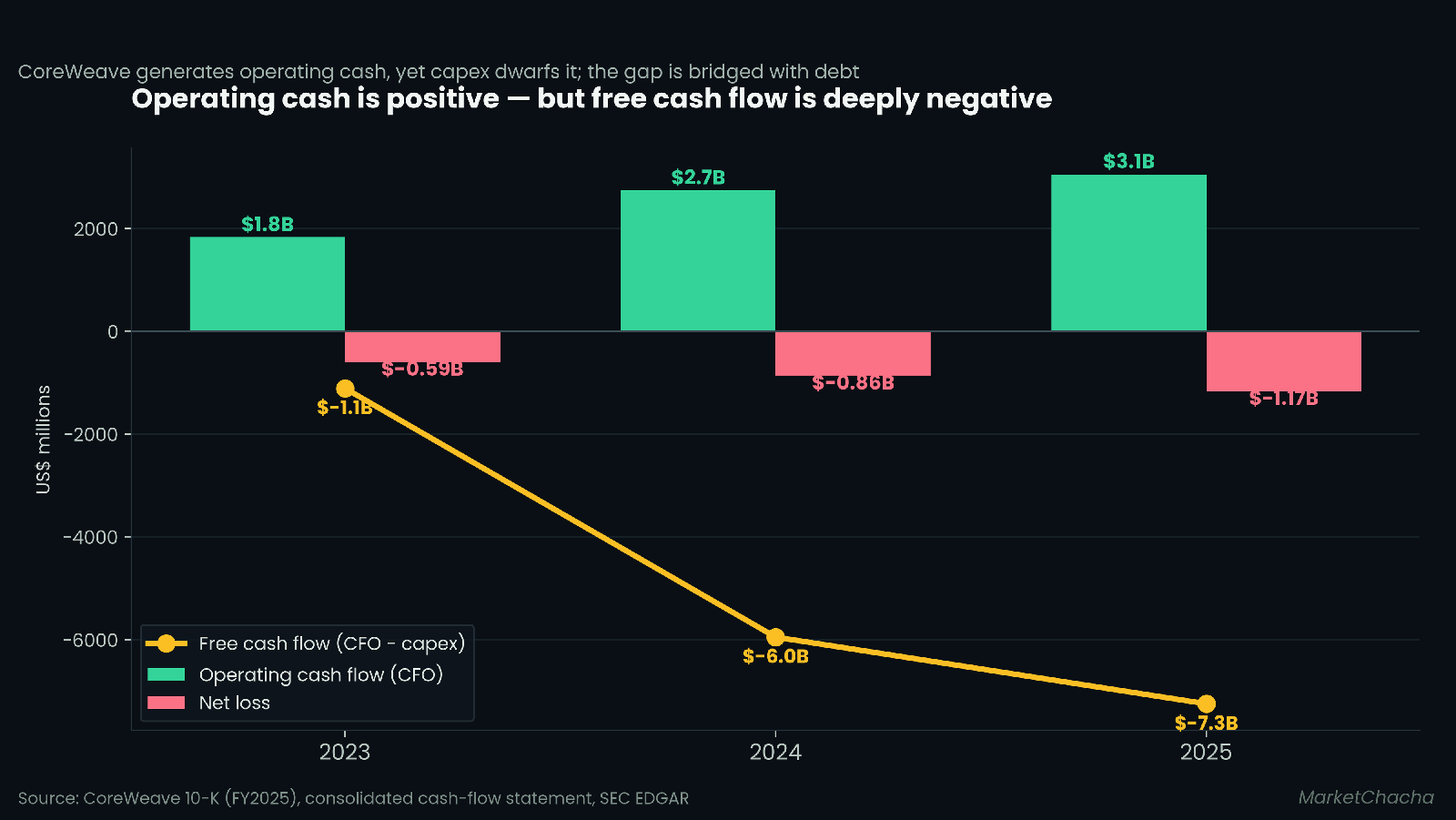
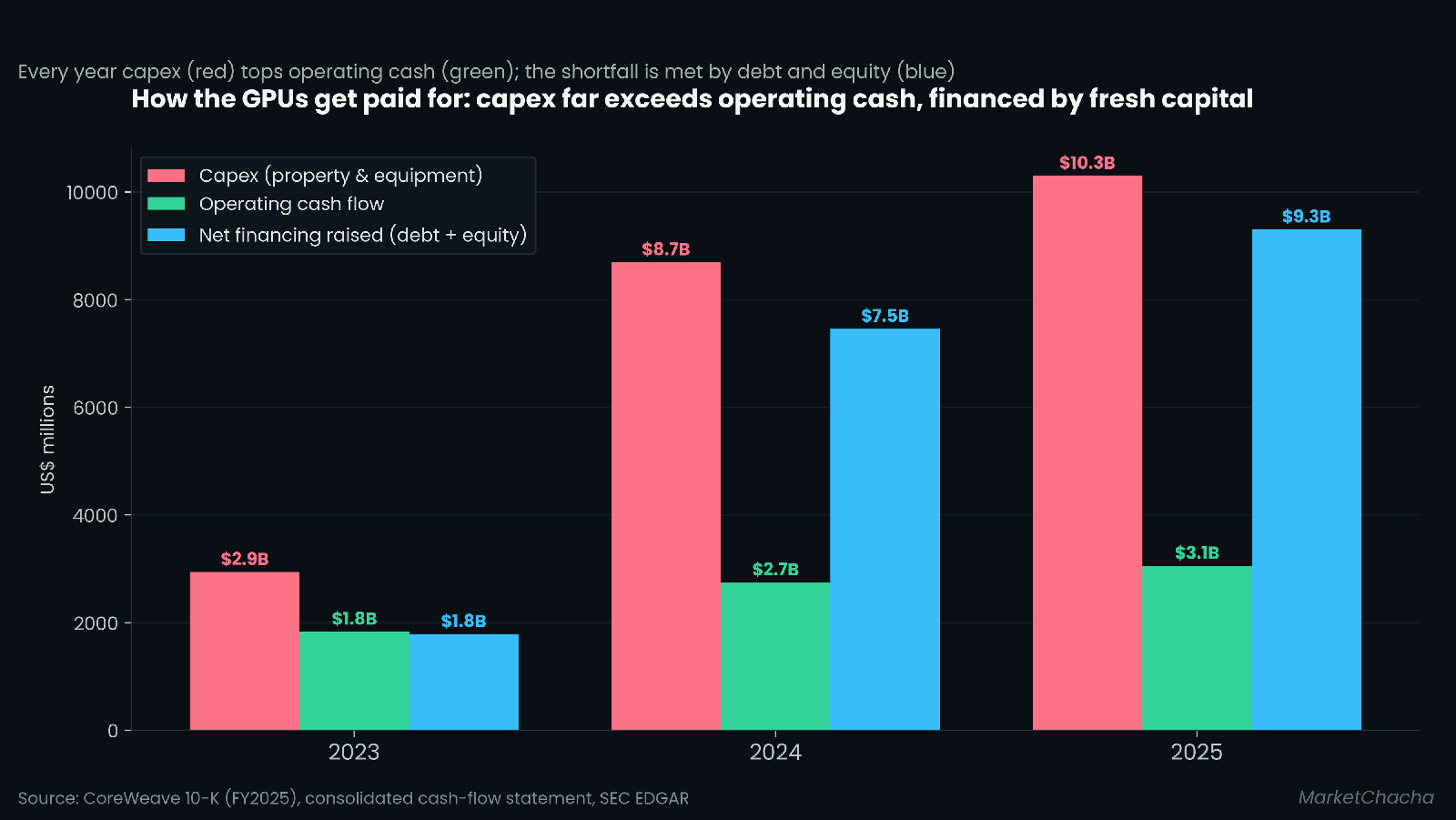
Here is the earnings-quality read in one paragraph. CoreWeave's operating cash flow is strongly positive — $3.06 billion in 2025 — even though it reports a net loss, because $2.4 billion of depreciation is a non-cash charge and customers prepay. That is the opposite of the classic "profits that never become cash" problem. The catch is one level down: capex ($10.3bn) dwarfs operating cash, so free cash flow was minus $7.25 billion in 2025 and has been deeply negative every year. Operating cash covered only about 30% of the investing outflow; the rest is financed. That is not hidden — it is the stated model — but it means the company's continued growth depends on continued access to capital markets on acceptable terms.
The latest quarter, decoded
The most recent fully reported period is the first quarter of 2026 (10-Q filed 8 May 2026). CoreWeave was scheduled to report second-quarter 2026 results on 11 August 2026 after the market close — the day this file was compiled — so those numbers are not yet in the audited record here. Figures US$ millions; the fourth-quarter-2025 column is derived by subtracting the nine-month 2025 figures from the audited full-year 2025 total, and is labelled as such.
| Quarter | Q1 2025 | Q4 2025 (derived) | Q1 2026 |
|---|---|---|---|
| Revenue | 982 | ~1,572 | 2,078 |
| Operating income (loss) | (27) | n/a | (144) |
| Net loss | (315) | ~(451) | (740) |
| Interest expense on debt | 257 | n/a | 427 |
Revenue rose about 112% year-on-year and roughly 32% quarter-on-quarter. But the net loss widened to $740 million, and the reason is consistent with the full-year story: interest expense on debt alone was $427 million in the quarter and climbing as the borrowing base grows. A widening loss on rising revenue is not, by itself, a quality flag here — it reflects a company front-loading debt-funded capacity ahead of contracted revenue. It becomes something to watch only if the contracted revenue is delayed relative to the interest clock.
Who owns it — and where those owners are registered
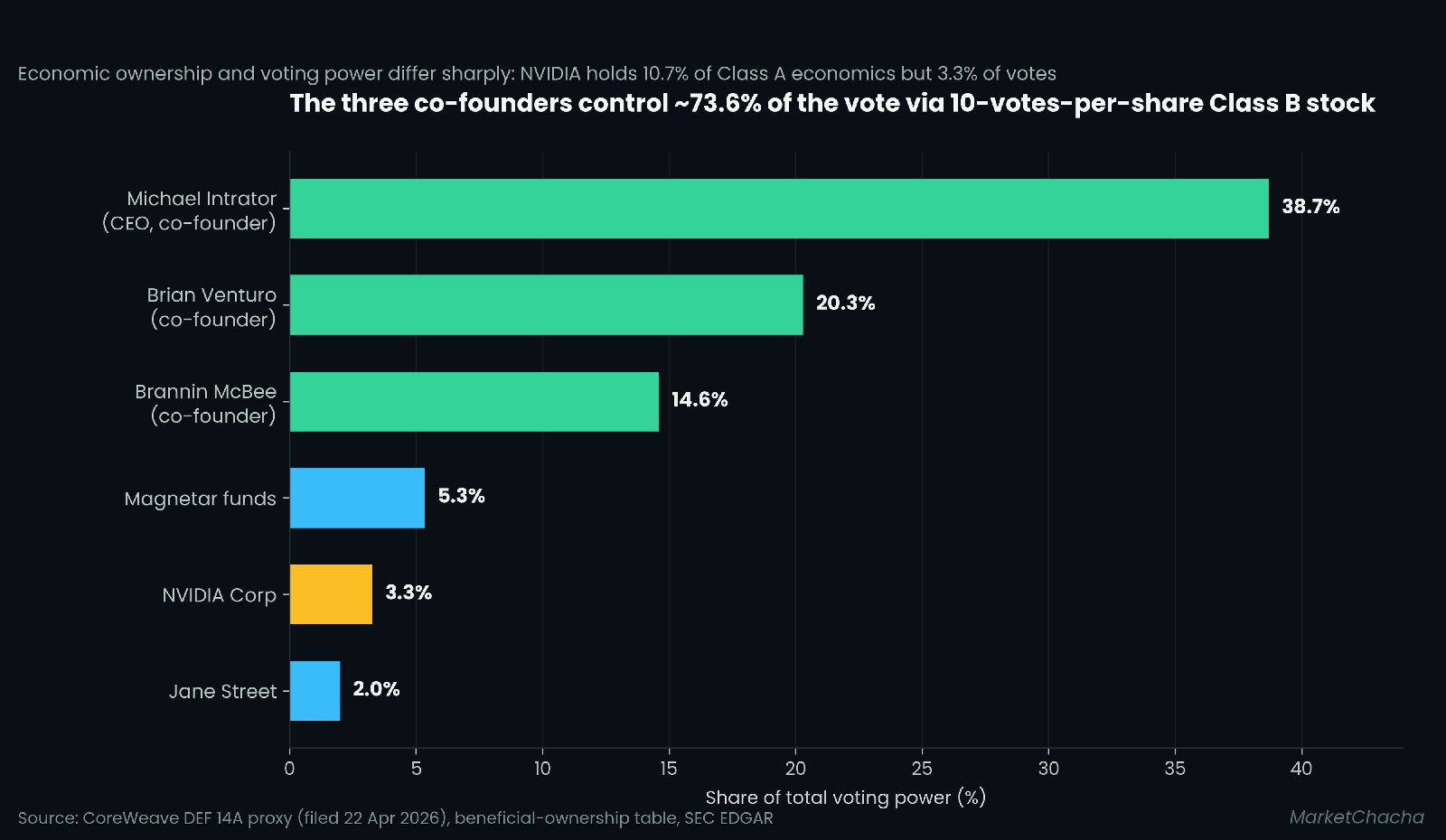
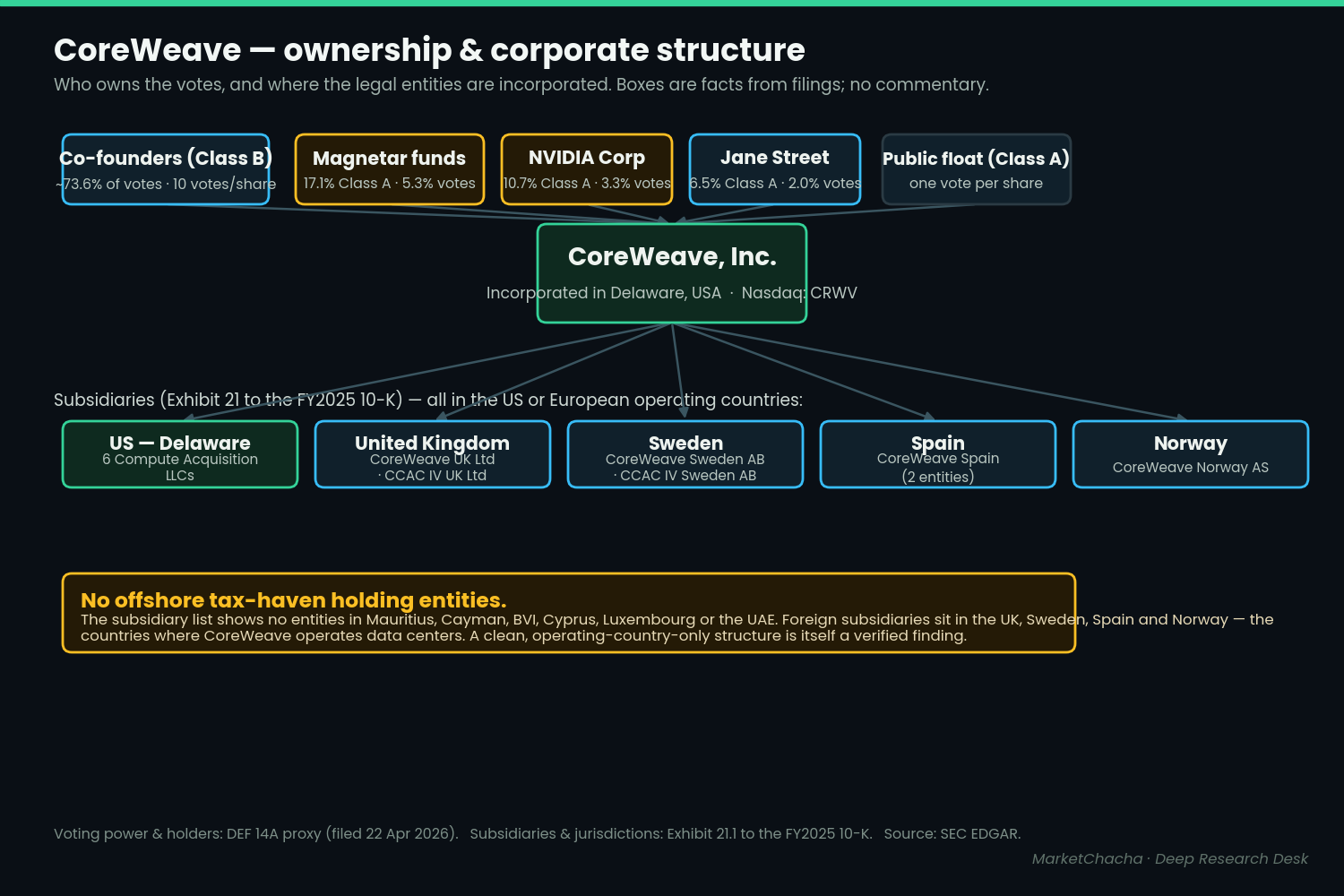
CoreWeave has a dual-class structure. Class A shares carry one vote; Class B shares carry ten votes each, and the founders hold the Class B. Per the April 2026 proxy's beneficial-ownership table (as of 15 April 2026), the three co-founders individually controlled Michael Intrator 38.7%, Brian Venturo 20.3% and Brannin McBee 14.6% of total voting power — together roughly 73.6%. The named 5%+ Class A holders were Magnetar Financial funds (17.07% of Class A, 5.34% of votes), NVIDIA Corporation (10.66% of Class A, 3.27% of votes) and Jane Street Group (6.53% of Class A, 2.00% of votes). NVIDIA's position is notable because NVIDIA is simultaneously a significant investor, the dominant supplier of the chips CoreWeave buys, and a customer that has rented capacity — a genuine three-way commercial relationship, disclosed in the filings. The financial statements' related-party note concerns Magnetar, which was a related party (with a board seat and financing arrangements) through March 2025; the filings state NVIDIA is not classified as a related party under ASC 850.
On jurisdiction — the question this desk always asks — the answer here is clean. The subsidiary list (Exhibit 21.1 to the 10-K) shows entities incorporated only in the United States (Delaware) and in the operating countries of the United Kingdom, Sweden, Spain and Norway. There are no entities in Mauritius, the Cayman Islands, the British Virgin Islands, Cyprus, Luxembourg or the UAE — no offshore tax-haven holding vehicles at all. The foreign subsidiaries map to where CoreWeave actually runs European data centers. A wholly operating-country structure is itself a verified finding, and a favourable one on the transparency dimension.
Capital history — every time they raised money
CoreWeave's capital story is unusually debt-heavy for a company its age. Before the IPO it issued convertible and senior secured notes (including 2021 convertible notes and 2022 senior secured notes to Magnetar-affiliated funds, with warrants), then built a series of GPU-collateralised delayed-draw term loans (the "DDTL" facilities), a Magnetar loan, and 2030 and 2031 senior notes. The March 2025 IPO raised about $1.5 billion of equity at $40 per share. Debt has kept growing since: on 10 August 2026 the company announced it had closed a $2.6 billion delayed-draw term loan (the "DDTL 5.5 Facility"), disclosing that the facility's approximate five-year maturity extends beyond the roughly three-year average length of the underlying customer contracts that back it — a factual mismatch the company frames as lender confidence in long-term GPU demand, and which a reader should simply note. Total carrying debt reached $21.6 billion at year-end 2025. Share count has risen too: weighted-average basic shares went from 192 million (2023) to 218 million (2024) to 435 million (2025), and about 527 million in Q1 2026, and 2025 share-based compensation was $630 million (roughly 12% of revenue).
Who runs it, and the auditor
The board is chaired by co-founder and CEO Michael Intrator; Nitin Agrawal is CFO. Independent directors named in the proxy include Karen Boone, Glenn H. Hutchins and Margaret C. (Meg) Whitman, among others. CEO total compensation was $3.45 million in 2025 (salary $0.75m, bonus $0.75m, and about $1.96m of other compensation, which the proxy notes includes personal-security services for Mr. Intrator and Mr. Venturo — a disclosed perquisite, not an accounting item). The auditor is Deloitte & Touche LLP (San Jose), which the filing states has served since 2024 and whose appointment shareholders ratified for 2026. There has been no auditor resignation or dismissal and no qualified opinion in the available history; the 10-K carries a critical audit matter relating to the accounting for long-lived assets (the useful lives and carrying values of that enormous GPU fleet), which is the natural focus area for a company of this shape and is not itself an exception.
The regulatory and legal record
Two items belong here, both stated as facts. First, a corporate action that failed: CoreWeave agreed in 2025 to acquire data-center operator Core Scientific in an all-stock deal valued around $9 billion ($20.40 per share; 0.1235 CoreWeave Class A shares per Core Scientific share). At a special meeting on 30 October 2025, Core Scientific stockholders voted the merger down; proxy advisers ISS and Glass Lewis and holders including Two Seas Capital and VanEck had opposed it. CoreWeave said it "respects the views" of those stockholders and that the two would continue their commercial partnership. Second, a securities class action: federal complaints under Sections 10(b) and 20(a) of the Securities Exchange Act name CoreWeave and executives Michael Intrator, Nitin Agrawal and Brannin McBee, on behalf of investors for the class period 28 March 2025 to 15 December 2025, with a lead-plaintiff deadline of 13 March 2026. The plaintiffs allege the company overstated its ability to meet demand and downplayed reliance on a single third-party data-center provider (Core Scientific). These are unproven allegations in early-stage private litigation; nothing here has been established, and the company has not been found liable. We report the existence and nature of the case, not any conclusion about it. We found no SEC enforcement order against the company in the record reviewed.
Forensic checks — what the accounts show
The heart of the file. Each row is the number, the source, and — where a figure raises a question — the benign reading alongside.
| Check | What we found | A benign explanation |
|---|---|---|
| CFO vs net income (3-yr cumulative) | CFO +$7.64bn vs cumulative net loss −$2.62bn. Operating cash is positive despite losses. | $2.4bn of non-cash depreciation and $8.2bn of customer prepayments lift CFO; the losses are largely interest and non-cash marks. |
| Free cash flow | −$1.1bn (2023), −$6.0bn (2024), −$7.25bn (2025). CFO covers ~30% of investing outflow. | Deliberate: capacity is built ahead of contracted revenue; the model is capital-intensive by design. |
| Composition of the loss | 2025 operating loss only −$46m; net loss −$1,167m, driven by −$1,229m net interest. | The loss is a financing cost of a debt-funded asset base, not an operating shortfall. |
| Implied interest rate on debt | ~7.7% on average 2025 debt ($1,148m ÷ ~$14.8bn); a further $182m of interest was capitalised, not expensed. | High-yield, asset-backed infrastructure debt carries elevated rates; capitalising interest on assets under construction is standard. |
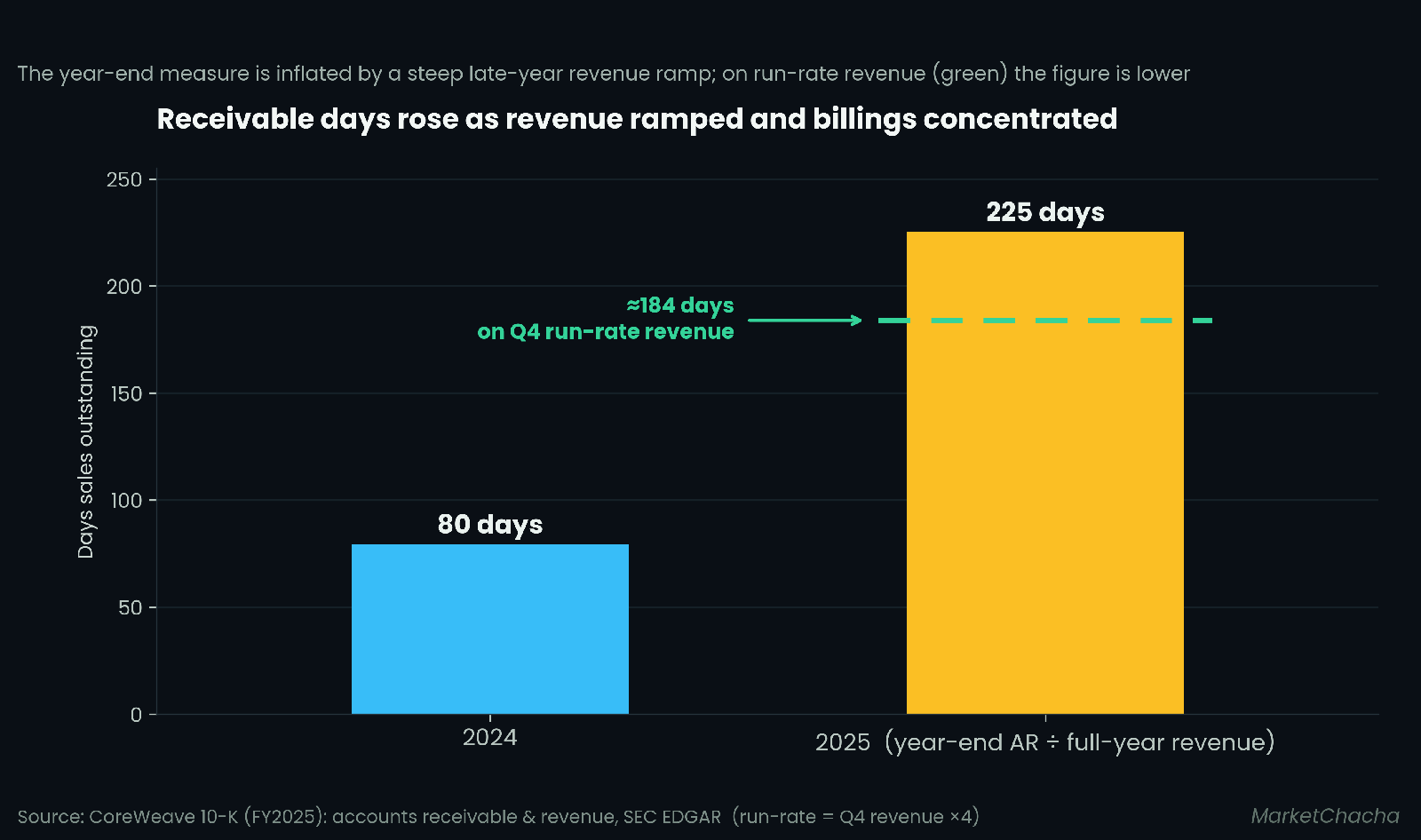
| Receivable days | ~80 days (2024) rising to ~225 on year-end AR ÷ full-year revenue (2025); ~184 on Q4 run-rate revenue. | Year-end AR is measured against a steeply ramping revenue line, which inflates the ratio; large new contracts also bill unevenly. |
| Related-party transactions | Magnetar (financing + former board seat) was a related party through March 2025; NVIDIA (investor+supplier+customer) is disclosed but not an ASC 850 related party per the filings. | The RPT that matters is Magnetar debt, disclosed and now below the influence threshold; NVIDIA's role is commercial and disclosed. |
| Ownership & control | Founders hold ~73.6% of votes via 10-vote Class B shares; NVIDIA 10.7% of Class A economics but 3.3% of votes. | Dual-class control is common for founder-led tech IPOs and is fully disclosed. |
| Auditor | Deloitte & Touche since 2024; no resignation, no qualified opinion; a critical audit matter on long-lived-asset accounting. | Long-lived-asset useful lives are the expected focus for a GPU-heavy balance sheet; not an exception. |
| Subsidiaries & jurisdictions | Entities only in US-Delaware and UK/Sweden/Spain/Norway; no tax-haven vehicles. | Foreign subsidiaries match the European data-center footprint — a clean structure. |
| Dilution | Weighted-avg shares 192m → 435m (and ~527m by Q1 2026); 2025 SBC $630m (~12% of revenue). | IPO issuance plus growth-stage equity compensation; normal for the phase, but real dilution. |
| Leverage | Total debt $21.6bn; liabilities ~93% of assets; debt/equity ~6.5x. | Infrastructure financed largely with debt; the assets (GPUs) are the collateral. |
| Capital intensity | Capex ~4.3x depreciation in 2025; asset turnover ~0.15x. | Fleet is being built faster than it depreciates; turnover rises as capacity fills. |
What we could not verify
Several things are genuinely not disclosed at the level a reader might want. The exact dollar value and delivery schedule of GPU purchase commitments to NVIDIA are described as risks but not fully itemised. The precise revenue split by named customer beyond the top-customer percentage is not given (only that Microsoft was ~67% and no other customer exceeded 10% in 2025). The ultimate economics of the OpenAI and Meta contracts — margins, take-or-pay terms, cancellation rights — are summarised, not laid out line by line. Second-quarter-2026 financials were not yet in the audited record when this was written. And the Q4-2025 quarterly figures used above are derived from full-year less nine-month data, not separately audited. None of these gaps implies anything; they are simply the edges of what the public filings show.
What would change the picture
Concrete, checkable things to watch, in order of signal. (1) The next shareholding/RPO and customer-concentration disclosure — does Microsoft's ~67% share fall as OpenAI and Meta ramp, diversifying the revenue base? (2) The interest line versus contracted revenue timing — the loss is financing-driven, so the question is whether contracted revenue arrives on the schedule the debt assumes. (3) Free cash flow — any inflection toward less-negative FCF would signal the capex wave maturing. (4) The receivables line — whether days normalise as revenue stops ramping so steeply. (5) The securities litigation docket — motions, dismissal or class certification. (6) Debt terms and maturities — new facilities' rates and the maturity-versus-contract-length gap the company flagged on the August 2026 facility. (7) The next auditor's report — any change to the critical-audit-matter language on long-lived assets.
Sources
All figures above are taken from the following primary documents. Readers should verify against the originals.
- [1] CoreWeave, Inc. Form 10-K for FY2025 (filed 2 March 2026): SEC EDGAR
- [2] CoreWeave Form 10-Q for Q1 2026 (filed 8 May 2026): SEC EDGAR
- [3] CoreWeave Definitive Proxy (DEF 14A), filed 22 April 2026 — beneficial ownership, board, auditor, compensation: SEC EDGAR
- [4] Exhibit 21.1 — Subsidiaries of CoreWeave, Inc. (FY2025 10-K): SEC EDGAR
- [5] CoreWeave IPO prospectus, Form 424B4 (filed 31 March 2025): SEC EDGAR
- [6] CoreWeave Form 8-K & press release, $2.6bn DDTL 5.5 facility (filed 10 August 2026): SEC EDGAR
- [7] SEC EDGAR full filing list, CIK 0001769628: EDGAR
- [8] XBRL financial data (companyfacts), CIK 1769628: data.sec.gov
- [9] CoreWeave IPO pricing press release (28 March 2025): PR Newswire
- [10] Core Scientific stockholder vote against the CoreWeave merger (30 October 2025) — media context: Data Center Dynamics
- [11] Securities class-action notice (Kessler Topaz; class period 28 Mar–15 Dec 2025) — plaintiff-side context, allegations only: PR Newswire
FAQ
Is CoreWeave profitable? No. It reported a net loss of $1.17 billion in 2025 on $5.13 billion of revenue. Its operating loss, however, was only $46 million; the bulk of the net loss was net interest expense of $1.23 billion on its debt.
How concentrated is its revenue? Very. CoreWeave disclosed that Microsoft was approximately 67% of 2025 revenue, and that no other single customer exceeded 10%. It also has large multi-year commitments from OpenAI (up to ~$11.9bn through 2030) and Meta (~$14.2bn through 2031).
Why is operating cash flow positive if the company loses money? Because $2.4 billion of depreciation is a non-cash expense and customers prepay (contract liabilities of $8.2 billion). Operating cash flow was $3.06 billion in 2025 — but capital expenditure of $10.3 billion means free cash flow was minus $7.25 billion.
Does CoreWeave use offshore tax-haven entities? Based on the subsidiary list in its 10-K, no. Its subsidiaries are incorporated in the US (Delaware) and in the UK, Sweden, Spain and Norway — the countries where it operates data centers. There are no Mauritius, Cayman, BVI, Cyprus, Luxembourg or UAE entities.
Who controls the company? The three co-founders, through Class B shares that carry ten votes each. Per the April 2026 proxy they held roughly 73.6% of total voting power combined, with CEO Michael Intrator alone at about 38.7%.
What is the lawsuit about? A securities class action alleges the company overstated its ability to meet demand and downplayed reliance on data-center provider Core Scientific during 28 March–15 December 2025. These are unproven allegations in early-stage litigation; no wrongdoing has been established.
Independent research for education and discussion only. Not investment advice, not a recommendation, and not a rating — we issue no buy/sell calls and no target prices. Every figure is sourced from the primary documents linked above; figures can be restated and we can make mistakes, so always verify against the original. Nothing here alleges wrongdoing by any company or individual: where a fact raises a question we state the fact, cite it, and give the benign explanation alongside. Offshore holding structures, pledging and preferential allotments are all legal and common — they are disclosed here as facts, not as accusations.
This article is for educational and informational purposes only. It is not financial advice, investment recommendation, or a solicitation to buy or sell securities. Investing involves significant risks. I am not a SEBI-registered investment advisor. Readers should consult their own financial advisor and conduct their own research before making any investment decisions.
Comments
Join the conversation
Sign in to join the conversation.
Follow replies, add your view, and take part in the discussion.
Sign in to commentLoading comments...