

Why did Capricor (CAPR) rocket ~67% after an FDA rejection scare?
What happened
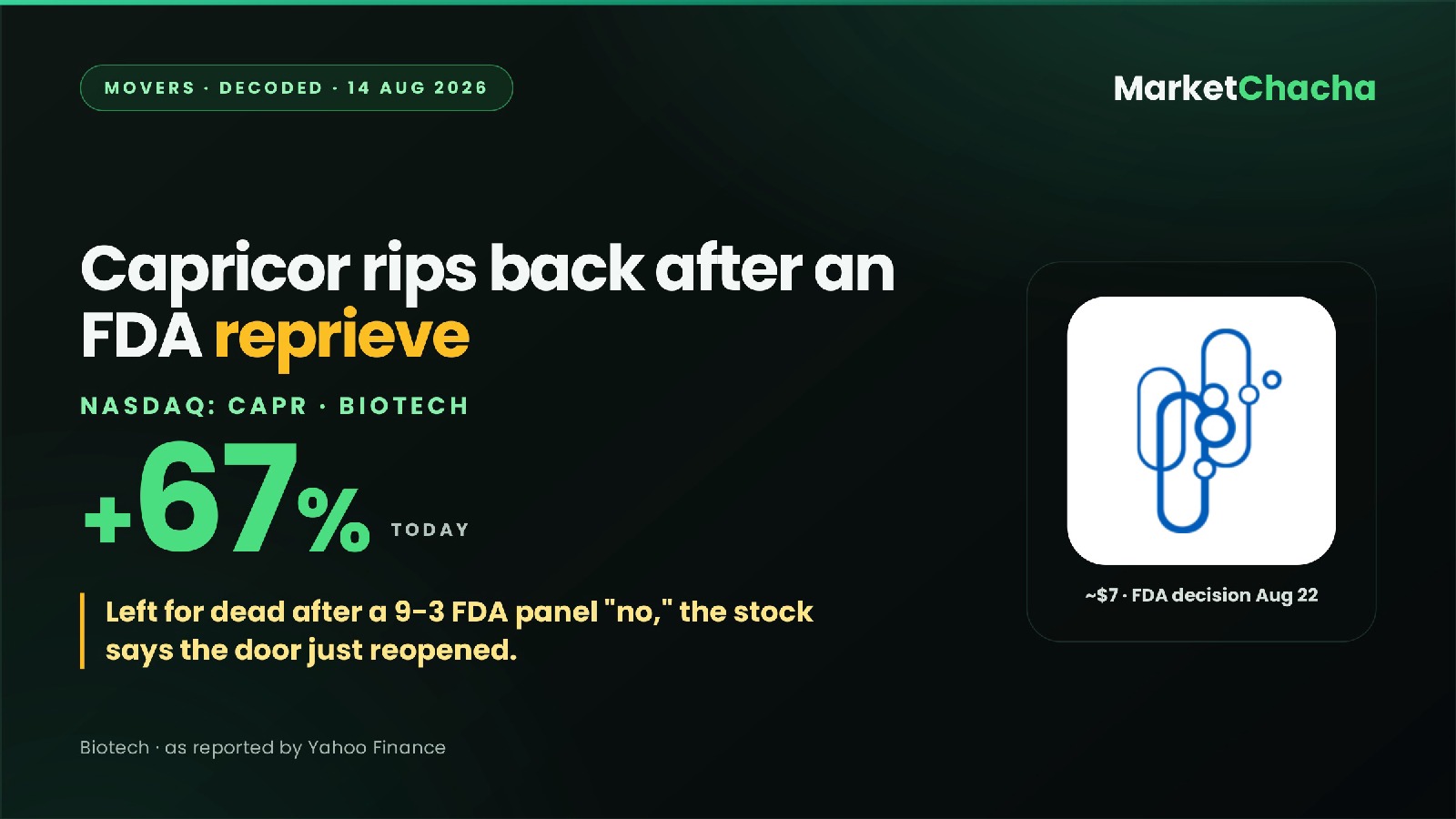
Capricor Therapeutics (NASDAQ: CAPR) rocketed higher — up about 67% in Thursday's after-hours session (as reported by Yahoo Finance) and extending the run into Friday, changing hands around $7 after touching a $7.90 high, having traded as low as $3.90 the same day (per StockAnalysis). What makes this wild: two weeks ago, this stock was basically left for dead.
Why it moved
The trigger is a regulatory lifeline, not a new drug result. On Thursday, Capricor said the FDA is willing to accept an amended version of its marketing application (a "BLA" — the Biologics License Application, the formal request for permission to sell a drug) for its lead therapy, deramiocel. In plain terms: after a brutal few weeks, the FDA signalled there's still a live path to approval, and the review continues toward a decision deadline of August 22, 2026.
To see why a "we'll keep reviewing it" message sent the stock up two-thirds, look at the hole it climbed out of. An FDA briefing document on July 27 attacked the statistics behind Capricor's trial, and on July 29 an outside expert panel (an advisory committee) voted 9-to-3 that the evidence did not support the drug's effectiveness for the heart complications of Duchenne. That one-two punch cratered the shares roughly 81% in a month — from about $22.43 on July 6 to $4.17 by August 4 (per tickeron). The key nuance most people miss: that panel vote is advisory only. The FDA makes the final call, and Thursday's update said the door is still open.
The business
Capricor is a clinical-stage biotech, which means it has no approved product and no product sales yet. Deramiocel (a heart-derived cell therapy) is effectively the whole company — it's aimed at the heart-muscle damage (cardiomyopathy) that eventually kills boys with Duchenne muscular dystrophy, a fatal genetic muscle-wasting disease. Its Phase 3 trial, HOPE-3, enrolled 106 patients and hit its main goal, slowing upper-limb decline by 54% versus placebo (p=0.03) alongside heart benefits. So today's move isn't about a business turning a corner — it's one drug and one regulator's decision carrying the entire stock.
Is it expensive?
Here a normal valuation yardstick breaks down: with no earnings and no product revenue, Capricor has no P/E ratio — there's nothing to divide by. What actually anchors the stock is cash versus optionality. Capricor ended the quarter with about $238 million in cash (enough to fund it for 12+ months), while the whole company is worth only a few hundred million dollars. In other words, at ~$7 the stock is trading not far above its own cash pile — it's essentially a bet, priced like a lottery ticket, on the August 22 FDA verdict. For scale, the established Duchenne drugmaker Sarepta Therapeutics (SRPT) is a multi-billion-dollar company with products already on the market; Capricor is a fraction of that size and a single-asset gamble, not a diversified franchise.
Who it touches
- Duchenne families: the real stakes — a decision on whether another treatment reaches patients with few options.
- Other single-asset biotechs: traders read moves like this as a template for how brutal, and how sharply reversible, binary FDA events can be.
- Sarepta (SRPT): the incumbent in Duchenne, whose franchise sets the commercial backdrop deramiocel would enter.
What to watch
One date decides it: August 22. Accepting an amended application is not the same as approving the drug — the FDA can still issue another rejection (a "Complete Response Letter"), and that 9-3 panel vote is a real warning. This 67% jump is renewed hope, not a green light. The binary lands in days, and it can swing just as hard the other way.
As of early trading Friday, August 14, 2026 (ET). Figures as reported by: Yahoo Finance, BioSpace, Capricor. For discussion and education only — not investment advice. Verify before acting.
This article is for educational and informational purposes only. It is not financial advice, investment recommendation, or a solicitation to buy or sell securities. Investing involves significant risks. I am not a SEBI-registered investment advisor. Readers should consult their own financial advisor and conduct their own research before making any investment decisions.
Comments
Join the conversation
Sign in to join the conversation.
Follow replies, add your view, and take part in the discussion.
Sign in to commentLoading comments...