

Tesla and SpaceX's $16.8B 'Terafab' chip bet — who actually gets paid?
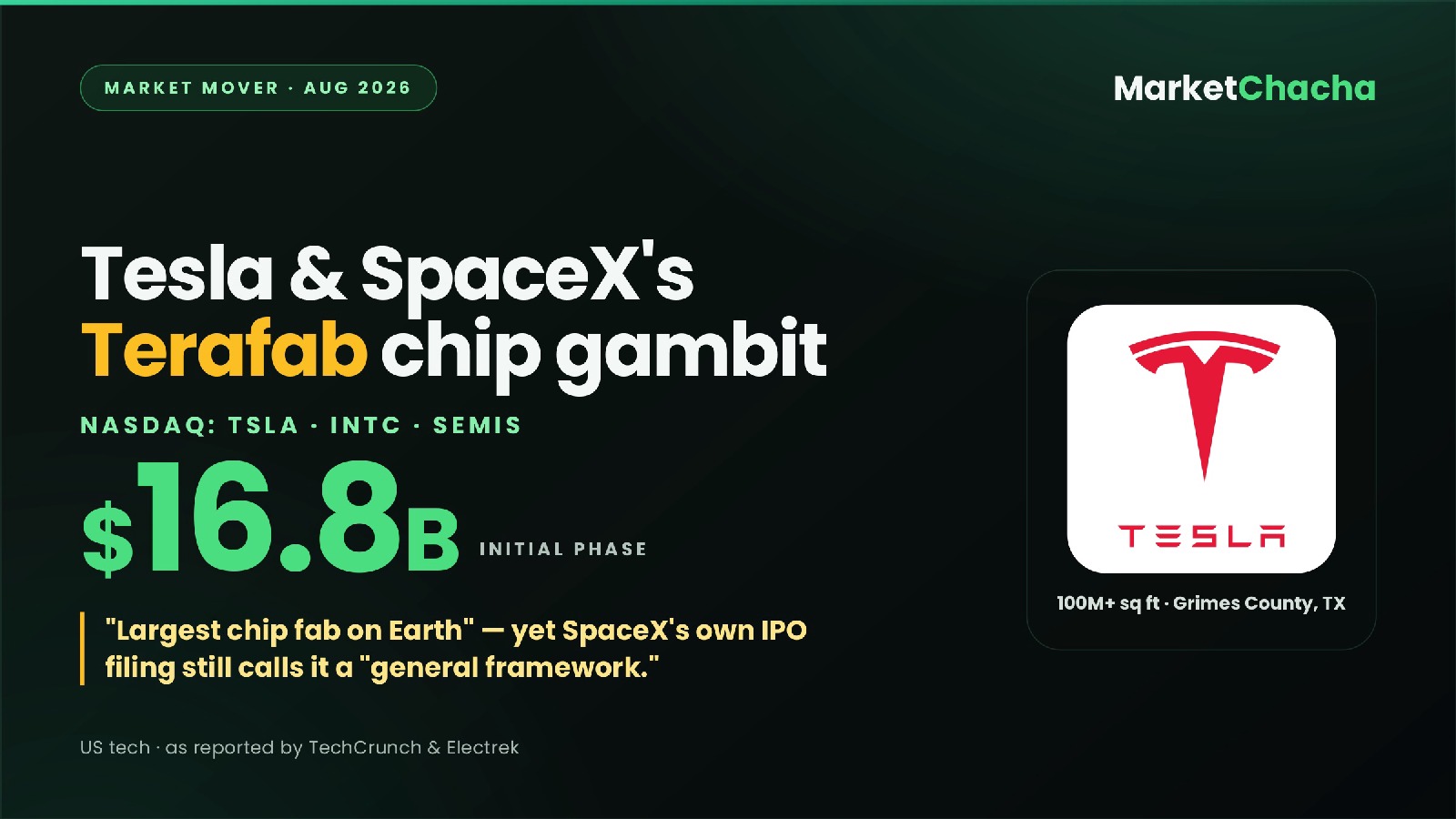
Tesla and SpaceX confirmed on Aug 6 that "Terafab" — the semiconductor megafactory Elon Musk first teased in March — will rise in Grimes County, Texas, with a first-phase investment of $16.8 billion. They're calling it the largest chip-manufacturing site on Earth: more than 100 million square feet, at least 3,000 mostly-local jobs, and logic, memory, packaging and testing all under one roof — to feed Tesla's Optimus robots and Cybercabs, plus SpaceX's planned "space-based data centers."
The pitch is vertical integration at a scale nobody has attempted. Musk's framing: both companies will soon need "more chips than current and future global production can supply," aiming for "over 1 terawatt of compute per year."
Why the fine print matters
The headline number keeps shrinking. When Terafab was first floated in March, the figure was $25 billion; it's now a "$16.8B initial phase," with the rest left vague — SpaceX filings have mentioned as much as $119 billion across a multi-phase build. And SpaceX's own May IPO paperwork (its S-1) described Terafab as only a "general framework" — no binding commitments, no finalized IP split, no obligation for either side to keep participating. The two also aren't building the fab technology themselves: Intel signed on in April to handle the actual manufacturing.
Who's actually exposed
Intel (INTC) is the cleanest public read-through — it's the named manufacturing partner, a marquee foundry win at the exact moment Intel Foundry needs to prove it can land one. Meanwhile Tesla's near-term silicon is already spoken for: Samsung's Taylor, Texas fab is in production on Tesla's AI5 chip, Tesla inked a $16.5B deal with Samsung for its next-gen AI6, and TSMC covers the rest. So Terafab doesn't dent Samsung's or TSMC's current Tesla revenue — it's a long-dated moonshot, not a 2026 supply story. For Tesla holders, the sharper question is how much of that $16.8B (and the "much higher" that's promised to follow) lands on Tesla's own balance sheet while its car business has stopped growing.
The one thing to watch: whether a binding, funded agreement — with a finalized IP split — actually shows up in Tesla's next 10-Q capex line or SpaceX's updated IPO filings. Until it does, the S-1's "general framework" wording and a number that's already slid from $25B to $16.8B are the tells that this is still a vision, not a signed cheque.
As of Aug 9, 2026 (announced Aug 6). Sources: TechCrunch, Electrek. For discussion and education only — not investment advice. Verify before acting.
This article is for educational and informational purposes only. It is not financial advice, investment recommendation, or a solicitation to buy or sell securities. Investing involves significant risks. I am not a SEBI-registered investment advisor. Readers should consult their own financial advisor and conduct their own research before making any investment decisions.
Comments
Join the conversation
Sign in to join the conversation.
Follow replies, add your view, and take part in the discussion.
Sign in to commentLoading comments...