

Hero MotoCorp: what their latest filing actually means
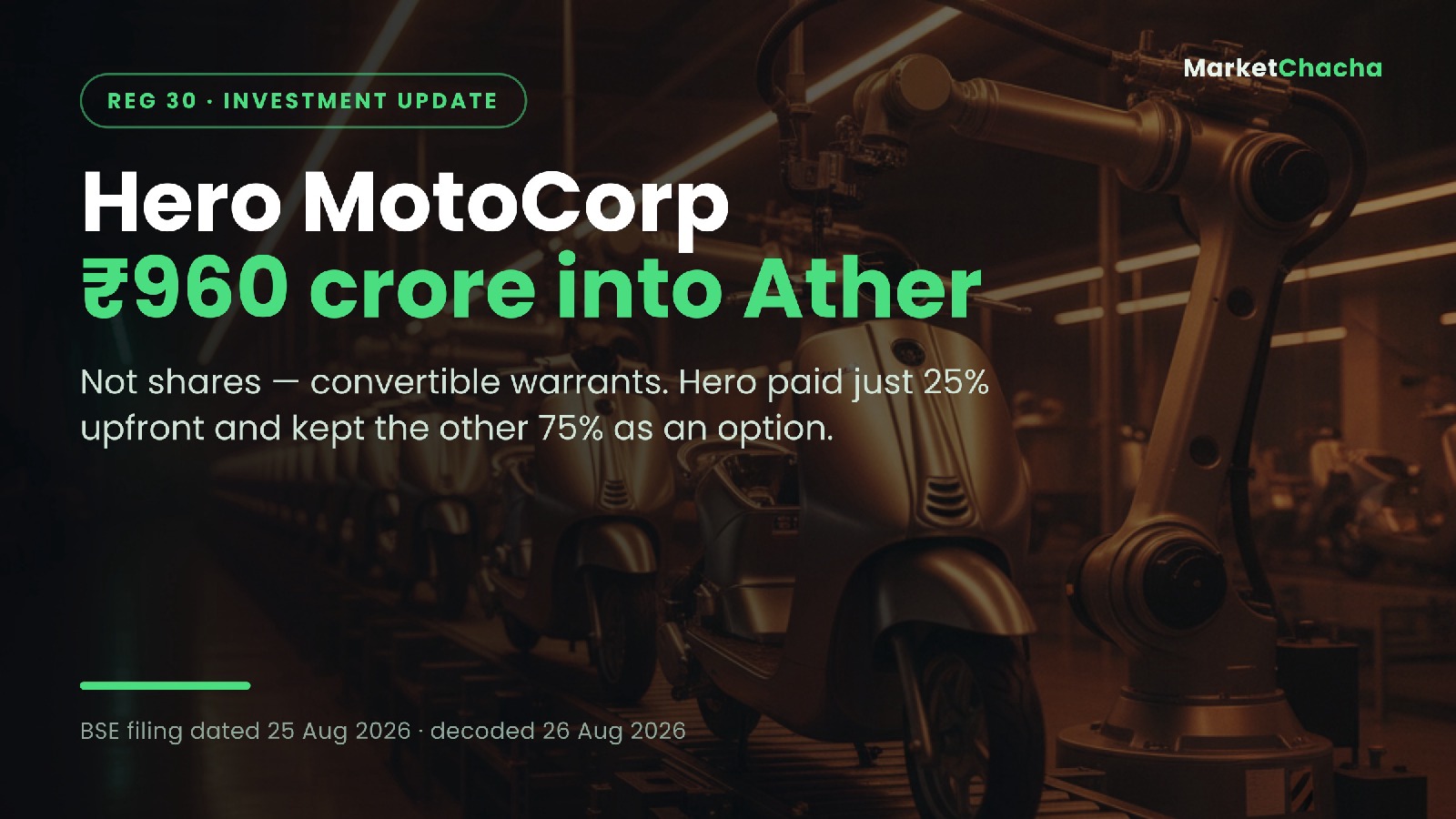
Hero MotoCorp told the exchanges on 25 August 2026 that it has completed the Ather Energy investment it first flagged in mid-July. Ather has allotted it 76,19,047 convertible warrants at ₹1,260 each — an aggregate ₹959.99 crore. Hero paid 25% of that (₹239.99 crore) on the day of allotment; the remaining 75% is only payable if and when Hero chooses to convert the warrants into Ather shares.
What was announced
- Instrument: convertible warrants issued on a preferential basis — not equity shares.
- Quantity: 76,19,047 warrants, each convertible into 1 Ather equity share.
- Issue price: ₹1,260 per warrant. Total: ₹959,99,99,220 (~₹960 crore).
- Paid now: ₹239,99,99,805 (25%). Balance: 75%, payable only on exercise, at Hero's option.
- Context: this executes the "up to ₹1,000 crore" commitment Hero disclosed on 14–15 July 2026. Ather is already an associate company of Hero, so this is topping up an existing holding, not a new entry.
Ather's wider round was ₹1,200 crore in total: the India-Japan Fund took ~₹200 crore of equity shares at ₹1,230, and founders Tarun Mehta and Swapnil Jain took ~₹20 crore of warrants each at ₹1,260 (per reporting on the allotment). Ather shares closed at ₹1,439.40 on the NSE on 25 August 2026 — so the ₹1,260 warrant price is roughly a 12% discount to the market price on the day.
What this type of filing means
This is a Regulation 30 disclosure — the SEBI LODR rule that forces a listed company to tell the exchange about anything price-sensitive, promptly. The specific sub-type here is an "update on acquisition/investment", meaning a previously announced deal has now actually been executed. That distinction matters: a July board approval is intent, an August allotment letter is money moving.
The instrument is the interesting part. A convertible warrant is a right, not an obligation, to buy a share at a fixed price within a fixed window. Under SEBI's ICDR rules for preferential issues, the subscriber pays 25% upfront and the balance 75% when converting, and the warrant typically must be converted within 18 months of allotment or the 25% is forfeited.
So a warrant is a financing compromise. The company gets cash today and certainty of more cash later. The investor gets a locked-in price with only a quarter of the capital committed — upside if the share rises above the strike, and a capped, walk-away loss of the 25% deposit if it does not. It is closer to a call option with a deposit than to a share purchase.
Also note the words preferential basis: shares or warrants are issued to a named set of investors at a board-set price, rather than to the public. SEBI polices the price with a floor formula based on recent traded averages, which is why the ₹1,260 sits below the day's market price but is not an arbitrary number.
Why it matters / potential impact
- Balance sheet: the cash cost to Hero right now is ₹240 crore, not ₹960 crore. Against TTM sales of about ₹50,810 crore and net profit of roughly ₹5,488 crore (Screener, consolidated), that is small and easily absorbed by a company Screener describes as almost debt-free.
- The real commitment is contingent: the other ~₹720 crore is a future call on Hero's cash, at Hero's discretion. If Ather's share price is comfortably above ₹1,260 near the deadline, Hero converts; if it is well below, walking away and forfeiting the deposit becomes the rational choice. This is optionality, deliberately bought.
- Strategic read: Hero's own EV brand is Vida. Deepening a stake in Ather — reported to move Hero's fully-diluted holding toward roughly 30% — means Hero is running two horses in electric two-wheelers: build in-house and own a large minority of a listed pure-play. Investors will read that as either sensible hedging or divided focus, depending on their prior.
- Earnings mechanics: Ather is an associate, so Hero picks up a share of Ather's profit or loss below the operating line. Ather reported a net loss of about ₹50.87 crore on ₹1,217 crore of revenue in its latest reported quarter, so a bigger stake means a bigger share of losses until Ather turns profitable. Warrants do not create that pickup until they convert into actual equity.
- No dilution for Hero shareholders: Hero is the buyer here, not the issuer. Hero's own share count does not change. The dilution happens at Ather's end, to Ather's other shareholders.
Is it expensive?
Hero MotoCorp trades at a share price of about ₹5,624 for a market cap of roughly ₹1,12,669 crore, on a P/E of about 20.3 and price-to-book of roughly 5.2x, with ROCE around 35% and ROE around 28% and a dividend yield near 3.3% (Screener, consolidated, as of 25 Aug 2026).
Compare that with Bajaj Auto, the most direct listed peer: roughly ₹3,21,520 crore market cap at a P/E near 30 (Tickertape). So Hero is the cheaper of the two on earnings — about a third less — while being roughly a third of Bajaj's size by market value. Twenty times earnings for a business earning 28% on equity and paying out most of its profit is not a demanding multiple by Indian large-cap standards; it looks fair-to-reasonable rather than cheap or rich. The discount to Bajaj is the market's long-running view on growth mix — Bajaj's exports and premium/KTM franchise versus Hero's heavier weighting to the domestic mass-market commuter. Whether that gap is deserved is exactly the debate an Ather-scale EV bet feeds into. None of this is a target or a recommendation.
The business
- Core: Hero MotoCorp is the world's largest two-wheeler manufacturer by volume, built on domestic commuter motorcycles — the Splendor and HF Deluxe franchises — which still drive the bulk of units.
- Premium & scooters: a smaller but strategically important slice, roughly a quarter of revenue on recent disclosure, covering sports, adventure and roadster bikes plus the scooter range.
- Parts, accessories and international: a steady aftermarket business and a growing export footprint.
- Electric: in-house through the Vida brand, plus minority stakes in Ather Energy (electric scooters, listed) and Zero Motorcycles.
The takeaway for reading this filing: it touches the investment slice of Hero, not the motorcycle factory. Nothing here changes what Hero sells, ships or earns from its own products this quarter.
Beginner takeaway
Hero did not spend ₹960 crore this week — it spent ₹240 crore and bought the right to spend the rest later. That structure is the whole story: a warrant lets a buyer lock a price today while keeping most of the cash, and keeping the choice. When you see "up to ₹1,000 crore" in a July announcement and a smaller number actually leaving the bank in August, read the instrument before you read the headline number.
FAQ
Does this change how many Hero MotoCorp shares exist? No. Hero is buying into another company, so Hero's own share count and your stake in Hero are untouched. The new shares are being created at Ather's end.
What happens if Hero never converts the warrants? The 25% already paid — about ₹240 crore — is forfeited to Ather, and Hero gets no shares from this tranche. That is the built-in cost of keeping the option open.
Why would Ather issue warrants at ₹1,260 when its shares traded at ₹1,439? Preferential issue prices are set off a SEBI floor formula based on recent average traded prices, not the closing price of the day, and investors putting in large committed capital typically get priced off that formula. It is a rule-bound discount, not a favour.
Is a bigger Ather stake good or bad for Hero's reported profit? Both, at different times. As an associate, Hero picks up its share of Ather's results — today that means a share of losses, and only later, if Ather turns profitable, a share of profit. Warrants do not trigger that pickup until they are converted.
As of 26 August 2026. Filing dated 25 August 2026. Source: official BSE/NSE filing — read it directly here. We summarise filings for education and may make errors, so always verify against the official document. Educational content only — not investment advice, not a buy/sell recommendation.
This article is for educational and informational purposes only. It is not financial advice, investment recommendation, or a solicitation to buy or sell securities. Investing involves significant risks. I am not a SEBI-registered investment advisor. Readers should consult their own financial advisor and conduct their own research before making any investment decisions.
Comments
Join the conversation
Sign in to join the conversation.
Follow replies, add your view, and take part in the discussion.
Sign in to commentLoading comments...