

Delton Cables: what their latest filing actually means
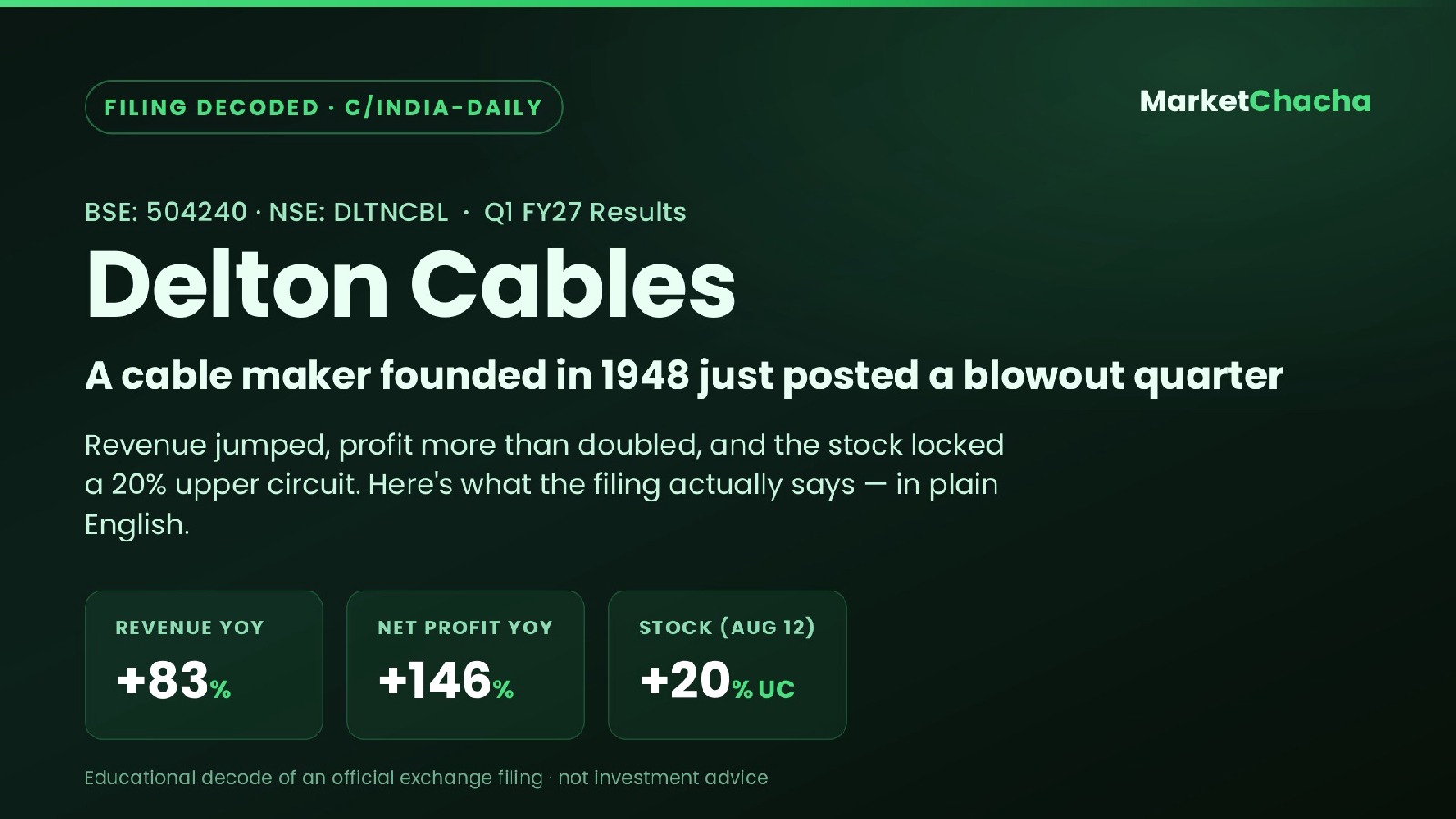
Delton Cables — a Delhi-based maker of cables, wires and switchgear — just filed its Q1 FY27 results with the exchanges, and they were strong: revenue up about 83% and net profit up about 146% versus a year ago. The stock responded by locking a 20% upper circuit the next session. Here's what the filing says and how to read it.
What was announced
On 11 August 2026, Delton Cables' board approved and filed its unaudited financial results for the quarter ended 30 June 2026 (Q1 FY27). The headline numbers:
- Revenue: ₹286.4 crore, up ~83% from ₹156.3 crore a year earlier.
- Net profit: ₹7.6 crore, up ~146% from ₹3.1 crore a year earlier.
- Operating profit: ₹24.8 crore, an operating margin of ~8.7% (broadly flat vs ~8.5% a year ago).
- EPS: ₹8.78 for the quarter.
- The company also disclosed an order book of about ₹418 crore as of 30 June 2026, fixed its AGM for 29 September 2026, and set 22 September 2026 as the record date for its final dividend.
What a "quarterly results" filing actually is
Every listed Indian company must report its financial performance each quarter to the BSE and NSE under SEBI's listing rules (LODR). It's an unaudited snapshot of sales, costs, profit and margins for those three months. Investors read it to see whether the business is growing, whether margins are holding, and how much debt and interest it is carrying. A results filing is mandatory disclosure of facts — it is not the company recommending anything.
Why it matters / what to actually look at
Beyond the eye-catching headline growth, the more useful things in this filing are:
- Margins vs growth. Revenue nearly doubled, but the operating margin (~8.7%) stayed thin — normal for a commodity-style cable maker where copper and aluminium are the biggest costs. Fast growth on a thin margin is more fragile than the same growth on a fat margin.
- Interest burden. Delton paid about ₹12.9 crore of interest in the quarter — more than its ₹7.6 crore net profit. That signals a business running on meaningful debt (~₹184 crore of borrowings), so a large share of operating profit goes to lenders before it reaches shareholders.
- Profit vs cash. Historically Delton's reported profit has not always turned into operating cash — a working-capital-heavy business (inventory plus receivables) can grow sales while cash stays tight. Worth watching in the coming filings.
Why did profit (+146%) grow so much faster than revenue (+83%)? Operating leverage — once rising sales cover the fairly fixed costs, extra revenue drops more heavily to the bottom line. None of this is a prediction about the share price; it is what a filing tells you about the quality of the growth.
Is it expensive?
At around ₹562 (13 August), Delton trades at a P/E of roughly 25×, a market cap of about ₹486 crore, and a book value near ₹397 a share. Its returns are modest — ROE around 7% and ROCE near 15%.
Against the big branded wire-and-cable names that P/E looks cheap: Polycab India and KEI Industries — each many times larger — typically trade near 45–55× earnings, and the listed-peer median is roughly 45×. But the discount exists for reasons: those peers earn far higher margins (double-digit vs Delton's ~8–9%), much higher ROE (~20%+), carry strong brands, and are less leveraged relative to their size. A lower multiple on a smaller, thinner-margin, more indebted company is normal — not automatically a bargain. Honest framing only: this is not a target price or a buy/sell call.
The business
Delton Cables was incorporated in 1948 and makes cables, wires and switchgear across three broad lines: industrial / EPC cables (instrumentation, control and braided cables for plants and projects), railway cables (signalling, quad and telephone cables for the railways), and telecom cables (jelly-filled and optical-fibre cables). It supplies infrastructure, railway and industrial projects rather than selling a consumer brand — so a strong quarter usually reflects project execution and order flow, not retail demand. Promoters hold about 73%.
Beginner takeaway
A results filing is a report card, not a recommendation. Delton's card this quarter looks good — sales up 83%, profit up 146% — and the market cheered it with an upper circuit. But read past the headline: thin margins and high interest costs are exactly why the stock trades at a big discount to marquee peers. Fast growth and a cheap-looking multiple can both be true while the business is still lower-quality than its larger rivals.
FAQ
What is an "upper circuit"? It is the maximum a stock is allowed to rise in a single session (here 20%). When buyers heavily outnumber sellers, the price hits that ceiling and further upside pauses — a sign of very strong one-sided demand, often right after news like these results.
Why did profit rise 146% when revenue rose only 83%? Operating leverage. Many costs — factory, staff, interest — are fairly fixed, so once revenue covers them, additional sales convert to profit at a higher rate, magnifying profit growth versus revenue growth.
Is a low P/E always better? No. A low P/E can mean a genuine bargain or a lower-quality business (thin margins, high debt, small size). Delton's discount to Polycab and KEI mostly reflects the second, so the number needs context rather than a straight comparison.
Does one strong quarter mean I should buy? One quarter is a data point, not a trend — and this is education, not advice. Watch whether margins hold, whether profit turns into cash, and how the debt evolves over the next few filings before drawing any conclusion.
As of 13 August 2026. Filing dated 11 August 2026. Source: official BSE filing — read it directly here. We summarise filings for education and may make errors, so always verify against the official document. Educational content only — not investment advice, not a buy/sell recommendation.
This article is for educational and informational purposes only. It is not financial advice, investment recommendation, or a solicitation to buy or sell securities. Investing involves significant risks. I am not a SEBI-registered investment advisor. Readers should consult their own financial advisor and conduct their own research before making any investment decisions.
Comments
Join the conversation
Sign in to join the conversation.
Follow replies, add your view, and take part in the discussion.
Sign in to commentLoading comments...