

Quanex grew sales just 1.3% last quarter. Why did the stock jump ~23%?
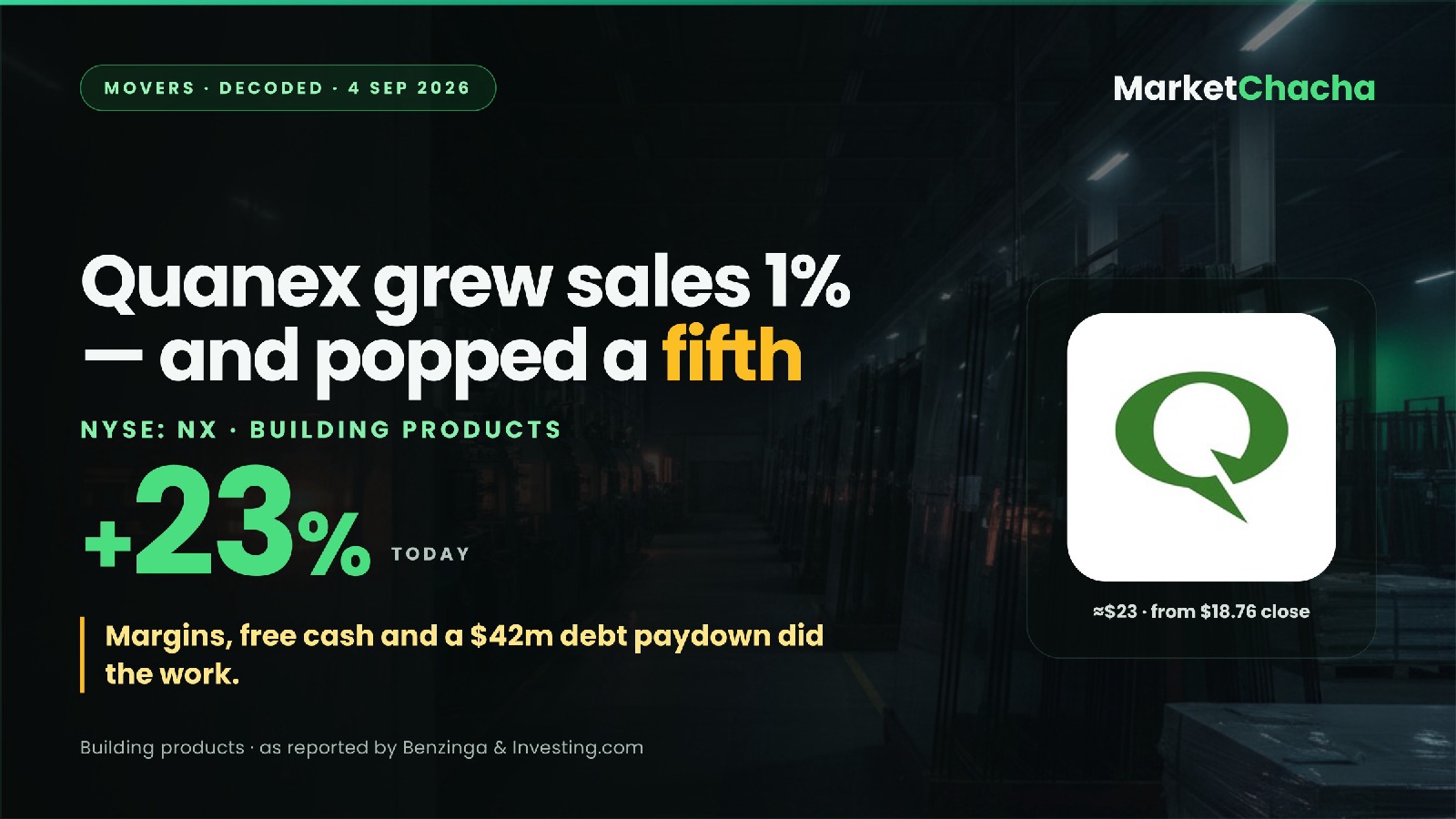
Quanex Building Products sold about 1% more than it did a year ago last quarter. The stock is up roughly 23% to $23.08 today, as reported by Benzinga, from an $18.76 close — Investing.com had it +20.6% to $22.63 in the after-hours session that followed the release. Either way, a company adds a fifth of its value on a quarter where sales barely moved.
So the sales line isn't what moved it. Here's what did.
What happened
Q3 net sales were $501.8m, up 1.3% from $495.3m, roughly in line with the $498.4m estimate. Adjusted diluted EPS came in at $0.79 against a $0.65 forecast — a 21.5% beat — and up from $0.69 a year ago (Investing.com).
Read those two together: revenue flat, profit per share up about 14%. Everything happened between the top line and the bottom line.
Why it moved
Margins. Gross margin went to 28.2% from 27.9%, and adjusted EBITDA rose to $72.7m from $70.3m — a 14.5% margin on flat sales. CEO George Wilson told the call the company had "meaningfully narrowed the cost price gap" by pushing through price increases from mid-single digits to the low teens, phased in over the quarter. That's the whole trick: tariffs and input costs raised the cost of a window component, and Quanex has now repriced enough of its book to cover it.
Then cash. Free cash flow was $47.8m and the company repaid $42.25m of debt in three months, leaving total debt at $672.2m and leverage at 2.8x net debt to trailing adjusted EBITDA, with liquidity up 10.5% to $363.1m.
One number to not misread
GAAP EPS was $0.58, against a loss of $(6.04) a year ago — net income of $26.5m versus a $(276.0)m loss. That looks like a $300m turnaround. It mostly isn't. The year-ago quarter carried a large non-cash goodwill writedown — an accounting haircut on the value of past acquisitions — which is now lapping out of the comparison. The operating improvement is the $0.69 to $0.79 adjusted number, not the $6.62 headline swing. Anyone quoting the bigger figure is quoting an accounting artefact.
The business
Quanex doesn't sell windows. It sells the parts inside them to the OEMs who do — insulating glass spacers, vinyl and aluminium extruded profiles, screens, and door and window hardware. Three segments moved differently this quarter: Hardware Solutions sales fell 2.7% on lower volumes and tariff reimbursements, Extruded Solutions rose 2.8%, and Custom Solutions rose 8.5%. So a single soft segment was offset elsewhere — this is a components portfolio, not a one-product bet.
Is it expensive?
At about $23, Quanex is a roughly $1bn company (StockAnalysis had market cap near $966m mid-session) on a trailing P/E of ~21 and a forward P/E of ~10.6, with TTM revenue of $1.86bn and a 1.51% dividend yield. A forward multiple around 10 is genuinely undemanding — it prices in very little earnings growth.
Against the obvious bigger name, Fortune Brands Innovations (FBIN): a $5.04bn company on a trailing P/E of ~34, forward ~14, with TTM revenue of $4.39bn that shrank 2.3%. So the much larger, better-known building-products name trades about a third richer on forward earnings while its revenue goes backwards. Quanex is cheaper and just grew. The catch is size: a $1bn company carrying $672m of debt has far less room for error than a $5bn one.
Who this touches
- US window and door OEMs and their suppliers — Fortune Brands, JELD-WEN, Gibraltar Industries, Apogee. Quanex sits upstream of all of them, so its order book is an early read on repair-remodel and new-build window demand.
- Anyone tracking tariff pass-through. This is a clean worked example: costs rose, the company took mid-single to low-teens price, and roughly a year later the margin came back. That lag — cost hits first, price catches up later — is the same arithmetic facing any exporter or importer repricing into tariffs, Indian ones included.
- Housing-cycle bulls. Management called the weakness "demand deferred rather than demand destroyed." That's a claim, not a fact, and Q4 tests it.
The one risk that flips it
Leverage cuts both ways. Guidance for Q4 is 2–3% revenue growth with 50–75 basis points of adjusted EBITDA margin expansion. With $672.2m of debt against a market cap near $1bn, a small miss on EBITDA moves the equity a lot — which is exactly why an in-line revenue quarter with a margin beat was worth 20%+ today. If "deferred" turns out to mean "destroyed", the same maths runs in reverse. Also worth noting: nine-month gross margin is still 26.1%, down from 26.8%, so one good quarter hasn't fixed the year yet.
As of 3:20pm ET, 4 Sep 2026. Figures as reported by the sources below, not live market data. Sources: Quanex Q3 2026 results release (StockTitan), Quanex 8-K filing, Investing.com earnings call coverage, Benzinga, StockAnalysis (NX), StockAnalysis (FBIN). For discussion and education only — not investment advice. Verify before acting.
This article is for educational and informational purposes only. It is not financial advice, investment recommendation, or a solicitation to buy or sell securities. Investing involves significant risks. I am not a SEBI-registered investment advisor. Readers should consult their own financial advisor and conduct their own research before making any investment decisions.
Comments
Join the conversation
Sign in to join the conversation.
Follow replies, add your view, and take part in the discussion.
Sign in to commentLoading comments...