

Suzlon Energy (SUZLON): the full file — the numbers, the owners, and what the filings actually show
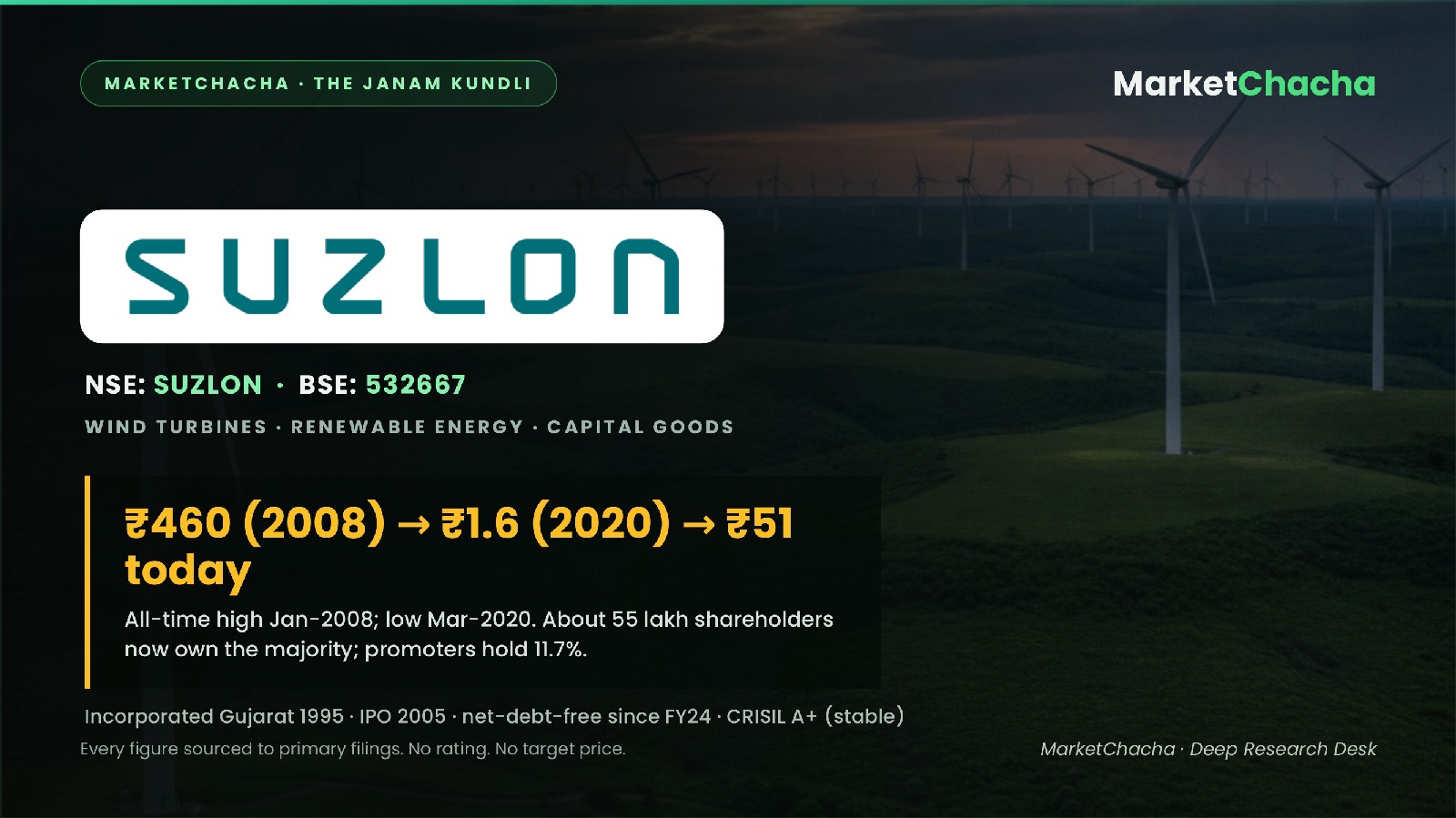
Suzlon Energy designs, builds, installs and maintains wind turbines. It earns money three ways: selling wind turbine generators (WTGs) and their components, executing the projects that erect them, and — increasingly — charging annual fees to operate and maintain the ~15 GW of turbines it has already put in the ground in India. It is the kind of business where the same company can lose ₹2,692 crore in a single year (FY2020) and, five years later, report a ₹3,163 crore profit (FY2026) without changing what it makes.
What the record shows, stated plainly: a company that was minutes from insolvency a decade ago and is now net-debt-free with a CRISIL A+ rating; a promoter family whose stake has fallen from 21% to under 12% while roughly 55 lakh retail shareholders came to own the majority; reported profits that are real but flattered by non-cash deferred-tax credits; and a SEBI order dated 29 May 2026 imposing ₹28.95 crore of penalties on the company and four individuals over financial statements from FY2014–FY2017 — an order Suzlon says it denies and is appealing. Every one of those is a fact with a document behind it. None of them is a recommendation.
Origin — the company's birth certificate
Suzlon Energy Limited was incorporated in Gujarat in 1995 (CIN L40100GJ1995PLC025447) by Tulsi Tanti, a textile entrepreneur who first bought wind turbines to secure cheap captive power for his fabric business and concluded that selling the turbines was the better business. It listed in 2005 in an IPO that was oversubscribed roughly 25 times, and for a brief window it was one of the largest wind-turbine makers in the world, having bought Belgium's Hansen Transmissions (gearboxes) and Germany's REpower/Senvion (turbines) with borrowed money.
Then the cycle turned. The stock hit an all-time high of ₹459.80 in January 2008 and never saw that level again. Debt taken on for the overseas acquisitions collided with the global financial crisis and a collapse in turbine orders. In 2012 Suzlon defaulted on foreign-currency convertible bonds (FCCBs) — at the time the largest FCCB default in India — and entered a corporate debt restructuring (CDR). To survive it sold the crown jewels: Senvion went to Centerbridge Partners for about US$1.1 billion in 2015 (via the Netherlands holding company AE Rotor Holding B.V.), and Hansen was exited earlier. A second crisis followed: a July 2019 FCCB default and a January 2020 disclosure of default on borrowings of ₹7,256 crore, ending in a 2020 lender-led restructuring under the RBI's June 2019 framework. Founder Tulsi Tanti died on 1 October 2022; his brother Vinod R. Tanti took over as Chairman and Managing Director. The company reached a net-debt-free position by FY2024. The stock bottomed at roughly ₹1.6 in March 2020 and trades near ₹51 today — meaning anyone who bought at the 2008 peak is still down about 89% eighteen years later, and anyone who bought at the 2020 low is up roughly thirty-fold.
The business — what they actually sell
Suzlon calls itself a vertically integrated WTG manufacturer: it designs and makes the major components (rotor blades, tubular towers, generators, control systems, gearboxes and nacelles), executes the projects, and runs the O&M. It says it has installed 21 GW across 17 countries over 30 years, employs ~7,800 people, and manages ~15.1 GW of Indian wind assets plus ~6 GW internationally. The revenue mix has three legs — product (turbine sales), project execution/EPC, and O&M services (the recurring, higher-margin annuity). The recent strategic pivot has been toward the S144 and larger 3-MW-class turbines and toward the commercial & industrial (C&I) and PSU customer segments, which the company says make up about two-thirds of its order book.
Who actually buys from them
Suzlon's customers are Indian independent power producers, C&I buyers procuring captive renewable power, and public-sector undertakings such as NTPC, ONGC and SJVN. The company reports an order book of about 5.9 GW exiting FY2026, with ~66% attributed to C&I and PSU customers. A precise customer-concentration figure — how much revenue comes from the single largest buyer — is not disclosed in the public results, which is itself worth noting: unlike a US 10-K, Indian disclosure does not force a "one customer = X% of revenue" line, so a reader cannot verify dependency on any single off-taker from the filings alone.
Where it is actually made — plants & supply chain
Suzlon's manufacturing is concentrated in India — nacelle and generator assembly and its large blade and tower operations across Gujarat, Tamil Nadu, Maharashtra and Madhya Pradesh, with forgings and heavy castings made in-house through subsidiary SE Forge. That in-house forging is unusual and is one of the company's stated advantages. What is not fully disclosed is single-source dependency for specific bought-in inputs (large bearings, certain rare-earth-bearing generator materials, and gearboxes since Hansen was sold); the filings describe capabilities more than they name suppliers. Land-banking and site development for wind farms sits inside Suzlon Gujarat Wind Park Ltd (SGWPL). Readers should treat the supply-chain picture as partial — the company describes its integration in broad terms but does not publish a supplier concentration table.
Five years of numbers
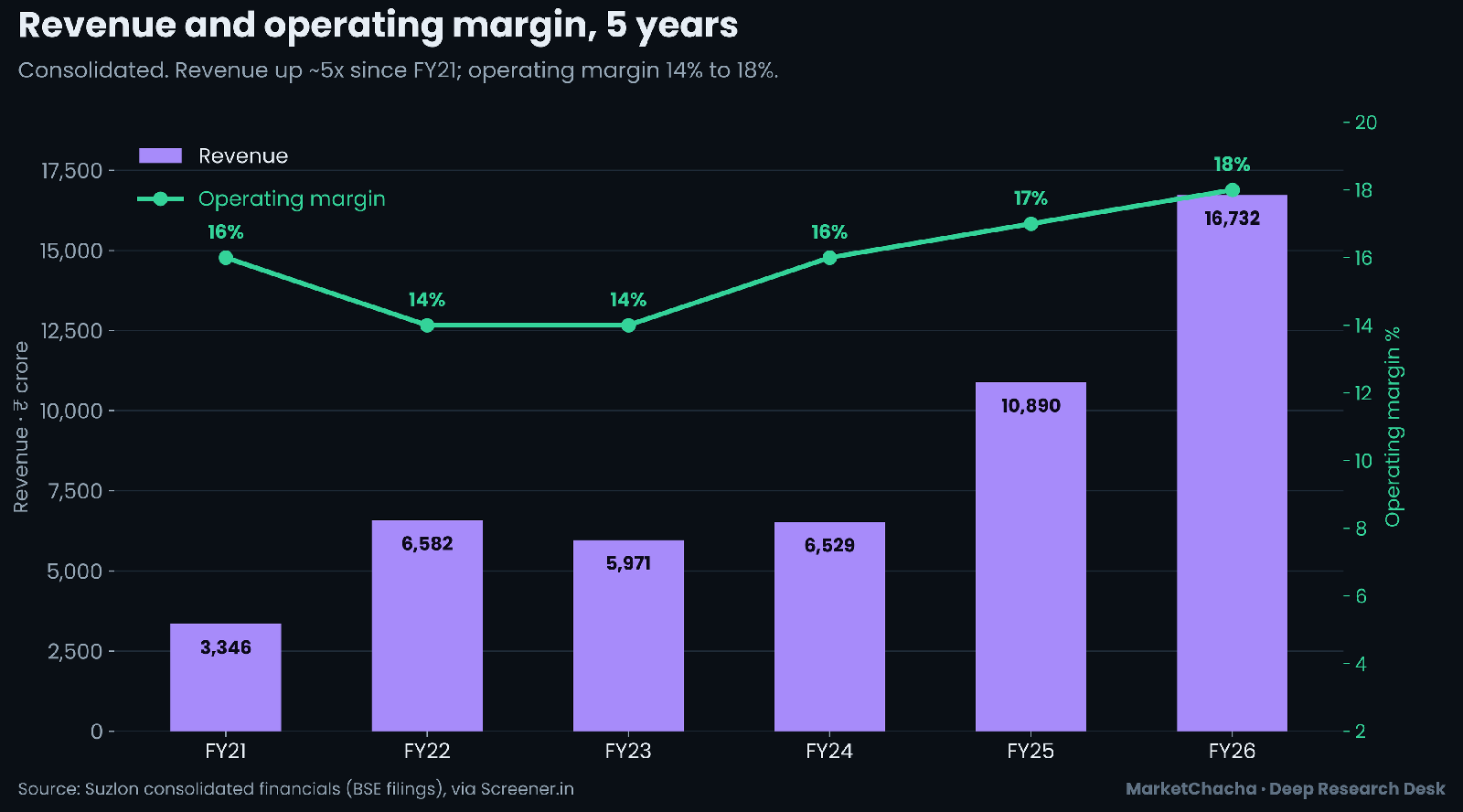
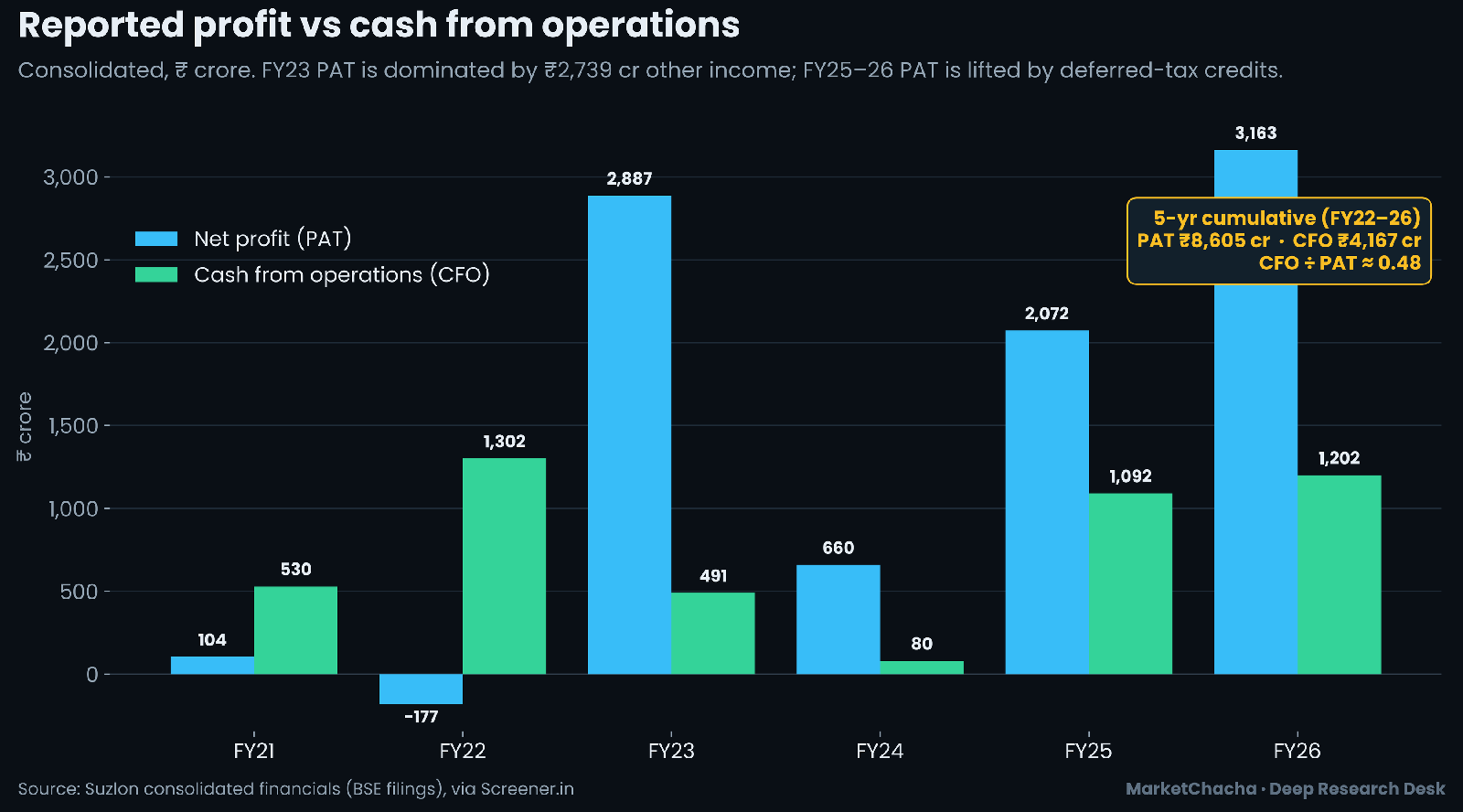
The consolidated five-year record (₹ crore) shows a genuine operating turnaround layered on top of a very noisy profit line. Note two things before reading it: FY2023's profit is almost entirely "other income" (₹2,739 crore of one-time restructuring and write-back gains), and FY2025–FY2026 profits are lifted above pre-tax profit by large deferred-tax credits (the tax line is negative, i.e. a credit, in both years).
| Year (Mar) | Revenue | Op. profit | OPM | PBT | Net profit | EPS ₹ | CFO |
|---|---|---|---|---|---|---|---|
| FY2021 | 3,346 | 537 | 16% | 105 | 104 | 0.10 | 530 |
| FY2022 | 6,582 | 900 | 14% | 0 | -177 | -0.17 | 1,302 |
| FY2023 | 5,971 | 833 | 14% | 2,892 | 2,887 | 2.28 | 491 |
| FY2024 | 6,529 | 1,037 | 16% | 659 | 660 | 0.49 | 80 |
| FY2025 | 10,890 | 1,863 | 17% | 1,447 | 2,072 | 1.53 | 1,092 |
| FY2026 | 16,732 | 3,022 | 18% | 2,422 | 3,163 | 2.33 | 1,202 |
Over five years revenue compounded at ~38%, operating profit faster, and the operating margin widened from 14% to 18%. The stock's five-year price CAGR is about 48% (roughly a 5.9x return). Those are the growth facts. The quality facts are in the next two charts.
The financial-statements block — FY2026 vs FY2025
Income statement (consolidated, ₹ crore): Revenue rose from 10,890 to 16,732 (+5,842, +53.6%). Expenses rose to 13,709 (+51.9%), so operating profit (EBITDA) rose from 1,863 to 3,022 (+62.2%) and the margin ticked up to ~18%. Other income was 97 → 180 (+85.6%). Finance cost rose sharply, 255 → 462 (+81.2%). Depreciation 259 → 318 (+22.8%). Profit before tax rose 1,447 → 2,422 (+67.4%). Then the tax line: a credit of ~₹741 crore in FY2026 (vs ~₹625 crore in FY2025) turned PBT into a reported net profit of 3,163 (+52.7%), with EPS 1.53 → 2.33 and a net margin near 19%.
Balance sheet (₹ crore): net worth (equity + reserves) rose ~55% from ~6,106 to ~9,464 as reserves nearly doubled (3,374 → 6,719). Borrowings remain tiny but rose 323 → 556 (+72% off a small base). Investments jumped 43 → 217. Total assets grew 46% to 18,869 — the growth is in working-capital "other assets," consistent with a business scaling fast. Cash flow (₹ crore): CFO 1,092 → 1,202 (only +10%), CFI −749 → −914, CFF +343 → −155, free cash flow 724 → 626.
The material-variance read: strong operating leverage (revenue +54% → EBITDA +62%) is the real story, but two lines deserve a reader's eye. First, cash from operations grew only 10% while reported profit grew 53% — because the fast revenue ramp tied up cash in receivables and working capital, and because a large slice of reported profit is a non-cash tax credit. Second, on earnings quality: of the ₹975-crore rise in PBT, essentially all of it is operating (EBITDA up ₹1,159 crore, partly offset by higher interest and depreciation); the additional gap between PBT and reported PAT is the deferred-tax credit — a legitimate, one-time, non-cash item recognised as accumulated tax losses become usable. Reported PAT therefore overstates the pace of the cash/operating improvement.
The latest quarter, decoded
The most recent reported quarter is Q4 FY2026 (quarter ended March 2026); the board meets on 28 July 2026 for Q1 FY2027. Figures are consolidated, ₹ crore.
| Line | Q4 FY26 | Q3 FY26 (QoQ) | Q4 FY25 (YoY) |
|---|---|---|---|
| Revenue | 5,493 | 4,236 (+29.7%) | 3,790 (+44.9%) |
| Operating profit | 964 | 738 (+30.6%) | 693 (+39.1%) |
| PBT | 833 | 567 (+46.9%) | 551 (+51.2%) |
| Net profit | 1,114 | 445 (+150%) | 1,181 (−5.7%) |
| EPS ₹ | 0.82 | 0.33 | 0.87 |
Read the bottom two rows together. Operating profit and PBT both rose strongly QoQ and YoY. Yet reported net profit fell 5.7% year-on-year even as PBT rose 51%. The reason is entirely in the tax line: the year-ago quarter (Q4 FY25) carried a much larger deferred-tax credit (its tax rate was −114%, adding a ~₹630 crore credit) than Q4 FY26 (tax −34%, ~₹281 crore credit). The QoQ jump to +150% is the mirror image — Q3 FY26 carried a tax charge, Q4 FY26 a credit. In plain terms: the operating business had a strong quarter; the headline "profit fell" is a tax-credit-timing artefact, not an operating decline.
Who owns it — and where those owners are registered
The ownership story is one of the most dramatic in the Indian market. The promoter (Tanti family) stake has fallen almost every year — 21.0% (FY2017) → 11.70% (June 2026) — the result of a decade of dilution described below, not, in the main, of recent selling. Foreign institutions have moved the other way, from a low of 3.63% in FY2020 to 24.15% in June 2026; domestic institutions hold ~11.1%. But the defining feature is the retail base: the number of shareholders has grown from ~9.7 lakh (FY2017) to roughly 55 lakh (5.5 million) in June 2026, one of the largest retail registers of any listed Indian company. Public/retail investors own ~53% of the equity — they, collectively, are the controlling shareholder.
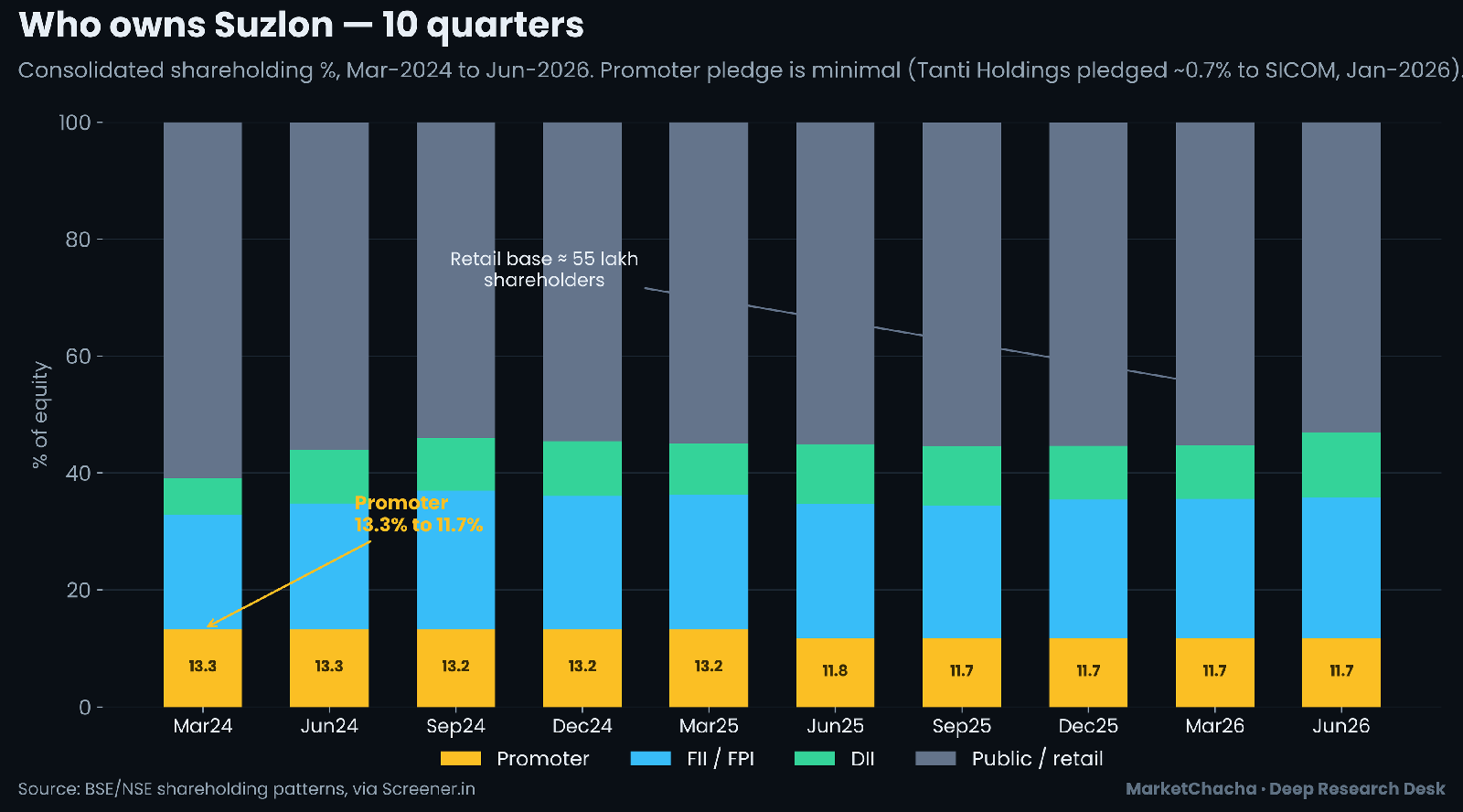
Pledge: promoter pledging is now minimal. The most recent disclosed activity was Tanti Holdings pledging about 0.74% of equity (≈1.3 crore shares) to SICOM in January 2026 — far from the 36% of the promoter stake that was pledged during the crisis years over a decade ago.
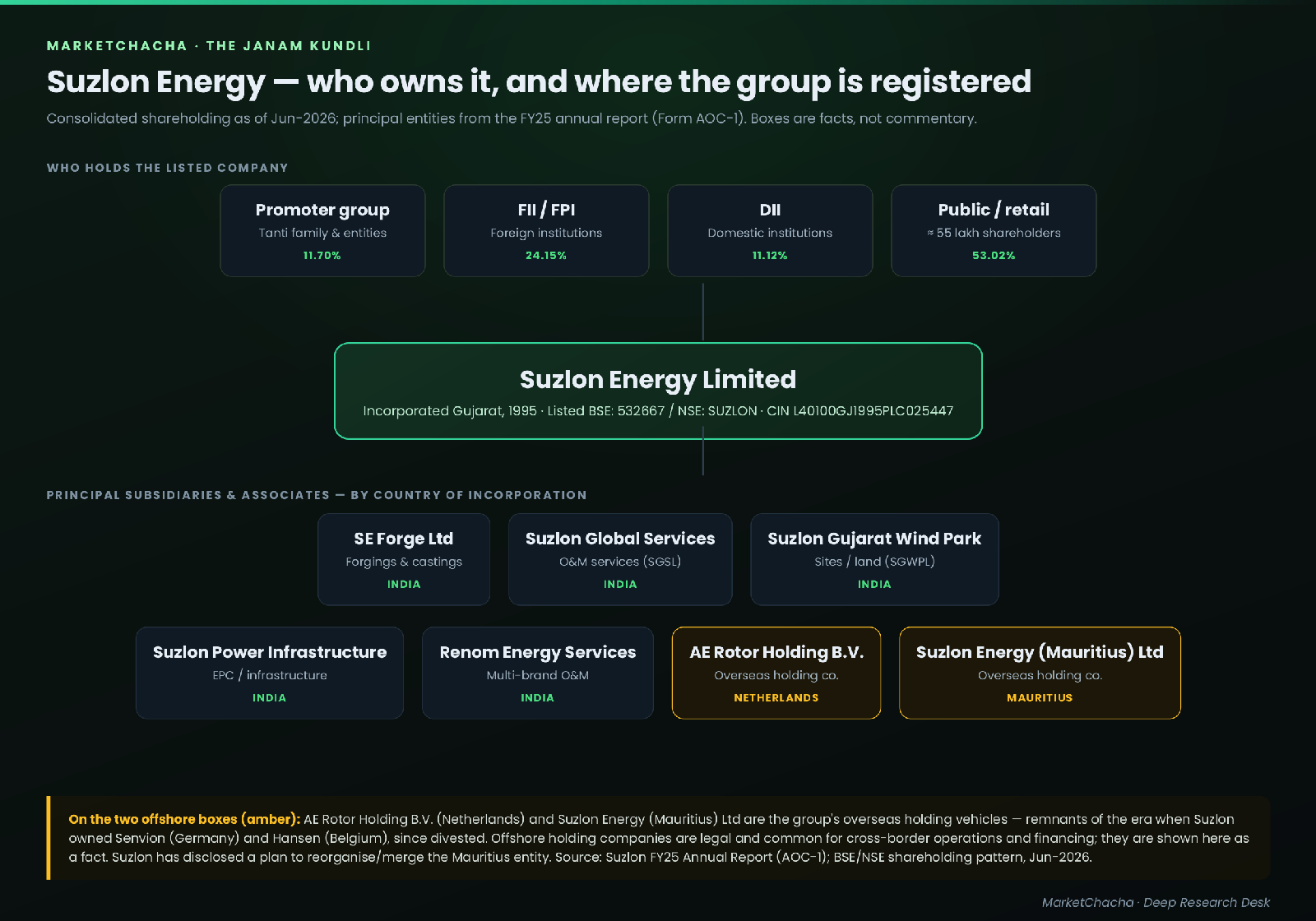
Jurisdictions. Suzlon's group is overwhelmingly Indian, but it does carry two offshore holding companies: AE Rotor Holding B.V. (Netherlands) and Suzlon Energy (Mauritius) Ltd (Mauritius). These are legacy vehicles from the era when the group owned Senvion (Germany) and Hansen (Belgium), both since divested; the Netherlands entity absorbed two other Dutch subsidiaries in February 2025 and the company has disclosed a plan to reorganise the Mauritius entity. Offshore holding companies are legal and extremely common for cross-border operations and financing — they are shown here as a disclosed fact, not an accusation. Equally, no single foreign portfolio investor is individually disclosed above the 1% threshold in the public pattern, and the promoter is a named, identifiable family — so the ownership is neither concentrated in one hidden hand nor opaque.
Capital history — every time they raised money
If one number captures Suzlon, it is the share count. The equity capital (face value ₹2) grew from ₹742 crore in FY2015 (≈371 crore shares) to ₹2,745 crore in FY2026 (≈1,373 crore shares) — a ~3.7x increase in eleven years, and vastly more since the IPO. The mechanisms, in sequence: the 2005 IPO; a subsequent stock split (₹10 to ₹2 face value); repeated FCCB issuances and, later, their conversion into equity; the 2015 preferential allotment to Dilip Shanghvi's group (~₹1,800 crore for ~23%, since largely exited); conversions of optionally/compulsorily convertible debentures (OCDs/CCDs) under the 2020 lender restructuring; a ₹1,200 crore rights issue in October 2022; and a qualified institutional placement (QIP). The SEBI order itself records that in FY2014–15 alone Suzlon issued 1,21,95,69,014 shares and raised ₹1,882 crore. Dilution on this scale is the reason the stock can rise many-fold while long-term holders from 2008 remain deep underwater — the pie grew, but so did the number of slices. The benign reading is straightforward and important: this dilution was the mechanism of survival. Converting debt into equity, and issuing new shares to lenders and investors, is precisely what kept Suzlon out of liquidation; the alternative for the 2012 and 2019 crises was insolvency, in which equity holders typically recover nothing.
Who runs it, and the wider web
The board remains anchored by the founding family: Vinod R. Tanti (Chairman & Managing Director) and Girish R. Tanti (director) are the surviving Tanti brothers, both named in the SEBI order discussed below. The FY2025 statutory auditor is Walker Chandiok & Co LLP (an affiliate of Grant Thornton Bharat; firm registration 001076N/N500013). Historically the accounts were audited jointly by SNK & Co and S R Batliboi & Co, and it is a matter of record that in FY2014 the auditors flagged concerns about the company's ability to generate adequate cash — a going-concern-type emphasis appropriate to that period. We did not identify a qualified opinion for FY2025 in the public summaries, but a reader should confirm the auditor's report, the emphasis-of-matter paragraphs and the related-party note directly in the annual report rather than relying on a secondary source. The group's principal subsidiaries are SE Forge (forgings), Suzlon Global Services (O&M), Suzlon Gujarat Wind Park (sites), Suzlon Power Infrastructure (EPC) and Renom Energy Services (multi-brand O&M), plus the two offshore holding entities named above.
The regulatory and surveillance record
This is the section a Suzlon holder should read most carefully, and the one where discipline matters most: we report what the documents say and nothing more.
SEBI order dated 29 May 2026. Following an investigation that began with a December 2019 complaint and an NSE preliminary examination, SEBI passed a 96-page order imposing cumulative penalties of ₹28.95 crore: ₹15.95 crore on Suzlon Energy Ltd, ₹5.75 crore on Vinod R. Tanti, ₹5.45 crore on Girish R. Tanti, ₹1.5 crore on former group finance head Kirti J. Vagadia and ₹30 lakh on Amit Agarwal. The order concerns the presentation of the company's financial statements over FY2013-14 to FY2016-17. In SEBI's words the accounts "did not present a true and fair view of the profitability, net worth." The specific matters the order examines include: the March 2014 transfer of Suzlon's O&M (OMS) business — with a net book value of about ₹77.08 crore — to wholly-owned subsidiary Suzlon Global Services for ₹2,000 crore, on which Suzlon booked an exceptional profit of ₹1,922.92 crore; a subsequent transfer of the SGSL stake to another subsidiary that booked a further ₹829.78 crore of profit on the same asset base; the manner in which ₹1,300 crore of the outstanding consideration was settled through repeated same-day routing of funds in March 2017 (the order describes ₹150 crore routed six times, and ₹100 crore four times); a disclosure question around a Stand-by Letter of Credit (SBLC) from SBI backing a subsidiary's loan; and ₹1,200 crore of "equity infusion" into SGWPL that SEBI characterises as sixteen circular entries of ₹75 crore each. SEBI alleges violations of its PFUTP (fraudulent-and-unfair-trade-practices) and LODR (disclosure) regulations, the SEBI Act and the SCRA.
Two things must be said alongside those facts, and they are facts too. First, Suzlon denies the allegations and has stated it is filing an appeal before the Securities Appellate Tribunal (SAT), and that the order has no impact on its financial or operational activities — so these are contested findings under appeal, not settled conclusions, and the individuals and company are entitled to that process. Second, the conduct examined dates to FY2014–FY2017, a period of acute financial distress and restructuring; the company's stated position is that the OMS transfer was part of an asset-monetisation plan under its Master Restructuring Agreement, supported by an independent valuation and board approvals, and intended to facilitate a possible Senvion acquisition. A reader deciding what weight to give this should watch the SAT outcome. We name the order, the amounts and the individuals because they are matters of public record; we draw no conclusion about guilt.
Credit ratings. The trajectory here runs the other way. In July 2025 CRISIL upgraded Suzlon's long-term rating to CRISIL A+/Stable (from A/Positive) with a CRISIL A1 short-term rating, and ICRA assigned [ICRA]A+ (Stable); the ratings reflect the near-zero net debt and improved cash generation. There is no "Issuer Not Cooperating" tag. Exchange surveillance: Suzlon is a large, highly liquid stock that is part of the F&O segment and the BSE-100/BSE-500 indices; it is not in the exchanges' ASM or GSM surveillance frameworks, which target thinly-traded or unusually volatile small-caps. No NCLT/IBC proceeding is outstanding; the historical CDR and 2020 restructuring were completed. No recent auditor or CFO resignation was identified around the FY2025 close.
Forensic checks — what the accounts show
Each check below is the number, the source, what it means, and the benign reading. None is totalled into a score, and none is an accusation.
| Check | What we found | A benign explanation |
|---|---|---|
| 5-yr CFO ÷ PAT (FY22–26) | CFO ₹4,167 cr ÷ PAT ₹8,605 cr ≈ 0.48 | Reported PAT contains large non-cash items — FY23's ₹2,739 cr exceptional gain and FY25–26 deferred-tax credits — and a 2.5x revenue ramp absorbed working capital. CFO ÷ EBITDA ≈ 0.54. |
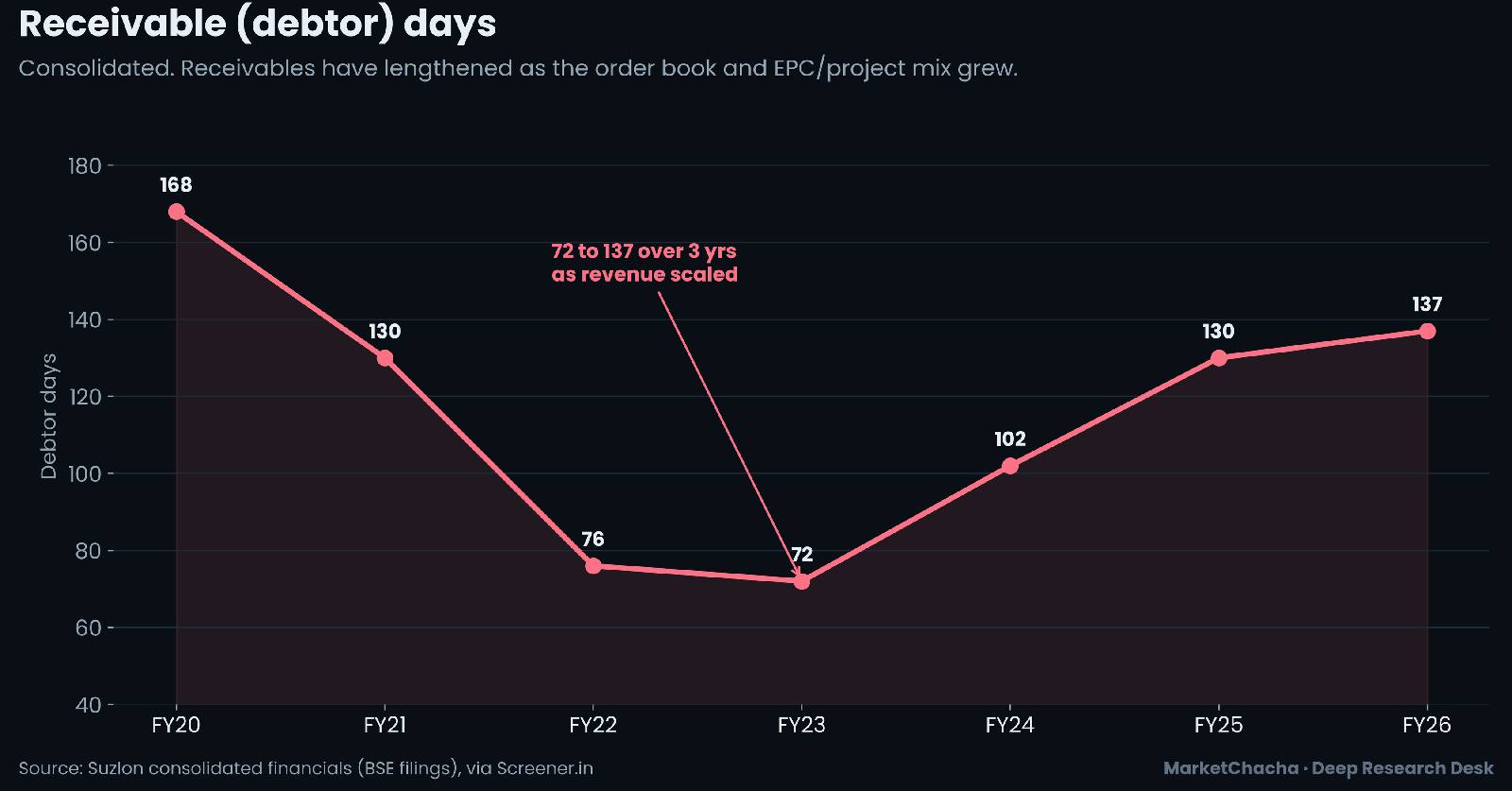
| Receivable days | 72 (FY23) → 137 (FY26) | Revenue rose 2.5x; EPC/project and C&I mix carry longer credit terms. Inventory days fell (210 → 152), partly offsetting. |
| Other income ÷ PBT | FY23 95%; FY25 7%; FY26 7% | FY23 was a one-off (restructuring/write-back gains). Recent years' profit is operating, not other-income-driven. |
| Deferred-tax credit | Tax line a credit in FY25 (~₹625 cr) & FY26 (~₹741 cr) | Standard once accumulated losses become usable; legitimate but non-cash and one-time. It lifts PAT above PBT. |
| Implied interest rate | Finance cost ₹462 cr on tiny reported borrowings | Most of the cost is on non-fund limits (bank guarantees, LCs) and lease liabilities, not term debt — normal for a WTG maker. |
| Promoter pledge & holding | Holding 21% → 11.7%; pledge minimal (~0.7%) | The stake fell mainly through survival dilution, not selling; pledge is a fraction of the crisis-era 36%. |
| Dilution | Shares ~371 cr (FY15) → ~1,373 cr (FY26) | Debt-to-equity conversions and capital raises kept the company solvent; the alternative was insolvency. |
| Auditor | Walker Chandiok & Co LLP (FY25) | No qualified FY25 opinion identified; FY14 auditors flagged going-concern — appropriate to that era. Verify in the AR. |
| Subsidiaries & jurisdictions | India + Netherlands (AE Rotor Holding B.V.) + Mauritius (Suzlon Energy Mauritius) | Legacy overseas holding vehicles from the Senvion/Hansen era; legal and common; a reorganisation is disclosed. |
| Regulatory | SEBI order 29 May 2026, ₹28.95 cr penalties, under SAT appeal | Concerns FY14–17 accounts; company denies and is appealing; ratings are A+ and improving. |
What we could not verify
We could not verify, from public documents: the single-largest-customer concentration (not disclosed under Indian rules); the exact quantum and counterparties of FY2025 related-party transactions as a percentage of revenue (the annual report's RPT note should be read directly); single-source supplier dependencies for key inputs such as large bearings and generator materials; the precise line-by-line contents of the FY2025 auditor's report, including any emphasis-of-matter paragraphs; and the ultimate beneficial ownership behind the offshore holding entities beyond what the group discloses. Each of those is a gap to close by reading the primary annual report, not an inference to draw.
What would change the picture
The concrete, checkable things to watch next: the SAT appeal outcome on the 29 May 2026 SEBI order (the single biggest open question); the Q1 FY2027 results due after the 28 July 2026 board meeting, and whether operating cash flow finally catches up with reported profit; the receivables line — whether 137 debtor days keeps climbing as the order book converts to revenue; the next shareholding pattern, for any change in promoter holding or pledge and whether the ~55-lakh retail base holds; the FY2026 annual report's auditor's report and related-party note; the tax line, since the deferred-tax tailwind that has flattered PAT will fade as losses are fully absorbed; and any credit-rating action from CRISIL or ICRA.
Sources
- Suzlon Energy — consolidated financials, quarterly results, shareholding patterns, credit-rating and annual-report links (aggregated from BSE/NSE filings): screener.in/company/SUZLON/consolidated
- SEBI — Order in the matter of Suzlon Energy Limited, 29 May 2026 (96 pp): sebi.gov.in — ORDER_1780045331.pdf
- Business Today — SEBI penalty breakdown (₹28.95 cr; the OMS transaction), 30 May 2026: businesstoday.in — BT Explainer
- Suzlon FY25 Annual Report (auditor, subsidiaries/AOC-1, related parties): suzlon.com — Annual Report 2024-25; FY25 & earlier ARs on BSE via the Screener "Documents" section above.
- ICRA rating rationale (19 May 2026 / 29 Jul 2025): icra.in — rationale 143081. CRISIL upgrade to A+ (29 Jul 2025): businesstoday.in — rating upgrade
- Suzlon FY25 results press release (revenue ₹10,851 cr; PBT ₹1,447 cr): suzlon.com — FY25 results
- FY26 results / order book (~5.9 GW): psuconnect.in — Q4 FY26
- Peer valuation — Inox Wind (NSE: INOXWIND): screener.in/company/INOXWIND
FAQ
Is Suzlon really debt-free? On a net basis, yes — reported borrowings are small (~₹556 crore at FY2026) against a larger cash balance, and the company states it is net-debt-free, a dramatic change from ₹13,210 crore of borrowings in FY2020. Gross "finance cost" of ₹462 crore still appears because it includes charges on non-fund facilities (bank guarantees, letters of credit) and leases.
Why did the SEBI order not hit the share price much? The order concerns accounts from FY2014–FY2017, the penalty (₹28.95 crore) is small relative to the company's ₹70,000-crore-plus market value, and Suzlon has said it will appeal at SAT with no operational impact. Whether that assessment holds depends on the appeal; the facts of the order stand as public record regardless.
How can profit rise while cash from operations barely moves? Two reasons: reported profit is lifted by non-cash deferred-tax credits, and a fast-growing turbine/EPC business ties up cash in receivables and inventory. Over FY2022–26, cumulative CFO (₹4,167 cr) was about half of cumulative PAT (₹8,605 cr).
Why do 2008 investors still have losses if the stock is a multibagger? Because of dilution. The share count has multiplied many times over as debt was converted into equity and new shares were issued to survive two crises. The all-time high was ₹459.80 in January 2008; the shares outstanding then were a small fraction of today's ~1,373 crore.
Who controls Suzlon now? No one holds a majority. The Tanti family (promoter) owns ~11.7%, foreign institutions ~24%, domestic institutions ~11%, and roughly 55 lakh public/retail shareholders own ~53% between them.
Independent research for education and discussion only. Not investment advice, not a recommendation, and not a rating — we issue no buy/sell calls and no target prices. Every figure is sourced from the primary documents linked above; figures can be restated and we can make mistakes, so always verify against the original. Nothing here alleges wrongdoing by any company or individual: where a fact raises a question we state the fact, cite it, and give the benign explanation alongside. Offshore holding structures, pledging and preferential allotments are all legal and common — they are disclosed here as facts, not as accusations. The SEBI order described above sets out allegations that the company denies and is appealing before the Securities Appellate Tribunal; those matters are not final.
This article is for educational and informational purposes only. It is not financial advice, investment recommendation, or a solicitation to buy or sell securities. Investing involves significant risks. I am not a SEBI-registered investment advisor. Readers should consult their own financial advisor and conduct their own research before making any investment decisions.
Comments
Join the conversation
Sign in to join the conversation.
Follow replies, add your view, and take part in the discussion.
Sign in to commentLoading comments...