

Why did Ultragenyx (RARE) crash ~44% today?
Ultragenyx spent years telling investors that a single drug for a rare brain disorder was its path to real profits. On Wednesday evening the trial that mattered came back empty — and by Thursday morning the stock had lost almost half its value. Here's what actually broke, and what's left.
What happened
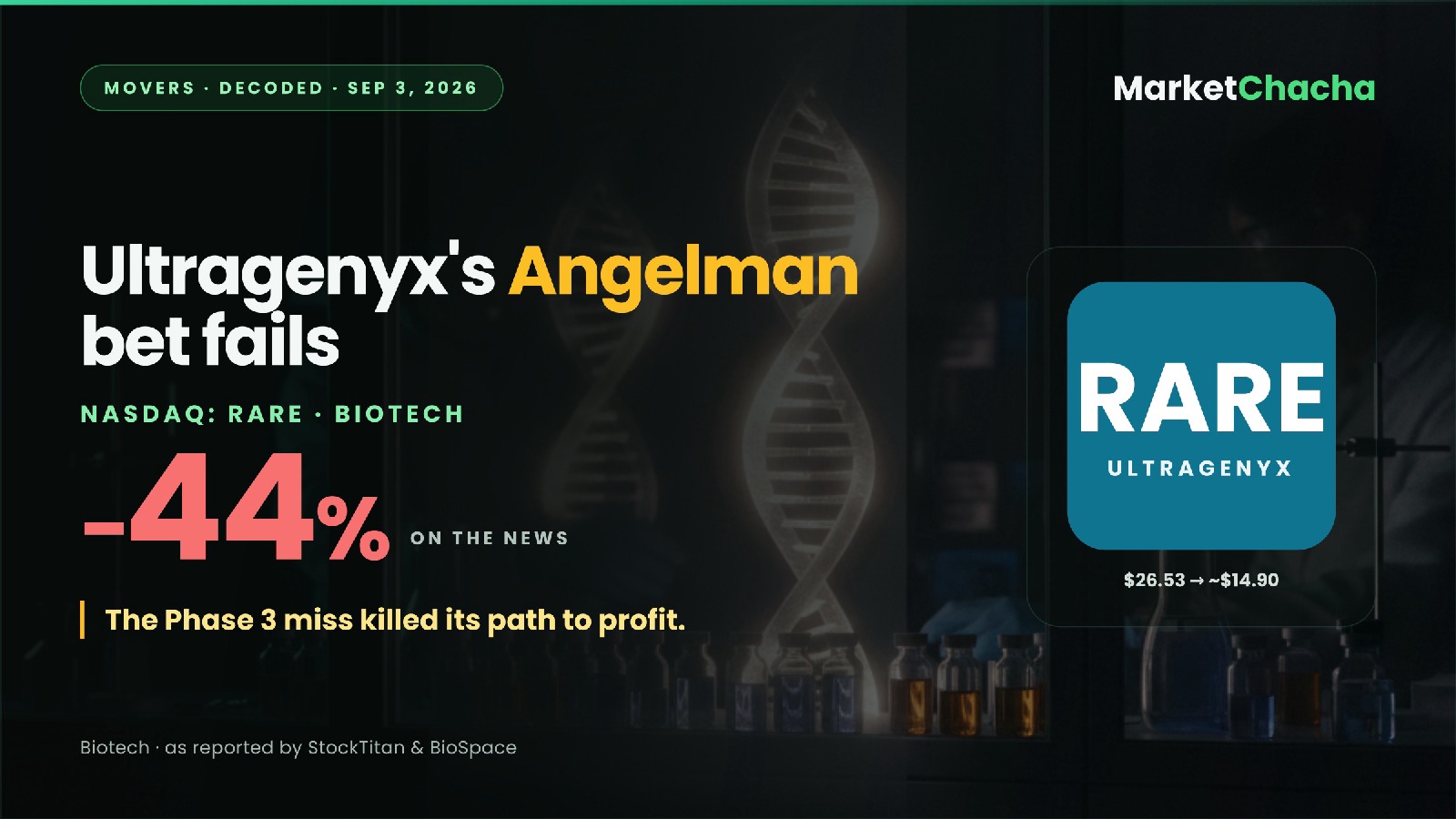
Ultragenyx (NASDAQ: RARE) fell about 44% after its Phase 3 Aspire study of apazunersen (also known as GTX-102) in Angelman syndrome failed. The shares dropped from a $26.53 close on Tuesday to around $14.90 — nearly halving a company that was worth roughly $2.3 billion the day before, as reported by StockTitan and Investing.com. That's close to a billion dollars of market value gone on one readout.
Why it moved
This wasn't a soft miss. Apazunersen is an antisense drug — a lab-made strip of genetic code designed to switch on the healthy backup copy of the UBE3A gene that's silenced in Angelman patients. In Aspire it was tested against a sham (placebo) procedure. The drug missed its primary endpoint (change in the Bayley-4 cognitive score) and its key secondary endpoint (the Multidomain Responder Index). In the company's own words, there were "no differences between the treated and control groups that could support efficacy." Safety looked fine — the problem is the drug simply didn't work. That's why the drop is so brutal: there's no "adjust the dose and re-run" story here. Analysts at William Blair, whose whole thesis rested on this readout, said they now see "no key value inflection points for the company in the next 12 months."
The business — this is not a one-drug company
Here's the nuance the headline misses. Ultragenyx already sells approved medicines and did about $630 million in trailing revenue at roughly 85% gross margin. The engine is Crysvita for the bone disease XLH (guided to about $500–520m this year) plus Dojolvi (around $100–110m), with smaller products Mepsevii and Evkeeza and a newly approved gene therapy, Genglycos. So the company doesn't disappear. What died Wednesday was the growth story on top of that base — the drug that was supposed to turn a cash-burning biotech into a profitable one.
Is it expensive?
Ultragenyx has no P/E — it doesn't make a profit (net margin near -92%), so there are no earnings to price. At about a $1.3 billion market cap on ~$630m of sales, it now trades near 2x revenue, which looks cheap until you remember why: the market just deleted its route to earnings. Compare it to the larger rare-disease name BioMarin (NASDAQ: BMRN), which actually turns a profit and trades on a triple-digit trailing P/E around a $67 share price — the market pays up for BioMarin because it earns money and sells a broad book. RARE is "cheap on sales" the way a company that just lost its catalyst usually is. Cheap and de-risked are not the same thing.
Who it touches
- Angelman families: the hardest hit. GTX-102 had shown promising early signals and carried Breakthrough, Orphan and Fast Track tags — hope that just evaporated.
- Ionis (NASDAQ: IONS): its rival Angelman drug ION582 is in Phase 3 with its own Breakthrough tag. A competitor stumbling can look like a clearer field — but apazunersen was also antisense, so its flat cognition data raises an uncomfortable question about whether the whole approach can move the needle.
- Neuren and other neuro-cognition players: a failed cognition endpoint in a well-run trial dents confidence that these scores can be shifted at all.
What to watch
Two near things. First, Ultragenyx said it will cut costs "significantly" and decide the drug's fate — watch for the scale of layoffs. Second, its gene therapy UX111 for Sanfilippo syndrome has an FDA decision due by mid-September; after Wednesday, that ruling suddenly carries a lot more weight for the stock than it did last week.
As of Sep 3, 2026, ~11:30am ET. Sources: StockTitan, BioSpace, Investing.com, Ultragenyx IR. For discussion and education only — not investment advice. Verify before acting.
This article is for educational and informational purposes only. It is not financial advice, investment recommendation, or a solicitation to buy or sell securities. Investing involves significant risks. I am not a SEBI-registered investment advisor. Readers should consult their own financial advisor and conduct their own research before making any investment decisions.
Comments
Join the conversation
Sign in to join the conversation.
Follow replies, add your view, and take part in the discussion.
Sign in to commentLoading comments...