

Sun Pharma: what their latest filing actually means
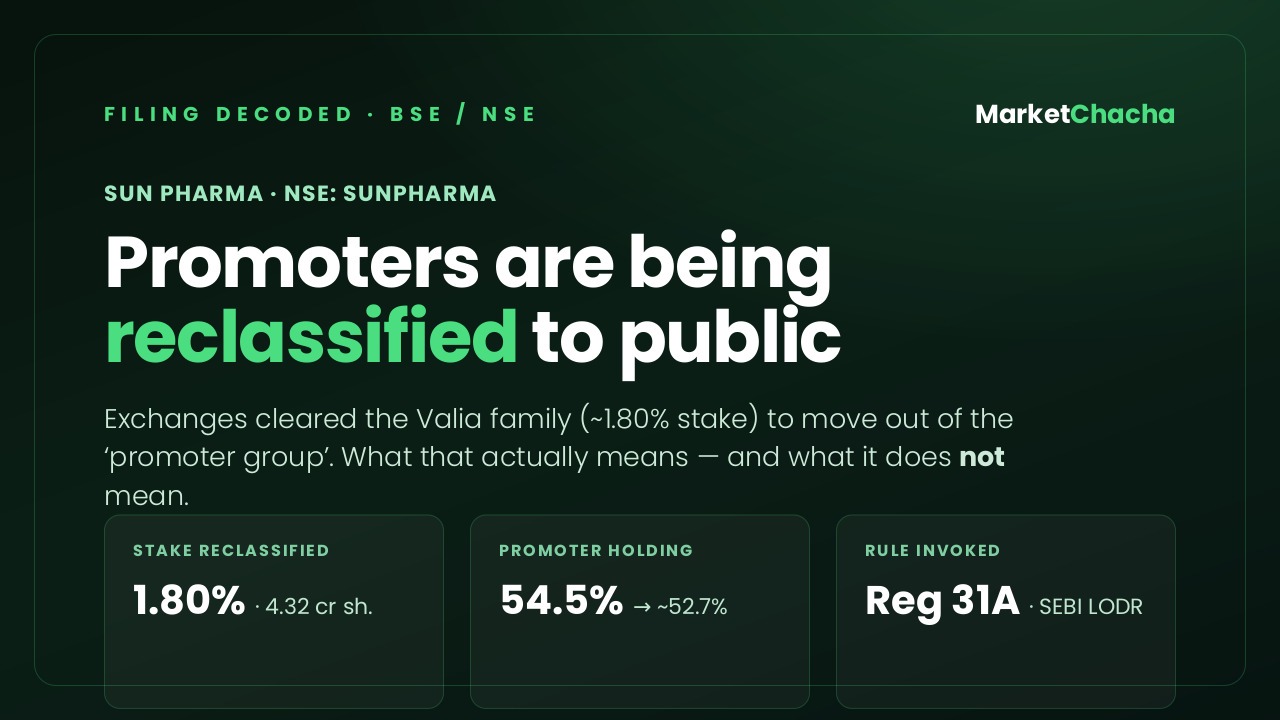
Sun Pharma — India’s largest drugmaker — told the exchanges on 6 August 2026 that NSE and BSE have granted their no-objection to reclassify three long-standing members of its promoter family, the Valias, out of the ‘promoter group’ and into the ordinary ‘public’ category. It is a labelling change on the shareholder register, not a sale of shares — but ‘promoter reclassification’ sounds scarier than it is, so it is worth understanding.
What was announced
- Sun Pharma received no-objection letters from NSE and BSE on 6 August 2026 to reclassify certain promoter-group members as public shareholders.
- Three individuals applied (application dated 26 May 2026): Sudhir V. Valia, Raksha S. Valia and Krishna V. Valia.
- Together they hold about 4.32 crore shares ≈ 1.80% of the company.
- The move is made under Regulation 31A of SEBI’s LODR rules, which governs how a promoter can be re-labelled as public.
- Sudhir Valia is the brother-in-law of founder Dilip Shanghvi and a former long-serving director of the company; this formalises that branch of the family stepping back from the controlling group.
- The founding Shanghvi family stays firmly in control. Reported promoter holding of roughly 54.5% would edge down by about 1.8 percentage points to ~52.7% once the change takes effect.
What “promoter reclassification” actually means
Every listed company splits its owners into two buckets: promoters (the founders / controlling group who set up and run the company) and public (everyone else — mutual funds, foreign investors, retail shareholders like you). SEBI’s Regulation 31A lets a person move from the promoter bucket to the public bucket if they no longer control the company — broadly, they can’t be a director or key manager, can’t hold more than 10% on their own, and can’t act in concert with the controlling promoters. It needs the board’s and shareholders’ approval, and finally the exchanges’ no-objection — which is the step that just happened.
The single most important point: this is a change of label, not ownership. Not a single share is bought or sold in the reclassification itself. The named people keep their shares; those shares simply now sit in the ‘public’ column instead of the ‘promoter’ column.
Why it matters / potential impact
- Reported promoter holding falls slightly and the public float rises on paper — here about 1.8 percentage points shifts columns.
- It usually signals a family member is stepping away from actively controlling the business, tidying up the cap table.
- No cash, no dilution, no new shares. By itself it does not change Sun Pharma’s revenue, margins, debt or operations.
- One thing to watch: once reclassified, those persons are treated like any public shareholder, so they are then free to sell in the open market under normal rules. That would be a separate future decision — it is not what today’s filing is.
Is it expensive?
Sun Pharma trades at roughly a P/E of 38–42x, with a market cap around ₹4 lakh crore — the largest and one of the most richly valued names in Indian pharma. For context, Cipla trades near a P/E of ~30x (market cap ~₹1.2 lakh crore) and Dr Reddy’s near ~18x (~₹1.05 lakh crore). So Sun Pharma carries a clear premium to its peers — that is rich, not cheap. The premium reflects its higher-margin global specialty and branded portfolio rather than plain generics; whether it is justified depends on that specialty pipeline continuing to deliver. This is framing only — not a target or a buy/sell call.
The business
Sun Pharma is India’s biggest pharmaceutical company and among the world’s largest specialty-generic drugmakers. Its main slices are the US business (generics plus high-margin specialty brands in dermatology, ophthalmology and onco-dermatology — e.g. Ilumya, Winlevi, Cequa, Odomzo), a leading India branded-generics franchise, Emerging Markets, Rest of World, and APIs (the raw chemical ingredients). Crucially, today’s filing is a shareholding / governance matter — it touches the promoter register, not any drug, plant or product — so it does not affect the underlying business at all.
Beginner takeaway
Reclassification means a promoter-group member is being re-labelled as an ordinary public shareholder. No shares are bought or sold in this step. Promoter holding dips a little (here ~54.5% to ~52.7%), but the founding Shanghvi family stays in control. Read it as housekeeping on the shareholder register, not a red flag.
FAQ
Are the promoters selling their shares? No. Reclassification only changes the category a shareholder sits in. No shares change hands here — the Valias keep their ~1.80%, now labelled ‘public’.
Does this mean the promoters are losing faith in the company? Not necessarily. It usually reflects a family member no longer being actively involved in controlling the company — a condition SEBI’s rules require before anyone can be reclassified.
Will it change Sun Pharma’s profits or debt? No. It is a shareholding-category change with zero impact on revenue, margins or the balance sheet.
Can the reclassified people now sell freely? Once they are public shareholders they can trade like anyone else under normal market rules — but that would be a separate future decision, not part of this filing.
As of 7 August 2026. Filing dated 6 August 2026. Source: official BSE/NSE filing — read it directly here. We summarise filings for education and may make errors, so always verify against the official document. Educational content only — not investment advice, not a buy/sell recommendation.
This article is for educational and informational purposes only. It is not financial advice, investment recommendation, or a solicitation to buy or sell securities. Investing involves significant risks. I am not a SEBI-registered investment advisor. Readers should consult their own financial advisor and conduct their own research before making any investment decisions.
Comments
Join the conversation
Sign in to join the conversation.
Follow replies, add your view, and take part in the discussion.
Sign in to commentLoading comments...