

Paytm: what their latest filing actually means
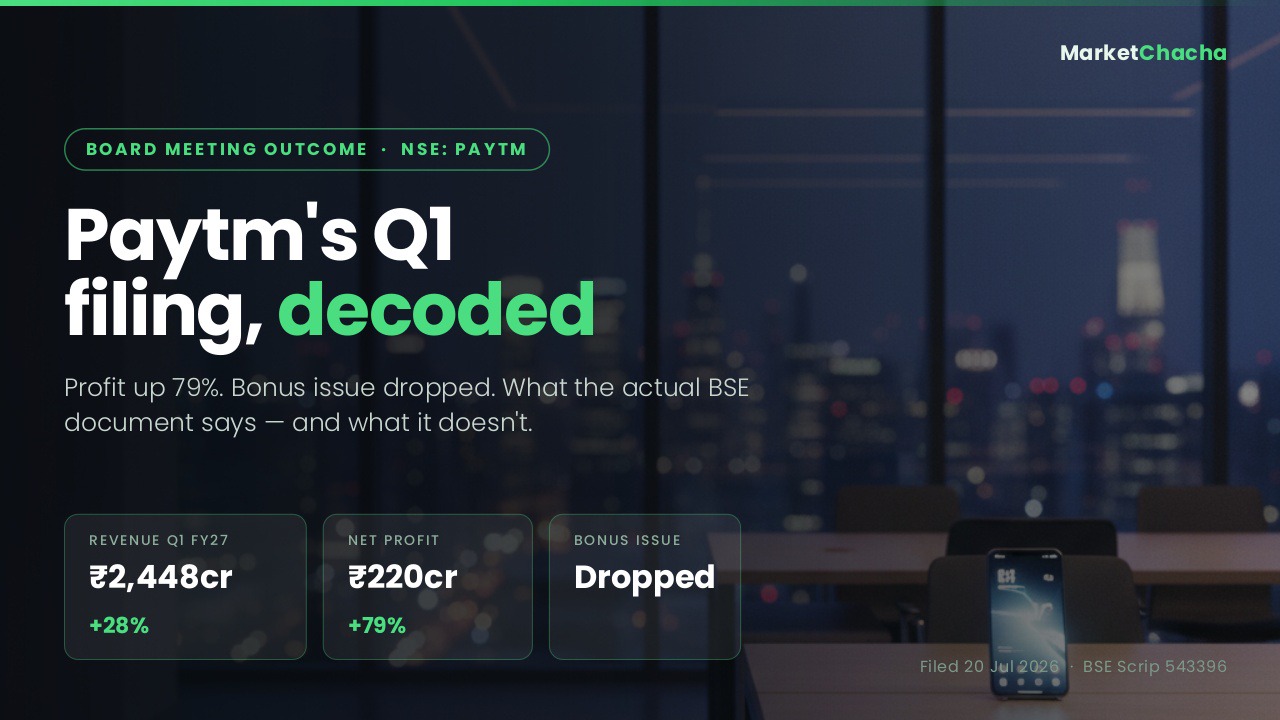
One 97 Communications (Paytm) filed its Board Meeting Outcome with BSE and NSE late on 20 July 2026. It is a genuinely busy document: June-quarter results showing net profit up 79%, a decision not to go ahead with the bonus issue the market had been waiting for, a ₹100 crore capital injection into Paytm Money, and a request to shareholders to redirect ₹1,686 crore of leftover IPO money. Five separate decisions, one filing.
What was announced
The board approved, among other things:
- Q1 FY27 results (quarter ended 30 June 2026). Revenue from operations ₹2,448 crore, up 27.6% from ₹1,918 crore a year ago and up 8.1% from ₹2,264 crore last quarter. Net profit ₹220 crore versus ₹123 crore a year ago — a 79% jump. Basic EPS ₹3.44 versus ₹1.92.
- No bonus issue. The board had flagged a bonus-share proposal for consideration. After deliberation it "decided not to proceed with the said proposal at this time," saying it would rather focus on compounding growth and profitability.
- ₹100 crore into Paytm Money. An additional subscription to equity shares of wholly owned subsidiary Paytm Money Limited via a rights issue, for technology, regulatory capital and expansion of the investment and wealth-management business.
- IPO money reallocation. Of the ₹2,000 crore earmarked at IPO under "Object 2" (new business initiatives, acquisitions, strategic partnerships), ₹1,686 crore is still unspent. The board wants shareholder permission to use that balance interchangeably between Object 1 and Object 2, and to extend the deadline to 31 March 2029. This needs a special resolution at the AGM.
- Board change. Amitabh Kumar Singhal, a former Senior VP of Google Search, appointed Additional Director (Non-Executive, Non-Independent) with effect from 20 July 2026, subject to shareholder confirmation at the AGM.
- ESOP amendments to the One 97 Employees Stock Option Scheme 2019.
What this type of filing means
A "Board Meeting Outcome" under Regulation 30 and 33 of SEBI's LODR rules is the company's legally required same-day disclosure of what its directors decided. It is the rawest form of company news you can get — no journalist, no analyst, no spin layer. If you only ever learn to read one type of exchange filing, make it this one.
Two items here deserve unpacking:
A bonus issue splits your existing shares into more shares. If you own 100 shares and a 1:1 bonus is declared, you end up with 200 shares each worth roughly half as much. Your ownership percentage, and the value of your holding, do not change. Companies do it to lower the optical share price and improve liquidity. So a board declining a bonus issue takes away nothing of real economic value — but it can still move a stock, because some buyers were positioned for the announcement rather than the business.
Changing IPO-proceeds utilisation is more consequential than it sounds. When a company IPOs, the prospectus commits it to spending the money on specified "Objects." Redirecting that money legally requires a special resolution — at least 75% of votes cast in favour. That high bar exists precisely because investors subscribed to a stated plan. The fact that ₹1,686 crore of ₹2,000 crore is still unspent nearly five years after the IPO is itself a data point about how few acquisitions Paytm has found worth making.
Why it matters / potential impact
The headline is the 79% profit jump. But read the expense side of the same filing and a more careful picture appears.
Total expenses were ₹2,383 crore against ₹2,448 crore of operating revenue. That leaves roughly ₹65 crore of operating profit after depreciation and finance costs. Profit before tax was ₹247 crore — and the gap is largely other income of ₹182 crore, which is mostly returns on the company's large cash and investment pile, not money earned from payments or lending. The core business is now profitable, which is a real milestone. It is just not yet the main source of the reported profit.
Second, tax. Total tax expense was ₹27 crore on ₹247 crore of pre-tax profit — an effective rate near 11%, far below India's headline corporate rate. Companies that lost money for years carry forward those losses and set them off against current profits. That shelter is finite. As it runs out, the same pre-tax profit will convert into visibly less net profit, and year-on-year growth optics get harder.
Third, dilution. The ESOP amendments matter for a company that has historically issued a lot of stock to employees. Every option that vests is a slice of your ownership. Worth tracking in the share-capital line each quarter.
On the positive side of the ledger: no exceptional items this quarter (Q1 last year carried a ₹17 crore hit and FY26 as a whole carried ₹186 crore), and the profit growth was accompanied by revenue growth rather than pure cost-cutting — payment processing charges rose in line with volumes, and marketing spend was actually increased.
Is it expensive?
Paytm's market capitalisation was around ₹86,000 crore with the share around ₹1,347–1,350, against a 52-week range of roughly ₹931 to ₹1,407.
You will see wildly different P/E figures quoted for this stock — some screeners show numbers above 1,000. That is an artefact, not an insight: those calculations still include loss-making or exceptional-item-hit quarters in the trailing window. Doing it from the filings themselves: trailing-twelve-month net profit is roughly ₹649 crore (FY26's ₹552 crore, plus this quarter's ₹220 crore, minus last year's June quarter ₹123 crore). That puts the trailing P/E at roughly 130×. On book value — other equity of ₹15,962 crore plus ₹64 crore of share capital — the P/B is around 5.4×.
For comparison, PB Fintech (Policybazaar), the closest listed new-age Indian fintech by profile, carries a market cap around ₹73,000 crore at a P/E in the region of 110×. Both are in the same valuation neighbourhood, and it is an expensive neighbourhood by any conventional yardstick. A 130× multiple is the market pricing in years of compounding that has not happened yet. Whether that is justified depends entirely on whether profit growth of this magnitude repeats — which nobody, including us, knows. This is context for your own thinking, not a view on the price.
The business
Paytm is not one business, which matters when reading any single filing:
- Payment services — QR codes, Soundboxes and card machines for merchants, plus consumer payments. Largely a subscription-and-transaction-fee model. This is the core.
- Financial services distribution — sourcing and servicing loans for partner lenders and banks, and insurance distribution. Paytm earns fees; the lender carries most of the credit risk. Historically the most volatile line, because it depends on lending partners' appetite.
- Paytm Money — broking and wealth management. Small today, and the direct beneficiary of the ₹100 crore approved in this filing.
- Marketing services, commerce and cloud — ticketing, deals, advertising.
So the ₹100 crore item affects one small slice, while the results and the IPO-proceeds decision affect the whole company.
Beginner takeaway
A profit number is a conclusion, not evidence. In this filing, the 79% jump is real, but the same document also shows that other income and a low tax rate are doing a lot of the work, and that the operating business earns a thinner margin than the headline implies. Learning to scroll two pages past the headline to the expense table is the single highest-return habit in reading Indian results filings.
FAQ
Did I lose anything because the bonus issue was cancelled? No. A bonus issue gives you more shares at a proportionally lower price and leaves your stake's value unchanged. Cancelling it removes no economic value — though it can disappoint traders who bought expecting the announcement.
What is "other income" and why should I care? It is income not from the main business — typically interest and gains on the company's cash and investments. It counts as profit, but it is not a sign the core operations are working. Here it was ₹182 crore of a ₹247 crore pre-tax profit, so it is worth separating.
Why is Paytm paying only about 11% tax? Companies can carry forward past losses and offset them against current profits, reducing tax payable. Paytm lost money for years, so it has that cushion. It is legitimate and normal — but it is temporary, and net profit will feel the difference when it runs out.
What is a special resolution and why does the IPO-proceeds change need one? A special resolution requires at least 75% of votes cast to be in favour, versus a simple majority for ordinary matters. SEBI rules require it for changing how IPO money is spent, because investors subscribed on the basis of the stated plan.
As of 21 July 2026. Source: official BSE filing dated 20 July 2026 — read it directly here. We summarise filings for education and may make errors, so always verify against the official document. Educational content only — not investment advice, not a buy/sell recommendation.
This article is for educational and informational purposes only. It is not financial advice, investment recommendation, or a solicitation to buy or sell securities. Investing involves significant risks. I am not a SEBI-registered investment advisor. Readers should consult their own financial advisor and conduct their own research before making any investment decisions.
Comments
Join the conversation
Sign in to join the conversation.
Follow replies, add your view, and take part in the discussion.
Sign in to commentLoading comments...