

Adani Ports: what their latest filing actually means
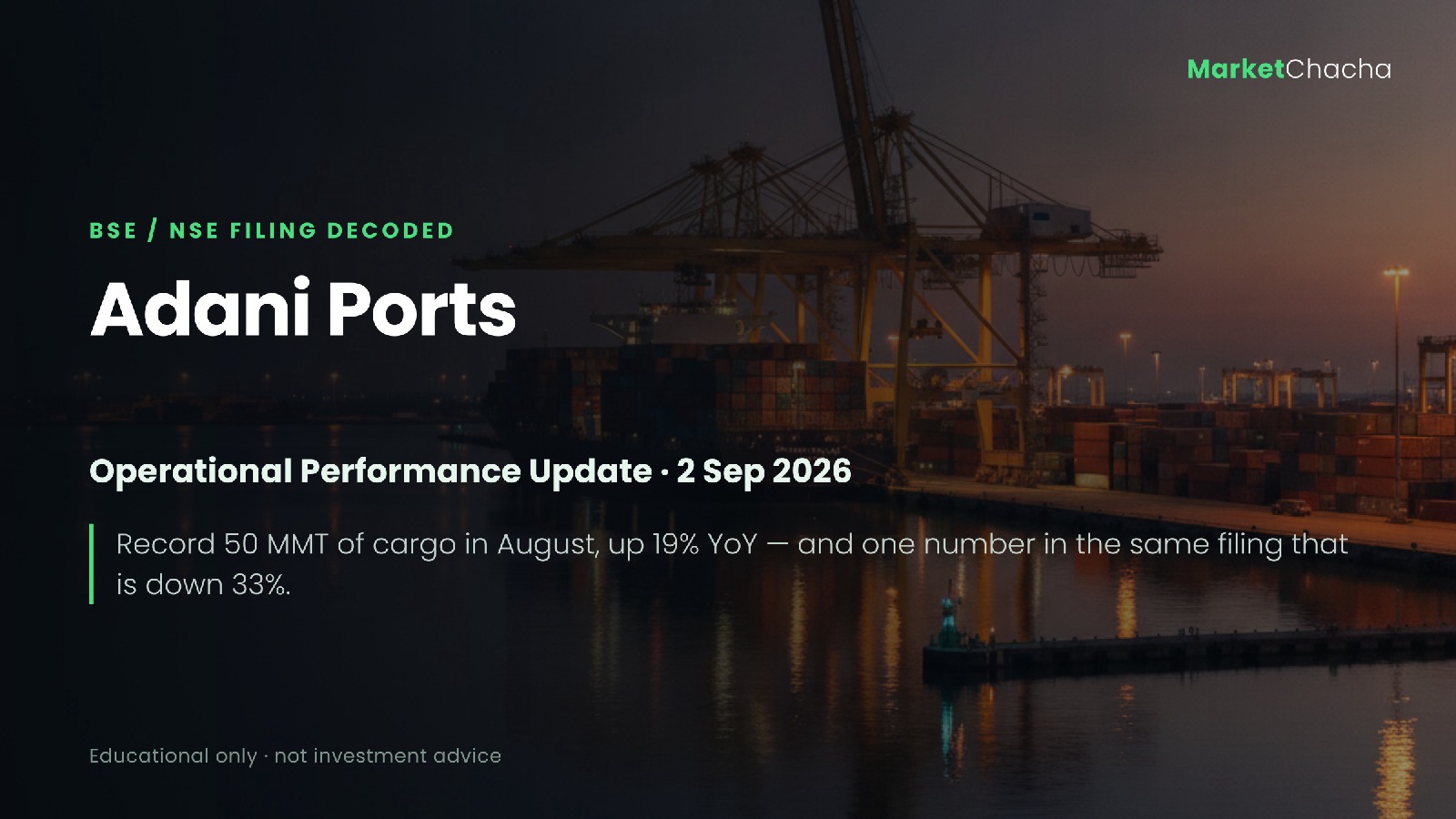
Adani Ports and Special Economic Zone (APSEZ) filed an operational performance update with the exchanges on 2 September 2026, disclosing that it handled a record 50 million metric tonnes (MMT) of cargo in August 2026 — its highest-ever monthly volume, up 19% year-on-year. This is a volume disclosure, not a results announcement, but it is the single best early read on how the company's quarter is going.
What was announced
In a letter to BSE and NSE (Ref: APSEZL/SECT/2026-27/68, signed at 08:35 IST on 2 September 2026), APSEZ reported the following operating numbers:
- August 2026 cargo: 50 MMT — the company's highest ever in a single month, +19% YoY.
- August growth was led by dry cargo +25% YoY and containers +15% YoY.
- Financial-year-to-date (April–August 2026): 234.4 MMT, +16% YoY, with dry cargo +17% and containers +15%.
- Container growth is attributed to its transshipment platform, specifically Vizhinjam (Kerala) and Colombo (Sri Lanka).
- Logistics rail volumes: 54,131 TEUs in August, up 6% sequentially — but YTD rail volumes stand at 2,50,461 TEUs, down 33% YoY.
- The company reiterated its stated ambition of handling 1 billion metric tonnes of annual cargo by FY31.
A "TEU" is a twenty-foot equivalent unit — the standard shipping-container counting unit. "MMT" is million metric tonnes, the standard measure for total port throughput across all cargo types.
What this type of filing means
This is an operational performance update made under Regulation 30 of SEBI's LODR (Listing Obligations and Disclosure Requirements) regulations. Regulation 30 requires a listed company to promptly disclose any information that a reasonable investor would consider material. Some companies go further and publish operating metrics on a fixed monthly rhythm, voluntarily.
Three things a beginner should understand about this format:
- It is not a results announcement. There is no revenue, no EBITDA, no profit, and nothing here is audited. It is a physical-volume disclosure — tonnes moved, containers moved.
- It arrives far earlier than results. August volumes are public on 2 September; the September-quarter results will not land until late October. That gap is exactly why these updates get watched.
- It is a common format across volume-driven sectors. Auto companies publish monthly dispatches, airlines publish monthly passenger load factors, telcos publish subscriber additions, NBFCs publish monthly disbursement or AUM updates. In each case the logic is the same: volume is the input, revenue is the output.
Why it matters / potential impact
For a port operator, throughput is close to being the revenue line itself. APSEZ earns a tariff per tonne or per container handled, so a 19% YoY jump in tonnage feeds fairly directly into the ports segment's top line — subject to cargo mix, because different cargo types earn very different rates per tonne. Containers typically earn more per unit of throughput than bulk commodities like coal or iron ore, so a month where dry cargo grows faster (25%) than containers (15%) can lift volumes more than it lifts realisations.
Ports are also a high operating-leverage business: berths, cranes, dredged channels and rail links are largely fixed costs that are paid for whether or not a ship arrives. Once a terminal is past its break-even utilisation, incremental tonnes drop through to margins at a high rate. That is why volume records tend to be read as margin news, not just revenue news.
Two things to hold in mind before treating this as unambiguously good:
- The logistics rail number is weak. YTD rail volumes are down 33% YoY. The monthly sequential uptick of 6% does not undo that. Logistics is a smaller slice of APSEZ than ports, but it is the segment the company has been positioning as its growth adjacency, so a decline of that size is a genuine soft spot the headline number does not show.
- One record month is not a trend. Port volumes are seasonal and can be flattered by commodity import cycles, a single large customer contract, or transshipment volumes that carry thinner economics than gateway cargo. The FY-to-date figure (+16%) is the steadier number to anchor on.
Nothing here changes the balance sheet, the share count, or the dividend. There is no dilution and no governance event in this filing — it is purely an operating datapoint.
The business
APSEZ is India's largest private port operator. As described in company disclosures, it runs 15 ports with roughly 633 MMT of total cargo-handling capacity, spanning both coasts of India, with international operations at Haifa (Israel), Dar es Salaam (Tanzania) and Colombo (Sri Lanka). Its flagship asset is Mundra in Gujarat, and it also develops the special economic zone attached to it. Alongside the ports business it runs a logistics arm — rail container movement, warehousing and inland container depots — which is where the 54,131 TEU rail figure comes from. So this filing touches the whole company: the ports number is the core franchise, and the rail number is the smaller adjacent segment.
Is it expensive?
On Screener.in's consolidated data, APSEZ trades at a P/E of about 28.6 with a market capitalisation of roughly ₹3.80 lakh crore (share price ₹1,648), a price-to-book of about 3.96x, ROCE of 14.1%, ROE of 16.4% and a dividend yield of 0.46%.
Against the broader Indian market that is a premium but not an extreme multiple — it is the kind of rating the market gives an infrastructure asset with high barriers to entry, long concession lives and pricing power, rather than a cheap cyclical. The nearly 4x book value is worth noticing separately: for a capital-heavy business, paying four times the accounting value of the assets means the market is capitalising future throughput growth, not just what is already built.
For a listed comparison: JSW Infrastructure, the other large private Indian port operator, trades at a P/E of roughly 50.8 on a market cap of about ₹78,684 crore (ROCE 13.6%, ROE 15.3%). So the smaller, faster-growing peer carries a distinctly richer multiple, while APSEZ — roughly five times its size — is the cheaper of the two on earnings and the higher-return one on ROCE. That does not make either "right"; it tells you the market is paying up for growth runway at the smaller name and for scale and cash generation at the larger one.
Beginner takeaway
Monthly operational updates are the cheapest information a volume business gives you, and most retail investors ignore them because they contain no profit number. Read them as a running scoreboard between quarters: the direction of tonnage tells you which way revenue is heading long before the results PDF arrives. And always read past the headline — this filing's record 50 MMT and its 33% YoY drop in rail volumes are in the same document.
FAQ
Is an "operational performance update" the same as quarterly results? No. Results are audited or limited-reviewed financial statements with revenue and profit. An operational update is just operating metrics — here, tonnes and containers — with no financials at all.
Does a record cargo month automatically mean record profit? Not automatically. Profit depends on cargo mix, tariffs, fuel and power costs, and how much of the volume is lower-margin transshipment versus higher-margin gateway cargo. Volume is the leading indicator, not the answer.
Why does the company report "MMT" for ports but "TEUs" for logistics? Ports handle everything — coal, crude, chemicals, containers — so tonnage is the only common unit. The logistics rail business moves containers specifically, so it is counted in TEUs (twenty-foot equivalent units).
Should I act on a monthly volume disclosure? A single month is a datapoint, not a thesis. Most experienced readers use these updates to track a trend across several months and to check whether management's stated guidance is being met — not as a trigger on its own.
As of 2 September 2026. Source: official BSE/NSE filing — read it directly here. Valuation data from Screener.in. We summarise filings for education and may make errors, so always verify against the official document. Educational content only — not investment advice, not a buy/sell recommendation.
This article is for educational and informational purposes only. It is not financial advice, investment recommendation, or a solicitation to buy or sell securities. Investing involves significant risks. I am not a SEBI-registered investment advisor. Readers should consult their own financial advisor and conduct their own research before making any investment decisions.
Comments
Join the conversation
Sign in to join the conversation.
Follow replies, add your view, and take part in the discussion.
Sign in to commentLoading comments...